
What is review velocity and does it matter for an HVAC company?
- What does review velocity mean, and how much should an HVAC company care about it?
- What does review velocity actually measure?
- Is review velocity a Google ranking factor?
- Why do recent reviews matter so much to homeowners?
- Can review velocity be too fast?
- How do I measure my own review velocity?
- How do I compare my review velocity with other HVAC companies?
- What makes an HVAC company's review velocity drop?
- How do I keep a steady pace of reviews?
- Does review velocity matter for Local Services Ads?
- What's different about review velocity for HVAC companies
- A worked example: same total, different velocity
- Frequently asked questions
- Key takeaways
- More in this section
- Sources
The short version
- Review velocity = new reviews per month, plus the gap since your last one.
- Homeowners read your newest reviews to judge the company they'll get this week.
- Google points to review count and ratings, not pace; unusual spikes can break its policy.
- A steady ask on every finished job beats an occasional push.
For HVAC owners who keep hearing about review velocity and want to know what it measures, what it does and doesn’t do for Google, and how to keep a steady pace.
Get a free visibility audit · Book a growth call
What does review velocity mean, and how much should an HVAC company care about it?
Review velocity is the pace at which new reviews arrive on your Google Business Profile, usually counted per month, along with how long it’s been since the last one. It matters for an HVAC company mainly because homeowners lean on recent reviews when they choose who to call, and a steady flow keeps your total and rating growing. Google doesn’t name velocity as a ranking factor; it says more reviews and positive ratings can help local ranking, and it treats unusual spikes that look like rating manipulation as a policy problem, so aim for a steady pace from real jobs, not bursts.
That steady, every-job habit is what our review work is built around: review responses and review generation are included in every one of our HVAC marketing packages, with advanced review generation in Growth and automated review requests in Scale, as part of our local SEO and Google profile work. For the bigger picture, the HVAC marketing guide covers every channel, and the HVAC marketing questions library goes question by question.
What does review velocity actually measure?
It’s a speed, not a total. Three numbers describe it, and all three are easy to read off your own Google Business Profile or anyone else’s:
- New reviews in the last 30 days. The headline pace.
- New reviews in the last 90 days. Smooths out one slow or busy month.
- Days since the last review. The number a homeowner actually notices when they open your profile.
Your total review count tells people how long you’ve been doing good work. Velocity tells them whether you’re still doing it. A company with 300 reviews and nothing new since spring can look less active than one with 90 reviews and a new one every few days.
Is review velocity a Google ranking factor?
Google doesn’t say so. Its help page on improving your local ranking says local results are mainly based on relevance, distance and popularity, and that how well-known a business is depends partly on how many reviews it has. It adds that more reviews and positive ratings can help your local ranking. It doesn’t mention pace or recency, and it says there’s no way to request or pay for a better local ranking.
So be wary of anyone who promises that a certain number of reviews a week will move you up the map pack. What a steady pace reliably does is keep your count and rating climbing, which Google does name, and keep your profile current for the people reading it, which is where most of the value is.
Why do recent reviews matter so much to homeowners?
Because they describe the company that will show up this week. Techs change, office staff change, and a review from three summers ago says little about either. In BrightLocal’s Local Consumer Review Survey 2026, a panel of 1,002 US adults asked about local businesses in general, 74% said they only care about reviews written in the last three months. That’s a cross-industry figure, not an HVAC benchmark.
What that means for your monthly target, and how to set one from your own job count, is covered in how many Google reviews a month an HVAC company should collect.
Can review velocity be too fast?
A fast pace from real customers isn’t a problem. A sudden spike that doesn’t match your work can be. Google’s prohibited and restricted content policy lists content showing unusual volumes or patterns of review contributions that indicate an effort to manipulate a rating as rating manipulation, which isn’t allowed and gets removed from Maps.
The same policy rules out the shortcuts that usually cause spikes: offering incentives such as discounts or free service for reviews, asking only happy customers, pressuring people on site, asking staff to bring in a set number of reviews, and asking reviewers to mention specific content, including a tech’s name.
The practical test: does your review count rise and fall with your job count? If you finished 120 jobs this month and got eight reviews, that’s believable. If you finished 40 and got 60, it isn’t, and that’s the pattern to avoid.
Curious what your marketing is actually booking?
Get a free visibility audit — no obligation, no sales pitch.
How do I measure my own review velocity?
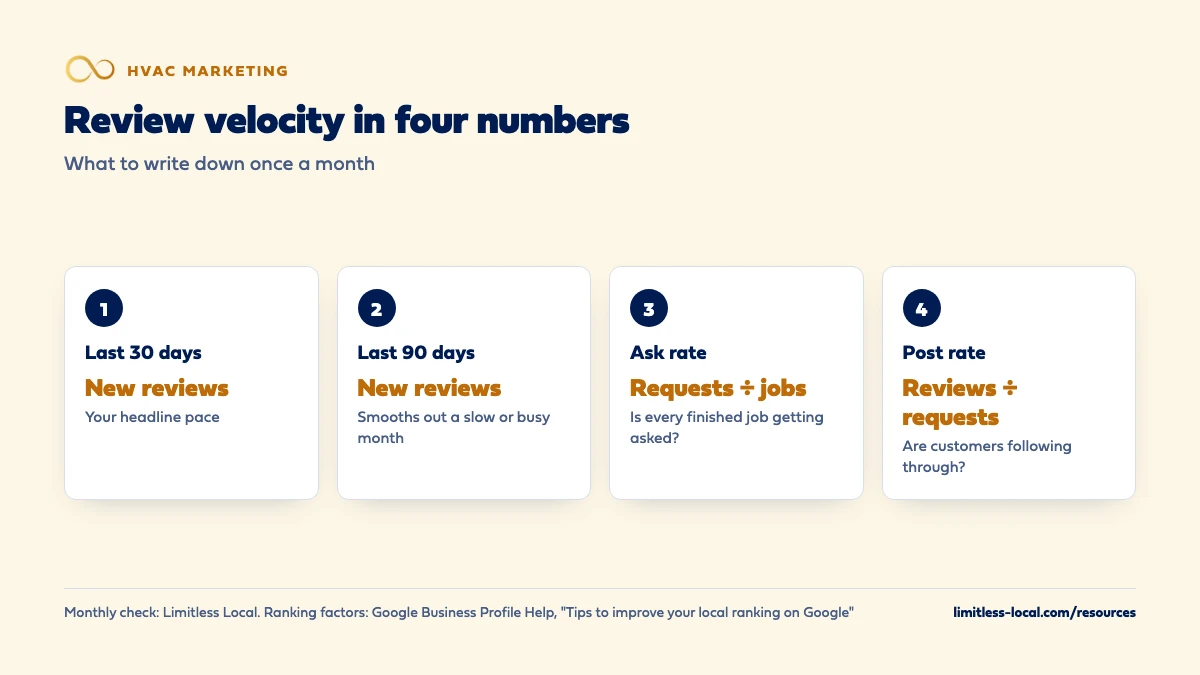
Once a month, write down four numbers:
- New Google reviews this month.
- New Google reviews in the last 90 days.
- Completed jobs this month, from your field software.
- Review requests actually sent this month.
The first two are your velocity. The last two explain it. Divide reviews by requests sent and you get your post rate; divide requests by completed jobs and you get your ask rate. When velocity drops, these two numbers tell you whether people stopped asking or customers stopped posting, and those have different fixes.
A small dip in a slow month is normal. Two or three months in a row of falling velocity while job counts hold steady means something in the ask has broken.
How do I compare my review velocity with other HVAC companies?
Search your main services in your main towns, the way a homeowner would, and open the profiles that show in the map pack next to you. Sort each one’s reviews by newest and count how many arrived in the last 30 and 90 days.
You’re looking for two things:
- Who’s growing faster than you. If the company above you adds three reviews for every one of yours, your gap in total reviews is getting wider every month, not narrower.
- Who’s gone quiet. A competitor with a big total and no new reviews since spring is leaving a recency gap you can fill.
Total counts are covered in how many Google reviews an HVAC company needs. Velocity is the part you can change starting this week.
What makes an HVAC company's review velocity drop?
It’s rarely a mystery. The usual causes:
- A tech who asked leaves. If reviews depended on one person’s habit, they leave with that person.
- The automation got switched off or the review link broke after a software change or a profile edit.
- Customer phone numbers aren’t on file, so text requests never go out. Housecall Pro, for example, only texts the request if there’s a number in the customer’s mobile field; otherwise it goes by email.
- The slow season. Fewer jobs means fewer reviews, which is fine as long as the ask rate holds.
- Reviews are being held or removed. Google checks reviews against its policies, which can take a few days, and reviews removed for violations aren’t restored.
Work through that list before assuming customers have stopped caring. If the slowdown came with a run of bad reviews, recovering after bad reviews is the better starting point.
How do I keep a steady pace of reviews?
Make the ask part of closing every job, so it doesn’t depend on memory:
- Automate the request. Most field software can do it. Jobber’s Reviews tool can text and email a Google review request after a visit is completed, a job is closed or an invoice is paid, and Housecall Pro sends requests by default when a job is marked finished, or when it’s paid if you change the setting.
- Back it up in person. The tech mentions it at the end of the visit, when the customer has just felt the air come on. Google’s own tips to get more reviews suggest asking customers to visit a Google link or scan a QR code.
- Ask everyone. Not just the customers who seemed happy.
- Reply to reviews, good and bad, within a few days. Replies show the profile is looked after; how an HVAC company should reply to Google reviews covers what to say.
For the in-person side, getting your techs to ask for Google reviews covers scripts and timing. If you’re thinking of messaging your whole past-customer list to catch up, the monthly reviews page above covers how to do that without a spike.
Does review velocity matter for Local Services Ads?
Reviews do. Google’s page on reviews and ratings on Local Services Ads says star ratings and number of reviews affect how your business ranks there, and that providers with higher ratings and more reviews stand out and typically book more jobs. Those reviews are the same ones on your Google Business Profile, managed there rather than in your ads account.
So the pace you keep on your profile feeds your ads too. A steady flow keeps both your count and your rating moving in the right direction without any extra work on the ads side.
What's different about review velocity for HVAC companies
Your pace will follow the weather. Job counts jump in the first heat wave and the first cold snap and sag in the shoulder months. Velocity will do the same. Judge a slow April against last April, and judge it by ask rate, not raw count.
Peak season is when it matters most. The homeowner comparing three HVAC companies on a 100-degree afternoon is reading the newest reviews. Make sure your ask is working before the rush, not after it.
Maintenance visits are review chances too. Tune-up and membership visits are quick, friendly and frequent. Asking on those, not only on big repairs and installs, keeps your pace up in months when breakdown calls are thin.
Installs earn the most detailed reviews. A homeowner whose new system just went in has a story to tell. Ask once the system is running and the site is clean, not mid-install.
Want to see where your company stands?
A free visibility audit shows where you show up on Google, Maps and AI answers, and what it's costing you in calls.
A worked example: same total, different velocity
These companies are made up to show the comparison, not a benchmark for your market. Two HVAC companies in the same town both show 180 Google reviews and a 4.7 rating.
- Company A got 150 of its reviews in a push two years ago. It has had 4 new reviews in the last 90 days, and its newest is seven weeks old.
- Company B asks on every finished job. It finishes about 160 jobs a month, asks on most of them and gets around 12 new reviews a month: 36 in the last 90 days, the newest posted yesterday.
A homeowner opening both profiles sees the same total and rating, then reads the newest reviews. Company B’s describe last week’s techs and this season’s jobs; Company A’s describe a crew that may not work there anymore. In a year, if nothing changes, Company B will have about 144 more reviews and Company A about 16. Finding where your own pace stands against the companies next to you is part of a free visibility audit.
Frequently asked questions
Is review velocity the same as review recency?
They’re related. Velocity is how many new reviews arrive in a period; recency is how new your latest reviews are. A steady pace keeps both healthy.
Do reviews on Yelp, Facebook or Angi count toward my Google review velocity?
No. Google shows reviews left on your Google Business Profile in its star rating and count. Other sites have their own counts and their own rules about asking.
Why did a review a customer says they left never show up?
Google checks reviews against its policies, which can take a few days. Reviews removed for policy violations aren’t restored, and customers on older phones or apps can have trouble posting.
Does replying to reviews count toward review velocity?
No. Velocity counts new reviews from customers, not your replies. Replies still matter: Google says positive reviews and helpful replies can help your business stand out, and they show the next homeowner the profile is looked after.
How long until a better pace shows up on my profile?
New reviews show as they post, so the newest-review date changes right away. The total and the 90-day count build over a few months of steady asking.
Key takeaways
- Review velocity is how fast new reviews arrive: count the last 30 and 90 days and the days since your newest.
- Google names review count and ratings in local ranking, not pace; velocity’s biggest effect is on the homeowner reading your profile.
- Unusual volumes or patterns that look like rating manipulation break Google’s policy, so tie your pace to real finished jobs.
- When velocity drops, check ask rate and post rate before blaming customers.
- Automate the request in your field software, back it up in person and ask every customer.
Not sure what's working right now?
Start with a free visibility audit: rankings, Google profile, reviews and tracking, checked against your service area.
More in this section
- How much do Google reviews affect calls to my HVAC company?
- How many Google reviews a month should an HVAC company collect?
- How many Google reviews does my HVAC company need?
- How fast should an HVAC company respond to new leads?
- How do I recover after a run of bad reviews on my HVAC company?
Sources
- Tips to improve your local ranking on Google — Google Business Profile Help
- Prohibited & restricted content — Maps User Generated Content Policy Help
- Tips to get more reviews — Google Business Profile Help
- About missing or delayed reviews — Google Business Profile Help
- Reviews and Ratings on Local Services Ads — Google Local Services Help
- Reviews | Marketing Tools — Jobber Help Center
- Reviews FAQs — Housecall Pro Help Center
- Local Consumer Review Survey 2026 — BrightLocal