
How many Google reviews a month should an HVAC company collect?

- What's a realistic monthly Google review pace for an HVAC company in 2026?
- Is there a number of reviews a month Google wants from an HVAC company?
- What does review velocity mean for my HVAC business?
- How much do homeowners care about recent reviews?
- How do I work out a monthly review target from my own jobs?
- Is 10 new HVAC reviews a month a realistic target for my team?
- Why is a steady pace better than a big review push?
- Should I text my whole past customer list asking for reviews?
- How should my review pace change between peak season and slow months?
- Should my techs have a monthly review number to hit?
- Should every review go to Google, or spread across other sites?
- How do I track my monthly review pace?
- What's different about review pace for HVAC companies
- A worked example: setting a monthly review floor for a 4-truck HVAC shop
- Frequently asked questions
- Key takeaways
- More in this section
- Sources
The short version
- There's no Google target; your pace comes from jobs, ask rate and post rate.
- Steady every month beats a big push once a year.
- Homeowners lean on reviews from the last few months, so a dry spell shows.
- Track the company's monthly count, but never give techs a review quota.
For HVAC owners who already know reviews matter and want a monthly number their crew can actually hit, in July and in the slow weeks of April.
Get a free visibility audit · Book a growth call
What's a realistic monthly Google review pace for an HVAC company in 2026?
Google doesn’t publish a monthly review number, so set your own from your job count: completed jobs a month, times the share of customers your team asks, times the share of those who actually post. Whatever that number is, keep it steady every month, slow season included, instead of saving it all for one big push. Homeowners lean on recent reviews, and Google’s review policy treats unusual volumes or patterns of reviews that look like rating manipulation as a problem, so a steady flow from real jobs works better on both counts.
Review generation sits next to Google Business Profile management in every one of our HVAC marketing packages, as part of our local SEO work, because a steady flow of reviews feeds the Maps 3-pack, your regular Google results and the AI answers homeowners now ask. The HVAC marketing guide covers how reviews fit with everything else, and the HVAC marketing questions library goes question by question.
Is there a number of reviews a month Google wants from an HVAC company?
No. Google doesn’t publish a monthly number, a minimum or a ceiling. What it does say, in its tips to improve your local ranking, is that local results are mainly based on relevance, distance and popularity, and that more reviews and positive ratings can help your local ranking.
So split the question in two:
- How many reviews do you need in total to look comparable to the HVAC companies showing next to you in Maps? That’s a market question, covered in how many Google reviews an HVAC company needs.
- How many new ones do you need each month to keep your profile looking current and keep closing that gap? That one comes from your own job count.
What does review velocity mean for my HVAC business?
Review velocity is just the pace: how many new reviews land on your profile in a given month. Two companies can both show 150 reviews, but if one got its last review in March and the other got eight this month, homeowners read them very differently.
For an HVAC company, velocity tells a homeowner three things your total can’t:
- You’re busy now. Fresh reviews say trucks are rolling this season, not three summers ago.
- The company they’ll get is the company in the reviews. Techs come and go. Recent reviews describe the crew that will actually show up.
- Problems got fixed. A complaint from two years ago, buried under a steady stream of good recent jobs, reads as history, not a pattern.
How much do homeowners care about recent reviews?
A lot, and more than they used to. BrightLocal’s Local Consumer Review Survey 2026, a panel of 1,002 US adult consumers asked about local businesses in general, found that 74% only care about reviews written in the last three months. 32% look for reviews written in the last two weeks, up from 20% the year before.
When the same people ranked what makes them trust a review, “posted within the last month” came third, chosen by 44%, behind reviews backed up by others with similar sentiment and reviews describing a positive experience.
That survey covers all kinds of local businesses, not HVAC specifically, so don’t read it as a rule for your trade. The direction is still useful: a profile whose newest review is from last season is asking homeowners to trust old news. A small number of new reviews every month keeps that window full.
How do I work out a monthly review target from my own jobs?
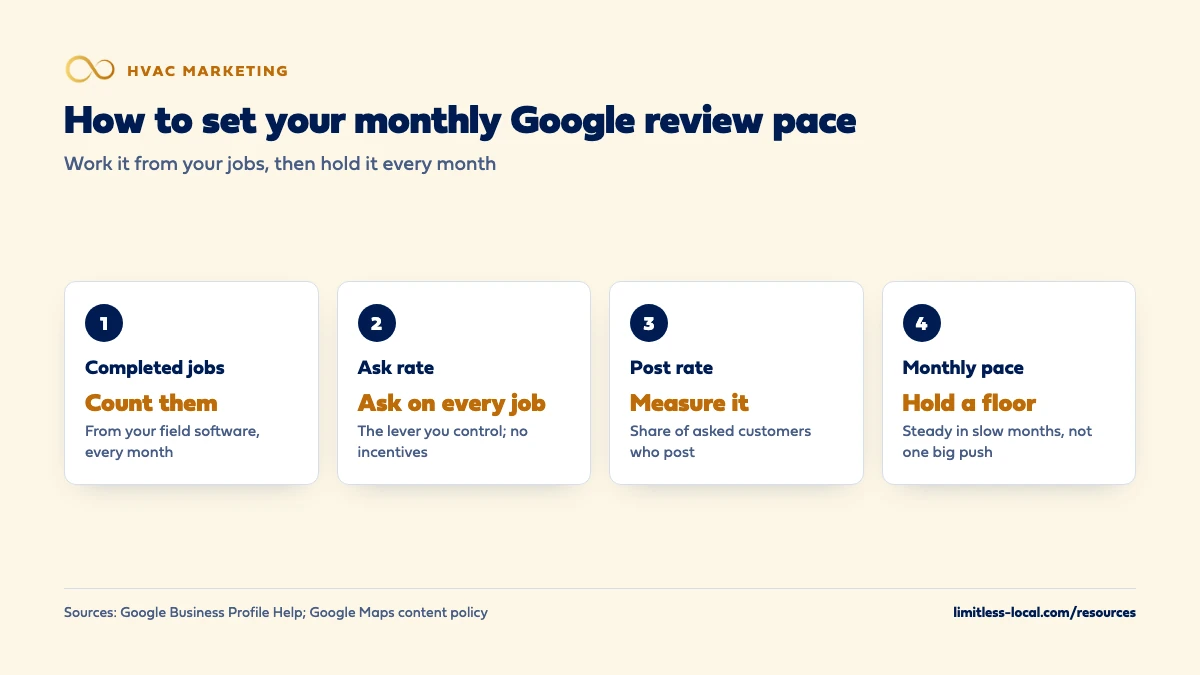
Work it from the jobs you already run. You need three numbers:
- Completed jobs a month. Pull it from ServiceTitan, Housecall Pro, Jobber or whatever runs your schedule. Use completed jobs, not booked calls.
- Ask rate. The share of those jobs where someone actually asked for a review and sent the link. This is the number you control.
- Post rate. The share of asked customers who go on to post. Don’t guess this one. Measure it for a month or two, because it swings with how and when you ask.
Multiply them and that’s your natural monthly pace. If you want more, the ask rate is the lever, not incentives, which Google’s policy forbids. Getting your techs to ask for Google reviews covers the script, the timing and the link.
If the companies above you in Maps add reviews faster than you do, the gap only grows. The fix is more asks, not a one-time push.
Is 10 new HVAC reviews a month a realistic target for my team?
It depends almost entirely on how many jobs you finish. These numbers are made up to show the math, not a benchmark: if about one in ten asked customers posts, 10 reviews a month needs about 100 asks. At a 90% ask rate, that’s roughly 110 completed jobs a month.
- A one- or two-truck shop finishing 50 jobs a month, asking on 45 of them, would land around four or five reviews a month at that post rate. Ten would take a much better post rate than the one in ten assumed here, so don’t beat yourself up if you land at four or five.
- A mid-size shop finishing 110 or more jobs a month can hit 10 with a solid ask habit and nothing fancy.
- A larger shop with several hundred jobs a month should be well past 10. If it isn’t, the ask is breaking down somewhere.
The right target is the one that matches your job count and that you can hold every single month. A smaller number you hit all year beats a bigger one you hit in July and miss from October to May.
Curious what your marketing is actually booking?
Get a free visibility audit — no obligation, no sales pitch.
Why is a steady pace better than a big review push?
Two reasons, one about homeowners and one about Google.
Homeowners. A push in March is stale by August. If you get forty reviews in a two-week campaign and then nothing for five months, the profile looks quiet right when the heat wave hits and new callers are comparing you.
Google. Google’s prohibited and restricted content policy lists “content exhibiting unusual volumes or patterns of review contributions that are indicative of efforts to manipulate a place’s rating” as rating manipulation, and says it isn’t allowed and will be removed from Maps. Genuine reviews from real jobs aren’t manipulation. But a review plan built on sudden blasts creates exactly the kind of spike-then-silence pattern that’s harder to explain than a steady flow.
If Google does decide a business has broken its fake engagement rules, its restrictions page says it can stop the profile from receiving new reviews for a set period, unpublish existing reviews for a set period, or show a warning that fake reviews were removed. For a company that lives on its reviews, any one of those hurts more than a slow month.
Should I text my whole past customer list asking for reviews?
Asking past customers is allowed, as long as you ask everyone and don’t filter for the happy ones. The trouble with one giant blast is what it produces: a pile of reviews about jobs from years ago, all landing in the same few days, followed by the usual trickle.
A better use of that list:
- Ask customers from the last few months who were never asked. Their job is fresh enough to describe, and the review matches the company you are today.
- Fold older customers into your normal contact, like a tune-up reminder or maintenance visit. When they become current customers again, ask then. Getting tune-up bookings from past HVAC customers covers that outreach.
- Fix the ask on new jobs first. If your team isn’t asking on today’s jobs, a one-off blast just postpones the problem.
How should my review pace change between peak season and slow months?
Your job count swings with the weather, so your review count will too. That’s normal. What you don’t want is the ask disappearing in the slow months just because the office is calmer and nobody’s watching.
- Set a floor, not just a target. Decide the minimum you want even in your slowest month, and check it.
- Use tune-ups and maintenance visits. Spring and fall tune-ups are completed jobs with a happy customer standing right there. They’re the easiest way to keep reviews coming between heat waves and cold snaps.
- Expect peak months to carry more. Twice the jobs should bring roughly twice the reviews. If not, the ask slips when techs are rushed.
- Compare with the same month last year, not just last month, so you don’t mistake the season for a problem.
Should my techs have a monthly review number to hit?
No. The company can have a monthly target. Your techs shouldn’t. Google’s policy lists “merchants requesting that staff solicit a certain number of reviews” as something it doesn’t allow, along with asking staff to get reviews that mention a specific employee.
Measure techs on what they control and what Google allows: whether they asked on every job and sent the link. Your field software can usually show which jobs got a review request, and you can compare that with completed jobs per tech. The review count belongs to the office and the owner, as a check on whether the whole system is working.
And customers get nothing for posting: no discount, gift card or free filter change, and no asking only the ones who seem happy.
Should every review go to Google, or spread across other sites?
For most HVAC companies, Google is where the monthly ask should point, because that’s where your Maps listing and the profile homeowners see first live. Facebook and industry sites are fine to have, but they don’t need their own monthly target.
Yelp is the one to treat differently. Yelp’s support center says don’t ask for reviews: its software tries to spot reviews that seem to have been requested and may not recommend them, and asking may hurt your Yelp rating. So keep your Yelp listing accurate and reply to what comes in, but leave it out of the ask.
How do I track my monthly review pace?
Once a month, write down the number of new Google reviews and the average rating, next to completed jobs. That gives you the one ratio that matters: new reviews per completed job. A few things to know when you read it:
- Reviews can show up late. Google says reviews are checked against its policies, and that can take a few days, so a review from the last day of the month may land in the next one. Details are in Google’s page about missing or delayed reviews.
- Your score lags too. Google says your review score is the average of all ratings published on Google, and that it may take up to 2 weeks to update after a new review.
- Look for drops, not just totals. A month with zero new reviews after a run of steady ones usually means the ask broke: a new tech, a changed text template, a review link that stopped working.
This fits into a short monthly routine with your other numbers. What to check every month for HVAC SEO and AI visibility lays out the whole list.
Not sure which of these is costing you jobs?
A free visibility audit checks the Google profile, reviews, site and tracking, and shows what to fix first.
What's different about review pace for HVAC companies
Your season sets your pace. HVAC job counts swing harder with the weather than most trades. Plan for review counts that rise in heat waves and cold snaps, and protect a floor in the spring and fall shoulder months.
Emergency calls are your best reviews. The family whose AC came back on at 9 p.m. in August has the strongest story to tell. Make sure after-hours techs ask too, not just the day crew.
Installs take longer to review. A system replacement customer may want to see a power bill or two before they post. Ask at the end of the install, then follow up once after a few weeks.
A worked example: setting a monthly review floor for a 4-truck HVAC shop
These numbers are made up to show the math, not a benchmark for your market. Say a four-truck HVAC company finishes about 240 jobs in a peak summer month and about 120 in a slow spring month. Its techs ask on 90% of jobs, and its office measured a post rate of one in ten over the last two months.
- Peak month: 240 jobs times 90% is 216 asks, and one in ten of those is about 22 new reviews.
- Slow month: 120 jobs times 90% is 108 asks, or about 11 new reviews.
- The floor: the owner sets a floor of 10 a month, so a slow month that dips under it gets a look the same week.
Now say a new tech starts in October and nobody shows him the review step, and the shop lands at 6 reviews that month. Because the owner checks the floor monthly, it gets fixed in weeks, not discovered next summer.
Basic review generation and review responses are included in our Essentials package at $3,500 a month, and Growth at $4,500 a month adds advanced review generation. A free visibility audit is the place to compare your review pace with the HVAC companies showing next to you in Maps.
Frequently asked questions
Does Google penalize an HVAC company for getting too many reviews at once?
Google doesn’t publish a number. Its policy targets unusual volumes or patterns of reviews that look like rating manipulation, so genuine reviews from real jobs, asked for steadily, are the safe pattern.
What if my HVAC company gets zero reviews in a month?
Treat it as a broken ask, not bad luck. Check whether techs are still sending the link, whether the text template changed, and whether the review link still works.
Do Google reviews older than a year still count?
They still count toward your review score, which is the average of all ratings published on Google. Homeowners just give them less weight than recent ones.
Can I ask a customer for a review more than once?
A single reminder is reasonable, especially after an install. Past that, let it go; a third or fourth nudge starts to feel like pressure.
Should the office or the tech send the review request?
The tech should ask in person at the end of the job, and the link should go out by text the same day, from the tech or automatically from your field software. That way the ask happens even when the tech forgets the text.
Do I need a separate review pace for Local Services Ads?
No. Google says your Local Services Ads reviews are managed through your Google Business Profile, not a separate account, and that star ratings and number of reviews affect how you rank there. One steady Google pace serves both.
Key takeaways
- Google sets no monthly review number; work yours out from completed jobs, ask rate and post rate.
- A steady monthly flow beats one big push, for homeowners and for Google’s review policy.
- Recent reviews carry the most weight with homeowners, so protect a floor in slow months.
- Give the company a monthly target, but measure techs on asking, never on review counts.
- Point the ask at Google, and leave Yelp out of it.
Want a second set of eyes on your setup?
We'll look at how you show up locally and where calls are leaking, then send you a plain-English breakdown.
More in this section
- How many Google reviews does my HVAC company need?
- How much do Google reviews affect calls to my HVAC company?
- How should an HVAC company reply to Google reviews?
- How do I get my HVAC techs to ask customers for Google reviews?
- How much should an HVAC company spend on Google Ads?
Sources
- Tips to improve your local ranking on Google — Google Business Profile Help
- Prohibited & restricted content — Maps User Generated Content Policy Help
- Business Profile restrictions for policy violations — Google Business Profile Help
- About missing or delayed reviews — Google Business Profile Help
- Understand review scores for local places & businesses — Google Business Profile Help
- Local Consumer Review Survey 2026 — BrightLocal
- Don't Ask for Reviews — Yelp for Business Help Center
- Reviews and Ratings on Local Services Ads — Google Local Services Help