
Should a restoration company fix SEO, ads or its website first?

- When SEO, ads and the website are all underperforming, which should a restoration company fix first?
- Why does the order matter when SEO, ads and the website all look bad?
- Step 1: Can you see which calls turn into jobs?
- Step 2: Is the phone the real problem?
- When should the website come first?
- When should the ads come first?
- When should SEO and the Google profile come first?
- How do SEO, ads and the website compare on speed and cost to fix?
- What does a 90-day fix plan look like?
- Can I fix all three at the same time?
- What should I not do first?
- How do I know the fixes are working?
- What's different about fixing marketing at a restoration company
- A worked example: why tracking and phones come first
- Frequently asked questions
- Key takeaways
- More in this section
- Sources
The short version
- First: call tracking and phone answering, so you can see what's actually broken.
- Second: the website pages ads and Maps send people to.
- Third: ads, which are the fastest to fix and show results in days.
- SEO and the Google profile run alongside from the start, because they're slow.
For established restoration companies where rankings, ads and the website all feel broken at once, and the owner needs an order to fix them in.
Get a free visibility audit · Book a growth call
When SEO, ads and the website are all underperforming, which should a restoration company fix first?
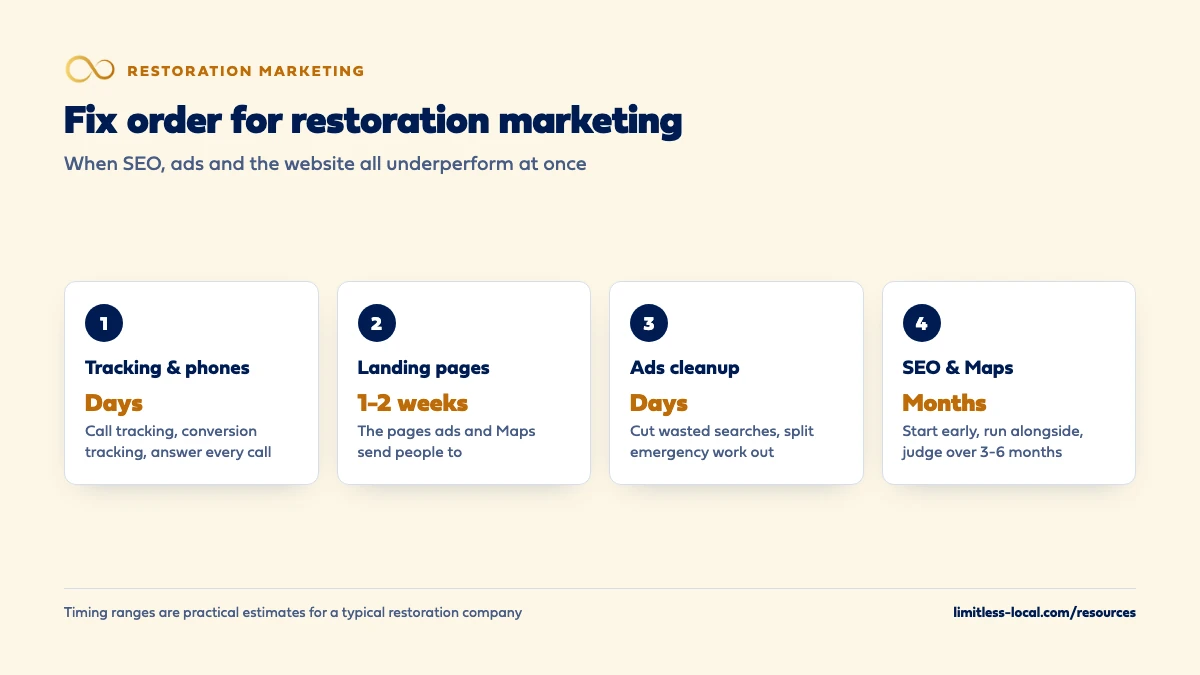
Fix tracking and phone answering first, because until you can see which calls book jobs you can’t tell which of the three is really failing. Then fix the website pages your ads and Google profile send people to, since a page that doesn’t get calls wastes every click from both. After that, clean up the ads for the fastest return, and keep SEO and your Google profile work running alongside, because they take months to pay off and should start early, not last.
That order matches how our restoration marketing starts: first the foundation (tracking, follow-up and a clean online presence), then lead flow from local SEO and ads around the towns and jobs you want, then monthly improvement based on calls, leads and revenue. The packages page shows what each tier covers. For every channel in one place, read the restoration marketing guide, and the restoration marketing questions library takes the rest one question at a time.
Why does the order matter when SEO, ads and the website all look bad?
Because the three are tangled together. Ads and your Google profile send people to the website. The website decides whether they call. The phone decides whether the call becomes a job. When everything looks bad, one weak link is often making the other two look worse than they are.
Fix them in the wrong order and you waste money twice. Pour more into ads before the landing page works and you pay for clicks that never call. Rebuild the whole website before you know which pages matter and you lose months. The right order fixes the parts that make every other fix measurable and worth more, first.
Step 1: Can you see which calls turn into jobs?
Start here, even before anything that looks like marketing. Without tracking, “SEO isn’t working” and “ads aren’t working” are guesses. You need three things:
- Call tracking numbers by source, so you know whether a call came from Google Ads, Maps, the website or a referral.
- Conversion tracking in Google Ads that counts real calls and form leads. Google’s conversion measurement is what tells you which keywords, ads and campaigns drive valuable customer activity.
- An outcome on every lead: booked, lost, not a real job, waiting on insurance.
This usually takes days, not months. How to track which marketing brings in booked restoration jobs covers the setup.
Step 2: Is the phone the real problem?
Before you blame any channel, listen to the calls. Many restoration companies with “bad marketing” have marketing that rings the phone just fine, and calls that go to voicemail at night, get a slow callback or get a vague answer about when someone can come out.
Pull a week of call recordings or call logs and count the calls that weren’t answered, weren’t called back within the hour, or didn’t get a time. If that number is high, fixing it is the cheapest win on this whole list. What missed calls cost a restoration company helps you put a dollar figure on it.
When should the website come first?
When it’s the page people land on and it doesn’t make calling easy. Check the pages your ads and Google profile actually send people to, on a phone:
- Is the number tappable at the top?
- Does the page match the job, like water extraction or sewage cleanup, instead of a general homepage?
- Does it say which towns you serve and how fast you come out?
- Does it load quickly on a phone? PageSpeed Insights reports both lab data and real-world data from Chrome users, and the real-world numbers are the ones your visitors live with.
You don’t need a new website to fix most of this. Fixing the handful of pages that get the traffic is faster and cheaper than a rebuild. Why a restoration website gets clicks but no calls lists the usual culprits.
When should the ads come first?
When the website and phones check out, but you’re spending money on clicks that don’t book. Ads are the fastest thing on this list to fix: a change today can show up in your calls within days.
Open the search terms report and look at what people actually typed. If you see do-it-yourself, job seeker or wrong-meaning searches, or towns you don’t serve, that’s wasted spend you can cut this week. Then check that emergency searches have their own budget and aren’t starved by mold or research clicks.
Ads are also the place to turn first when the phone needs to ring now. Ads can generate leads within days of launch, while SEO typically takes 3-6 months to show meaningful organic growth.
Curious what your marketing is actually booking?
Get a free visibility audit — no obligation, no sales pitch.
When should SEO and the Google profile come first?
When the trouble is in Maps and free search, not in paid clicks. Signs: you dropped out of the map pack, your profile was suspended or edited, reviews have stalled, or a newer competitor now shows up above you for water damage in your own town.
Google says local results are mainly based on relevance, distance and popularity, and that more reviews and positive ratings can help your local ranking. Some fixes are quick: correcting categories, hours and service areas, and restarting review requests. Others, like building service pages and local links, take months. That’s why SEO shouldn’t wait for everything else to be fixed; start the slow work early so it’s paying off by the time the rest is sorted. Getting a restoration company back into the Map Pack covers the Maps side.
How do SEO, ads and the website compare on speed and cost to fix?
- Tracking and phones: days to set up, low cost, and every other fix depends on them.
- Landing pages: a week or two for the key pages, moderate cost, and they lift ads and Maps at once.
- Ads cleanup: days, mostly time rather than money, and results show within days.
- Google profile fixes: days for the basics, with ongoing review work.
- SEO: months of steady work. Typically 3-6 months before meaningful growth shows, which is why it starts early and runs alongside everything else.
- A full website rebuild: the slowest and most expensive. Only do it once you know the problem is the site itself, not a few pages.
What does a 90-day fix plan look like?
- Weeks 1-2: call tracking, conversion tracking and lead outcomes. Fix after-hours answering and callback times.
- Weeks 2-4: rework the pages that ads and your Google profile send people to. Clean up the Google profile basics.
- Weeks 3-6: cut wasted ad spend from the search terms, split emergency from planned work, and point ads at the improved pages.
- Weeks 4-12: start the slow SEO work, like service pages, town pages that earn their place, local links and steady review requests.
- Week 12: compare cost per booked job by channel against where you started.
Give each change time to show. Google’s SEO starter guide notes that some changes take effect in a few hours and others could take several months, and that you’ll likely want to wait a few weeks to judge whether a change helped.
Can I fix all three at the same time?
You can work on all three at once if you have the budget and the help, and the slow SEO work should start early regardless. What you shouldn’t do is change everything in the same week. If you rewrite the landing page, change ad budgets and switch call routing all on Monday, and calls go up, you won’t know which change did it, or which one to undo if they go down.
Stagger the changes within each channel, write down what changed and when, and judge each one on booked jobs.
What should I not do first?
- Don’t rebuild the whole website first. It’s slow, expensive and often not the actual problem.
- Don’t pause everything. Shutting off ads while you fix the site stops the calls you’re getting now. Cut the waste, keep the working parts running.
- Don’t switch agencies before tracking is in place. Without it, you can’t tell whether the old one was the problem or the next one is better.
- Don’t double the ad budget. More spend on a leaky page and an unanswered phone just buys more missed jobs.
If you’re not sure which part broke, whether a quiet phone is a Maps, ads or reviews problem walks through the diagnosis.
How do I know the fixes are working?
Watch one number by channel: cost per booked job. Add up what each channel cost in a month, divide by the jobs it booked, and compare month to month. Ads should improve first, within weeks of the cleanup. Website fixes should lift the share of visitors who call. SEO and Maps will move last, over months.
Also watch the basics that caused the trouble: missed calls with no callback, after-hours answer rate and how many leads have an outcome recorded. If those slip, the channel numbers will slip after them.
Not sure which of these is costing you jobs?
A free visibility audit checks the Google profile, reviews, site and tracking, and shows what to fix first.
What's different about fixing marketing at a restoration company
The phone is a bigger share of the problem. Restoration leads go to whoever answers first, often in the middle of the night. A company with average ads and a great phone process will usually beat one with great ads and voicemail.
Storms distort everything. A storm month can make broken marketing look great, and a quiet month can make good marketing look broken. Compare like with like, and don’t judge a fix on one weather-driven month.
Several services, several pages. Water, fire, mold and sewage each need a page that matches the search. A site that sends every ad to the homepage is a common reason restoration ads look worse than they are.
Referral work hides in the numbers. Jobs from plumbers, property managers and agents can make total revenue look fine while the marketing channels are struggling. Track referral jobs separately so they don’t mask a problem.
A worked example: why tracking and phones come first
These numbers are made up to show the math, not a benchmark for your market. A restoration company spends $4,000 a month on ads and gets 50 calls. It books 8 jobs, so each booked job costs $4,000 / 8 = $500. The owner thinks the ads are the problem.
After adding call tracking, the owner finds 10 of those 50 calls came in after hours and went to voicemail, and only 1 of them was called back in time. Once the company sets up after-hours answering and a fast callback, it books 3 more jobs from the same calls.
- Same $4,000 in ads, now 11 booked jobs.
- Cost per booked job: $4,000 / 11 = about $364.
Nothing about the ads changed. The phone fix came first, and now the ad cleanup starts from a better number.
Frequently asked questions
My website is old. Shouldn't I just rebuild it?
Not first. Fix the pages that get ad and Maps traffic, then decide. A rebuild makes sense when the site can’t be fixed page by page, like when it won’t work on phones at all.
Should I pause my ads while I fix the website?
Usually not. Cut the wasted searches and keep the ads that book jobs running. Pausing everything stops the calls you’re getting now and doesn’t make the website fix any faster.
How long before I see results from fixing all three?
Phone and ad fixes can show within days or weeks. Website fixes show as soon as traffic hits the new pages. SEO typically takes 3-6 months to show meaningful organic growth.
What if I can only afford to fix one thing?
Fix tracking and phone answering. They’re the cheapest, and they make every dollar you already spend on ads and Maps work harder.
Do Local Services Ads change the order?
Not much. They depend on answering calls and on your reviews and Google profile, so the same first steps apply before you spend more on them.
Can my current agency handle this triage?
Ask it for the order it would fix things in and why. If it wants to start with a website rebuild or more ad spend before tracking, ask what it will measure to prove it worked.
Key takeaways
- Start with tracking and phone answering; they decide whether every other fix can be measured.
- Fix the pages ads and Maps send people to before buying more traffic.
- Ads are the fastest to clean up and show results in days.
- Start SEO and Google profile work early; it takes months, so it can’t wait until last.
- Change one thing at a time per channel and judge it on cost per booked job.
Want a second set of eyes on your setup?
We'll look at how you show up locally and where calls are leaking, then send you a plain-English breakdown.
More in this section
- Is paying for SEO worth it for a restoration company?
- Can a restoration company rely on SEO and Maps without ads?
- How should a restoration company use SEO and ads in a slow season?
- Do Google Ads help a restoration company's SEO rankings?
- Can a restoration owner do their own SEO instead of hiring someone?
Sources
- About conversion measurement — Google Ads Help
- About the search terms report — Google Ads Help
- About PageSpeed Insights — Google for Developers
- Tips to improve your local ranking on Google — Google Business Profile Help
- SEO Starter Guide: The Basics — Google Search Central