
When does a restoration company need to spend 10k a month on ads?

- At what point is a $10,000 monthly ad budget right for a restoration company?
- Is $10,000 a month a lot for restoration ads?
- What signs say I've outgrown a smaller ad budget?
- How many towns and services does $10,000 have to cover?
- What changes in the account at $10,000 a month?
- Should all $10,000 go to Google search ads?
- What has to be in place before I spend $10,000 a month?
- How do I get from where I am to $10,000 a month?
- How do I know $10,000 a month is working?
- When is $10,000 a month the wrong number?
- How should seasons change a $10,000 budget?
- What's different about a $10,000 ad budget for restoration companies
- A worked example: splitting $10,000 across a restoration account
- Frequently asked questions
- Key takeaways
- More in this section
- Sources
The short version
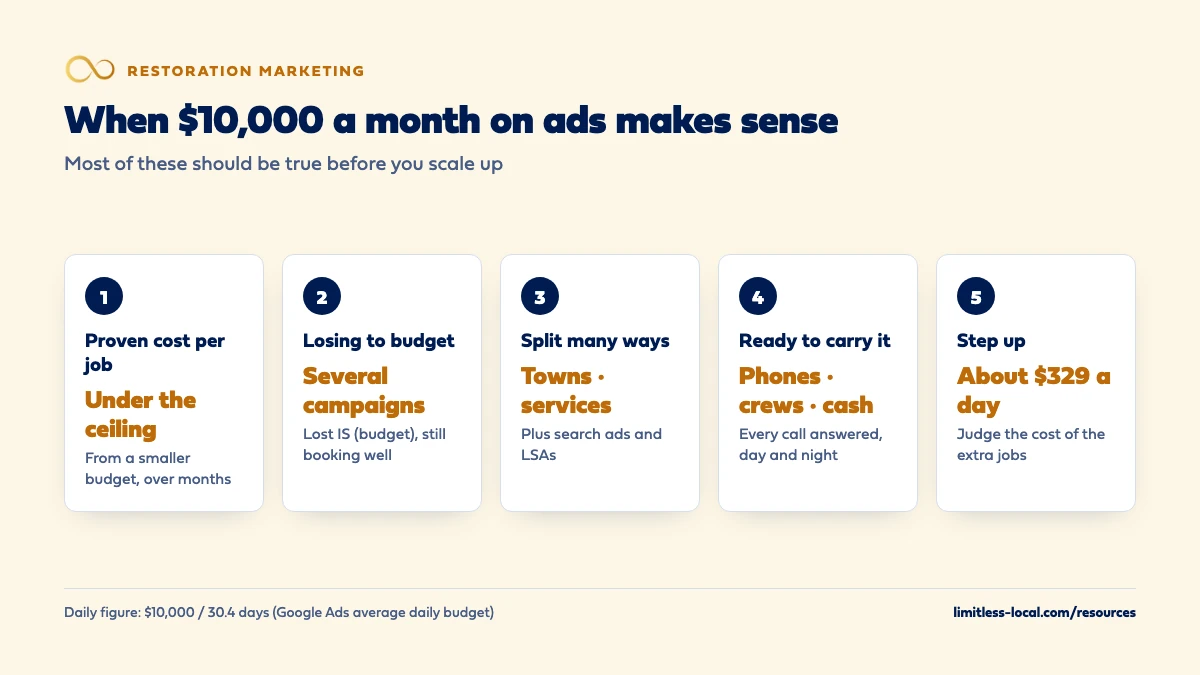
- $10,000 a month is a scaling budget, not a starting one.
- Prove your cost per booked job at a smaller budget first.
- It usually makes sense when the money is split across several towns, services or ad types.
- It changes how the account must be built and how often someone must check it.
- Phones, crews and cash flow have to keep up with the extra jobs.
For restoration owners who’ve proved their ads at a smaller budget and are wondering whether, and when, $10,000 a month makes sense.
Get a free visibility audit · Book a growth call
At what point is a $10,000 monthly ad budget right for a restoration company?
A restoration company needs around $10,000 a month on ads when a smaller budget has already shown what a booked job costs, that cost sits well under what a job is worth, and the ads keep running out of money before they run out of good searches. That usually happens when you cover several towns, several services such as water, sewage, mold and fire, or both search ads and Local Services Ads, so the money is split many ways. Your phones, crews and cash flow must be able to carry the extra work. A company serving one service in one mid-size market may never need that much.
Google Ads management is part of every Limitless Engine package. Essentials covers up to $2,500 a month in ad spend and Growth up to $5,000 with Local Services Ads management; an account spending $10,000 a month is a Scale plan, with custom pricing, custom Google Ads and Local Services Ads across multiple markets. Ad spend is paid directly to Google, never bundled into the fee. See how our local ads work fits restoration companies, read the restoration marketing guide, or browse more restoration marketing questions.
Is $10,000 a month a lot for restoration ads?
It’s a serious budget for one company. Whether it’s too much depends less on the number than on how much it has to cover: emergency searches are competitive, and a storm can eat a week’s budget in a day.
Google spends a monthly budget as an average daily budget. Its page about average daily budgets says to divide the monthly figure by 30.4, and that for most campaigns you’ll never pay more than two times the daily average on one day, or more than 30.4 times it in a month. So $10,000 a month is an average of about $329 a day, with room to spend up to about $658 on a busy day.
Whether that’s a lot depends on how many ways it’s split. $329 a day on one service in one town can buy most of the emergency searches in a mid-size market. The same amount spread across four services in three markets is about $27 a day per campaign, which may not keep any of them running all day. If you’re weighing an even bigger jump, whether to spend $20k a month on Google clicks runs the same test at that level.
What signs say I've outgrown a smaller ad budget?
Look for most of these together, over at least a couple of months:
- Your cost per booked job is proven and has headroom. You know what a signed job costs from your ads, and it sits well under the most you’ll pay.
- Several campaigns are losing searches to budget. Search lost IS (budget) is meaningful in more than one campaign, and those campaigns book well.
- The budget runs out before the night does. Ads stop by evening, and the after-hours searches that bring emergency jobs go to competitors.
- You’ve added towns or services that each need their own budget to produce enough data.
- Crews and phones have room, and you’ve stopped turning work away.
If only the first sign is there, raise the budget in steps and keep checking. How many booked jobs a month before raising a restoration budget covers that step-by-step test. $10,000 is where those steps tend to lead when several of these are true at once.
How many towns and services does $10,000 have to cover?
This is the question that usually decides it. Restoration accounts split naturally:
- By service. Water, sewage, mold and fire have different searches, different costs and different job values, so they work best as separate campaigns with their own budgets.
- By market. If you cover a second city, or a set of towns far from your base, those searches cost and book differently from your home market.
- By ad type. Search ads and Local Services Ads each need their own budget.
Count the campaigns you’d really need, then ask whether each one could run all day, every day, on its share. If you have one service in one market, $10,000 may be more than the market can use. If you have three services in three markets plus Local Services Ads, it may be about the least that keeps every campaign running.
Not every combination deserves a campaign. Put money first where jobs are proven, and add a market or service only when you can staff it. How a restoration budget changes for one city versus several covers the market side.
What changes in the account at $10,000 a month?
Mostly structure and attention. A budget this size needs:
- Separate campaigns per service and market, so you can see which ones book and move money between them.
- A small campaign for your own company name, so people already looking for you don’t land on a competitor’s ad.
- An ad schedule that matches the hours someone answers.
- Location reports. Google’s page about measuring geographic performance explains the Locations report, which shows performance by the places you targeted and the places your ads actually matched. At this budget, you’ll want to know which towns book and which just click.
- A view of the competition. The auction insights report compares your impression share, overlap and top-of-page rates with other advertisers in the same auctions, which tells you who you’re paying to outbid.
- Weekly search terms reviews, daily during freezes and storms.
You can also group campaigns under a shared budget, which lets unused money from one campaign flow to others in the group. That saves time, but it can also let one busy campaign starve a profitable smaller one, and Google says shared budgets aren’t available for Performance Max campaigns. Use them for campaigns with similar goals and similar job values, and keep separate budgets where you need firm control.
Curious what your marketing is actually booking?
Get a free visibility audit — no obligation, no sales pitch.
Should all $10,000 go to Google search ads?
Not necessarily. At this level it’s worth splitting it across ad types, judging each one on its own cost per booked job.
- Search ads give you control over which searches you pay for and which page people land on. They’re usually the core of a restoration budget.
- Local Services Ads charge per lead instead of per click. They’re moving into Google Ads as Performance Max campaigns with pay-per-lead goals; Google’s transition page says service-area businesses without storefronts move in late 2026, and that weekly budgets become daily budgets, with monthly spend capped at the daily average times 30.4.
- Remarketing reminds people who visited your site but didn’t call. It’s a small slice for most restoration companies, because emergency callers rarely come back days later, but it can help with mold and planned rebuild work.
There’s no correct split for every company. Start with what already books, and move money monthly toward the ad type with the lowest cost per booked job. Whether to run Google Ads, LSAs or both goes into the trade-offs.
What has to be in place before I spend $10,000 a month?
Everything that turns a click into a booked job has to work at a higher volume:
- Tracking to booked jobs. Calls and forms tagged by campaign, and booked jobs marked in your job software, so you can see cost per booked job by campaign, not just by account.
- Answering every call, day and night. At this spend, missed calls are the most expensive leak in the business.
- A landing page for each service, with a tap-to-call number and what to do next.
- A solid negative keyword list, so the extra money doesn’t flow to do-it-yourself and job-hunting searches.
- Follow-up for leads that don’t book on the first call, through your CRM or job software.
- Crews and equipment for the extra work, and the cash to carry insurance jobs until they pay.
If any of these is weak, fix it before you raise spend. It’ll make the money you already spend work harder, and it’ll make a bigger budget easier to judge. Tracking which marketing brings in booked restoration jobs covers the first item in detail.
How do I get from where I am to $10,000 a month?
In steps. Raise the budget, hold it long enough to see booked jobs come through, check what the extra jobs cost, then decide whether to step again. A few weeks per step is a sensible minimum for most restoration accounts, and longer if a storm or a dry spell lands in the middle.
Spend each step where the evidence is strongest. The first extra money usually goes to the campaign that’s losing the most searches to budget while still booking well. New towns and new services come later, as tests with a set budget and an end date.
Write down each step: spend, real leads, booked jobs and cost per booked job, by campaign. That record is what tells you whether $10,000 is the right stopping point, too little, or more than your market can use.

How do I know $10,000 a month is working?
Judge it campaign by campaign, not as one big average. An account can look healthy overall while one market or one service quietly loses money.
- Cost per booked job by campaign against the ceiling for that job type.
- The cost of the extra jobs. Compare what you spend and book now with what you spent and booked before the increase. The extra money divided by the extra jobs is the real price of growth.
- Bookings by town, from the location reports and your job software.
- Answered calls. If the missed-call rate rose with the budget, the ads are fine and the phones are the problem.
Review it monthly, and move money from campaigns over their ceiling toward the ones under it. A $10,000 budget that’s rebalanced every month usually beats a $10,000 budget set once and left alone.
When is $10,000 a month the wrong number?
Hold back if any of these describe you:
- You haven’t proved a cost per booked job yet. A bigger budget just makes guesses more expensive.
- You serve one service in one smaller market. There may not be $10,000 worth of real emergency searches to buy.
- Crews are already full. Extra leads become work you hand to competitors.
- Calls go to voicemail at night. The most valuable searches would be the ones you waste.
- Cash is tight. Insurance-paid jobs pay late, and a bigger ad bill comes due now.
None of these is permanent. Each is something to fix first, and each fix also makes your current budget work better.
How should seasons change a $10,000 budget?
Restoration demand isn’t flat, so a flat $10,000 every month rarely fits. In a freeze or storm week, searches jump and clicks get more expensive; in a dry month, the same budget may struggle to find good searches to buy.
Treat $10,000 as a monthly average rather than a fixed bill. Raise daily budgets ahead of the season when your area usually freezes or floods, pull them back in quiet months, and keep the yearly total where your numbers say it should be. Google’s daily flexibility helps on storm days, but it won’t move money from a slow month into a busy one for you. Why restoration ad costs spike during storms and freezes covers how to plan for it.
Not sure which of these is costing you jobs?
A free visibility audit checks the Google profile, reviews, site and tracking, and shows what to fix first.
What's different about a $10,000 ad budget for restoration companies
Several services, several budgets. Water, sewage, mold and fire each need their own campaigns, so a restoration budget splits faster than one for a single-service trade.
Nights matter most. Burst pipes and backed-up sewers happen at all hours, so the budget has to last into the night and someone has to answer.
Insurance slows the money. A bigger budget means more jobs waiting on payment, so plan the cash before you plan the spend.
Mitigation can lead to rebuild. Decide whether you’re judging the ads on the mitigation job alone or on the whole job, and stay consistent.
A worked example: splitting $10,000 across a restoration account
These numbers are made up to show the math, not a benchmark for your market. Say you spend $4,000 a month on water damage ads in your home market and book 8 jobs from them, $500 each. Your ceiling for a water job is $1,500, and the campaign loses a big share of searches to budget. You also cover two nearby towns and do sewage work, with no budget behind either.
You plan $10,000 a month like this: home-market water $4,600, home-market sewage $1,400, Town B water $1,600, Town C water $1,200, your company name $300 and Local Services Ads $900. Home-market water, the campaign that was losing searches to budget, gets the biggest raise and works out to about $151 a day.
Two months later, the account books 16 jobs a month. The average is $625 a job. The extra $6,000 a month bought 8 extra jobs, about $750 each, still well under $1,500. But the location report shows Town C booked only once in two months. You move most of its budget back to home-market water and keep testing the rest.
Frequently asked questions
Can a small restoration company spend $10,000 a month on ads?
It can, but it rarely should until it has proved its cost per booked job, can answer every call and has crews to spare. Smaller, tighter budgets usually teach more at that stage.
Will Google spend all $10,000 if my market is small?
Only if there are enough eligible searches. In a small market a big budget often goes unspent, or gets spent on broader, weaker searches if your settings allow it.
Is $10,000 better spent on one channel or several?
Usually several, judged separately. Search ads tend to carry most of it, with Local Services Ads alongside, and every channel earns its share by its cost per booked job.
Does spending $10,000 on ads help my Google Maps ranking?
No. Google’s local ranking help says there’s no way to request or pay for a better local ranking. Ads buy ad placements, not a higher spot in the free Maps results.
Should I sign a long contract to get a lower fee at this budget?
Be careful. A budget this size needs monthly proof that it’s booking jobs, so you want the freedom to change course if it isn’t.
How fast can I go from $3,000 to $10,000 a month?
In steps, over a few months. Jumping straight there makes it hard to tell which extra dollars bought jobs and which bought junk clicks.
Key takeaways
- $10,000 a month is a scaling budget for restoration companies that have already proved their cost per booked job.
- It usually fits when the money is split across several towns, services or ad types.
- At this level, build separate campaigns by service and market, and check them weekly.
- Judge it campaign by campaign and by the cost of the extra jobs.
- Phones, crews and cash flow must keep up, or the extra spend leaks away.
- Treat it as a monthly average that rises before busy seasons and falls in quiet ones.
Want a second set of eyes on your setup?
We'll look at how you show up locally and where calls are leaking, then send you a plain-English breakdown.
More in this section
- What monthly marketing budget does a restoration company need?
- Should a restoration company spend 20k a month on Google clicks?
- How much should a restoration company spend on Google Ads?
- How should a restoration company use SEO and ads in a slow season?
- How should a restoration company run Google Ads for fire damage?
Sources
- About average daily budgets — Google Ads Help
- About shared budgets — Google Ads Help
- About measuring geographic performance — Google Ads Help
- Use auction insights to compare performance — Google Ads Help
- Local Services Ads transition to Performance Max campaigns with pay-per-lead goals — Google Ads Help
- Tips to improve your local ranking on Google — Google Business Profile Help