
What should I pay per booked HVAC maintenance call?
- How much can an HVAC company afford to spend to book a tune-up?
- Why does a maintenance call need its own cost ceiling?
- What does a booked maintenance call earn on the first visit?
- What happens after a tune-up that's worth counting?
- How do I set a ceiling that counts the follow-on work?
- Should I count the whole lifetime of a plan customer?
- Where are booked maintenance calls cheapest?
- Is it worth paying for tune-up leads from ads?
- When should maintenance marketing run?
- How does a discounted tune-up change what I can pay?
- How do I measure my actual cost per booked maintenance call?
- What should I check if maintenance calls cost more than my ceiling?
- How do maintenance plans change the math?
- What's different about maintenance calls for HVAC companies
- A worked example: a first-visit ceiling versus a one-year ceiling
- Frequently asked questions
- Key takeaways
- More in this section
- Sources
The short version
- A tune-up's first-visit profit is small, so it can't carry much marketing cost on its own.
- Add a cautious, one-year share of plan sign-ups and repairs found on the visit.
- Set your ceiling well below that break-even, and track follow-on work by source.
- Past customers and plan members are the cheapest maintenance calls to book.
For HVAC owners setting a limit on what a booked tune-up or maintenance visit can cost them, once plans and follow-on work are counted.
Get a free visibility audit · Book a growth call
How much can an HVAC company afford to spend to book a tune-up?
Work out the most you’ll pay per booked HVAC maintenance call from your own numbers: the gross profit on the visit itself, plus a cautious share of what those customers bring in over the next year through plan sign-ups and repairs found on the visit. On the first visit alone, a tune-up can rarely carry much marketing cost, so the ceiling is usually lower than for repair calls unless enough tune-up customers go on to join a plan or book more work. Book past customers first, because they cost the least to bring back, and only raise the ceiling once you’ve tracked the follow-on work by source.
That full picture, from the booked tune-up to the plan and the repair that followed, is how we judge maintenance marketing too. Every one of our HVAC marketing packages includes call, web and form tracking with source tagging and a monthly report with a cost-per-lead breakdown, and automation add-ons like calendar and reminders plug into any tier. The HVAC marketing guide covers every channel, and the rest of the HVAC marketing questions library goes question by question.
Why does a maintenance call need its own cost ceiling?
Because it’s a different kind of job. A tune-up is planned, not urgent. The ticket is small, often priced low on purpose to get you in the door, and homeowners shop it on price more than they shop an emergency repair. On the first invoice, a booked maintenance call is usually worth less than a booked repair call and far less than a booked replacement estimate.
But a tune-up does something a repair call often doesn’t: it puts your tech in front of the system on a calm day, with time to talk. That’s when maintenance plans get sold, small problems get found before they become emergencies, and the homeowner learns who to call when the system finally gives out.
Lump maintenance in with repairs and the cheap tune-up bookings either look too expensive or hide what each kind of job really costs. The cost per booked call an HVAC company should aim for covers separate targets in general; this page is about the maintenance one.
What does a booked maintenance call earn on the first visit?
Start with the visit itself. Take the tune-up price, subtract what the visit directly costs you (the tech’s time, drive time, filters and materials), and you have gross profit per completed visit. Multiply by the share of booked tune-ups that actually get done, since some cancel or reschedule into oblivion, and you have the first-visit break-even per booked call.
For a lot of shops, that number is small. A low-priced tune-up with a full hour of tech time and a drive can leave very little after direct costs. If that’s all you count, you can only afford to pay a little to book one, and most paid channels will look too expensive.
That’s not a reason to stop. It’s a reason to count what comes after the visit, carefully.
What happens after a tune-up that's worth counting?
Three things, mainly:
- Plan sign-ups. A customer who joins a maintenance plan pays for future visits and books them without new marketing.
- Repairs found on the visit. A worn capacitor, a clogged drain line or a failing motor found during a tune-up becomes a repair ticket, often the same day.
- Replacements later. A tech who sees the system twice a year is the first to know when it’s near the end, and the first company the homeowner calls.
ServiceTitan’s help page on memberships and service agreements describes both as designed to give businesses a steady flow of income and to get technicians back onsite to identify upsell and replacement opportunities.
The first two show up within weeks or months and are easy to track. Replacements can take years. That difference is why the next section treats them differently.
How do I set a ceiling that counts the follow-on work?
Add a cautious, one-year view of the follow-on work to the first visit:
- First-visit gross profit per completed tune-up.
- Plus plan value: the share of tune-up customers who join a plan, times the gross profit from a plan in its first year.
- Plus repair value: the share of tune-ups that turn up a paid repair within the year, times the gross profit on those repairs.
- Times the share of booked tune-ups that get completed. That’s your break-even per booked maintenance call.
Then aim well below it. At break-even, the marketing eats all the profit and the visit adds nothing toward overhead or your own pay. Decide how much of that profit you want to keep, and the rest is what you can spend to book the call.
Use your own rates from your field software, not a number you’ve read somewhere. If you don’t have them yet, set the ceiling from the first visit alone and raise it as the follow-on data comes in.
Should I count the whole lifetime of a plan customer?
Not when setting the ceiling. The Business Development Bank of Canada’s guide to lifetime value calculates it as the average value of a sale, times the average number of repeat transactions, times the average retention period in years, and says to take maintenance and after-sale service into account. That’s useful for understanding what a good customer is worth.
But lifetime value is a forecast. Plan customers cancel, move or switch companies, and the replacement you’re counting on may go to whoever answers first that day. If you spend today’s cash against ten years of future work, you can grow busy and broke at the same time.
A safer approach: set the ceiling from first-visit profit plus one year of follow-on work, and look at the lifetime view separately when deciding which channels and offers to keep investing in.
Curious what your marketing is actually booking?
Get a free visibility audit — no obligation, no sales pitch.
Where are booked maintenance calls cheapest?
With people who already know you. In rough order:
- Plan members. Their visits are already scheduled. The marketing cost is close to nothing.
- Past customers. An email, a text or a postcard to customers who’ve used you before costs a fraction of a paid lead, and they already trust you.
- Recent repair and install customers. Booking the first tune-up before the tech leaves the job is the cheapest booking there is.
- Referrals and reviews. Happy customers send neighbors, especially when you ask.
- Paid ads to new customers. The most expensive way to book a tune-up, and the one that most needs a ceiling.
Work the list from the top. How to get tune-up bookings from past HVAC customers covers timing, messages and which customers to contact first.
Is it worth paying for tune-up leads from ads?
Sometimes. It works when your follow-on numbers are strong, your techs reliably offer plans and spot repairs, and you run the ads when you have room on the schedule. It struggles when the offer attracts coupon hunters who never come back, or when the ads run during a peak when techs are already booked with higher-value work.
Treat paid maintenance as its own campaign with its own budget and ceiling, so it can’t quietly borrow from emergency or replacement money. How to split an HVAC budget between emergency, install and maintenance covers how much to give each bucket and how to judge them.
And tag every paid tune-up as its own job type, so you can see a year later whether those customers joined plans and booked repairs at the rate you assumed.
When should maintenance marketing run?
Ahead of each season, and in the gaps. ENERGY STAR’s maintenance checklist tells homeowners to have a contractor do annual pre-season check-ups, with cooling checked in spring and heating in fall, and notes that contractors get busy once summer and winter come.
That lines up with what an HVAC schedule needs. Spring and fall are when techs have open slots, and a tune-up booked into a slow week uses time you’re paying for anyway. In practice, that means a tune-up in a shoulder-season week is worth more to you than the same tune-up squeezed into a peak week, when that tech could be running a repair.
So it’s reasonable to let the ceiling flex with the schedule: closer to break-even when the board has gaps, much lower or zero when it’s full.
How does a discounted tune-up change what I can pay?
A discount lowers first-visit profit, sometimes to zero or below. That puts all the weight of the math on what happens after the visit. If plan sign-ups and repairs found on the visit are strong, a low-priced tune-up can still be worth booking. If they’re weak, every discounted tune-up loses money twice: once on the visit and again on the marketing.
Discounts also change who calls. A rock-bottom price brings in people shopping for the lowest price, who are less likely to join a plan or approve a repair. Watch the follow-on rates for discounted tune-ups separately from full-price ones.
Which promotions and offers work for an HVAC company goes deeper on offers that bring in customers worth keeping.
How do I measure my actual cost per booked maintenance call?
Divide what you spent on maintenance marketing in a period by the maintenance calls it booked. That needs two things: maintenance jobs tagged as their own job type, and a lead source on every job.
Field software can do much of the work. The ROI table in Housecall Pro’s marketing dashboard, for example, shows results by lead source and can add columns such as cost per job and cost per scheduled job, once you’ve entered your spend for each source. Its view for new jobs, estimates and leads includes activity from existing customers, which it describes as the one for measuring reactivation and win-back campaigns.
Then follow the same customers for a year. Record how many joined a plan and how many booked a repair, by source. That’s the data that lets you raise or lower the ceiling with confidence.
What should I check if maintenance calls cost more than my ceiling?
Work through these before cutting the budget:
- Who you’re targeting. If you’re paying to reach strangers before you’ve emailed past customers, start with the list you already have.
- The timing. Maintenance ads in the middle of a heat wave compete with emergency searches and fill slots you don’t have.
- The offer. A vague “tune-up special” gets fewer bookings than a clear price and a clear list of what’s included.
- How easy booking is. If booking a tune-up takes a phone call during business hours, you’ll lose the people who wanted to book at night.
- The follow-on side. If techs don’t offer plans or explain what they found, raise that rate before you lower the ceiling.
That last one often matters most. A better plan sign-up rate raises what every booked tune-up is worth, which raises what you can pay to book one.
How do maintenance plans change the math?
They turn a one-time tune-up into recurring income and make every future visit free to book. Selling the plan on the visit is the step that matters most. In Housecall Pro, for instance, a service plan can be sold from the customer profile or added as an offer on a saved estimate, and a stored card is billed automatically at the frequency selected.
Whatever software you use, make the plan offer part of every tune-up and track the sign-up rate by tech and by lead source. A channel whose tune-up customers join plans at a high rate can earn a higher ceiling than one whose customers don’t.
Plans also change which customers to market to. Members get their scheduled visits; non-members get the tune-up reminder and the plan offer. How to segment your HVAC marketing audience covers splitting your list that way.
Talk it through with someone who runs this every day
A 15-minute growth call: your market, your numbers, and what a realistic budget looks like. No pressure.
What's different about maintenance calls for HVAC companies
Two seasons, two tune-ups. Cooling tune-ups book in spring, heating tune-ups in fall, so a plan customer can mean two visits a year and two chances to spot a repair. Count both when you work out a plan’s first-year value.
Shoulder-season capacity is the real prize. HVAC demand peaks in summer and winter. A tune-up booked into a quiet spring or fall week keeps a tech busy who would otherwise be idle, which is worth more than the visit’s price suggests.
The system’s age decides the follow-on. A tune-up on a newer system rarely leads to a replacement soon. A tune-up on an older one can lead to a repair now and a replacement conversation later. Your field software’s equipment records help you see which booked tune-ups are worth more.
A worked example: a first-visit ceiling versus a one-year ceiling
These numbers are made up to show the math. They aren’t a benchmark for HVAC tune-up prices, margins or plan sign-up rates.
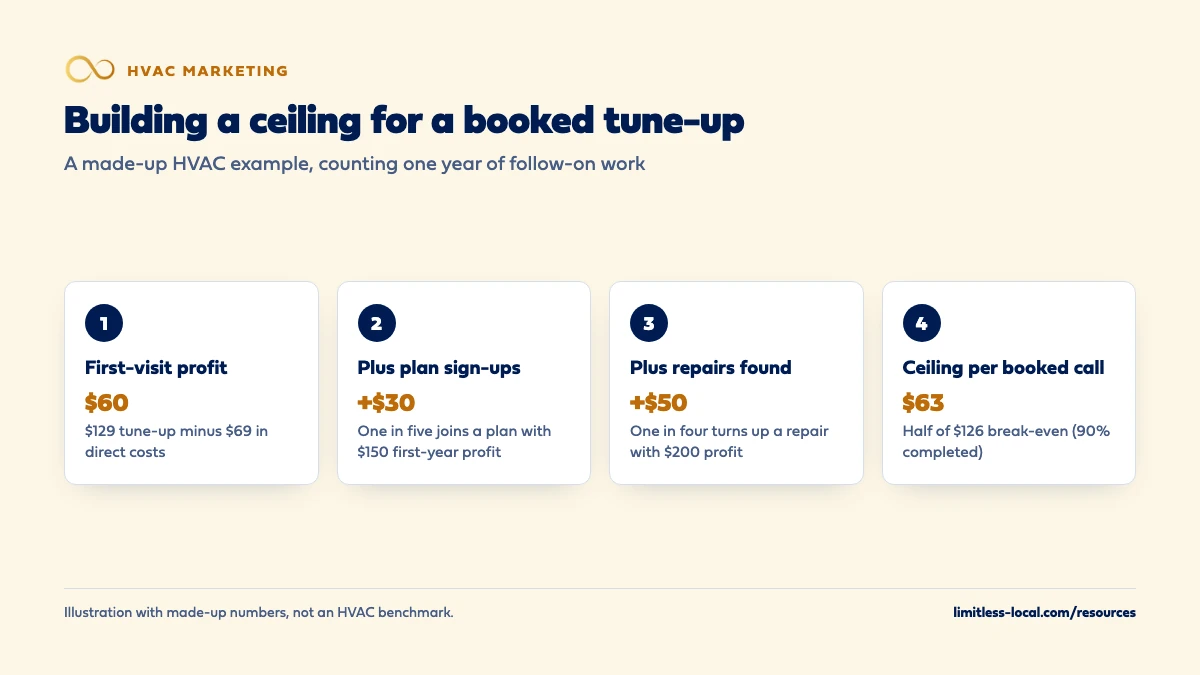
The visit. Say a tune-up costs the homeowner $129, and the tech’s time, drive and materials cost you $69. That leaves $60 in gross profit per completed visit. If 90% of booked tune-ups get completed, the first-visit break-even is $54 per booked call. Aim for half, and your first-visit ceiling is $27.
The year after. Now say one in five tune-up customers joins a plan worth $150 in gross profit in its first year. Spread across every completed visit, that’s $30. And say one in four tune-ups turns up a paid repair worth $200 in gross profit, which adds $50 per completed visit.
The one-year ceiling. $60 plus $30 plus $50 is $140 per completed visit. Times 90% completed, break-even is $126 per booked call. Half of that is a ceiling of $63, more than double the first-visit ceiling. Every dollar of it depends on those sign-up and repair rates holding, which is why you track them by source before you trust the higher number.
Frequently asked questions
Should a booked tune-up cost less than a booked repair call?
On the first visit, usually yes, because the ticket is smaller. Once you count plan sign-ups and repairs found on the visit, the gap can narrow, but only by as much as your own follow-on numbers support.
Do plan members' visits count toward cost per booked maintenance call?
No. Plan members book without new marketing, so leave their visits out. Counting them makes paid channels look cheaper than they are.
Is it worth giving tune-ups away free to get in the door?
Only if your plan sign-up and repair rates are strong enough to cover the visit and the marketing. Track free or deeply discounted tune-ups separately, because they tend to attract price shoppers.
How long should I track a tune-up customer before judging the channel?
A full year covers both a spring and a fall visit and gives repairs time to show up. Check plan sign-ups sooner, since most happen on or right after the visit.
How do I judge maintenance leads from Local Services Ads?
By the same ceiling as any other source: take what you were charged for those leads, divide by how many booked a tune-up, and compare the result with your limit per booked maintenance call.
Key takeaways
- A tune-up’s first-visit profit is small, so set a separate ceiling for maintenance calls.
- Add only one year of follow-on work, plan sign-ups and repairs found, to the first visit.
- Aim well below break-even, and track follow-on rates by source before raising the ceiling.
- Book plan members, past customers and recent repair customers before paying for new tune-up leads.
- Run maintenance marketing ahead of each season and in the gaps, when techs have room.
Ready to compare options?
Book a short growth call and we'll walk through the math for your service area, including when we're not the right fit.
More in this section
- What cost per booked call should an HVAC company aim for?
- What is a good ad click to booked call rate for HVAC?
- How do I get HVAC calls coming back on a tight budget?
- What percentage of calls should my HVAC office be booking?
- Is $100 per HVAC lead too much if the calls are good?
Sources
- Understand differences between memberships and service agreements — ServiceTitan Help Center
- Calculating customer lifetime value & cost of acquisition — Business Development Bank of Canada
- Maintenance Checklist — ENERGY STAR
- Marketing Dashboard: ROI Table — Housecall Pro Help Center
- How to Sell A Service Plan — Housecall Pro Help Center