
Why is marketing important for roofing companies?
- Why does a roofing company need steady marketing, not just referrals and storm work?
- What does marketing actually do for a roofing company?
- Why can't a roofer just rely on referrals?
- How does steady marketing help with storms and slow seasons?
- How does marketing help with crew scheduling and hiring?
- Why does being easy to find on Google matter so much for roofers?
- Does marketing let a roofer choose the jobs they want?
- Why does cutting marketing in a slow month often backfire?
- Is marketing an expense or an investment for a roofer?
- How do I know if my roofing marketing is doing its job?
- Where should a roofer start if marketing has been an afterthought?
- What's different about marketing for roofers
- A worked example: how many extra roofs does marketing need to pay for itself?
- Frequently asked questions
- Key takeaways
- More in this section
- Sources
The short version
- Homeowners rarely buy a roof, so you need to be found the moment they start looking.
- Steady marketing smooths out the gaps between storms and through the slow season.
- A predictable flow of inspections keeps crews busy and makes hiring decisions easier.
- Marketing you can track tells you what each signed roof cost, so you spend on what works.
For roofing owners who’ve grown on referrals and storm seasons and are wondering what steady marketing would actually change.
Get a free visibility audit · Book a growth call
Why does a roofing company need steady marketing, not just referrals and storm work?
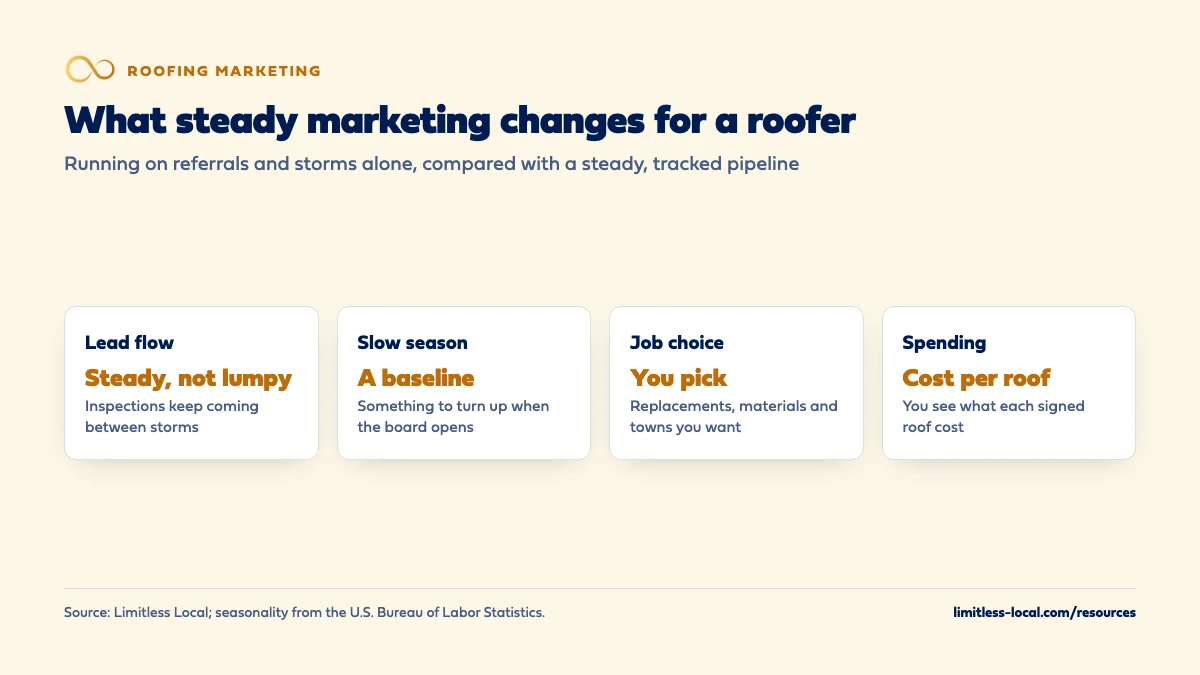
Marketing matters for a roofing company because homeowners only need a roofer a few times in their lives, so you have to be easy to find at the exact moment a leak, a storm or an old roof pushes them to look. Steady marketing keeps inspections coming between storms and through slow months, so your crews stay booked instead of swinging from overloaded to idle. It also lets you choose more of your work, such as replacements over small repairs or the towns you actually want, instead of taking whatever referrals happen to bring in.
That last point is the one we build everything around: booked jobs and what each one cost, not clicks or traffic. Our roofing marketing packages start by fixing tracking and follow-up, then turn on local SEO and ads around the towns and roofs you want, then improve month by month from the calls, leads and revenue you can see. For every channel in one place, read the roofing marketing guide, and the roofing marketing questions library answers the follow-ups one at a time.
What does marketing actually do for a roofing company?
Strip away the jargon and marketing does one job for a roofer: it puts your name in front of homeowners who need a roof looked at, and gets enough of them to call you that your inspection calendar stays full. Everything else, the Google profile, the reviews, the website, the ads, is just a different way of doing that one job.
It helps to think of it as a pipeline, not a megaphone. A homeowner finds you, calls or fills out a form, books an inspection, gets an estimate and signs. Marketing feeds the top of that pipeline. Your office and your sales process decide how much of it turns into signed roofs. When owners say marketing “doesn’t work,” the leak is often lower down: calls nobody answered, inspections that never got booked, estimates nobody followed up on. A good marketing setup watches the whole thing, from first call to signed contract, because a lead that never becomes a roof didn’t help you.
Why can't a roofer just rely on referrals?
Referrals are the best leads most roofers get. The homeowner already trusts you, they rarely shop on price, and they close well. Keep asking for them on every job.
The trouble is that you don’t control them. You can’t turn referrals up when the schedule opens or aim them at the jobs you want. They come in when a past customer happens to talk to a neighbor who happens to need a roof. And because a homeowner may go many years between roofs, your past customers aren’t a steady source of repeat work the way they are for a plumber or an HVAC company.
Referrals also cap how fast you can grow. If you add a second crew, your referral base doesn’t double overnight. Marketing is what lets you fill the new capacity on your schedule, not your past customers’ schedule.
How does steady marketing help with storms and slow seasons?
Roofing has a rhythm that most trades don’t. The U.S. Bureau of Labor Statistics’ profile of roofers notes that in northern states roofing work may be limited during the winter months, while roofers may work overtime to finish jobs during the busy summer months. Add hail and wind events on top, and many roofing companies live in a cycle of too much work, then not enough.
Storms bring a flood of calls you can’t always handle, and then they stop. A company that leans on storm work alone has nothing coming in when the weather is quiet. Steady marketing doesn’t stop storms from spiking your calls, but it keeps a baseline of repair and replacement inspections coming in the rest of the year, from homeowners with old roofs, leaks, home sales and everyday retail work.
It also gives you something to turn up and down. When the board is full after a storm, you can ease off ad spend. When it opens up in late fall, you turn it back on.
How does marketing help with crew scheduling and hiring?
Crews cost you money whether they’re on a roof or not. When the pipeline is lumpy, you either have crews sitting idle or you’re turning away work because everyone is booked three weeks out. Both cost you.
Steady, trackable marketing gives you a pipeline you can see ahead of time. If you know roughly how many inspections come in each week and how many of those sign, you can see a slow stretch coming and do something about it before your crews feel it. That same view helps with bigger calls. Adding a crew is a lot less of a gamble when you can point to a steady number of signed roofs each month instead of hoping the phone keeps ringing.
Curious what your marketing is actually booking?
Get a free visibility audit — no obligation, no sales pitch.
Why does being easy to find on Google matter so much for roofers?
When a homeowner has water coming through the ceiling or shingles in the yard, they don’t ask around for weeks. Most grab a phone, search for a roofer, look at the Google results and the map, check a few reviews and call. Google’s own guide to local ranking explains that when someone searches for a business near them, they find local results on Google Maps and Search, and that local results are mainly based on relevance, distance and popularity. It also says there’s no way to request or pay for a better local ranking.
That has two consequences for a roofer. First, if you don’t show up in those local results for the towns you serve, you’re not in the running for those calls at all. Second, showing up takes work that compounds: a complete Google Business Profile, accurate details, steady reviews and a website that backs it all up. Nobody builds that overnight, which is exactly why the roofers who keep at it are hard to catch. What the map pack is and why roofers need to be in it explains the part of those results that tends to bring the most calls.
Does marketing let a roofer choose the jobs they want?
Yes, and this is one of the most overlooked reasons to market at all. Referrals bring whatever the referrer’s neighbor needs. Marketing lets you decide what to go after.
- Job type. If a full replacement is worth far more to you than a small repair, your website pages, ads and Google profile can lean toward replacements. Whether to market repairs or replacements goes through that trade-off.
- Materials. If you want more metal, tile or specialty work, you can build pages and ads around it instead of waiting for it to find you.
- Towns. You can aim at the neighborhoods with the roof ages and home values you want, and stop paying for leads two counties past where your crews like to drive.
- Residential or commercial. Commercial work needs a different message and different channels, and you only get it in volume by going after it.
Owners who feel stuck with low-margin repairs and price shoppers are usually stuck because they never chose. Marketing is how you choose.
Why does cutting marketing in a slow month often backfire?
When money is tight, marketing feels like the easiest line to cut. The U.S. Small Business Administration’s article on getting the most from your marketing budget calls out the trap: sales drop, you cut marketing, and sales drop further. It suggests that slowing sales may be the right time to increase marketing, especially when other businesses are cutting back.
For a roofer that loop has a delay built in. A roof that signs in March often started as a search, a call or an inspection weeks earlier. Cut everything in a slow month and you won’t feel it right away. You’ll feel it a month or two later, when the pipeline is empty and you’re scrambling.
That doesn’t mean spend blindly. Cut the channels that aren’t producing signed roofs, keep the ones that are, and keep the slow-building work like reviews and your Google profile going no matter what. If you’re booked out and wondering whether to pause, whether to pause roofing marketing when your crews are booked out has the answer by channel.

Is marketing an expense or an investment for a roofer?
It’s an investment only if you can see what it returns. Marketing that drives sales is an investment; marketing nobody measures is just a bill.
The way to measure it is cost per signed roof. Add up what a channel cost you in a month, including ad spend and any fees, and divide by the roofs it signed. Then compare that to what a roof is worth to you after materials and labor. If a channel’s cost per signed roof is comfortably below your profit on a roof, it’s paying for itself. If you can’t calculate the number at all, you can’t tell an investment from a leak.
Roofing makes this math friendlier than most trades. Because a replacement is a high-ticket job, it doesn’t take many extra signed roofs a month to cover a serious marketing budget. The worked example below shows the arithmetic.
How do I know if my roofing marketing is doing its job?
Ask three questions every month: how many new leads came in, how many turned into inspections, and how many signed. Then ask where each signed roof came from.
The SBA’s guide to making a marketing plan puts it simply: compare your marketing and sales costs to the revenue they generate, so you know you’re getting a positive return, and be consistent in how you measure. Tracking can start as simply as asking every new customer how they found you and writing it down.
Google gives you some of the rest for free. If your Business Profile is verified, its performance report shows how many people viewed your profile, the searches they used to find you, and how many tapped the call button or clicked through to your website. Put that next to your own record of which calls became signed roofs, and you can see whether the work is turning into jobs. How to track which roofing leads turn into signed jobs lays out the full setup.
Where should a roofer start if marketing has been an afterthought?
Start with the parts that make everything else work better, not the most exciting channel:
- Make sure leads get answered. Before spending a dollar, make sure calls and forms get a fast response. Marketing that brings calls nobody picks up is the most expensive kind.
- Fix your Google Business Profile. Verified, accurate, the right categories, real photos and a habit of asking for reviews.
- Get a simple website that converts. Clear services, the towns you serve, a phone number on every page.
- Add paid ads if you need calls soon. Ads can drive leads within days; SEO typically takes 3 to 6 months to show meaningful growth, so most roofers who need work now run both.
- Track every lead to a signed roof. So next month’s decisions are based on what actually worked.
What marketing a roofing company should add first to grow goes through that order in detail, and how a roofer sets up a funnel for roofing leads shows how the pieces connect from first call to signed job.
Want to see where your company stands?
A free visibility audit shows where you show up on Google, Maps and AI answers, and what it's costing you in calls.
What's different about marketing for roofers
Customers buy rarely. A homeowner may only replace a roof once or twice while they own a home. That means you can’t build the business on repeat customers the way a service-plan trade can. You need a steady supply of new homeowners, and your reviews and referrals have to do extra work.
The ticket is large and the decision is slow. A replacement means an inspection, an estimate, often a second opinion and sometimes an insurance process. Marketing has to keep you in front of the homeowner through all of that, not just get the first call.
Weather sets the calendar. Storms create bursts of demand, and winter slows work in colder states. Your marketing has to flex: ready to scale up after a storm, and steady enough to carry you through the quiet weeks.
A worked example: how many extra roofs does marketing need to pay for itself?
These numbers are made up to show the math, not a benchmark for your market. Say a typical replacement for your company leaves you about $4,000 after materials and labor.
Our Essentials package is $3,500 a month and covers local SEO, Google Business Profile management, Google Ads management up to $2,500 a month in spend, and call and form tracking. Ad spend is paid to Google separately, so say you spend $2,000 a month on ads. Your total is $5,500 a month.
Divide $5,500 by $4,000 and you get about 1.4. So two extra signed replacements a month cover the whole cost, and every roof after that is profit. If the marketing can’t produce two more signed roofs a month than you’d get anyway, it isn’t paying for itself, and you’d want to know that quickly. That’s why tracking each lead to a signed roof matters more than any single channel.
Frequently asked questions
Do small roofing companies need marketing, or is it only for big ones?
Small companies often need it more, because one slow month hurts a one- or two-crew shop harder. The difference is scale: a small roofer can start with a solid Google profile, steady reviews and a simple website before spending much on ads.
Is word of mouth a form of marketing?
Yes, and a strong one. The difference is that you can’t control its timing or volume, so most roofers use it alongside marketing they can turn up and down.
How much should a roofing company spend on marketing?
It depends on your market, your goals and what a signed roof is worth to you. Start from what a signed roof is worth to you and work back to how many extra roofs the budget has to produce.
Can marketing make up for a bad sales process?
No. More leads just means more leads lost if calls go unanswered or estimates never get followed up. Fix how leads are handled first, then add volume.
Should a roofer market during storm season?
Usually yes, but differently. The Google profile and reviews should keep going, while paid ad spend can be eased back if you can’t handle more calls and turned up again when the rush ends.
Does a roofer still need marketing with a long backlog?
A backlog is the best time to build the slow work, like reviews, photos and website pages, so you aren’t starting from zero when it runs out. You can trim paid ads while you’re booked.
Key takeaways
- Homeowners rarely buy a roof, so you need to be easy to find at the moment they start looking.
- Referrals are great leads, but you can’t control their timing, volume or job type.
- Steady marketing smooths out storm spikes and slow seasons, so crews stay busy.
- Cutting marketing in a slow month tends to show up as an empty pipeline a month or two later.
- Judge marketing by cost per signed roof, not by clicks or calls alone.
Not sure what's working right now?
Start with a free visibility audit: rankings, Google profile, reviews and tracking, checked against your service area.
More in this section
- What marketing should a roofing company add first to grow?
- How does a roofer run a profitable business with marketing?
- What marketing brings a roofing company the most phone calls?
- How should a roofing company market commercial roofing?
- What is marketing attribution for a roofing company?
Sources
- Roofers: Occupational Outlook Handbook — U.S. Bureau of Labor Statistics
- How to Get the Most From Your Marketing Budget — U.S. Small Business Administration
- Manage your business: Marketing and sales — U.S. Small Business Administration
- Tips to improve your local ranking on Google — Google Business Profile Help
- Understand your Business Profile performance & insights — Google Business Profile Help