
What HVAC leads and jobs to expect in 30, 60 and 90 days?

- How many HVAC leads and booked jobs should new marketing bring in the first 90 days?
- Is there a standard number of leads an HVAC company should get in 90 days?
- How do I work out what my first 90 days should produce?
- What should days 1 to 30 produce?
- What should days 31 to 60 produce?
- What should days 61 to 90 produce?
- Which channels bring HVAC leads in 30 days, and which take longer?
- Why do booked jobs and revenue lag behind leads?
- What should I count at each checkpoint?
- How does the season change what 30, 60 and 90 days look like?
- What are the warning signs at day 30, 60 and 90?
- What if my first 90 days come in under the plan?
- What's different about the first 90 days for HVAC companies
- A worked example: one Google Ads budget across 90 days
- Frequently asked questions
- Key takeaways
- More in this section
- Sources
The short version
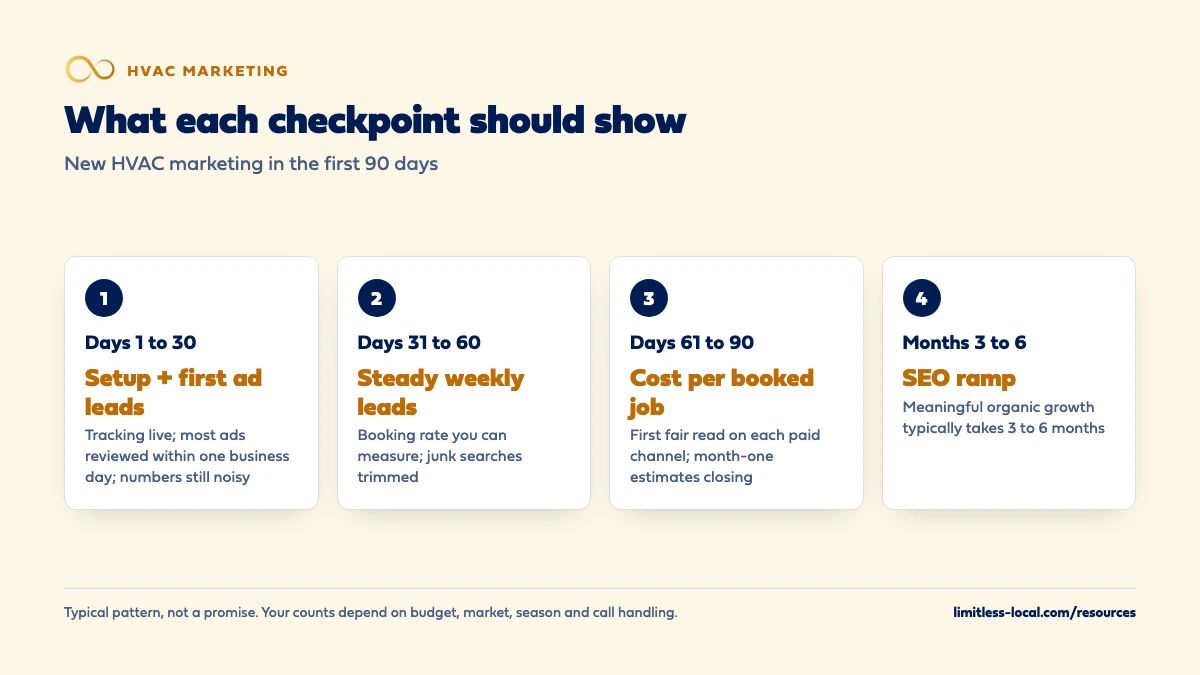
- Days 1 to 30: setup, first ad leads, and numbers too noisy to judge.
- Days 31 to 60: steady weekly leads and a booking rate you can measure.
- Days 61 to 90: a cost per booked job for each paid channel you can act on.
- Replacement jobs and SEO calls lag behind; count them on a longer clock.
For HVAC owners starting new marketing who want a realistic count of leads and booked jobs at each checkpoint, built from their own numbers.
Get a free visibility audit · Book a growth call
How many HVAC leads and booked jobs should new marketing bring in the first 90 days?
In the first 30 days, expect leads mainly from paid search and past-customer outreach, with booked jobs low while tracking, call handling and the ads get tuned. By day 60, paid channels should produce a steady weekly count of leads and a booking rate you can measure, and by day 90 you should have a cost per booked job for each paid channel worth judging. SEO usually adds little before day 90, because it typically takes 3 to 6 months to show meaningful growth. The actual counts come from your own budget, cost per lead and booking rate, not an industry average.
Those checkpoints line up with how we run a new program: tracking and the foundation first, then ads and local SEO turned on around the towns and jobs you want, then monthly changes based on calls, leads and booked jobs. Onboarding takes your team about 2 to 3 hours and campaigns go live in weeks 1 to 2. Our HVAC marketing packages include the call tracking and reporting that make each checkpoint countable. The HVAC marketing guide covers every channel, and the rest of the HVAC marketing questions library goes question by question.
Is there a standard number of leads an HVAC company should get in 90 days?
No, and any number quoted without your market attached is a guess. Two HVAC companies running the same budget can see very different counts because of the season they start in, how crowded their towns are, which jobs they advertise, whether the office answers every call, and how many reviews they already have.
What you can have is a realistic expectation built from your own inputs. That’s more useful than a national figure anyway, because it tells you whether your program is on track, not whether you beat someone else’s average.
The other thing to settle before you start: count leads and booked jobs separately. A lead is a call, form or message. A booked job is one that made it onto the schedule. The gap between the two is where most first-quarter problems hide.
How do I work out what my first 90 days should produce?
Work it out channel by channel with three numbers:
- Leads. Monthly budget divided by what you expect to pay per lead. Use last year’s numbers if you ran that channel before. If you didn’t, the first 30 days give you your first real figure.
- Booked jobs. Leads times your booking rate, the share of leads your office turns into a scheduled visit. Your call recordings and field software will tell you this.
- Paid jobs. Booked jobs minus cancellations and no-shows, and for replacements, times your close rate on estimates.
Write those down before day one. Then each checkpoint isn’t a gut feeling; it’s a comparison between what you expected and what happened, step by step. If leads are on plan but booked jobs aren’t, you know where to look. How many booked calls your HVAC company needs runs the same math backward from a revenue goal.
What should days 1 to 30 produce?
Mostly setup, plus the first paid leads. Here’s what has to happen and how long each piece takes:
- Tracking. Call tracking numbers per channel, tracked forms and a lead source on every job. Do this before anything goes live, or your first month can’t be counted.
- Google search ads. Google says most ads are reviewed within one business day, so search ads can produce calls within days of launch.
- Google Business Profile. If you need to verify or re-verify, Google’s review can take up to 5 business days after you complete the steps.
- Local Services Ads. New accounts go through Google’s screening and verification first, which Google says takes 3 to 4 weeks on average after you submit your documents. Start the paperwork on day one, and don’t count on LSA leads in the first month.
- Past customers. A tune-up reminder by email or text can book jobs within days, and it’s often the cheapest booked work in the whole quarter.
Expect day-30 numbers to be noisy. A partial month, a new office script and ads that haven’t been trimmed yet all push cost per booked job up. Use the month to check the plumbing: are calls tagged, answered and booked?
What should days 31 to 60 produce?
A steady weekly count of leads from paid search, and a booking rate you can actually measure. By now you should have:
- Enough calls to trim waste. Listen to recordings and look at the search terms. Cut searches that bring parts shoppers, job seekers and DIY questions.
- Bidding that has settled. Google’s Smart Bidding guide says the “Learning” status never lasts more than 7 days, but performance typically settles over 1 to 2 conversion cycles. Fewer tracked calls means a slower settle, which is one more reason tracking comes first.
- LSA leads, if verification cleared. Answer them fast, every time.
- Early SEO signs. More Google Business Profile views and more searches you appear for, but usually few extra calls yet.
Booked jobs should now track leads more closely than in month one. If leads went up and booked jobs didn’t, look at the office before the ads.
What should days 61 to 90 produce?
The first numbers worth deciding on. By day 90 a paid channel has run long enough to show:
- Cost per lead that has stopped swinging week to week.
- Booking rate by channel, so you can see whether LSA calls, search ad calls and form leads book at different rates.
- Cost per booked job, the number that tells you whether a channel is paying its way at your average ticket and margin.
- Replacement estimates booked in month one starting to close.
That’s enough to make the first real moves: shift budget toward the channel with the lowest cost per booked job, raise spend on a channel that’s running out of budget before the day ends, or fix a step in the funnel that’s leaking. It’s not enough to judge SEO. Day 90 sits at the very start of the typical 3 to 6 month SEO ramp, so judge it on early signs, not calls. How many months to wait before judging Google Ads covers when a paid channel has had a fair test.
Curious what your marketing is actually booking?
Get a free visibility audit — no obligation, no sales pitch.
Which channels bring HVAC leads in 30 days, and which take longer?
Roughly in order of speed:
- Past-customer reminders: days. Your list already knows you.
- Google search ads: days, once approved and tracked.
- Local Services Ads: after screening and verification, which averages 3 to 4 weeks from submitting documents.
- Facebook and Instagram ads: days to weeks. Meta’s learning phase usually ends after about 50 results in the week after the last significant edit, so small budgets can stay in learning for a while, and most people who see the ad didn’t need HVAC that day.
- Google Business Profile fixes: weeks. Correct categories, services and hours tend to show up before deeper SEO work does.
- Website SEO pages: months. Google’s SEO Starter Guide says some changes take effect in a few hours and others take several months.
- Referrals and partnerships: months, and lumpy.
So a 90-day plan that leans only on SEO will look empty at every checkpoint, even if it’s working. Pair the slow channels with at least one fast one.
Why do booked jobs and revenue lag behind leads?
Because HVAC jobs close on different clocks. A no-cool call usually books the same day and gets invoiced the same week. A replacement lead books an estimate, the homeowner compares quotes and maybe applies for financing, and the install can land weeks later.
That means your 30-day revenue understates what month one actually produced. Track replacement work in its own line: estimates booked, estimates sold, and installs completed, each by the month the lead first came in. Then when you look back at day 90, month one gets credit for the installs it started.
Maintenance has its own lag in the other direction. A tune-up is small revenue on day one, but a tune-up customer often turns into repair work, a maintenance plan and, in time, a replacement.
What should I count at each checkpoint?
The same short list at day 30, 60 and 90, for each channel:
- Leads (calls, forms, messages, bookings)
- Answered calls, and calls missed
- Booked jobs, split into repair, maintenance and replacement estimates
- Replacement estimates sold
- Spend, including any management fee
- Cost per lead and cost per booked job
Keep it in one place, a simple spreadsheet works, and pull the lead source from your field software rather than from memory. If more than a small share of booked jobs have no source, fix the tagging before you trust the totals. How to track whether your HVAC marketing is paying off covers the setup.
How does the season change what 30, 60 and 90 days look like?
A lot. Start in late spring and your first 90 days run straight into cooling season: more searches, more calls and, often, a booking rate limited by how many techs you have. Start in October and the first 60 days may straddle the shoulder season, with lower volume until the first cold snap.
Neither is wrong, but it changes what a fair checkpoint looks like. Compare each period with the same weeks last year, not with the month before. A slower day 60 in mid-fall isn’t the marketing failing, and a busy day 60 in June isn’t proof it’s working. If you have no history, write down which season you started in next to every checkpoint so you don’t misread it later.
What are the warning signs at day 30, 60 and 90?
- Day 30: no way to tell which channel a booked job came from; calls going to voicemail; ads still waiting on approval or LSA verification stalled because documents weren’t submitted.
- Day 60: leads coming in but booked jobs flat, which usually points to call handling or follow-up; a high share of junk calls that nobody has used to trim the ads.
- Day 90: cost per booked job well above what your average job can carry, with no improvement from month two to month three; or replacement estimates piling up without closing.
Each of those has a different fix, and spending more doesn’t solve any of them. Telling whether it’s your ads, website or follow-up walks through finding which one it is.
What if my first 90 days come in under the plan?
Go back to the three numbers you wrote down and find the step that missed. Leads under plan points at budget, targeting or a cost per lead higher than you assumed. Leads on plan but booked jobs under plan points at the phones and follow-up. Booked jobs on plan but revenue under plan points at cancellations, close rate or the job mix.
Then decide on one change per channel, not five. Give paid channels another full month after a real change before you judge again. And keep SEO on its own clock: nobody can honestly promise a ranking, a lead count or a date, so judge it on the early signs until it has had its full 3 to 6 months.
Talk it through with someone who runs this every day
A 15-minute growth call: your market, your numbers, and what a realistic budget looks like. No pressure.
What's different about the first 90 days for HVAC companies
Capacity can cap the count. In a heat wave the limit is often how many calls your techs can run, not how many leads come in. If you’re booking out several days, booked jobs will flatten no matter what the marketing does, so note your schedule lead time at each checkpoint.
Emergency and planned work behave differently. No-heat and no-cool calls book fast and show up in the 30-day numbers. Replacements, heat pump conversions and duct work show up in the 60 and 90-day numbers, or later.
Maintenance lists are a quick win. An HVAC company with a few years of customers can fill gaps in the first month with tune-up reminders while new channels ramp.
A worked example: one Google Ads budget across 90 days
These numbers are made up to show how the checkpoints read. They aren’t a forecast or a benchmark for your market.
Say you spend $3,000 every 30 days on Google search ads, with tracking in place from day one.
- Days 1 to 30: 32 leads. The office books about 40% of them, so 13 booked jobs. That’s about $231 per booked job.
- Days 31 to 60: waste trimmed and the call script tightened. 42 leads, half of them booked, so 21 booked jobs, or about $143 each.
- Days 61 to 90: 46 leads and 25 booked jobs, about $120 each.
Over the quarter, $9,000 bought 120 leads and 59 booked jobs, about $153 per booked job. Meanwhile, 6 replacement estimates booked in the first 30 days: 1 had sold by day 30, and 3 by day 90.
Judged at day 30 alone, the ads looked expensive and the replacements looked like a miss. Judged at day 90, the same spend was getting cheaper per booked job every month, and month one’s estimates were still turning into installs.
Frequently asked questions
Should I expect any SEO calls in the first 30 days?
A few, mostly from fixing your Google Business Profile and people searching your company name. New pages and rankings for service searches usually take months, not weeks.
Is it normal for cost per booked job to be highest in the first month?
Yes. The first month carries untrimmed searches, a partial month of data and a call process that’s still being tuned. Judge the trend from month one to month three, not month one alone.
What if I start right before cooling season?
Expect more leads and a busier schedule, and watch capacity closely. Compare your checkpoints with the same weeks last year, since a hot June flatters every channel.
Do I count a lead from a past customer as new marketing?
Count it in its own line. Past-customer jobs are real and worth tracking, but mixing them in with new-customer leads makes your paid channels look better or worse than they are.
When should I raise the budget?
When a channel’s cost per booked job is working at your margins and it keeps running out of budget before the day ends, and only if your crews can take the extra work.
Can an agency tell me exactly how many jobs I'll get by day 90?
No one can honestly promise a lead count or a date. A good agency should show you the math it’s planning from and report against it at every checkpoint.
Key takeaways
- There’s no standard 90-day lead count; build your own from budget, cost per lead and booking rate.
- Days 1 to 30 are for setup and first ad leads; judge the plumbing, not the price.
- By day 60 you should have steady weekly leads and a booking rate you can measure.
- By day 90 each paid channel should have a cost per booked job worth acting on.
- Replacement jobs and SEO calls run on a longer clock, so credit them back to the month they started.
Ready to compare options?
Book a short growth call and we'll walk through the math for your service area, including when we're not the right fit.
More in this section
- How long does it take an HVAC lead to turn into a booked job?
- What marketing results can an HVAC company expect in month 1, 3, 6?
- How fast should an HVAC company respond to new leads?
- How many leads and booked jobs to justify hiring an HVAC agency?
- Which HVAC jobs should I market to get more repairs or installs?
Sources
- About the ad review process — Google Ads Help
- About Smart Bidding learning — Google Ads Help
- Business screening and verification requirements – United States — Google Local Services Help
- Verify your business on Google — Google Business Profile Help
- About the Learning Phase — Meta Business Help Center
- SEO Starter Guide: The Basics — Google Search Central