
Where do homeowners research pool builders before they call?
- Which places do homeowners in my service area check before contacting a pool builder?
- Where do homeowners start looking for a pool builder?
- What do homeowners check on Google Search and Maps?
- How much do reviews matter when homeowners compare builders?
- What do homeowners look for on a pool builder's website?
- Do homeowners look at Instagram, Facebook and Houzz?
- How much do friends, neighbors and community groups matter?
- Do homeowners ask AI tools about pool builders?
- Do industry directories and manufacturer sites matter?
- In what order do homeowners usually check these places?
- How do I find out where my own homeowners did their research?
- Where should a pool builder focus first?
- What's different about how homeowners research pool builders
- A worked example: what twenty consultations tell one builder
- Frequently asked questions
- Key takeaways
- More in this section
- Sources
The short version
- Google Search and Maps: your profile, photos and reviews.
- Your website, especially the gallery of finished pools.
- Social media and design sites for inspiration and proof you're active.
- Friends, neighbors, community groups and AI answers for a recommendation.
For pool builders who want to know where homeowners size them up before the phone rings, and which of those places deserve the most attention.
Get a free visibility audit · Book a growth call
Which places do homeowners in my service area check before contacting a pool builder?
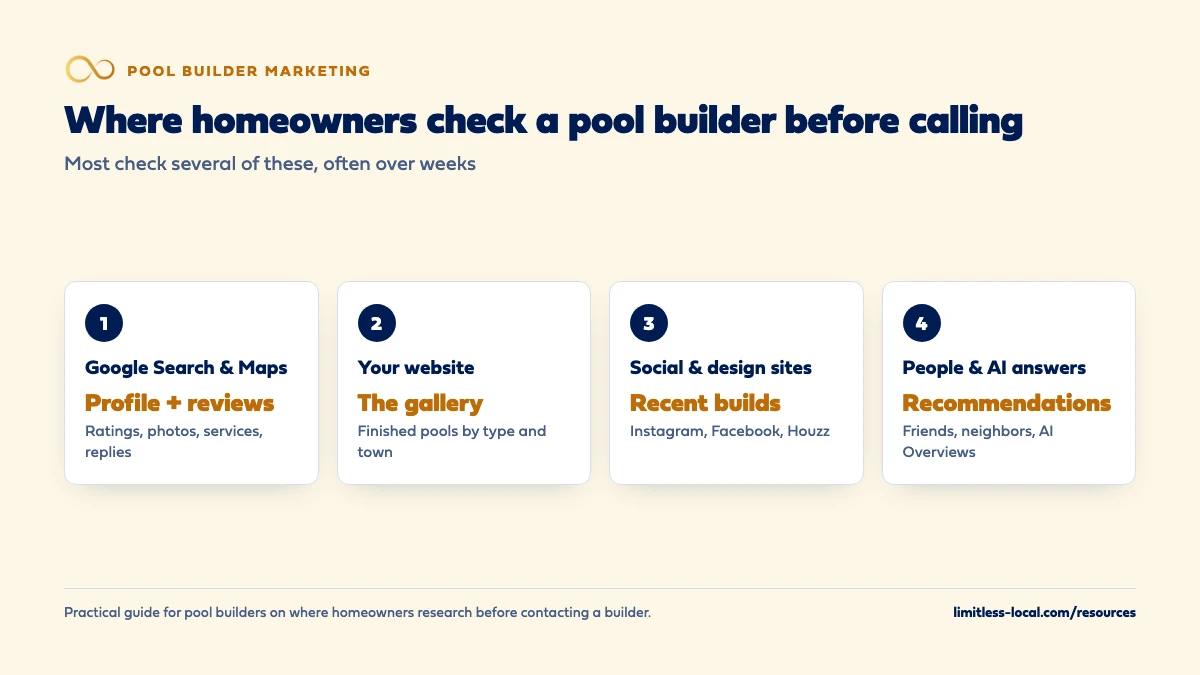
Before they call, most homeowners check a pool builder in several places: Google Search and Maps, where they compare Business Profiles, photos and reviews; the builder’s own website, especially the gallery of finished pools; Instagram, Facebook and design sites like Houzz for inspiration; friends, neighbors and community groups for a recommendation; and AI answers such as Google’s AI Overviews. A pool is a big, slow purchase, so most buyers check more than one of these before they reach out. You don’t need to be everywhere, but your Google profile, reviews and website gallery need to be strong, because nearly every path leads back to them.
Those are the same places we work on: we optimize for the regular Google results, the Maps 3-pack and AI answers, because that’s where homeowners check you out before they call. Our local SEO work covers the Google profile, reviews and the listings that feed all three, and our pool builder marketing page explains how we work with pool companies. The pool builder marketing questions library goes deeper on each one.
Where do homeowners start looking for a pool builder?
Rarely in one place. A homeowner thinking about a pool usually starts with ideas long before they look for a builder: pools they’ve seen at friends’ houses, photos on Instagram or Pinterest, a neighbor’s new build. When they’re ready to find someone, most go to Google, ask people they know, or both.
Then they check. A pool is one of the largest purchases most families make for their home, so very few homeowners call the first builder they find. They look at a handful of companies, compare reviews and photos, and ask around, often over weeks or months.
That’s why it helps to think of research as a set of places your company gets inspected, not one channel to win. Each one either builds the homeowner’s confidence or quietly knocks you off their list.
What do homeowners check on Google Search and Maps?
Your Google Business Profile, usually before your website. When someone searches for a pool builder nearby, the Maps results show a short list of businesses with their star rating, number of reviews, photos, hours and a button to call or visit the website. Many homeowners decide who to look at more closely right there.
Google says local results are mainly based on relevance, distance and popularity, and that complete, accurate business information makes a profile more likely to show up. For a pool builder, the details homeowners look at most are:
- Reviews: how many, how recent, and what customers say about the build and the crew.
- Photos: real finished pools, ideally the type they want.
- Services: whether you build what they’re picturing, and in their town.
- Your replies to reviews, especially the unhappy ones.
If you don’t show up for searches in your towns at all, start there. How to get a pool company to rank in Google Maps covers the steps.
How much do reviews matter when homeowners compare builders?
A lot, and more for big purchases. Northwestern University’s Medill Spiegel Research Center studied online reviews of retail products, in findings first published in 2017. It found that displaying reviews raised the conversion rate by 190% for a lower-priced product and by 380% for a higher-priced one, and that purchase likelihood typically peaked at star ratings of 4.0 to 4.7 before dropping as ratings approached 5.0. That’s research on online shopping, not pool construction, but the pattern fits what pool buyers do: the more a purchase costs, the harder people lean on what other customers say.
For a pool builder, that means a steady flow of honest reviews from finished pools matters more than a perfect score. A few thoughtful replies to less-than-perfect reviews can reassure a careful buyer more than a wall of five stars. If your review count is thin because past customers were never asked, how to ask past pool customers for reviews after the build covers that.
What do homeowners look for on a pool builder's website?
Proof that you build the kind of pool they want, in a yard like theirs. Most visitors go straight to the gallery. What keeps them on the site and gets them to reach out:
- A gallery sorted by pool type and style, with real photos of finished pools and a line about each project’s town and features.
- Your process, from design consultation to startup, so they know what they’re signing up for.
- The towns you build in, so they don’t wonder whether you’ll come to them.
- Reviews and credentials on the pages they’re already reading.
- A clear next step: a short consultation form and a phone number.
A website that hides the work behind stock photos or a slow-loading page sends homeowners back to Google to look at the next builder. How to set up a pool builder’s project gallery page covers what to include.
Do homeowners look at Instagram, Facebook and Houzz?
Many do, mostly for inspiration and to see whether a builder is active. A homeowner who saves photos of pools they love will often check whose work it is, and a builder whose last post was two years ago can look like a builder who’s slowing down.
- Instagram and Facebook show recent builds, the crew at work and finished pools at sunset. Regular posts from real jobs matter more than polished ads.
- Houzz is a directory of home remodeling and design professionals. Houzz says the main factors in how it orders pros in its free listings include category and location, relevance (including distance and how well your project photos match the style a homeowner has saved) and content quality, such as the number of reviews and photos saved to ideabooks.
None of these replaces your Google profile, but they’re often where a homeowner first sees your work. Post real projects, keep your profile details matching your website, and reply to messages as fast as you’d answer the phone.
Curious what your marketing is actually booking?
Get a free visibility audit — no obligation, no sales pitch.
How much do friends, neighbors and community groups matter?
For pools, a great deal. A homeowner who can stand in a neighbor’s backyard and see your work is already half-sold, and many pool searches start with “who built yours?”
Online, that conversation happens in neighborhood apps and groups. On Nextdoor, neighbors can recommend a business on its page or by tagging it in a post, and those recommendations show on the business page under “What neighbors say”. Business recommendations are visible to anyone, and businesses can see and reply to them.
You can’t control these conversations, but you can feed them: build pools people want to talk about, give every customer an easy way to recommend you, claim your business pages, and reply politely when you’re mentioned. A single happy customer on a busy street can bring more consultations than a month of ads.
Do homeowners ask AI tools about pool builders?
Some do, especially for the early questions: what a pool type involves, what to ask a builder, which builders nearby have good reviews. Google’s AI Overviews and AI Mode show a summary with links to supporting websites, and Google says they may run several related searches across subtopics to build a response.
There’s no separate trick to show up there. Google’s guidance on AI features and your website says the same foundational SEO practices apply, that a page has to be indexed and eligible to show in Search with a snippet to be used as a supporting link, and lists keeping your Business Profile information up to date among the things worth doing. In practice, the builders AI answers can describe are the ones with clear service pages, consistent details across the web and plenty of reviews. How a pool builder shows up in AI search results covers the details.
Do industry directories and manufacturer sites matter?
They matter to a smaller group of careful buyers, and they help in another way: they’re credible places that mention your company. Some homeowners start with an industry association or a manufacturer they trust:
- Industry directories, like the Pool & Hot Tub Alliance’s Find a Pro directory for locating pool and hot tub professionals.
- Dealer locators from fiberglass pool manufacturers and equipment brands, if you’re an authorized dealer or installer.
- Local business directories like your chamber of commerce.
Make sure every listing you control has the same business name, phone number, service area and website as your Google profile. Which sites should mention your pool company goes through the list.
In what order do homeowners usually check these places?
There’s no fixed path, but a common one for a pool buyer looks like this:
- Inspiration: social media, design sites and friends’ backyards, sometimes for a year or more.
- Shortlist: a Google search for builders in their town, and a scan of the Maps results and ratings.
- Vetting: reading reviews, browsing each builder’s gallery, maybe asking an AI assistant or a neighborhood group what people think.
- Gut check: asking anyone they know who’s built a pool.
- Contact: a call or form to two or three builders.
By the time a homeowner calls, they’ve often already decided you’re worth a meeting. Everything before the call did that work, and a weak spot anywhere along the path can quietly drop you off the shortlist.
How do I find out where my own homeowners did their research?
Ask, and check your numbers:
- At every consultation, ask how they found you and where else they looked. “Did you see our reviews or gallery first?” tells you which pages are doing the work.
- Your Google profile’s performance report shows the search terms people used to find your profile, how many viewed it, and how many called or clicked to your website. The searches metric updates at the start of each month.
- Lead source tracking in your CRM or job software, so every consultation and signed pool has a source attached.
A few months of answers show you where your homeowners actually do their research, which is better than any general list. For the words they type once they’re ready to hire, see what homeowners search when they’re ready to hire a pool builder.
Where should a pool builder focus first?
On the places nearly every homeowner passes through, in this order:
- Your Google Business Profile: complete, accurate, with real photos of finished pools and replies to reviews.
- Reviews: a steady flow from every finished pool, asked for the same way every time.
- Your website gallery: sorted by pool type, with towns and short descriptions.
- Consistent details everywhere: the same name, phone, website and service area on every listing.
- Social and design sites: regular posts from real jobs.
- Neighbors and partners: make your builds easy to talk about.
The first three carry most of the weight, and they also feed what AI answers say about you. Get them right before spreading effort across more platforms.
Want to see where your company stands?
A free visibility audit shows where you show up on Google, Maps and AI answers, and what it's costing you in calls.
What's different about how homeowners research pool builders
Research runs long. A homeowner who needs a plumber today checks one or two things and calls. A pool buyer may browse for months, so your profile and gallery get looked at many times before the first contact.
It’s a visual purchase. Homeowners are buying something they’ll look at every day. Photos of finished pools carry more weight than in almost any other trade.
Your work is on display. Finished pools sit in backyards friends and neighbors visit. Word of mouth starts at the pool’s edge.
Trust has to survive a big check. Financing, permits and a construction schedule that runs for weeks make homeowners look hard at how long you’ve been around and what past customers say.
A worked example: what twenty consultations tell one builder
These numbers are made up to show how to use the answers, not a benchmark for your market. A builder asks every homeowner at 20 design consultations where they looked before calling. Seventeen read the Google reviews, 12 browsed the website gallery, 8 heard about the company from a friend or neighbor, 5 found it on Instagram, and 2 mentioned asking an AI assistant. Most named more than one place.
The takeaway for this builder: Google reviews and the gallery are the two places almost everyone passed through, so they get attention first. Referrals are strong enough to deserve a proper ask at every handover. Instagram and AI answers are worth keeping up, but not at the expense of the first two. Your own tally will look different, which is the point of keeping one. A free visibility audit is a quick way to see how your profile, reviews and site look to a homeowner in your towns.
Frequently asked questions
Do homeowners still use Yelp to find pool builders?
Some do, depending on the market. Claim your listing, keep the details matching your Google profile, and reply to reviews there too, but put most of your effort into Google first.
Should I pay to be featured on design or directory sites?
Only if you can track the consultations and signed pools it brings. A free, complete profile with real photos is the place to start.
How many builders does a homeowner usually contact?
Usually more than one. Assume you’re being compared, and make sure your reviews, gallery and response time hold up side by side.
Do homeowners look at a builder's social media before calling?
Many glance at it, mostly to see recent work and whether the company is active. A few posts a month from real jobs is enough.
Can a bad review on one site cost me the job?
It can if it goes unanswered. A calm, specific reply that shows how you fixed the problem often reassures a careful buyer more than a perfect score.
Does my truck or yard sign count as research?
For many homeowners, yes. A sign at an active build is often the first time a neighbor sees your name, and they’ll look you up on Google next.
Key takeaways
- Homeowners check pool builders in several places before calling: Google and Maps, reviews, your website, social and design sites, people they know and AI answers.
- Your Google profile, reviews and website gallery are on almost every path, so they come first.
- Reviews weigh more on big purchases; a steady flow of honest reviews beats a perfect score.
- Keep your name, phone, service area and website the same on every listing.
- Ask every homeowner where they looked, and let their answers set your priorities.
Not sure what's working right now?
Start with a free visibility audit: rankings, Google profile, reviews and tracking, checked against your service area.
More in this section
- What do homeowners search when they are ready to hire a pool builder?
- How can pool builders get referrals from landscapers and builders?
- Which online listings should a pool builder have besides Google?
- How do I estimate how many people search for pool builders in my area?
- What should a pool builder website include to get more consultations?
Sources
- Tips to improve your local ranking on Google — Google Business Profile Help
- How Online Reviews Influence Sales — Medill Spiegel Research Center
- Pros Shown on Houzz — Houzz Pro Help
- About business recommendations on Nextdoor — Nextdoor Help Center
- AI features and your website — Google Search Central
- Find a Pro — Pool & Hot Tub Alliance
- Understand your Business Profile performance & insights — Google Business Profile Help