
What types of HVAC ads on Facebook and Google bring calls that book?
- Which Google and Facebook ad formats actually bring an HVAC company phone calls?
- Which ad types actually make an HVAC company's phone ring?
- How do Google search ads with a call button work?
- What happened to Google's call-only ads?
- Are Local Services Ads a type of call ad?
- Do Google lead form ads bring HVAC calls?
- How do Facebook and Instagram call ads work?
- Do Facebook lead form ads work for HVAC?
- What should an HVAC ad on Facebook actually offer?
- Where does remarketing fit?
- Which ad type fits which HVAC job?
- How do I tell which ad type is bringing booked calls?
- What's different about ad types for HVAC companies
- A worked example: the same budget on three ad types
- Frequently asked questions
- Key takeaways
- More in this section
- Sources
The short version
- Google search ads with call assets and Local Services Ads reach people searching right now.
- Google's call-only ads are being retired; move phone numbers to call assets.
- Facebook call ads open the dialer; lead form ads collect details you have to call back.
- Judge every format on booked calls, not clicks or form fills.
For HVAC owners sorting through the ad formats on Google and Facebook who want to know which ones make the phone ring, and for which jobs.
Get a free visibility audit · Book a growth call
Which Google and Facebook ad formats actually bring an HVAC company phone calls?
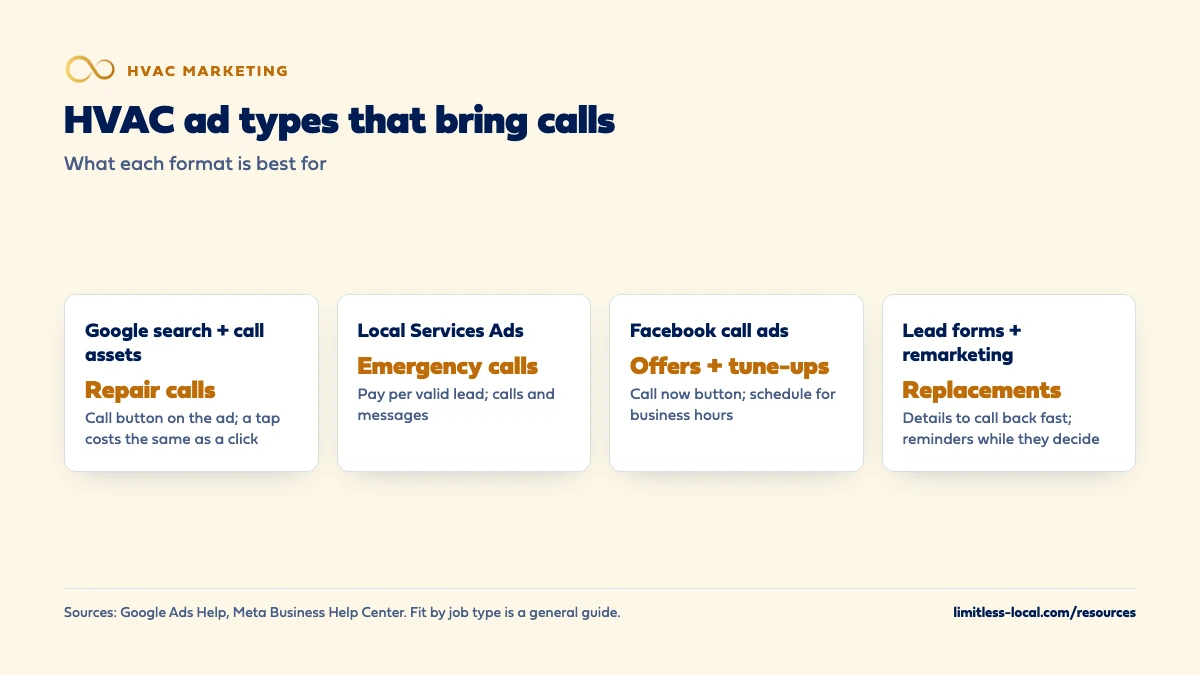
On Google, the ad types that bring HVAC calls most directly are search ads with a call button (call assets) and Local Services Ads, because both show to people who are searching for help right now. On Facebook and Instagram, call ads with a Call now button and remarketing to people who already visited your site are the closest to a phone call, while lead form ads bring in names to call back. Match the format to the job: search and Local Services Ads for repair and emergency calls, and forms, offers and remarketing for tune-ups and replacements.
Picking the format is half of it; the other half is tracking which one books jobs. Google Ads management is in every one of our HVAC marketing packages, and Growth adds Local Services Ads management and Meta remarketing, with call tracking and source tagging so each ad type is judged on booked jobs. Our local ads page covers how we run them. The HVAC marketing guide covers every channel, and the rest of the HVAC marketing questions library goes question by question.
Which ad types actually make an HVAC company's phone ring?
The big split is between ads that show to people who are searching and ads that show to people who fit an audience you picked. Google search ads and Local Services Ads show up when a homeowner types “AC repair” or “furnace not working.” Facebook and Instagram ads show up in someone’s feed, and most of those people don’t need an HVAC company that day.
That doesn’t make Facebook useless. It makes it better at different jobs. Here are the formats worth knowing:
- Google: search ads with call assets, Local Services Ads, and lead form ads.
- Facebook and Instagram: call ads, lead form ads, and ads that send people to your site with a call button.
- Both: remarketing to people who already visited your website.
How do Google search ads with a call button work?
A standard Google search ad can carry a phone number through a call asset. On a phone, the ad shows a call button under the ad; on a computer, a “Call us” button. Google’s call assets guide says a tap on the call button costs the same as a click on the headline, and you can set the number to show only when your business can take calls.
This is the workhorse format for HVAC repair calls. The homeowner sees your ad for “AC repair near me,” taps call, and you’re talking to them in seconds. Those who’d rather read first can still click through to your site.
Two setup details matter. Turn on call reporting so calls are counted as conversions, using a Google forwarding number that records each call’s length and start time. And put the phone number in a call asset, not in the ad text, because Google says a number elsewhere in the ad text may get the ad disapproved.
What happened to Google's call-only ads?
They’re being retired. Call ads, the format sometimes called call-only ads, showed only on phones and placed a call when tapped. According to Google’s call ads page, all options to create new call ads were removed in February 2026, and existing call ads stop receiving impressions in February 2027. Google’s advice is to move your phone numbers into call assets on responsive search ads.
If you still have call ads running, don’t wait for them to go dark. Build search ads with call assets for the same keywords now, run them alongside, and compare calls and booked jobs while both are live. That way the switch doesn’t leave a gap in your phone volume, and you’ll know whether the new setup books as well as the old one.
Are Local Services Ads a type of call ad?
Close to it. Local Services Ads show your business name, rating and, once you’ve passed Google’s checks, the Google Verified badge on Search and Maps, and a homeowner can call or message you straight from the ad. You pay per valid lead, not per click.
They’re also changing. Google is moving Local Services Ads into Google Ads as Performance Max campaigns with pay-per-lead goals, and HVAC is named in the first phase, starting in August 2026. You still pay only for valid leads, the ads still show only on Google Search and Maps, and targeting is still by service categories and areas instead of keywords.
For HVAC, LSAs suit repair and emergency calls best, as long as someone answers the phone and your reviews are strong. They give you less control than search ads over which searches you show for. Whether Local Services Ads are better than Google Ads for HVAC compares the two head to head.
Do Google lead form ads bring HVAC calls?
Not directly. They bring contact details. A lead form asset lets someone fill out a short form inside your ad without going to your website. Google’s lead form guide says forms can be added to Search and Performance Max campaigns, and that you need a privacy policy link to use them.
That suits jobs where the homeowner isn’t in a rush: replacement estimates, heat pump quotes, maintenance plan sign-ups. It’s a poor fit for a no-cool call, where the homeowner wants a person on the phone now.
The catch is follow-up. A form isn’t a booked call until someone calls back, so connect the leads to email notifications or your CRM, and call fast. Google stores form leads for 60 days, and a manual CSV download only covers the last 30, so don’t leave them sitting in the account.
Curious what your marketing is actually booking?
Get a free visibility audit — no obligation, no sales pitch.
How do Facebook and Instagram call ads work?
A Facebook or Instagram call ad has a Call now button that opens the phone’s keypad with your number filled in. Meta’s guide to ads with calling describes three versions: call ads that optimize for phone calls only, call add-ons that send people to your website with a Call now button at the bottom, and “website and calls” campaigns that optimize for both. Call ads show only on mobile, in placements like the Facebook and Instagram feeds and Stories.
A few settings matter for HVAC. Schedule the ads to run during your business hours. Meta reports that in one of its experiments, call ads scheduled for business hours delivered 25.4% more call conversions than ones that weren’t. Turn on callback requests, so a missed caller can ask you to call back. And watch the call reporting, which counts calls placed and calls that lasted at least 20 seconds or a full minute: a long call is a far better sign of a real customer than a tap.
Do Facebook lead form ads work for HVAC?
They can, for the right jobs. Facebook lead ads with an instant form let people send their details without leaving the app, and their name, email and phone number may be filled in for them. Easy for the homeowner, which is also the problem: it’s easy to submit without much intent.
Meta gives you some tools to raise the bar. You can pick a higher-intent form type, add custom questions such as “What do you need help with?” or “Is your system over 10 years old?”, and require phone number verification before the form submits. Each one cuts volume and raises quality.
Use lead forms for planned work: tune-up specials, maintenance plans and replacement quotes. Call every lead the same day, ideally within minutes. A form lead that waits until tomorrow has often already talked to someone else. Whether Facebook ads work for HVAC calls covers where Facebook fits overall.
What should an HVAC ad on Facebook actually offer?
Because people on Facebook aren’t searching for you, the offer does the work. What tends to fit HVAC:
- Seasonal tune-ups. A spring AC check or a fall furnace check, run a few weeks before the season turns.
- Maintenance plans. What’s included, what it costs and why it saves money on repairs.
- Replacement consultations. A free in-home estimate for homeowners with an older system.
- Real proof. Your techs, your trucks, your reviews. Stock photos of smiling models get scrolled past.
Keep it to one offer per ad and one action: call, or fill out the form. If you want to advertise financing, check the rules first; whether an HVAC company should advertise financing offers covers what to watch.
Where does remarketing fit?
Remarketing shows ads, on Google or Facebook, to people who already visited your site. For HVAC it’s most useful for replacements, where a homeowner may look at your heat pump page, leave to compare quotes and come back a week later. A remarketing ad keeps your name in front of them while they decide, and it’s often a call ad or a lead form underneath.
It’s less useful for emergency repairs, because those decisions are made in minutes. Keep lists tight: people who visited replacement, heat pump or financing pages, minus anyone who already called or booked. How to use remarketing for HVAC leads without wasting spend walks through the setup.
Which ad type fits which HVAC job?
- Emergency repair (no heat, no cool): Google search ads with call assets and Local Services Ads. The homeowner is searching and wants to call now.
- Routine repair: the same two, with your call assets set to business hours.
- Tune-ups and maintenance plans: Facebook and Instagram offer ads with a call button or a short lead form, plus emails to past customers.
- Replacements and heat pump installs: Google search ads aimed at replacement searches, Google or Facebook lead forms for estimate requests, and remarketing to people who visited those pages.
- After-hours calls: Local Services Ads message and booking leads, or Facebook callback requests, so homeowners can reach you when nobody’s in the office.
Most HVAC companies don’t need every format. Start with the one that fits the jobs you most want, get it booking well, then add the next.
How do I tell which ad type is bringing booked calls?
Give each ad type its own way to be counted. Google call reporting counts calls from call assets. Local Services Ads show each charged lead in your Google Ads account. Meta reports calls placed and call length for call ads. Lead form leads should land in your CRM tagged by source.
Then match each one to your job board. Count booked jobs and revenue by ad type, not just calls or form fills, because a cheap lead that never books is expensive. A format that brings fewer calls but books more of them is the better one.
If you’re running ads yourself and aren’t sure what they’re producing, how to tell what your DIY HVAC marketing is really producing walks through a self-audit.
Want to see where your company stands?
A free visibility audit shows where you show up on Google, Maps and AI answers, and what it's costing you in calls.
What's different about ad types for HVAC companies
Urgency decides the format. A homeowner sweating through a no-cool afternoon searches and calls. That’s search ads and Local Services Ads territory, and a lead form only slows them down.
The shoulder seasons belong to planned work. Spring and fall are when tune-up offers on Facebook and maintenance plan pushes make sense, because emergency volume is lower and your techs have room.
Replacements take more than one touch. A system replacement is a big decision, often made over days. That’s where lead forms, remarketing and strong replacement pages earn their keep, because the homeowner may need to see you several times before they call.
A worked example: the same budget on three ad types
These numbers are made up to show why booked calls matter more than leads. They aren’t a benchmark for any ad format.
Say you test three ad types for a month, $1,500 each:
- Google search ads with call assets: 25 calls, 12 booked. That’s $125 per booked job.
- Facebook call ads: 32 calls, 6 booked. That’s $250 per booked job.
- Facebook lead form ads: 40 form leads, 5 booked. That’s $300 per booked job.
Judged by cost per lead, the lead forms look best: about $38 each against $60 for the search ad calls. Judged by cost per booked job, they’re the most expensive. Your own test could come out the other way, especially for tune-up offers, which is exactly why you test with tracking in place and judge on booked jobs.
Frequently asked questions
Do I still need a website if I run call ads?
Yes, in practice. Google checks the phone number in call ads and call assets against your website, many homeowners click through to read before they call, and remarketing only works on people who visited your site.
Do I pay when someone taps the call button on a Google ad?
Yes. A tap on the call button is charged like a click on the headline. With Local Services Ads you pay per valid lead instead.
Should I run Facebook call ads at night?
Only if someone answers. Schedule them for your business hours, and turn on callback requests so people who reach a busy line can ask for a call back.
Are boosted posts the same as Facebook ads?
They’re a simpler kind of ad with fewer choices. If you want calls, set up a call ad or a lead ad in Ads Manager, where you can choose the goal and see calls and leads.
Can I use the same ad all year?
Not well. Change the offer with the season: cooling checks in spring, emergency repair in the heat, furnace checks in fall, and no-heat repair in the cold.
Which ad type should a small HVAC company start with?
Usually Google search ads with call assets or Local Services Ads, because they reach people already looking for help. Add Facebook once those are booking jobs and you want more planned work.
Key takeaways
- Google search ads with call assets and Local Services Ads reach people searching for HVAC help right now.
- Google’s call-only ads are being retired; put phone numbers in call assets instead.
- Facebook call ads and lead forms suit planned work like tune-ups, plans and replacement quotes.
- Lead forms only become calls when someone calls back fast.
- Judge every ad type on booked jobs, not cost per click or per lead.
Not sure what's working right now?
Start with a free visibility audit: rankings, Google profile, reviews and tracking, checked against your service area.
More in this section
- Do Facebook ads work for getting HVAC calls?
- How soon will Google Ads start bringing in HVAC calls?
- How do I get HVAC calls without paying for ads?
- What is a good ad click to booked call rate for HVAC?
- Are Google Local Services Ads worth it for an HVAC company?
Sources
- About call assets — Google Ads Help
- About call ads — Google Ads Help
- Local Services Ads transition to Performance Max campaigns with pay-per-lead goals — Google Ads Help
- About lead form assets — Google Ads Help
- About lead ads with calling — Meta Business Help Center
- About lead ads with instant form — Meta Business Help Center