
How much should a pool builder budget for landing pages and tracking?
- What should a pool builder set aside for ad landing pages, call tracking and conversion setup?
- What do landing pages and tracking cover for a pool builder?
- How many landing pages does a pool builder need to pay for?
- What makes a pool landing page cost more or less?
- Do I need a new website before I pay for landing pages?
- What does call and form tracking cost each month?
- What does it take to set up conversion tracking in Google Ads?
- Should my tracking follow each lead to a signed pool?
- What should a pool builder fund first if money is tight?
- How should I split one-time and monthly costs?
- When should a pool builder spend more on landing pages and tracking?
- What's different about landing pages and tracking for pool builders
- A worked example: one year of landing pages and tracking
- Frequently asked questions
- Key takeaways
- More in this section
- Sources
The short version
- A few landing pages, one per kind of pool work you advertise, usually cover it.
- Call and form tracking is a small monthly subscription; Google Ads conversion setup is mostly someone's time.
- Fund tracking first, then one strong landing page, then more pages.
- Judge the spend by whether you can see what each signed pool cost.
For pool builders setting up, or fixing, the pages their ads land on and the tracking that shows which ads sign pools, before the ad budget goes up.
Get a free visibility audit · Book a growth call
What should a pool builder set aside for ad landing pages, call tracking and conversion setup?
Budget landing pages and tracking as a one-time setup cost plus a small monthly line, and fund them before you raise ad spend. Most pool builders need only a few landing pages, one for each kind of work they advertise, such as new inground pools and renovations, plus call and form tracking and conversion tracking that follows each lead to the signed contract. The setup is mostly page building and a few hours of configuration, while the monthly cost is usually a tracking subscription and the odd page update. Spend enough to see which ads and pages produce design consultations and contracts; past that point, the extra money belongs in the ads.
That’s the order we build in, too: tracking and a clean place for the ads to land come before anything gets turned up. Our Essentials package, at $3,500 a month, includes 1 landing page and call, web and form tracking with basic attribution, Growth adds advanced attribution, and ad spend is always paid directly to Google or Meta. If the site itself needs work, our website page covers builds and pricing. The pool builder marketing page shows how we work with pool companies, and the pool builder marketing questions library takes the rest one question at a time.
What do landing pages and tracking cover for a pool builder?
Two jobs that sit between the ad and the signed contract. The landing page is where a homeowner arrives after clicking your ad. Tracking is how you find out what happened next: whether they called, filled out the form, booked a design consultation and, months later, signed.
On paper, the setup usually looks like this:
- Landing pages: a page for each kind of pool work you advertise, with your own finished pools, a short explanation of how you work and one clear way to request a design consultation.
- Call tracking: tracking phone numbers on your ads and pages, so each call is tied to where it came from.
- Form tracking: the same thing for consultation requests sent through the website.
- Conversion tracking in your ad accounts: telling Google Ads, and Meta if you run it, which calls and forms count, so the platform can report on them and bid toward them.
- A lead source in your CRM: a field that follows each lead to the proposal and the contract.
None of it is ad spend, and all of it decides whether you can tell good ad spend from wasted ad spend. The rest of what sits next to the ads, such as the website build, photos and sales materials, is covered in what a pool builder budgets beyond ad spend.
How many landing pages does a pool builder need to pay for?
Fewer than most owners expect. Build one for each kind of job you advertise and want more of, not one for every keyword. For many pool builders that means new inground pools and renovations. If you sell fiberglass and concrete pools to different buyers, each may earn its own page. A builder who only advertises new custom pools in one metro can start with a single page.
City pages are a different job: they’re built for organic search and belong in your SEO budget.
On the ads side, Google Ads scores each page on landing page experience, a measure of how relevant and useful your landing page will be to people who click your ad. Google says pages with higher ratings are usually well organized and have text that relates to what the person searched. What goes on each page is covered in whether pool builders need a separate landing page for Google Ads.
What makes a pool landing page cost more or less?
Mostly who builds it and how much of it already exists. The things that move the price:
- Where it’s built. A page added to your current website with its existing page builder costs less than a new site, or a separate landing page tool with its own monthly fee.
- Photos. If you already have strong photos of finished pools of the right type, the page comes together fast. If not, the shoot is the real cost.
- The form. A form that sends consultation requests straight into your CRM or job software takes more setup than one that emails the office, and it’s worth it.
- The writing. Someone has to write up your process, where you build and the answers homeowners want before they book a consultation.
- Copies. The first page is the expensive one. Once it works, a page for renovations or a different pool type is mostly a copy with new photos and words.
So build one page properly, prove it, then copy it. Paying for five half-finished pages at once is a common way this budget gets wasted.
Do I need a new website before I pay for landing pages?
Usually not. If your current site works well on a phone, loads properly and lets you add pages, your landing pages can live there. A new site only comes first when the current one is broken badly enough to waste the ad money, and whether your pool website needs a redesign before marketing walks through how to tell.
If the site really is beyond fixing, you can still run a landing page on its own while the new site gets built. Keep it on your own domain where you can, so the pages, the tracking and the history stay with you when the new site launches.
Either way, don’t let a website project hold up tracking.
Curious what your marketing is actually booking?
Get a free visibility audit — no obligation, no sales pitch.
What does call and form tracking cost each month?
A small subscription, plus usage. As one example, CallRail’s pricing page listed call and text tracking at $50 a month plus additional usage in November 2026, with plans that start with 5 numbers and 250 minutes, and a plan that adds form tracking at $95 a month plus usage. Other tools price it differently, and prices change, so check the current page before you budget.
Usage is the part that grows: a builder tracking several campaigns, a home show and a yard sign uses more numbers and minutes than one who only tracks Google Ads.
If homeowners often reach you through the website form instead of the phone, form tracking is worth the step up. A consultation request that isn’t tied to a source gets credited to nobody, and the campaign that earned it looks worse than it is.
What does it take to set up conversion tracking in Google Ads?
Time, more than a subscription. Google Ads can count several kinds of calls, including calls straight from your ads, calls to a Google forwarding number shown on your website after someone clicks an ad, and taps on the phone number on your mobile site. For calls from ads and calls to the number on your website, phone call conversion tracking lets you set a minimum call length, and every call that lasts at least that long is counted as a conversion.
Consultation requests are tracked with the Google tag, either when the thank-you page loads or when the button is clicked. Google’s guide to setting up web conversions warns against double-tagging your site, such as through a website plugin and a manual tag at once, which can cause duplicate conversion reporting.
Budget a few hours to set it up and a short check every month after. The costly mistake isn’t the setup time. It’s counting the wrong things, like page views or every short call, which makes cheap clicks look like good leads. What conversion tracking means for a pool builder covers which actions to count.
Should my tracking follow each lead to a signed pool?
Yes, and it’s the part worth paying for once the basics work. A long call tells you a homeowner was interested. A signed contract tells you which ad paid for itself. Those can be very different campaigns.
There are two levels. The basic one is a lead source field in your CRM or job software that stays with every lead through the proposal, so you can count signed pools by source yourself. The advanced one sends those results back to Google Ads. Importing offline conversions lets you measure what happens offline, at your office or over the phone, after your ad results in a click or call. For advertisers who haven’t adopted offline conversion import yet, Google recommends starting with enhanced conversions for leads instead.
Start with the source field. It costs nothing but discipline, and tracking which marketing produces signed pool contracts shows how to set it up. Add the import once you’re signing enough pools from ads for the numbers to mean something.
What should a pool builder fund first if money is tight?
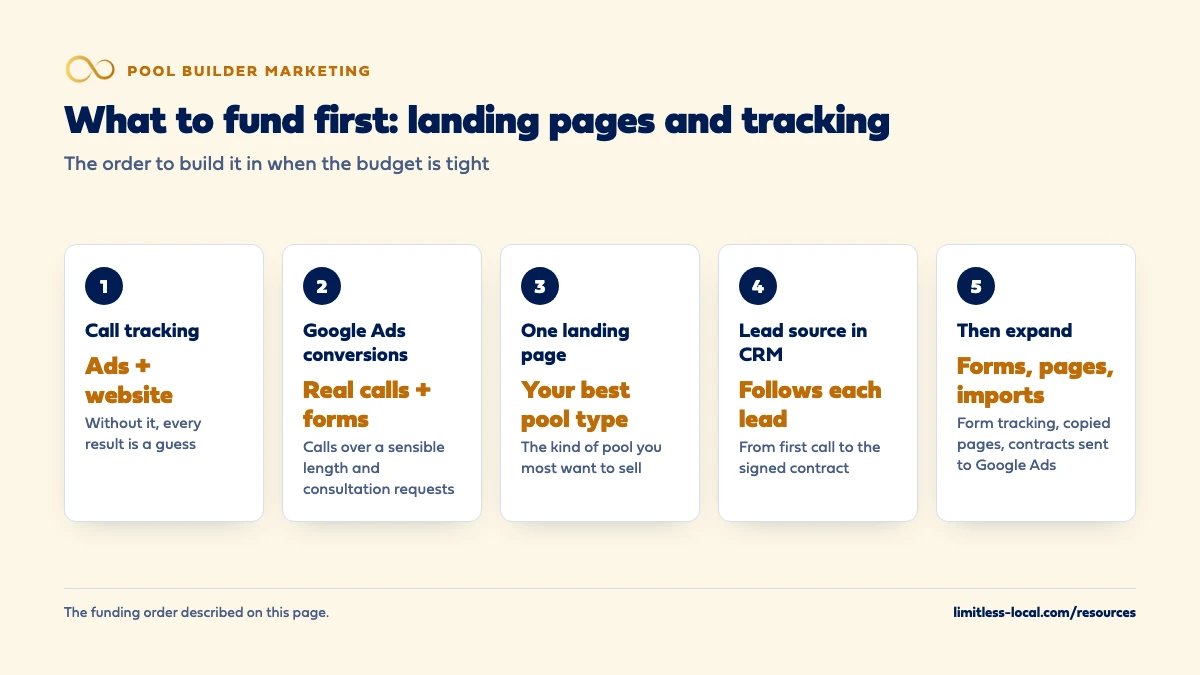
Fund them in this order, and stop where the budget runs out:
- Call tracking on the ads and the website. Without it, every result is a guess.
- Conversion tracking in Google Ads for calls over a sensible length and for consultation requests, so the ads aim at real leads.
- One landing page for the kind of pool you most want to sell.
- A lead source field in your CRM that follows each lead to the contract.
- Form tracking, once the website form brings in a real share of your leads.
- More landing pages, copied from the first, for renovations or other pool types.
- Signed contracts sent back to Google Ads, once there are enough of them to matter.
If you can only afford the first three, run a smaller ad budget until you can afford the rest. A budget you can measure beats a bigger one you can’t.
How should I split one-time and monthly costs?
Keep them on separate lines, so a build month doesn’t look like a bad month for your ads.
- One-time: building each landing page, a photo shoot if you need one, setting up tracking numbers and conversion actions, and connecting the form to your CRM.
- Monthly: the tracking subscription and its usage, any landing page tool fee, and a little time to check that calls and forms are still being counted.
- Seasonal: fresh photos and wording on the landing pages before the spring rush, and a new page when you add a new line of work.
Spread the one-time costs over the seasons you’ll use them. A landing page you’ll run for two or three seasons shouldn’t be charged against one March, and the build invoice shouldn’t be the reason you cut ads that month.
When should a pool builder spend more on landing pages and tracking?
When the current setup is costing you information or jobs. The usual signs:
- Your ads still send people to your home page.
- Google Ads shows a below-average landing page experience for your main keywords.
- Calls come in and nobody can say which ad, listing or show they came from.
- You’ve added a line of work, such as renovations, and it shares a page with new pools.
- The ad account reports plenty of conversions, but the office says the calls are junk. That usually means the wrong things are being counted.
And when to stop: once every source is tracked to a signed contract and each kind of work you advertise has its own page, more money here adds little. Put it into the ads instead.
Talk it through with someone who runs this every day
A 15-minute growth call: your market, your numbers, and what a realistic budget looks like. No pressure.
What's different about landing pages and tracking for pool builders
The sale outlasts the default tracking window. Google Ads uses a 30-day click-through conversion window unless you change it, and Google’s page on conversion windows says a custom window suits businesses whose buying cycle doesn’t fit the default. A homeowner who clicks in January and signs in April won’t show up as a signed contract unless the setup is built for that wait.
One contract pays for the setup. A pool is a high-ticket job, so a few landing pages and a year of tracking cost little next to a single signed pool. Skimping here to save ad money gets the math backwards.
Different pools, different buyers. A renovation customer and a new-build customer search differently and want to see different work, so each needs its own page and its own tracking source.
Build in the off-season. Pages and tracking take a few weeks to get right. Set them up in fall and winter, so they’re tested before spring searches pick up.
A worked example: one year of landing pages and tracking
Apart from the CallRail plan price above, these numbers are made up to show the math, not a benchmark for pool builders. Say a pool company builds two landing pages, one for new inground pools and one for renovations:
- Two landing pages at $1,200 each: $2,400, one-time.
- Tracking and conversion setup: 8 hours at $60 an hour: $480, one-time.
- Call and form tracking at $95 a month for the year: $1,140.
Year one comes to $4,020, about $335 a month. If the ads produced 6 signed pools that year, the setup added about $670 to each contract. In year two, with the pages built, the line drops to the tracking subscription plus a $300 refresh of photos and wording: $1,440.
The bigger payoff shows up in the ad account. Say the tracking shows one of three campaigns produced most of the design consultations, while the others produced mostly short calls. Moving that budget is worth more than the setup cost, and you can’t make that call without it. A free visibility audit checks whether your current tracking can tell you that.
Frequently asked questions
Can I build my own pool landing pages?
Yes, if your website’s page builder lets you add a page and connect the form to your CRM or inbox. The hard part isn’t the building. It’s writing a page that matches the search and shows the right pools.
Is call tracking worth it if I only run one ad campaign?
Yes. Even with one campaign, you’ll want to know how many calls came from the ad versus your Google profile, referrals or a yard sign. Without tracking, the ad gets judged on a guess.
Should every call count as a conversion?
No. Set a minimum call length so wrong numbers and hang-ups don’t count, and listen to a few recordings now and then to make sure the calls you count are real pool leads.
Do Facebook and Instagram ads need landing pages too?
If the ad sends people to your website, the same rule applies: a page about the kind of pool in the ad, with one clear way to request a consultation, and tracking on both the form and the phone number.
Who should own the landing pages and tracking accounts?
Your company, under your own logins. That way the pages, the tracking numbers and the history stay with you if you change who runs your marketing.
Key takeaways
- Most pool builders need only a few landing pages, one for each kind of work they advertise.
- Call and form tracking is a small monthly subscription plus usage; Google Ads conversion setup is mostly time.
- Fund tracking first, then one strong landing page, then more pages copied from it.
- Follow each lead to a signed pool with a lead source field before paying for anything more advanced.
- Keep one-time build costs and monthly tracking costs on separate lines, and spread the build over the seasons you’ll use it.
Ready to compare options?
Book a short growth call and we'll walk through the math for your service area, including when we're not the right fit.
More in this section
- How much should a pool builder spend on marketing?
- What does a pool builder budget beyond ad spend?
- What tracking shows a pool builder cost per qualified lead?
- Do pool builders need a separate landing page for Google Ads?
- Should a pool builder budget for follow-up, not just lead generation?
Sources
- Landing page experience: Definition — Google Ads Help
- About phone call conversion tracking — Google Ads Help
- Set up your web conversions — Google Ads Help
- About offline conversion imports — Google Ads Help
- About conversion windows — Google Ads Help
- Compare Pricing Plans — CallRail