
What are the best marketing strategies for an electrical business?
- Which marketing strategies bring an electrical business the most booked jobs, and in what order?
- What makes a marketing strategy the best one for an electrician?
- Strategy: own your spot on Google Maps
- Strategy: make asking for reviews part of every job
- Strategy: build a website that books jobs
- Strategy: answer every call and follow up on every quote
- Strategy: pay for calls with search ads and Local Services Ads
- Strategy: win repeat work from past customers, builders and other trades
- Strategy: track every lead to a booked job
- In what order should an electrician add these strategies?
- Which strategies fit service calls, big installs and commercial work?
- Which marketing can an electrician skip for now?
- What's different about marketing an electrical business
- A worked example: reading a month of booked jobs by strategy
- Frequently asked questions
- Key takeaways
- More in this section
- Sources
The short version
- Track every lead to a booked job, and answer every call and quote.
- Google Business Profile and reviews: how you show up in Maps.
- A website with one page per job you want more of.
- Search ads or Local Services Ads for calls on demand.
- Past customers, builders and other trades for repeat work.
For electrical contractors who want a short list of what’s worth running, and the order to add it, instead of trying every channel at once.
Get a free visibility audit · Book a growth call
Which marketing strategies bring an electrical business the most booked jobs, and in what order?
The strategies that book the most electrical work are tracking every lead to a booked job and answering every call, a strong Google Business Profile with a steady flow of reviews, a website with a page for each job you want, paid search or Local Services Ads for calls on demand, and repeat work from past customers, builders and other trades. Add them roughly in that order, starting with the free ones, and only add the next when the last one is working and your crews can take the extra work.
Our packages bundle most of these strategies for shops that would rather not run them in-house: Essentials ($3,500 a month) covers Google Business Profile management, review response and basic review generation, website content, Google Ads management and call tracking, and Growth ($4,500 a month) adds Local Services Ads management. Ad spend is paid directly to Google. Our electrical contractor marketing page explains how we work with electrical shops, and the rest of the electrical marketing questions library takes each strategy question by question.
What makes a marketing strategy the best one for an electrician?
The best strategy is the one that books the work you want at a cost you can carry, with crews free to do it. That depends on three things:
- Your job mix. A shop living on service calls needs a steady stream of local calls. A shop chasing panel upgrades, EV chargers and generators needs fewer, better-matched leads. A commercial shop needs relationships more than ads.
- Your budget and time. Some strategies cost mostly owner time; others cost money every month.
- Your capacity. Marketing that books more than the crews can handle turns into long waits and lost jobs.
So judge every strategy the same way: what does a booked job cost from it, and is that job the kind you want? Clicks, likes and impressions don’t pay the electric bill.
Strategy: own your spot on Google Maps
When a homeowner’s breaker keeps tripping, they search, and the Maps results with reviews and a call button are often the first thing they see. Google’s guide to improving your local ranking says local results are mainly based on relevance, distance and popularity, and that more reviews and positive ratings can help a business’s local ranking.
For an electrician, that means:
- The right primary category, with services like panel upgrades, EV charger installation and generator installation listed.
- Accurate hours, service area and phone number.
- Real photos of your trucks, crews and finished work.
- Reviews coming in every month, with replies.
It costs owner time, not ad spend, which is why it comes first. How to optimize an electrician Google Business Profile goes setting by setting.
Strategy: make asking for reviews part of every job
Reviews feed both your Maps ranking and the homeowner deciding whether to call. Google’s tips to get more reviews suggest asking customers to visit a Google link or scan a QR code, and warn that offering incentives such as discounts in exchange for reviews counts as fake and misleading content.
- Ask at the moment the customer sees the result: the power’s back on, the charger works, the panel passed inspection.
- Send the link automatically from ServiceTitan, Housecall Pro or Jobber after every completed job, so it doesn’t depend on a tech remembering.
- Ask every customer, not only the ones you think were happy.
The payoff builds over months rather than days. How long after asking for reviews an electrician gets more jobs lays out the timeline.
Strategy: build a website that books jobs
Your website does two jobs: it gives Google something to rank for each kind of work, and it turns a visitor into a call. For an electrical business, that means:
- One page per job type you want more of, such as panel upgrades, EV chargers, generators, rewiring, lighting and commercial service, each saying who it’s for, where you do it and how to book.
- A phone number and call button at the top of every page on mobile.
- Proof: your license, real job photos and reviews.
- Service-area pages only for towns you actually serve, each with something specific to say.
SEO is the slow part. Google’s SEO Starter Guide says some changes take effect in a few hours while others can take several months. Which service pages an electrical contractor website should have lists the pages worth building first.
Strategy: answer every call and follow up on every quote
This is the cheapest strategy on the list and the one most often skipped. Every other strategy produces calls; this one decides how many become jobs.
- Answer live during business hours, and have a plan for calls that come in while you’re on a ladder.
- Call back missed calls fast, before the homeowner calls the next electrician on the list.
- Follow up on quotes for panel upgrades, generators and rewires, which often don’t book on the first visit.
Responsiveness even affects paid placements: Google’s page on Local Services Ads rankings lists your responsiveness to customer inquiries as a factor and says missed calls may hurt it. How to stop an electrical company from missing calls covers the fixes.
Curious what your marketing is actually booking?
Get a free visibility audit — no obligation, no sales pitch.
Strategy: pay for calls with search ads and Local Services Ads
Paid search is the fastest way to add calls, because it reaches people at the moment they search. Ads can generate leads within days of launch, while SEO typically takes 3-6 months to show meaningful organic growth.
- Local Services Ads charge per valid lead and sit at the top of the results with your reviews. You choose job types and areas, not keywords.
- Google search ads charge per click and let you target specific work, like “panel upgrade” or “EV charger installation,” and send it to a matching page.
Google is moving Local Services Ads into Google Ads as Performance Max campaigns with pay-per-lead goals, with select electrical advertisers in the first phase from August 2026, so both now live in the same account. Start with one, for the jobs you most want, in the towns closest to your shop. Whether an electrical company should start with LSAs, Google Ads or SEO helps you pick.
Strategy: win repeat work from past customers, builders and other trades
Your cheapest jobs come from people who already know you:
- Past customers. A short email or text twice a year, a reminder about surge protection before storm season, or a note about EV chargers to customers who just bought one.
- Referrals. Make it easy: a line on the invoice, a card left at the panel, a thank-you when someone sends a neighbor.
- Builders, remodelers and other trades. HVAC, plumbing, solar and remodeling contractors all run into electrical work. Show up on time and they’ll call you first.
- Property managers for steady commercial and rental service work.
This strategy costs time and good work more than money, and it keeps paying when ad budgets tighten.
Strategy: track every lead to a booked job
Tracking is what lets you tell which strategies are working. The SBA’s guide How to Get the Most From Your Marketing Budget notes that tracking can be as simple as asking new customers where they heard about you.
- Ask every caller how they found you, and log the answer in your field software.
- Use call tracking so calls from ads, Maps and the website are counted separately.
- Tag each booked job with its source, then add up cost per booked job by channel each month.
Without this, the loudest channel wins the budget instead of the one that books the most profitable work. How to track which electrical marketing brings in real jobs walks through the setup.

In what order should an electrician add these strategies?
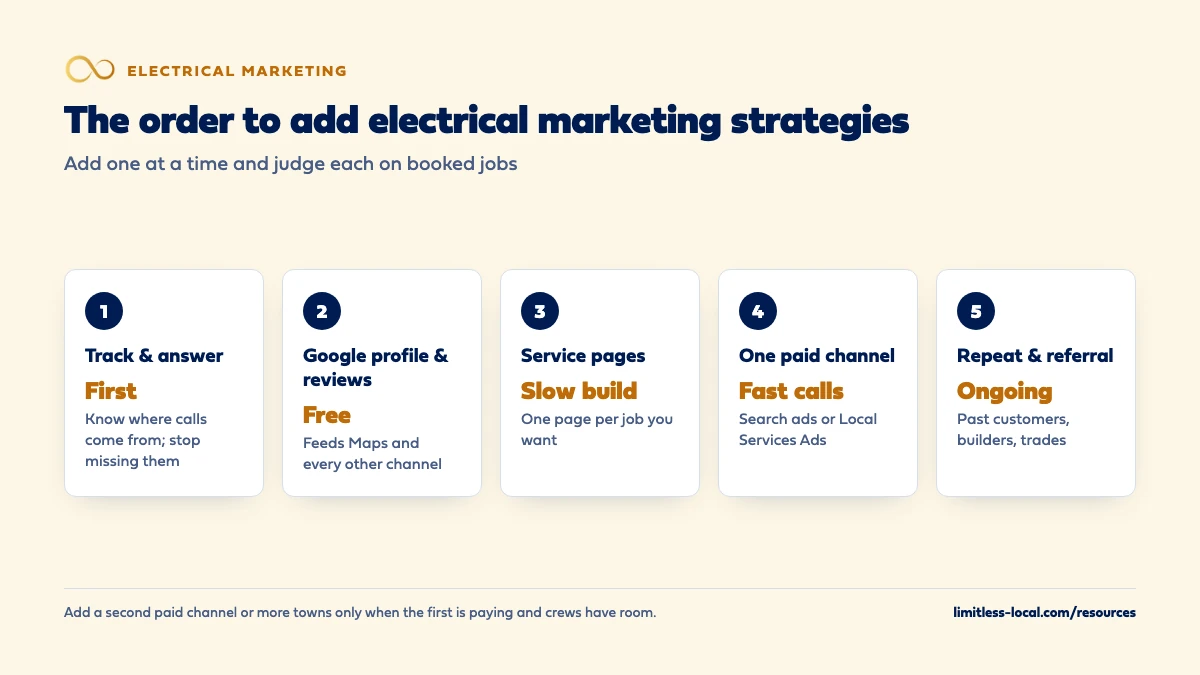
- Tracking and answering. Know where calls come from and stop losing the ones you get.
- Google Business Profile and reviews. Free, and it improves every other channel.
- Service pages on your website. Start the slow build early.
- One paid channel, search ads or Local Services Ads, for the jobs you want most.
- Past customers, referrals and trade partners, worked steadily alongside the rest.
- A second paid channel or more towns, once the first is clearly paying and the crews have room.
Add one at a time, give each a fair run, and judge it on booked jobs before adding the next. Running everything at once makes it hard to tell what worked.
Which strategies fit service calls, big installs and commercial work?
- Service and emergency calls: Maps, reviews and Local Services Ads, plus someone who answers fast. These are searched for right now and booked with whoever picks up.
- Planned installs (panels, EV chargers, generators, rewires): search ads and a dedicated page for each job, job photos and reviews that name the work, and quote follow-up. Homeowners compare, so proof and follow-up matter more.
- Commercial and builder work: relationships, bids and a website that shows commercial jobs and licensing. Ads play a small part.
Most shops do some of each. Lean your effort toward the work with the best margin and the most room on your schedule.
Which marketing can an electrician skip for now?
- Broad brand advertising, like billboards or radio, before the basics are in place. It’s hard to track and slow to pay back for a small shop.
- Posting on every social platform. One channel done steadily beats five done occasionally. Social works better for showing off finished jobs and staying in touch than for emergency calls.
- Paying for fake reviews or link schemes. They break Google’s rules and can cost you the profile you built.
- Every channel at once. Thin budgets across many channels leave each too small to judge.
None of these are wrong forever. They’re just later on the list than the strategies that put booked jobs on the schedule now.
Not sure which of these is costing you jobs?
A free visibility audit checks the Google profile, reviews, site and tracking, and shows what to fix first.
What's different about marketing an electrical business
The work ranges from a dead outlet to a full commercial build-out. One strategy rarely fits all of it, so match the channel to the job type instead of running one campaign for everything.
Licensing is a selling point. Homeowners worry about safety and permits. Showing your license and inspection-passed work in your profile, pages and reviews answers that worry before they call.
New demand keeps arriving. EV chargers, battery backup, solar tie-ins and generators bring searches that didn’t exist for electricians a few years ago. Give each one its own page and, where it pays, its own ads.
Emergency calls go to whoever answers. No strategy saves a missed call at night.
A worked example: reading a month of booked jobs by strategy
These numbers are made up to show the math, not a benchmark for your market. Say a two-truck electrical shop tags every booked job by source for a month and finds 31 booked jobs:
- Past customers and referrals: 12 jobs, no ad spend.
- Google Maps and the website: 9 jobs, owner time only.
- Search ads: 6 jobs from $1,500 of ad spend, or $250 per booked job.
- Local Services Ads: 4 jobs from $600 of lead charges, or $150 per booked job.
On cost alone, Local Services Ads look best. But if the search ad jobs were mostly panel upgrades and the Local Services Ads jobs were small service calls, the search ads may have earned far more gross profit. The right next step is to check gross profit per job by source, then put the next dollar where the profit is, and keep feeding the free strategies that booked 21 of the 31 jobs.
Frequently asked questions
What's the single best marketing strategy for a new electrician?
A complete Google Business Profile plus a habit of asking every customer for a review. It costs time rather than money and helps every channel you add later.
Is social media a good marketing strategy for electricians?
It helps with staying in touch and showing finished work, especially bigger installs, but it rarely brings emergency or service calls on its own. Add it after the basics are working.
Should an electrician use lead-buying sites?
They can fill gaps, but you’re often competing with other electricians for the same lead. Track cost per booked job from them like any other channel and keep them only if the numbers hold up.
How many strategies should a small electrical shop run at once?
Usually three or four: Google profile and reviews, answering and follow-up, tracking, and one paid channel. Add more only when those are working and the crews have room.
Do yard signs and truck wraps count as a marketing strategy?
Yes, as support. They help neighbors remember your name when they search later, but they’re hard to track, so ask callers how they found you.
Key takeaways
- The core strategies are Google profile and reviews, a website with job pages, answering and follow-up, paid search or Local Services Ads, and repeat work.
- Track every lead to a booked job so you know which strategy earns the next dollar.
- Add strategies one at a time, free ones first, and judge each on booked jobs.
- Match the strategy to the work: Maps and fast answers for service calls, job pages and follow-up for installs, relationships for commercial.
- Skip broad brand ads, scattered social posting and fake reviews until the basics are paying.
Want a second set of eyes on your setup?
We'll look at how you show up locally and where calls are leaking, then send you a plain-English breakdown.
More in this section
- How do I grow a small electrical business with marketing?
- How do I market a new electrical business from day one?
- How should I market a small electrical business on a tight budget?
- Is it the 4 or 5 Ps of marketing for an electrical business?
- What are the 5 Cs of marketing for an electrical business?
Sources
- Tips to improve your local ranking on Google — Google Business Profile Help
- Tips to get more reviews — Google Business Profile Help
- SEO Starter Guide: The Basics — Google Search Central
- About ad rankings — Google Local Services Help
- Local Services Ads transition to Performance Max campaigns with pay-per-lead goals — Google Ads Help
- How to Get the Most From Your Marketing Budget — U.S. Small Business Administration