
How long until marketing books 5 to 10 restoration jobs a month?
- How many months does it take for restoration marketing to book 5 to 10 jobs a month?
- What does 5 to 10 booked jobs a month actually take?
- How fast can paid ads start booking restoration jobs?
- Why does the first month rarely hit the target?
- How long do Local Services Ads take to reach steady jobs?
- How long do Maps and SEO take to book steady restoration jobs?
- What speeds up the timeline?
- What slows it down?
- Does the size of my market change the timeline?
- What does a realistic path to 5 to 10 jobs look like?
- How do I know if I'm on track?
- What if I need the jobs sooner?
- What's different about this timeline for restoration companies
- A worked example: a three-month climb to 8 jobs a month
- Frequently asked questions
- Key takeaways
- More in this section
- Sources
The short version
- Paid ads can bring calls within days, but steady booked jobs take a few months of tuning.
- Two to four months is a realistic target for 5 to 10 jobs a month from ads in one market.
- Maps and SEO usually take longer, and they add up over time.
- Missed calls and a low booking rate slow it down more than the budget does.
For restoration owners who want a realistic timeline from turning marketing on to a steady handful of booked jobs every month.
Get a free visibility audit · Book a growth call
How many months does it take for restoration marketing to book 5 to 10 jobs a month?
With Google Ads or Local Services Ads aimed at one market, a realistic target for 5 to 10 booked restoration jobs a month is two to four months: ads can bring calls within days, but the first months go to cutting junk searches, fixing missed calls and learning what a booked job costs. Through Maps and SEO alone it takes longer, because SEO typically takes three to six months to show meaningful organic growth and steady booked jobs follow after that. Your market size, budget, answer rate and booking rate decide where you land, and nobody can promise a date.
That’s the ramp we plan around too: ads can generate leads within days of launch, and SEO typically takes three to six months to show meaningful organic growth. Onboarding takes your team about 2-3 hours, and campaigns go live in weeks 1-2. From there, every package tracks calls, forms and booked-job sources, so you can see the climb month by month. See how our restoration marketing works, compare the packages, read the restoration marketing guide, or browse more restoration marketing questions.
What does 5 to 10 booked jobs a month actually take?
Work backward from the jobs. If you book about half the real leads you get, 5 to 10 jobs means roughly twice that many real leads. If only part of your calls are real leads (the rest are wrong numbers, job seekers, people outside your area or work you don’t do), you need more calls again.
That math tells you two things before you spend a dollar. First, how many calls your market has to produce. Second, which number to fix first: a company that books one in four real leads needs twice the calls of one that books half, so a better booking rate shortens the timeline as much as a bigger budget does.
How many water damage jobs a month you need to hit your revenue goal walks through the full calculation from revenue down to calls.
How fast can paid ads start booking restoration jobs?
Fast, once they’re live. Google’s page about the ad review process says most ads are reviewed within one business day, and clicks can start soon after. For an emergency trade like restoration, that can mean calls in the first week.
The first calls aren’t the same as a steady 5 to 10 booked jobs, though. A new campaign has no history: it doesn’t yet know which searches book, which towns are worth paying for, or which hours bring real emergencies. That’s why the first month is usually a mix of good calls and wasted clicks, and the next month or two go to tightening it.
For how quickly each channel starts producing leads at all, how fast restoration marketing channels produce leads compares them side by side.
Why does the first month rarely hit the target?
Because most of the first month is spent finding leaks:
- Junk searches. Do-it-yourself, job-seeker and wrong-service searches show up in the search terms report, and each one needs to be blocked.
- Missed calls. Ads often expose gaps in who answers at night and on weekends.
- Tracking gaps. Calls that aren’t tagged by source can’t be judged, so the first weeks often include fixing call and form tracking.
- Landing pages. If people click and don’t call, the page needs work: a tap-to-call number up top, the towns you serve and what happens next.
- Area and hours. The first month shows which towns and times bring real jobs and which just cost money.
None of this is wasted. It’s the work that turns a campaign that brings some calls into one that books jobs every week.
How long do Local Services Ads take to reach steady jobs?
Longer to start than search ads, because Google screens and verifies the business first. Google’s page on the screening and verification process says some advertisers may be eligible for accelerated verification and get the Google Verified badge quickly, then have 14 days to finish additional steps to keep the ad running. Others are guided through extra steps first, so the start date varies.
Once they’re running, Local Services Ads are ranked by an auction that weighs your bid, how responsive you are and your profile quality, which includes your rating and number of reviews. A company with a strong review base can climb quickly; one with few reviews often takes longer to win enough leads. Answering every lead fast matters here, because missed calls can count against your responsiveness.
How long do Maps and SEO take to book steady restoration jobs?
Longer, but the jobs keep coming without a per-click bill. SEO typically takes three to six months to show meaningful organic growth, and steady booked jobs come after the growth shows up, not at the same moment.
Maps usually moves before the website. Google’s page on improving your local ranking says local results are mainly based on relevance, distance and popularity, and that more reviews and positive ratings can help. So a complete, verified Google profile with steady new reviews can start bringing calls from the towns nearest your shop well before the website ranks for wider searches.
If organic and Maps are your only channels, plan on most of a year before they reliably carry 5 to 10 jobs a month on their own, and longer in a crowded metro. What a realistic restoration SEO timeline looks like breaks that down stage by stage.
Curious what your marketing is actually booking?
Get a free visibility audit — no obligation, no sales pitch.
What speeds up the timeline?
- An established Google profile. Reviews, photos and a verified profile give Maps and Local Services Ads something to work with from day one.
- Past ad data. If you’ve run ads before, that history helps a new campaign settle faster.
- Answering every call. The fastest way to more booked jobs is booking more of the calls you already get.
- A tight focus. One main service and the towns you reach fastest, then widen.
- A budget that lasts all day. Ads that run out by afternoon miss the evening emergencies.
- Referral partners alongside. Plumbers, property managers and insurance agents can send jobs while paid and organic channels build.
What slows it down?
- A brand-new company. No reviews, no history and no website pages that rank yet.
- A crowded metro. More companies bidding for the same searches means each job costs more and takes more tuning.
- Spreading too wide. Several services across a big area, each with too little budget to learn.
- Missed calls and slow callbacks. Emergency callers move to the next company in minutes.
- No booked-job tracking. Without it, you can’t tell which channel is close to the target and which is wasting money.
- Changing everything at once. New budget, new area and new keywords in the same week make it hard to learn what worked.
Most of these are fixable in weeks. A slow timeline is usually a sign that one of them is in the way, not that marketing doesn’t work for restoration.
Does the size of my market change the timeline?
Yes, in both directions. In a small town, there may only be a limited number of water damage emergencies a month that reach Google, so 10 booked jobs could mean winning most of them. You may need a second service or a wider area to get there, which adds time.
In a big metro, there are plenty of searches, but more companies compete for them. You can usually reach 5 jobs a month faster there, but each job may cost more, and holding 10 a month can take more budget and more months of tuning. Either way, set the target against what your area can produce, not against a number you heard from another market.

What does a realistic path to 5 to 10 jobs look like?
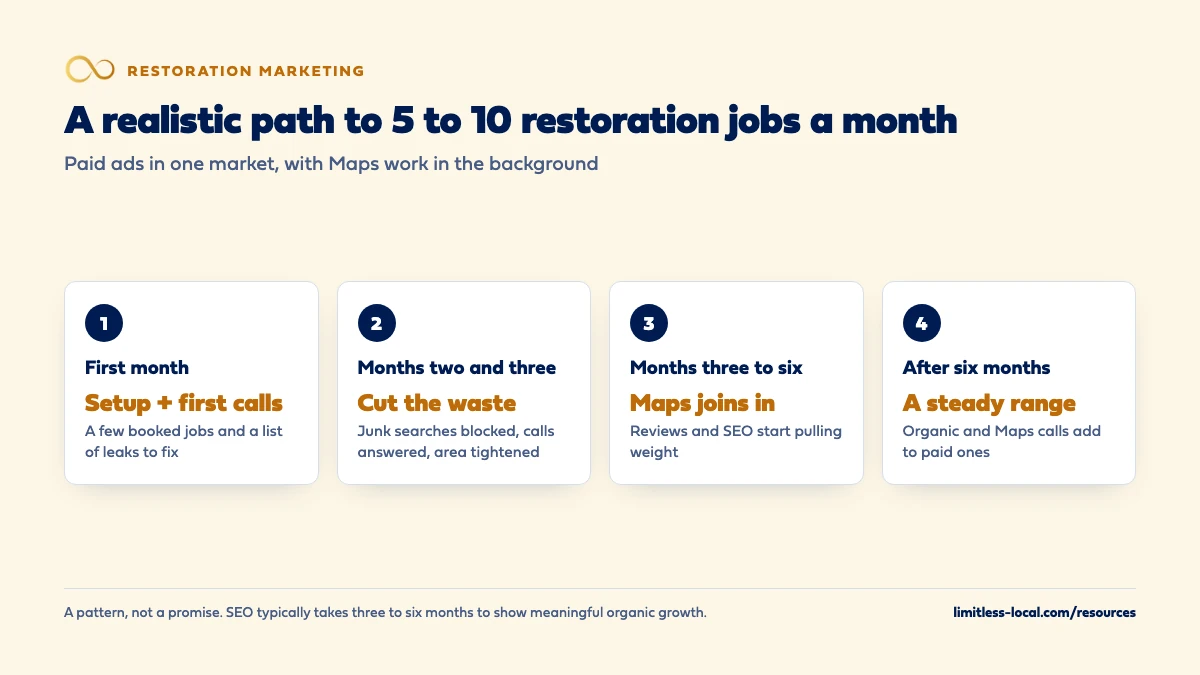
For a restoration company running search ads or Local Services Ads in one market, with Maps work going on in the background, a common path looks like this:
- The first month. Setup, tracking and the first calls. A few booked jobs, plus a list of leaks to fix.
- The second and third months. Junk searches cut, calls answered, the area tightened. Booked jobs climb toward the lower end of the target.
- Months three to six. The Google profile and reviews start pulling more weight, SEO shows early growth, and the total settles into a steady range.
- After six months. Organic and Maps calls add to the paid ones, which can lower the average cost per booked job.
That’s a pattern, not a promise. Storm months will jump above it and dry months will dip below it.
How do I know if I'm on track?
Look at the numbers that come before booked jobs:
- Calls answered. Nearly every call during ad hours should reach a person.
- Share of real leads. It should rise as junk searches are blocked.
- Booking rate. What share of real leads become jobs, by channel.
- Cost per booked job. It should fall or hold steady as the campaign settles.
If calls and real leads are climbing month over month, the booked jobs usually follow. If calls are flat after the second month, the issue is reach (budget, area or ranking). If calls are up but jobs aren’t, the issue is the phone or the booking process. Tracking which marketing brings booked restoration jobs covers the setup.
What if I need the jobs sooner?
Lean on the channels that don’t need a ramp. Paid search is the fastest marketing channel to switch on. Referral partners can send jobs this month if you already know them. And answering faster books more of the calls you already get, starting today.
Then keep the slower channels going underneath, because they’re what lowers your cost per job later. How to get restoration leads while SEO ramps up covers that combination.
Want to see where your company stands?
A free visibility audit shows where you show up on Google, Maps and AI answers, and what it's costing you in calls.
What's different about this timeline for restoration companies
Storms skew the months. A freeze can bring a month of jobs in a week, then a dry spell brings almost none. Judge progress over a rolling three months, not one.
Emergencies happen at night. Much of the work comes after hours, so a timeline depends on who answers then as much as on the marketing.
Several services, different speeds. Water damage calls tend to book quickly. Mold and fire work often takes longer to decide, so count those separately.
Insurance delays the money, not the job. A booked job counts toward the target the day it’s booked, even if the claim pays weeks later.
A worked example: a three-month climb to 8 jobs a month
These numbers are made up to show the math, not a benchmark or a forecast for your market. Say you want 8 booked water damage jobs a month. You book about half your real leads, so you need 16 real leads. About two in three calls are real, so you need about 24 calls a month.
Month one, the ads bring 12 calls and you book 3 jobs. Junk searches are still getting through, and two calls went to voicemail on a Saturday night.
Month two, after blocking junk searches and fixing weekend coverage, the ads bring 18 calls and you book 6 jobs.
Month three, with the area tightened and a few more reviews on your Google profile, you get 24 calls and book 8 jobs. You’ve reached the target in about three months, and from here the question is whether to hold it or raise the budget toward 10.
Frequently asked questions
Can a brand-new restoration company book 5 jobs a month in its first month?
It can happen with paid ads and a fast phone, but don’t plan on it. A new company has no reviews and no ad history, so the first month is mostly about learning what works.
Does a bigger budget get me to 10 jobs faster?
Up to a point. More budget buys more calls, but if calls go unanswered or junk searches aren’t blocked, it mostly buys waste faster. Fix the leaks, then add budget.
Should I count mitigation and rebuild as separate jobs?
Count them however you’ll judge the marketing, and keep it the same every month. Many owners count the mitigation job as the booking and track the rebuild as extra value from it.
What if a storm gets me to 10 jobs in month one?
Enjoy it, but don’t judge the marketing on it. Storm months inflate results; a rolling three-month average tells you whether the setup holds when the weather is quiet.
Do I need a website to reach 5 to 10 jobs a month?
You can book jobs from Local Services Ads and your Google profile without much of one, but search ads need a page to send clicks to, and SEO needs pages to rank. A simple, fast site with a page for each main service is usually enough to start.
Key takeaways
- Paid ads can bring calls within days, but steady booked jobs usually take two to four months of tuning in one market.
- Maps and SEO take longer; SEO typically takes three to six months to show meaningful organic growth.
- Work backward from the target: jobs, then real leads, then calls.
- Answering every call and booking more of your leads shortens the timeline as much as budget does.
- Judge progress over a rolling three months, because storms skew single months.
Not sure what's working right now?
Start with a free visibility audit: rankings, Google profile, reviews and tracking, checked against your service area.
More in this section
- What monthly marketing budget does a restoration company need?
- How profitable is a restoration company, and where does marketing fit?
- When does a restoration company need to spend 10k a month on ads?
- How many booked jobs a month before raising a restoration budget?
- How do I keep marketing steady while hiring restoration techs?
Sources
- About the ad review process — Google Ads Help
- Understand the screening and verification process — Google Local Services Help
- About ad rankings — Google Local Services Help
- Tips to improve your local ranking on Google — Google Business Profile Help