
How should a 10+ truck plumbing company market while hiring techs?

- How do I keep ten or more plumbing trucks busy while I'm still hiring?
- What's different about marketing while I'm hiring at 10+ trucks?
- How tight is the plumber hiring market right now?
- Step 1: How do I measure how much work my crew can take?
- Step 2: What should keep running even when I'm short on techs?
- Step 3: How do I turn paid ads up and down with capacity?
- Step 4: Which jobs should marketing chase while I'm short-handed?
- Step 5: How do I ramp marketing as each new tech starts?
- Step 6: How do I market the company to plumbers I want to hire?
- Should I build an apprenticeship path to keep hiring?
- How do I keep the office from becoming the bottleneck?
- What should I watch each week while I'm hiring?
- What's different about this for plumbing companies
- A worked example: how many calls two new hires need
- Frequently asked questions
- Key takeaways
- More in this section
- Sources
The short version
- Keep SEO, your Google profile, reviews and past customers steady all year.
- Flex paid ads weekly with open tech hours, aimed at high-margin jobs.
- Raise demand in steps as each new tech can run calls alone.
- Market to plumbers too: careers page, Google-readable job posts, apprentices.
For owners of larger plumbing companies who need calls for the trucks they have, room for the techs they’re about to hire, and applicants for the seats still empty.
Get a free visibility audit · Book a growth call
How do I keep ten or more plumbing trucks busy while I'm still hiring?
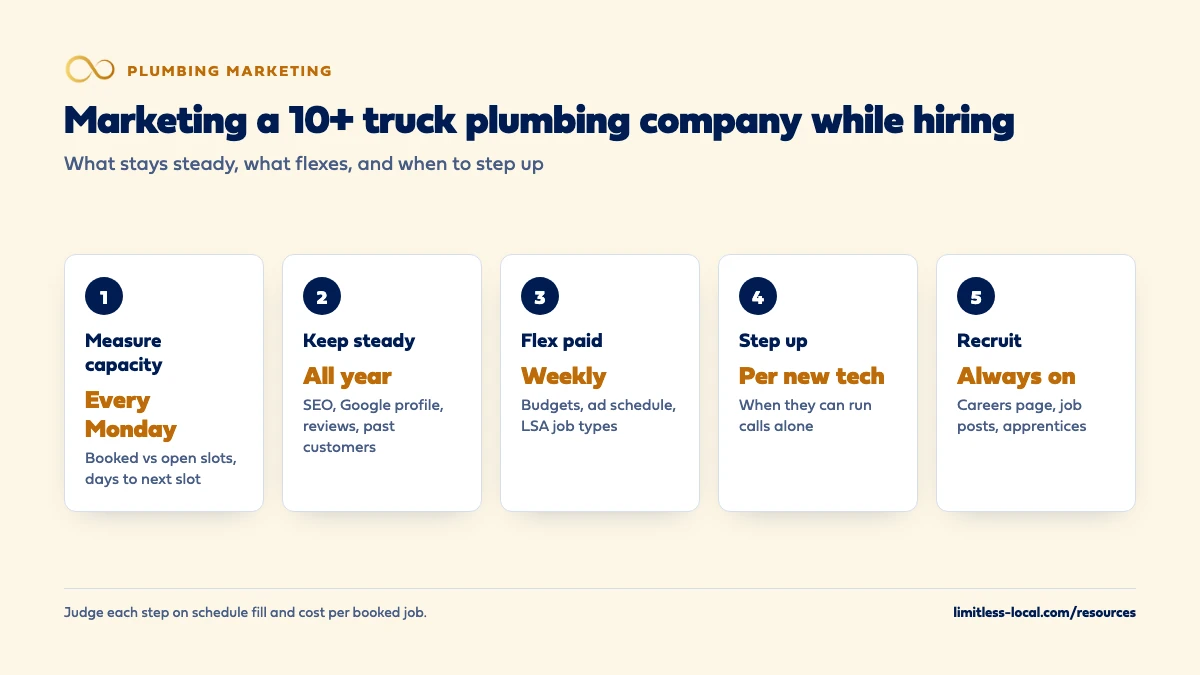
Run two kinds of marketing at once and pace them to your crew. Keep the slow, steady pieces (SEO, your Google profile, reviews and past customers) running all year, and turn paid ads up or down each week based on open tech hours, aiming them at the jobs your senior plumbers do best while you’re short. Add paid demand in steps as each new tech becomes able to run calls alone, and market the company to plumbers at the same time with a careers page, job posts that Google can show in job search and an apprenticeship path. Judge it every week on how full the schedule is and what each booked job cost.
At this size, marketing has to follow the schedule, not a fixed monthly plan. Our Growth package ($4,500 a month) covers SEO for up to two locations, Google Ads management up to $5,000 a month in spend and Local Services Ads management, and Scale is priced to the company for multi-location SEO and LSAs across multiple markets. Ad spend is paid directly to Google, and every package includes call tracking, source tagging and a real-time dashboard, so you can see booked jobs against capacity. See the packages and what’s included, how it fits marketing for plumbing companies, or the rest of the plumbing marketing questions library.
What's different about marketing while I'm hiring at 10+ trucks?
At this size, capacity moves every month. A tech quits, two start, one is still riding along, and the schedule swings between turning calls away and paying people to restock vans. Marketing that runs at the same level all year gets it wrong both ways.
You’re also selling to two audiences at once: homeowners who need a plumber, and plumbers deciding where to work. The second one is easy to forget, and it’s the one that decides how fast you can grow.
The two common mistakes are opposites. Some owners keep ads at full blast while short-handed and lose customers to week-long waits. Others cut everything when they’re full and then sit through a slow month when the new hires arrive. The steps below avoid both. If you’re still deciding whether to hire first or market first, whether to market harder before or after hiring covers that call.
How tight is the plumber hiring market right now?
Tight enough that recruiting needs a plan. The Bureau of Labor Statistics’ Occupational Outlook Handbook projects employment of plumbers, pipefitters and steamfitters to grow 7 percent from 2025 to 2035, much faster than the average for all occupations, with about 42,000 openings a year on average over the decade, many of them to replace workers who retire or change occupations. Those are national figures for the whole occupation, not your town, but they explain why good plumbers have options.
That’s the reason to market the job as carefully as the services: pay, schedule, training and the kind of company you run are what you’re competing on.
Step 1: How do I measure how much work my crew can take?
Use the schedule, not a feeling. Every Monday, look at three numbers:
- Booked versus available slots for the coming week, across every tech who can run calls alone.
- Days to the next open slot for a new customer’s non-emergency call.
- Calls turned away or pushed last week because nobody was free.
When the schedule is nearly full and new customers wait days, you’re short on techs, and more marketing only adds to the wait. When there are open slots most days, you’re short on calls. Most weeks at a growing company sit somewhere between, which is why the next steps separate what stays steady from what flexes. Changing plumbing marketing spend with seasons and tech capacity goes deeper on the weekly measure.
Step 2: What should keep running even when I'm short on techs?
Anything slow to build and slow to restart:
- SEO and your website pages. They take months to build, and switching them off doesn’t save much this week but costs you later.
- Your Google Business Profile. Accurate hours, services and photos cost little to keep up.
- Reviews from every truck. Keep the ask on every job; the review strategy for a plumbing company with 10+ trucks lays out the system.
- Past customers and members. Maintenance reminders and water heater checks fill gaps you choose, not gaps the phone chooses.
These are the base. They don’t swing week to week, so the work they bring stays fairly predictable while you hire.
Step 3: How do I turn paid ads up and down with capacity?
Paid search and Local Services Ads are the part you flex. A few controls do most of the work:
- Daily budgets. Google’s page on how budget changes take effect says you’ll see a change to your average daily budget in your account immediately, and that changing it can affect how often your ads show and how much you can be charged.
- Ad schedules. Google’s ad schedule page says your ads will only be eligible to show during the times you specify. If the night crew is down a tech, trim the overnight hours instead of the whole campaign.
- Local Services Ads job types and areas. Google’s page on editing industries, service areas and job types shows how to switch job types on or off and include or exclude service areas.
One thing to plan for: Google’s page on Local Services Ads moving to Performance Max lists plumbing in the first phase, which began in August 2026 for select advertisers, so check where your LSA settings now live before you need to change them in a hurry.
Curious what your marketing is actually booking?
Get a free visibility audit — no obligation, no sales pitch.
Step 4: Which jobs should marketing chase while I'm short-handed?
When slots are scarce, fill them with the work that pays most for the hours it takes. For most plumbing companies that means aiming paid ads at:
- Water heater replacements and tankless installs.
- Repipes and sewer line repair or replacement.
- Emergency calls you can reach quickly, in the towns closest to your shop.
And easing off on:
- Low-margin specials, like discounted drain cleanings.
- Far towns where each call eats an hour of drive time.
When the new techs are running calls, open the smaller work back up. It’s often the right training ground for them and a cheap way to win customers who come back for bigger jobs.
Step 5: How do I ramp marketing as each new tech starts?
Add demand when a new hire can run calls alone, not on their first day. An apprentice adds hands to an existing truck; a journey-level plumber who can work independently adds a truck to fill. Licensing requirements vary by state and locality, and often call for 2 to 5 years of experience and an exam before a plumber can work independently.
A practical ramp:
- Ride-along weeks: no change in spend.
- First solo weeks: route simpler calls to the new tech and raise paid spend a step.
- Full schedule: raise spend again, and add the job types they can sell.
Check cost per booked job and the next-open-slot number before each step.
Step 6: How do I market the company to plumbers I want to hire?
Treat recruiting like any other marketing: a page that sells the job, ways to be found and a fast reply.
- A careers page with real details: pay range, schedule and on-call rotation, trucks and tools, training, and how a helper becomes a licensed plumber with you.
- Job posts Google can read. Google’s documentation on job posting structured data says adding it makes your postings eligible to appear in the job search experience in Google Search, featuring your logo, reviews, ratings and job details, and that job seekers can filter by location or job title.
- Your own techs. A referral bonus for hires who stay is often the best source a plumbing company has.
- Photos of your crew on your site and Google profile. Plumbers looking for work check them too.
Answer applicants within a day. Good plumbers rarely wait long.
Should I build an apprenticeship path to keep hiring?
For a company that plans to keep growing, usually yes, because it turns hiring from a hunt into a pipeline. Most plumbers learn the trade through a 4- or 5-year apprenticeship, typically with 2,000 hours of paid on-the-job training plus technical instruction each year.
The Department of Labor’s page on apprenticeship benefits for employers lists recruiting and developing a skilled workforce, increasing retention of workers during and after the apprenticeship, and tax credits and employee tuition benefits in participating states. For marketing, an apprenticeship path is also a recruiting message: it tells helpers and career changers there’s a way up with you.
How do I keep the office from becoming the bottleneck?
Hiring techs without growing the office moves the bottleneck from the trucks to the phones. As calls climb, check that someone answers every call in the hours your ads run, that booking stays fast, and that dispatch can handle more trucks on the board.
After-hours is the usual weak spot for a growing company. If the on-call plumber is also the person answering the phone, calls get missed while they’re under a sink. Stopping lost after-hours plumbing calls covers the options, and it’s worth solving before you add the next truck.
What should I watch each week while I'm hiring?
One short weekly sheet, shared by the owner, the service manager and whoever runs marketing:
- Schedule fill: booked slots against available slots, for the coming week.
- Days to next open slot for a new customer.
- Calls turned away or pushed for lack of a tech.
- Cost per booked job by channel.
- Applicants per open position, and where they found you.
- New techs’ ramp: who’s riding along, who’s solo, who’s on a full schedule.
If schedule fill is high and calls are being turned away, ease paid spend and push hiring. If fill is low, raise paid spend a step. Scaling a plumbing business with marketing covers the bigger steps that come after.
Not sure which of these is costing you jobs?
A free visibility audit checks the Google profile, reviews, site and tracking, and shows what to fix first.
What's different about this for plumbing companies
Emergencies don’t wait for a hire. Burst pipes and sewer backups keep coming whether you’re short or not. Protect emergency capacity first, even if it means slowing planned work, because an emergency customer who can’t get you calls someone else and often stays with them.
Licensing shapes the ramp. A helper or apprentice can’t take a call alone, so adding one doesn’t add a truck. Plan marketing around licensed plumbers who can work independently.
Big jobs need experienced hands. Repipes, sewer replacements and tankless installs usually need your most experienced plumbers. Point marketing at those jobs only when those plumbers have room.
On-call rotations change the night schedule. One fewer plumber in the rotation means fewer night hours you can cover, so adjust ad schedules for nights before you touch daytime spend.
A worked example: how many calls two new hires need
These numbers are made up to show the math, not a benchmark for your market. Say a plumbing company has 12 plumbers who run calls alone, each with room for about 25 jobs a week: 300 slots. Last month it averaged 270 booked jobs a week, 90% full. About 60% of answered calls book.
- Two new licensed plumbers start. In their first solo weeks, they run about 40% of a full schedule between them, adding about 20 slots a week. At 60% booking, that needs roughly 33 more answered calls a week.
- Once both are on a full schedule, they add 50 slots a week, which needs roughly 83 more answered calls a week.
That’s why spend goes up in steps: jumping to the full-schedule level on day one would buy calls the new plumbers can’t run yet, and waiting until they’re fully ramped leaves them standing in the shop. Measure your own booking rate first; it changes the whole calculation.
Frequently asked questions
Should I pause all ads while I'm short on plumbers?
Usually not all of them. Trim the hours and job types you can’t cover and keep emergency and high-margin campaigns running, so you don’t have to restart from nothing when new hires arrive.
Can my Google Business Profile help with hiring?
It helps indirectly. Plumbers looking for work check your reviews and photos just like homeowners do, so a profile with recent reviews and real crew photos makes your job posts more convincing.
Should I run ads for job openings?
They can help in a tight market, but start with a strong careers page, job posts Google can read and referrals from your own techs. Paid recruiting ads work better once the page they send people to sells the job well.
How far ahead should marketing know about a new hire?
As early as you know the start date. That leaves time to plan the spend steps and line up the job types the new plumber will run first.
Does adding trucks mean I need more service areas?
Not at first. Fill the towns closest to your shop before widening, because closer calls take less drive time and usually win more often in Maps.
What if a tech leaves suddenly?
Cut paid spend for the hours and job types that tech covered, keep the steady base running, and tell the office which calls to push out. Then step spend back up when the seat is filled.
Key takeaways
- Measure capacity every week: schedule fill, days to next slot and calls turned away.
- Keep SEO, your Google profile, reviews and past customers steady all year.
- Flex paid ads with budgets, ad schedules and LSA job types as capacity changes.
- Step up demand when each new plumber can run calls alone, not on day one.
- Market the job to plumbers too: careers page, Google-readable job posts and an apprenticeship path.
Want a second set of eyes on your setup?
We'll look at how you show up locally and where calls are leaking, then send you a plain-English breakdown.
More in this section
- How do I grow a plumbing business past one or two trucks?
- How should a plumbing company market to commercial customers?
- What review strategy works for a plumbing company with 10+ trucks?
- Should I market harder before or after hiring another plumber?
- How should a new plumbing company get its first customers?
Sources
- How budget changes take effect — Google Ads Help
- Set up an ad schedule — Google Ads Help
- Edit your industries, service areas, and job types — Local Services Help
- Local Services Ads transition to Performance Max campaigns with pay-per-lead goals — Google Ads Help
- Plumbers, Pipefitters, and Steamfitters: Occupational Outlook Handbook — U.S. Bureau of Labor Statistics
- Job posting (JobPosting) structured data for Job Search — Google Search Central
- What are the benefits of apprenticeships for employers? — U.S. Department of Labor, Apprenticeship.gov