
How do I market my HVAC business when I’m starting from scratch?

- What order should an HVAC company do its marketing in when nothing is set up yet?
- Where do I start if my HVAC company has no marketing at all?
- What has to be ready before I spend a dollar on marketing?
- How do I set up my Google Business Profile the right way from day one?
- How do I get my first Google reviews when I'm starting from zero?
- Do I need a website before I market anything?
- Which paid channel should I turn on first?
- How do I track where my calls come from from the very first week?
- How much should I budget in the first few months?
- What does the first three months look like, step by step?
- What's different about starting HVAC marketing from scratch
- A worked example: judging the first paid channel
- Frequently asked questions
- Key takeaways
- More in this section
- Sources
The short version
- Fix the phone and booking process before you spend anything.
- Verify your Google Business Profile and fill in every field.
- Ask every customer for a review, starting this week.
- Turn on one paid channel, track it, and judge it by cost per booked job.
For HVAC owners with no marketing in place yet, whether the company is brand new or has run on word of mouth until now.
Get a free visibility audit · Book a growth call
What order should an HVAC company do its marketing in when nothing is set up yet?
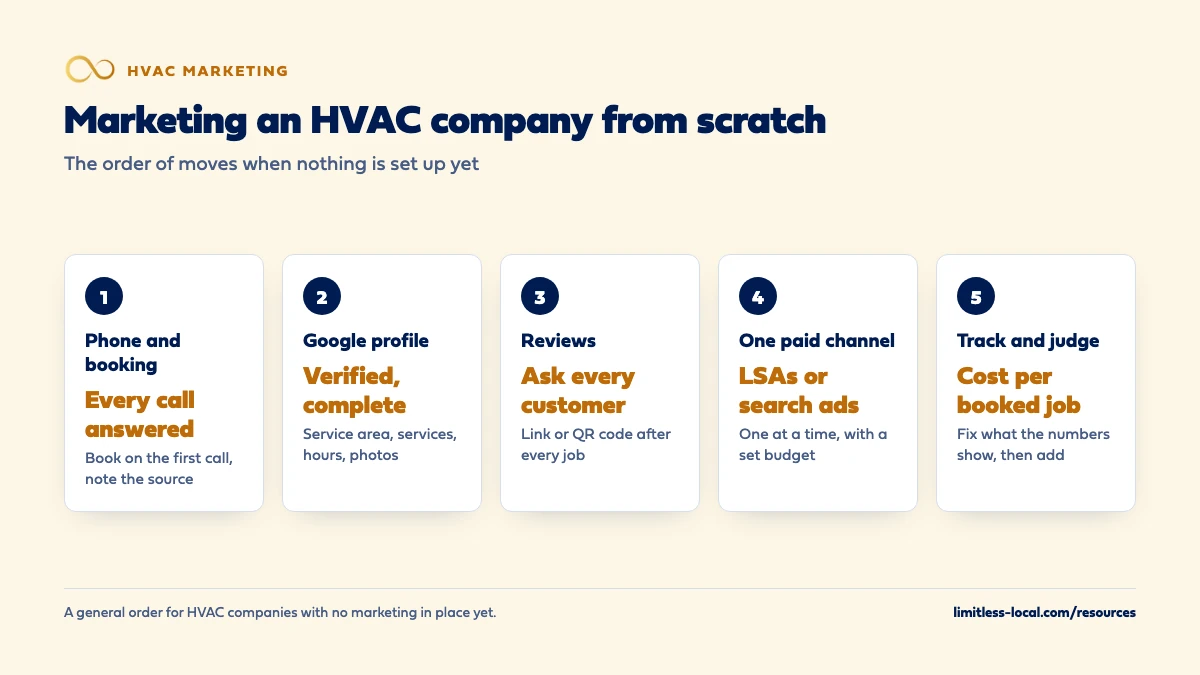
Start in this order: make sure every call gets answered and booked, set up and verify your Google Business Profile, then ask every customer for a Google review. Once that base is in place, turn on one paid channel, usually Local Services Ads or Google search ads, and track every call back to a booked job from day one. Add a second channel only after the first one is booking jobs at a cost you’re happy with.
That order is the same three-phase setup we use: build the foundation (tracking, follow-up and a clean online presence), turn on lead flow with local SEO and ads around the towns and jobs you want, then improve month by month based on calls, leads and revenue. Our Essentials package, at $3,500 a month for one location, covers Google Business Profile management, listing cleanup, basic review generation, call tracking and Google Ads management up to $2,500 a month in ad spend, which you pay to Google separately. See how it fits our HVAC marketing. The HVAC marketing guide covers every channel in more depth, and the rest of the HVAC marketing questions library goes question by question.
Where do I start if my HVAC company has no marketing at all?
Start with the parts that make every later dollar work harder, and add spending last. The order that holds up for most HVAC companies:
- The phone and the booking process. Someone answers, books the job and writes down where the customer heard about you.
- Your Google Business Profile. Verified, complete and set up as a service-area business.
- Reviews. A request to every customer, every job, starting now.
- A simple website. One page per main service, with your phone number at the top of every page.
- One paid channel. Local Services Ads or Google search ads, not both on day one.
- Tracking. A way to tie each call to a booked job, so you can tell what’s working.
Steps one to four cost mostly time. Step five is the first real spend, and it comes after the base is ready because ads send people to your phone, your profile and your reviews. If any of those are weak, you pay for the clicks and lose the job anyway.
This works whether you opened last month or you’ve been running on referrals for ten years. A word-of-mouth shop usually has a head start on steps one and three, because it already has happy customers to ask.
What has to be ready before I spend a dollar on marketing?
The boring stuff. Before any ad runs, check these:
- Who answers. During business hours, a person picks up. After hours, there’s a plan, whether that’s an on-call tech, an answering service or a voicemail that gets a callback first thing.
- How a call becomes a job. Whoever answers can quote your service call fee, check the schedule and book the visit on that first call.
- Where it’s written down. Every job lands in one place, even if that’s a spreadsheet before you pick job software like Housecall Pro, Jobber or ServiceTitan.
- The jobs you want. Decide which work you’re chasing first, such as repair calls, replacements or maintenance plans, and which towns your trucks will actually drive to.
The phone matters most. A new company paying for calls it can’t answer is paying for a competitor’s next job. For the full picture of what a good call-handling setup looks like, see how an HVAC office should handle incoming calls.
How do I set up my Google Business Profile the right way from day one?
Your Google Business Profile is the free listing that shows up in Google Maps and the local results. It’s often the first thing a homeowner sees, and setting it up well from the start saves a cleanup job later.
- Verify it. Google says verifying gives you ownership of the profile and lets you edit your information. The methods offered depend on your business, so use whatever option Google shows you.
- Set it up as a service-area business if customers don’t come to your shop. Google’s guide for service businesses describes a service-area business as one that visits customers directly but doesn’t serve them at its business address, which is how most HVAC companies work.
- Fill in everything. Business hours, primary category, services, the areas you serve, a description and real photos of your trucks, team and work. Google says businesses with complete and accurate information are more likely to show up in local results.
- Use the same name, phone number and website everywhere. Match what’s on your truck, invoices and website exactly.
Pick your categories carefully, because they tell Google which searches you’re relevant for. Choosing Google Business Profile categories for an HVAC company walks through the choices.
How do I get my first Google reviews when I'm starting from zero?
Ask. Every customer, every job, the same way. Google gives each Business Profile a review link and a QR code, and you can send the link by text or email right after the job, or print the QR code on a leave-behind card.
If you’ve been in business a while, you have a list most new companies don’t: past customers. A short, personal note to recent customers asking for an honest review is a fair way to get your first handful. Keep it to real customers, and don’t offer a discount or a free filter for it; Google doesn’t allow incentives for reviews.
A few numbers to keep in mind. Google recommends at least five reviews for Local Services Ads, and some business types need five before the ad will show at all. Beyond that, there’s no magic count; the goal is a steady flow of new ones every month.
Asking well is a skill of its own. Asking HVAC customers for reviews without being pushy covers the wording, timing and channel.
Curious what your marketing is actually booking?
Get a free visibility audit — no obligation, no sales pitch.
Do I need a website before I market anything?
You need a simple one before you run Google search ads, because those ads send people to a page. You can start your Google profile and reviews without one, and Local Services Ads don’t need a strong website to work.
A starting website doesn’t have to be big. It needs:
- A home page that says what you do, where you do it, and how to call.
- One page for each main service you want to sell, such as AC repair, furnace repair, system replacement and maintenance plans.
- Your service area, written out by town.
- A tap-to-call phone number at the top of every page, and a short form for people who’d rather not call.
That’s enough to support ads and give Google something to rank. More pages can come later.
Which paid channel should I turn on first?
One channel, picked for where you are right now:
- Local Services Ads if you have at least a handful of good reviews and someone always answers the phone. You pay per lead, not per click, and the setup is simpler because there are no keywords to manage.
- Google search ads if you want specific jobs, like replacements, and you have a landing page built to turn clicks into calls. You pay per click and control which searches you show up for.
Start one, give it enough time and budget to learn from, and add the second once the first is booking jobs at a cost you’re comfortable with. Running both on day one splits a small budget in two and makes it harder to tell which one worked.
If you’re not sure your reviews and traffic are strong enough for ads yet, checking whether your HVAC company has enough reviews and traffic for paid ads gives you a readiness check.
How do I track where my calls come from from the very first week?
Set up tracking before the first ad goes live, not after the first month. Otherwise you’ll have a month of spend and no way to judge it.
- Ask every caller. “How did you hear about us?” written into the job record is the simplest tracking there is, and it still works.
- Use your Google profile’s Performance report. It shows how many people viewed your profile and how many tapped the call button. Google notes these numbers include activity from Google Ads too, so read them alongside any ad changes.
- Track ad calls in Google Ads. Google Ads phone call conversion tracking can count calls from your ads and from your website, and lets you set a minimum call length so a hang-up doesn’t count.
- Close the loop in your job software. Tag each booked job with its source so you can count jobs per channel, not just calls.
The number to run the business on is cost per booked job. Tracking whether your HVAC marketing is paying off covers the setup in detail.
How much should I budget in the first few months?
There’s no fixed starting number that fits every market, and anyone who quotes one without asking about your area, your job mix and your ticket size is guessing. Work it out from your own numbers instead:
- Pick the job you want most, and know roughly what one is worth to you after costs.
- Decide what you’d be willing to pay to book one of those jobs.
- Set a first month’s ad budget big enough to book several of them, so you have something real to judge.
Keep the timelines straight while you plan. Ads can generate leads within days of launch. SEO, meaning showing up in Maps and the regular results without paying per click, typically takes three to six months to show meaningful organic growth. So the ad budget carries the early months while the free side builds.
Season matters too. Starting in spring, ahead of the first heat wave, gives a new profile and ad account a few weeks to settle before demand jumps. Hold some money back for the first month’s lessons, such as a landing page that needs fixing or a service area that’s too wide. To see what realistic early months look like, read the HVAC leads and jobs to expect in the first months.
What does the first three months look like, step by step?
A simple plan for an owner doing most of it alongside running the trucks:
- Weeks one and two: phone coverage settled, booking process written down, Google Business Profile claimed and verification started, same name and number on every listing.
- Weeks three and four: profile completed with services, service area and photos; review requests going out after every job; a basic website live with a page per main service.
- Month two: one paid channel switched on with call tracking in place; every caller asked how they heard about you; every job tagged by source.
- Month three: first look at cost per booked job; fix what the numbers point to, such as the landing page, the service area or the call handling, before adding budget or a second channel.
Hold off on shared leads, long contracts and big brand spends like billboards or TV until these steps are working. Keep a short weekly check of calls, booked jobs and new reviews; the habit matters more than the tool.
What's different about starting HVAC marketing from scratch
Demand comes in waves. The first heat wave and the first cold snap bring a rush of no-cool and no-heat calls. A new company that has its profile, reviews and phone coverage ready before that wave catches far more of it than one setting up during it.
Emergency calls reward the basics. A homeowner with a dead AC at night calls whoever looks open, close and trustworthy. That’s your profile, your hours and your reviews, before it’s anything you paid for.
Maintenance customers are your base. Tune-ups and maintenance plans give a young company repeat visits, steady work in slow months and its most loyal reviewers. Sell plans from day one.
Replacements need trust. A system replacement is the biggest ticket you sell, and homeowners shop it harder. Reviews and real install photos do much of the selling before an estimate is ever booked.
Not sure which of these is costing you jobs?
A free visibility audit checks the Google profile, reviews, site and tracking, and shows what to fix first.
A worked example: judging the first paid channel
These numbers are made up to show the math. They aren’t a benchmark for your market.
Say an HVAC company with a verified profile and a dozen reviews turns on Local Services Ads with a $1,200 first-month budget. It’s charged for 20 leads, about $60 each. Of those, 8 book a job, so each booked job cost about $150.
If the average ticket on those jobs is $450, those 8 jobs brought in about $3,600 in revenue.
The useful part is the follow-up question. If only 8 of 20 leads booked, were the other calls missed, wrong-service, or lost on price? The answer tells you whether the next dollar goes into more budget or into the phone, the profile or the service area.
Frequently asked questions
Should I buy leads from lead sites while I'm getting started?
It’s usually better to wait. Shared leads are often sold to several companies at once, so you race competitors to the same homeowner. Put that money into a channel where the lead comes to you alone, like Local Services Ads or your own search ads.
Can I do all of this myself?
The first steps, yes: the profile, review requests and a basic website are owner-doable with a few hours a week. Paid ads and tracking take more skill, and that’s where many owners bring in help. See the skills and tools an owner needs to run their own marketing.
Should I start with Facebook ads because they're cheaper?
Cheaper clicks aren’t cheaper jobs. People on Facebook mostly aren’t looking for HVAC help right now, so search channels usually book jobs faster for a new company. Facebook fits better later, for remarketing and maintenance plan offers.
Is it worth starting SEO on day one?
The foundation of SEO, yes: a complete Google profile, a real website with service pages and consistent listings. Those cost little and start the clock on a channel that takes months. Paid SEO work can wait until the basics and one ad channel are in place.
What if I already tried ads and they didn't work?
Check the base before blaming the channel. Missed calls, a thin profile, no reviews or no landing page can sink any ad. Fix those, set up tracking, and test one channel again with a clear budget and end date.
Key takeaways
- Order matters: phone and booking first, then Google profile, reviews, a simple website, one paid channel and tracking.
- Most of the first steps cost time, not money; the first real spend comes after the base is ready.
- Google recommends at least five reviews for Local Services Ads, and some business types need five to show.
- Ads can bring calls within days; the free side typically takes three to six months.
- Judge every channel by cost per booked job, and add a second only after the first is working.
Want a second set of eyes on your setup?
We'll look at how you show up locally and where calls are leaking, then send you a plain-English breakdown.
More in this section
- How do I market my HVAC company in a new city where nobody knows us?
- How do I grow my HVAC company with marketing?
- How do I scale my HVAC business with marketing?
- What low-cost ways can a brand-new HVAC company market itself?
- What's the simplest marketing setup for a small HVAC company?
Sources
- Verify your business on Google — Google Business Profile Help
- Business Profile for service businesses overview — Google Business Profile Help
- Tips to improve your local ranking on Google — Google Business Profile Help
- Create a Google link or QR code to request reviews — Google Business Profile Help
- Improve your Local Services Ads performance — Google Local Services Help
- Understand your Business Profile performance & insights — Google Business Profile Help
- About phone call conversion tracking — Google Ads Help