
Which plumbing lead source is easiest for my techs to close?
- Which plumbing leads turn into sold work most often once the tech is in the house?
- What makes a plumbing lead easy for a tech to close?
- Why do referrals and repeat customers close so easily?
- Do calls from my Google Business Profile close well?
- Do Google Ads and Local Services Ads leads close well?
- Why are marketplace and coupon leads harder to close?
- Do emergency or planned plumbing jobs close more easily?
- How much of the close happens on the phone, before the tech arrives?
- How do I measure close rate by lead source?
- Should I spend more on the source my techs close most easily?
- How can I make the harder sources easier to close?
- What's different about closing plumbing leads
- A worked example: close rate by source for one plumbing shop
- Frequently asked questions
- Key takeaways
- More in this section
- Sources
The short version
- Referrals and repeat customers usually close easiest: the trust is already there.
- Google profile, search ad and Local Services Ads calls close well when the homeowner picked you for a specific problem.
- Shared marketplace leads and coupon calls usually close hardest.
- Much of the close rate is set on the phone, before the tech arrives.
- Track close rate, ticket and cost per sold job by source in your field software.
For plumbing owners who see their techs win most calls from one source and struggle with another, and want to know whether it’s the leads, the phones or the techs.
Get a free visibility audit · Book a growth call
Which plumbing leads turn into sold work most often once the tech is in the house?
Referrals and repeat customers are usually the easiest leads for plumbing techs to close, because the homeowner already trusts you before the truck pulls up. Next come homeowners who found you on Google for a specific problem, through your Google Business Profile, search ads or Local Services Ads, while shared marketplace leads and coupon-driven calls are usually the hardest, because the homeowner is comparing several plumbers on price. Your own numbers settle it: tag every job with its lead source and compare close rate, average ticket and cost per sold job by source over a few months.
Close rate by source only works if every call carries its source from the first ring to the invoice. Every one of our packages includes call tracking with recording and transcription, form and chat lead tracking, source tagging and a monthly report with a cost-per-lead breakdown, so you can see which sources your techs close and what each sold job cost. Our plumbing marketing page shows how we work with plumbing companies, and the plumbing marketing questions library covers the rest of the lead and booking questions one at a time.
What makes a plumbing lead easy for a tech to close?
Four things, and the lead source sets most of them before the tech ever knocks:
- Trust before arrival. A homeowner who was told “call these guys” by a neighbor opens the door already on your side. One who clicked the first ad they saw is still deciding.
- A real problem, right now. Water on the floor, no hot water, a backed-up drain. Urgent problems get fixed the same visit far more often than “I’ve been meaning to look at that.”
- The right expectations. If the homeowner already knows there’s a service fee, roughly when the tech will arrive and who’s coming, the visit starts with the problem instead of an argument.
- Who else they called. A homeowner who called only you is easier to close than one with two more plumbers booked for the afternoon.
When you compare sources, you’re really comparing how much of that each one hands your tech at the door.
Why do referrals and repeat customers close so easily?
Because the selling is done before the call. A repeat customer has seen your work and your prices. A referred homeowner borrowed that trust from a friend. Neither is shopping you against three other plumbers, and both tend to say yes to the repair, and to the bigger job your tech recommends.
There are two catches. First, you can’t buy more of them on demand; they grow from good work, a follow-up after the job and staying in touch. Second, don’t let them flatter your marketing numbers. A repeat customer who clicked your ad on the way to calling you would probably have called anyway, so count them as repeat, not as an ad win.
Because they’re your easiest jobs to close, they’re worth feeding on purpose. How to get more repeat customers and referrals for plumbing covers the follow-up, the reminders and when to ask.
Do calls from my Google Business Profile close well?
Usually, yes. A homeowner who calls from your Google profile in Maps has often already read your reviews, looked at your photos and chosen you over the plumbers listed next to you. That’s a small dose of referral-style trust, from strangers instead of a neighbor.
How well they close depends on what the profile promised. If it says you’re open 24 hours and the homeowner reaches voicemail at 9 p.m., the trust is gone before the tech is dispatched. If your photos show clean trucks and uniformed plumbers and the tech who shows up matches, the visit starts well.
Two things help profile calls close even better:
- Recent reviews that mention the job. A homeowner with a failed water heater who reads three recent reviews about water heater swaps is halfway to yes.
- Hours that match who answers. Listing only the hours you really cover keeps the profile’s promise and the call’s experience the same.
Do Google Ads and Local Services Ads leads close well?
They can close very well, because the homeowner searched for the exact problem and called you from the ad. How well depends on the job and the lead type.
- Emergency searches like a burst pipe or a sewer backup tend to close on the call and again in the house. The homeowner wants it fixed today.
- Planned-job searches like a water heater replacement or a repipe are more likely to be gathering quotes, so they close slower and lean harder on price, reviews and how the tech explains options.
- Message leads from Local Services Ads can be colder than calls. Google’s page on how Local Services leads work says a message lead’s price is based on the customer’s estimated likelihood to book you, including whether they’ve contacted other local advertisers. That’s a hint that some of them are reaching out to several plumbers at once. Answer them fast and pick up the phone if you can.
How Google Ads and Local Services Ads compare for plumbing lead quality goes deeper on the differences between the two.
Curious what your marketing is actually booking?
Get a free visibility audit — no obligation, no sales pitch.
Why are marketplace and coupon leads harder to close?
Because they start with comparison. A lead marketplace often sends the same homeowner to several plumbers, so your tech may be the second or third truck in the driveway that day, and the homeowner is listening for the lowest number. A coupon ad pulls in people who chose you for the discount, and they’re the most likely to balk when the fix costs more than the coupon suggested.
That doesn’t make these sources worthless. They can fill a slow week, and some of those homeowners become loyal customers. But your techs will close a smaller share of them, and they’ll spend more time per sale doing it.
If price shoppers are dragging your close rate down, the fix starts in the ads, not with the techs. How to stop attracting price shoppers to your plumbing company covers the searches, offers and wording that pull them in.
Do emergency or planned plumbing jobs close more easily?
Emergency jobs close more easily; planned jobs pay more per close. Treat them as different sales.
Emergency calls close on urgency. The homeowner wants the water stopped, and the tech who arrives first and explains the fix clearly usually gets the job. The risk is the follow-on work: once the leak is stopped, a homeowner may want to think about the repipe or the water heater the tech recommended. A written option with a clear price, left behind the same day, keeps that bigger job with you.
Planned jobs like a water heater replacement, a repipe or sewer line work close slower. The homeowner has time to get other quotes, check reviews and ask a spouse. Here the tech’s job is to explain the options and leave a clear quote, and the office’s job is to follow up on every open estimate within a day or two.
So when you compare sources, compare them on the same job types. A source that sends mostly emergencies will always look easier to close than one that sends mostly estimates.
How much of the close happens on the phone, before the tech arrives?
A lot. The person who answers sets the expectations the tech has to work with. A call that ends with the homeowner knowing the service fee, the arrival window, the tech’s name and that the fee goes toward the repair hands your tech a much easier visit than one that ended with “someone will be out this afternoon.”
A few habits lift close rates across every source:
- Answer live, and call back missed calls within minutes, before the homeowner calls the next plumber.
- State the service or diagnostic fee on the call, so it’s not a surprise at the door.
- Send the tech’s name and photo by text before arrival, so the homeowner knows who’s knocking.
- Note what the homeowner said on the job, so the tech walks in knowing the problem.
How fast a plumbing office should answer a new call covers the answering side in detail.

How do I measure close rate by lead source?
Put a lead source on every job, then report on it. Housecall Pro’s guide to using lead sources says a lead source can be added to customers, jobs and estimates, and that tracking it lets you invest in the sources that bring you good jobs. Jobber’s lead source report does the same job, showing leads and the first revenue tied to each source.
Then track three numbers per source:
- Close rate: the share of visits or estimates where the homeowner said yes to the work. Use the same definition for every source. In ServiceTitan’s technician scorecard, close rate covers sold estimates, and a separate conversion rate covers work done on invoices, so check which one you’re reading.
- Average ticket: revenue per sold job from that source.
- Cost per sold job: what the source cost you in a month, divided by the jobs sold from it.
Look at at least three months together. A single week of a dozen calls swings too much to tell you anything. How to track which plumbing marketing books jobs covers the tracking setup end to end.
Should I spend more on the source my techs close most easily?
Not automatically. Easiest to close isn’t the same as best to buy. Three checks before you move money:
- Can you buy more of it? Referrals and repeat customers don’t scale with spend. Your Google profile calls grow slowly with reviews and local work, not with a bigger budget this month.
- What does a sold job cost? A source your techs close half the time can still be cheaper per sold job than one they close most of the time, if its leads cost far less.
- What’s the ticket? A source that closes well on small drain calls may be worth less than one that closes less often on water heaters and repipes.
The number that decides it is cost per sold job next to average ticket. Close rate tells you where to look; that pair tells you where to spend.
How can I make the harder sources easier to close?
Set better expectations before the visit, and follow up after it:
- Say your fee and hours in the ad. Homeowners who call knowing there’s a service fee are less likely to balk at the door.
- Send ad clicks to a job-specific page with reviews about that job, so the homeowner arrives at the call with some trust.
- Answer marketplace leads first. If several plumbers get the same lead, being first on the phone matters more than anything else.
- Give techs options, not one price. Good, better and best on a water heater swap gives a price-minded homeowner a way to say yes.
- Follow up on every open estimate. A call or text within a day or two wins jobs the tech couldn’t close on the spot.
If a source still closes poorly after all that, it may be the leads, not your team. That’s when its cost per sold job decides whether it stays in the budget.
Not sure which of these is costing you jobs?
A free visibility audit checks the Google profile, reviews, site and tracking, and shows what to fix first.
What's different about closing plumbing leads
Urgency does a lot of the selling. Plumbing is emergency-heavy. A homeowner with water on the floor wants it stopped, so emergency leads from almost any source close well on the first visit. Compare sources on planned work too, or the emergency mix will hide the real difference.
After-hours calls carry a fee conversation. Night and weekend rates are a common reason a visit goes sideways. State them on the call, every time.
The big tickets get second opinions. Water heaters, repipes and sewer lines are large tickets, and homeowners often want another quote. The tech’s explanation and the office’s follow-up matter more here than the lead source.
Techs are in people’s homes. Trust decides a lot. Sources that bring trust with them, like referrals, repeat customers and reviews, close better partly because the homeowner is comfortable letting your plumber in.
A worked example: close rate by source for one plumbing shop
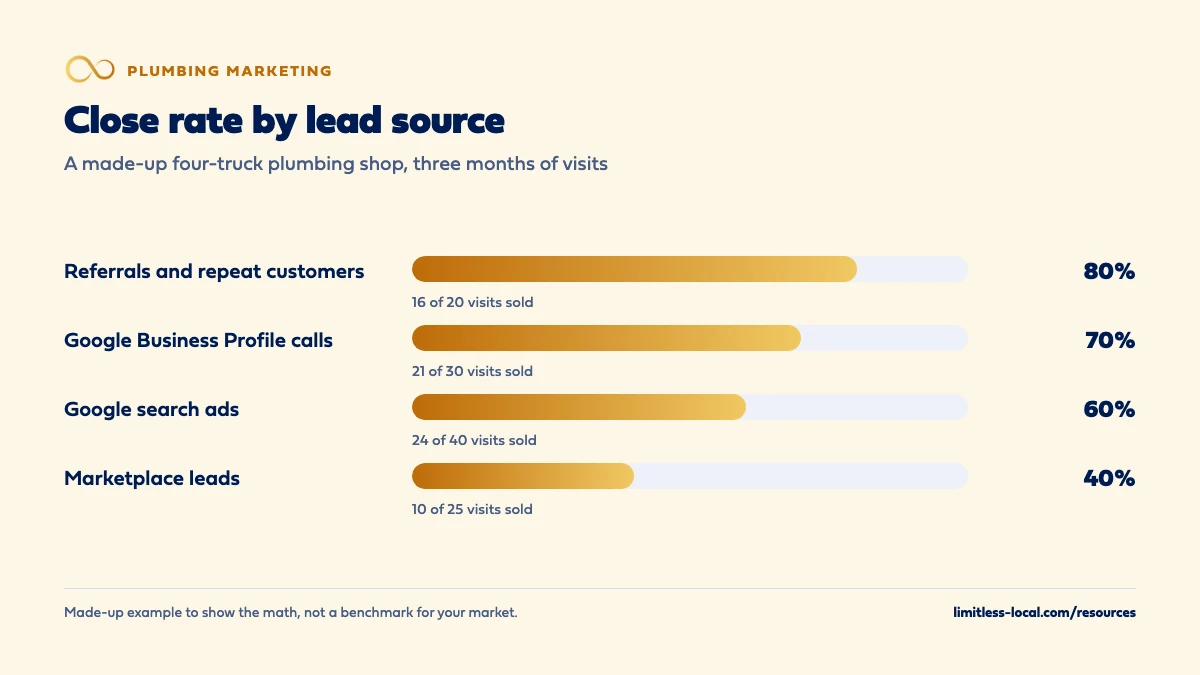
These numbers are made up to show the math, not a benchmark for your market. Over three months, a four-truck plumbing shop tags every new-customer visit with its lead source and counts how many the homeowner said yes to:
- Referrals and repeat customers: 20 visits, 16 sold, an 80% close rate.
- Google Business Profile calls: 30 visits, 21 sold, 70%.
- Google search ads: 40 visits, 24 sold, 60%, on $3,600 of ad spend.
- Marketplace leads: 25 visits, 10 sold, 40%, on $1,500 of lead fees.
Now the cost per sold job. Search ads: $3,600 ÷ 24 = $150. Marketplace leads: $1,500 ÷ 10 = also $150.
On paper the two paid sources cost the same per sold job. But the marketplace leads took 2.5 visits for every sale, against about 1.7 for search ads, so they ate more truck time for the same result. If the shop is busy, that truck time is the deciding cost, and the search ads win. If the trucks have empty slots, the marketplace leads may still be worth keeping.
Frequently asked questions
Is close rate the same as booking rate?
No. Booking rate is the share of calls the office turns into scheduled visits. Close rate is the share of visits or estimates where the homeowner says yes to the work. A source can book well and close poorly, or the other way round.
Why do my techs close some sources better than others?
Mostly because of what the homeowner believed before the visit: whether they trust you already, how urgent the problem is, whether they knew the fee and how many other plumbers they called. Check those before blaming the tech.
Should my techs know where each lead came from?
Yes. A tech walking into a marketplace lead knows to explain options and price clearly; one walking into a referral can mention the neighbor who sent them. Put the source on the job where the tech can see it.
Do Local Services Ads leads close better than regular Google Ads leads?
It depends on your market and job mix. Call leads from either one are usually warm. Compare them on the same job types in your own data, by close rate and cost per sold job.
Can one tech's close rate skew the comparison?
Yes. If your best closer runs most of the referral jobs, referrals will look even better than they are. Compare sources within each tech’s jobs, too, when you have enough of them.
How many jobs do I need before close rates by source mean anything?
More than a week’s worth. Give it about three months, and be careful with any source that has only a handful of visits, because one or two jobs either way swing its rate a lot.
Key takeaways
- Referrals and repeat customers usually close easiest, because the trust is already there.
- Calls from your Google profile, search ads and Local Services Ads close well when the homeowner picked you for a specific problem.
- Shared marketplace leads and coupon calls usually close hardest, because they start with price comparison.
- The office sets up the close: fee, arrival window and tech’s name on every call.
- Decide where to spend on cost per sold job and average ticket, not close rate alone.
Want a second set of eyes on your setup?
We'll look at how you show up locally and where calls are leaking, then send you a plain-English breakdown.
More in this section
- Which plumbing channel brings the highest-quality leads?
- When should a plumbing company stop spending on a lead source?
- What is a lead source and why does it matter to a plumber?
- How do I get more plumbing leads?
- Do I have a plumbing lead volume, quality or closing problem?
Sources
- How leads work — Google Local Services Help
- How to Use Lead Sources — Housecall Pro Help Center
- Technician’s Close or Conversion Rate does not look correct — ServiceTitan Help
- Conversion Rate Reporting — Housecall Pro Help Center
- Lead Source Report — Jobber Help Center