
How much profit do pool builders make per project?
- How much does a pool construction company actually keep from each pool it builds?
- Is there a typical profit per pool I can compare against?
- What's the difference between gross and net profit on a pool?
- What moves profit per pool up or down?
- Do fiberglass, gunite and vinyl pools leave different profit?
- How much do change orders and site surprises change the picture?
- Where does overhead come into profit per pool?
- How do I work out my own profit per pool?
- Why does profit per pool decide what I can spend on marketing?
- Is there a rule of thumb for what winning a customer should cost?
- Can marketing raise profit per pool, not just the number of pools?
- Why profit per pool is hard to pin down
- A worked example: one pool, two marketing costs
- Frequently asked questions
- Key takeaways
- More in this section
- Sources
The short version
- There's no profit-per-pool figure you can safely borrow; work out your own.
- Gross profit = final contract value minus that pool's direct costs.
- Net profit = gross profit minus each pool's share of overhead, including marketing.
- Build type, change orders, site conditions and overhead move the number most.
- Your net profit per pool caps what you can spend to win one signed contract.
For pool builders who want to know what a pool really leaves them, and what that means for how much they can spend to win the next one.
Get a free visibility audit · Book a growth call
How much does a pool construction company actually keep from each pool it builds?
It depends on the builder, and the published figures floating around online rarely say whose pools, which year or which costs they include. Profit per pool swings with the type of build, the features sold, local labor and permit costs, site conditions, change orders and how much overhead each pool has to carry. The only number worth planning around is your own: final contract value minus the direct costs of that pool gives gross profit, and gross profit minus each pool’s share of overhead gives net profit, which sets the most you can afford to spend winning a signed contract.
Marketing is paid out of what a pool leaves you, not what it sells for, so profit per pool is where a pool builder’s marketing budget starts. We know the other side of the desk too: we were an equity partner in a pool construction company, where we streamlined back-office operations, built the lead-generation engine and ran sales and marketing, and that business did $2M+ revenue in year one. Every one of our packages includes monthly reports with a cost-per-lead breakdown, so you can hold marketing costs up against profit per pool. See how it fits on the pool builder marketing page, or browse more pool builder marketing questions.
Is there a typical profit per pool I can compare against?
Not one worth trusting. Profit figures for pool builders turn up in forum threads, sales pitches and supplier blogs, and almost none of them say whether they mean gross or net profit, whose pools they counted, what year, or whether the owner’s own labor and the marketing were in the costs. Two builders quoting the same percentage can be keeping very different amounts.
The pools themselves differ too much for one number to mean anything. A compact fiberglass install in a market with cheap permits and a custom gunite pool with a spa, an automation system and a rock-heavy dig are different businesses, even when the same company builds both.
So treat any outside figure as a conversation starter, not a target. If yours is lower than something you read, find out why before you change your prices. If it’s higher, don’t relax until you know it includes everything.
What's the difference between gross and net profit on a pool?
Gross profit is what a pool leaves after the costs of building it. BDC, Canada’s business development bank, defines gross profit margin as gross profit, net sales minus cost of goods sold, divided by net sales and multiplied by 100%. For a pool, the direct costs are materials, crew labor, subcontractors, permits, engineering, equipment rental and any commission paid on that sale.
Net profit is what’s left after everything else too. The same bank’s definition of net profit margin is the percentage of revenue remaining as profit after all expenses, including interest and taxes, are paid. For a builder, that means office staff, rent, insurance, trucks and equipment you own, software, the owner’s salary and marketing.
Both matter, for different jobs. Gross profit per pool tells you whether you’re pricing and building each pool well. Net profit per pool tells you whether the business is actually making money once it carries its full weight.
What moves profit per pool up or down?
The same handful of things, over and over:
- Build type and features. Spas, water features, automation, lighting and upgraded finishes often carry different margins from the base pool.
- Local costs. Labor rates, subcontractor prices, permits and engineering vary a lot from one market to the next.
- The site. Rock, poor soil, groundwater, tight access and long haul-off add cost that’s hard to price in advance.
- Change orders. Priced well, they lift profit; given away to keep the homeowner happy, they eat it.
- Crew time. Delays between phases, return trips and rework all cost labor that wasn’t in the bid.
- Sales costs. Commissions, design time on proposals that didn’t sign, and any fee you pay a lender to offer financing.
- Warranty and callbacks after handover.
Most builders know their prices well. The profit leaks are usually in the last four.
Do fiberglass, gunite and vinyl pools leave different profit?
They usually do, because the cost structure is different. A fiberglass pool puts a big share of the cost into the shell you buy, with a shorter install. A custom gunite or shotcrete pool puts more into labor, steel, concrete and finish, with more room to sell features and more room for the job to run over. Vinyl liner pools sit somewhere else again, and remodels and resurfacing have their own economics entirely.
That’s why one blended average across everything you build hides the answer. Work profit out separately for each type you sell, and for new builds versus remodels. You may find that the pool type you sell the most isn’t the one that leaves you the most, or that remodels make up for a lower ticket with fewer surprises.
The split matters for marketing too, since each type can have its own pages, ads and budget. How to budget for new pools versus remodels uses those split numbers.
Curious what your marketing is actually booking?
Get a free visibility audit — no obligation, no sales pitch.
How much do change orders and site surprises change the picture?
A lot, in both directions, because pools are long jobs with plenty of chances to add or lose money.
Change orders can be some of the best profit on a pool if they’re priced at your normal margin and written up properly. A homeowner who adds a sun shelf, lighting and a spa mid-build is buying work your crew is already set up for. They hurt when they’re done on a handshake, priced on the spot below cost, or never billed.
Site surprises mostly go one way. Rock, water and access problems turn up after the contract is signed, and if your contract doesn’t account for them, they come straight out of profit.
Both belong in your numbers. Use the final contract value, including change orders, and the actual costs, including the surprises. A profit figure built from signed prices and bid-time estimates will look better than the money in the bank.
Where does overhead come into profit per pool?
After gross profit, and it’s where many builders find out a good-looking pool wasn’t. Overhead is everything you pay whether or not you’re building this month: office, insurance, owned trucks and equipment, salaries outside the crews, software and marketing.
The SBA’s break-even point calculator works it this way: fixed costs divided by price minus variable costs per unit gives the break-even point in units. For a pool builder, that’s a year’s overhead divided by gross profit per pool, which tells you how many pools you have to build before the business makes anything at all.
Spread overhead across the pools you actually built, and you get each pool’s share. Gross profit minus that share is net profit per pool. In a slow year, each pool carries more overhead, so the same pool at the same price leaves less. That’s one reason profit per pool and pool count can’t be judged separately.
How do I work out my own profit per pool?
Take last full season’s completed pools, add up the final contract values and the direct costs for each, and you have gross profit per pool. Spread the year’s overhead across those pools for net profit. How a pool builder works out average project value and profit walks through it step by step.
The hard part is getting real costs instead of guesses, which means tagging every supplier invoice and crew hour to a job as it happens. Field software can do much of the math. Housecall Pro’s job costing reports, for example, define gross profit as job revenue minus labor, material, commission and miscellaneous costs, and profit margin as gross profit divided by job revenue.
If you run a crew or the excavator yourself, put a fair cost on those hours. Otherwise your profit per pool includes a wage you’re paying yourself for free.

Why does profit per pool decide what I can spend on marketing?
Because marketing is paid out of what a pool leaves you. If you sign a pool for a large contract but it leaves a modest net profit, the amount you can spend to win it is a slice of that profit, not of the contract.
Owners who plan marketing from the contract price tend to overpay for leads without noticing, because the big number makes any cost per lead look small. Owners who plan from net profit per pool can set a clear ceiling: the most they’ll spend, across every channel, to get one signed contract. Planning to spend well under that ceiling leaves room for a slow month or a run of lost proposals.
How much you can afford to spend to win one pool customer sets the ceiling step by step, and what a good cost per signed pool contract is covers how to judge it once you’re spending.
Is there a rule of thumb for what winning a customer should cost?
Only a loose one. The same bank’s guide to lifetime value and cost of acquisition calls it a very general guideline, depending on the benchmark you look at, that a customer’s lifetime value should be 2.5 to 3 times what it cost to acquire them. It also says to count any maintenance or after-sale service as part of a customer’s value.
For a pool builder, lifetime value can be more than the build: later equipment upgrades, a resurfacing job, a remodel, and the neighbors who ask who built it. Some builders can count on that. Many can’t track it reliably yet. Until you can, plan from the profit on the build itself and treat anything later as upside.
Use the guideline as a sanity check, never a target for your market. Your own profit per pool and your own close rate tell you far more.
Can marketing raise profit per pool, not just the number of pools?
Yes, and it’s often the bigger lever. Marketing decides which homeowners call you, and that shapes the pools you sign:
- The right pools. Pages, photos and ads built around the pools you make the most on bring more of those enquiries.
- Fewer price shoppers. Clear starting prices and a strong portfolio put off people only collecting the lowest bid. How pool builders stop attracting price shoppers covers it.
- Better-qualified consultations. Fewer design hours spent on proposals that were never going to sign.
- Room to price properly. A builder with a steady pipeline doesn’t have to discount to fill a gap in the schedule.
A few more pools at a thin profit can be worth less than the same number at a healthy one. Look at both before deciding a campaign worked.
Talk it through with someone who runs this every day
A 15-minute growth call: your market, your numbers, and what a realistic budget looks like. No pressure.
Why profit per pool is hard to pin down
Few jobs, big numbers. A builder completes far fewer jobs than a service company, so one bad dig or one generous change order swings the average.
Costs arrive for weeks. Supplier invoices, sub bills and crew hours come in across a long build, so the true cost of a pool is often known only after handover.
Mixed work. New builds, remodels, resurfacing and service can sit in one company with very different economics.
Seasonal overhead. Overhead runs all year while building slows in winter in many markets, so each pool carries a different share depending on how many you built.
A worked example: one pool, two marketing costs
This pool and these numbers are made up to show the math, not a benchmark for your market.
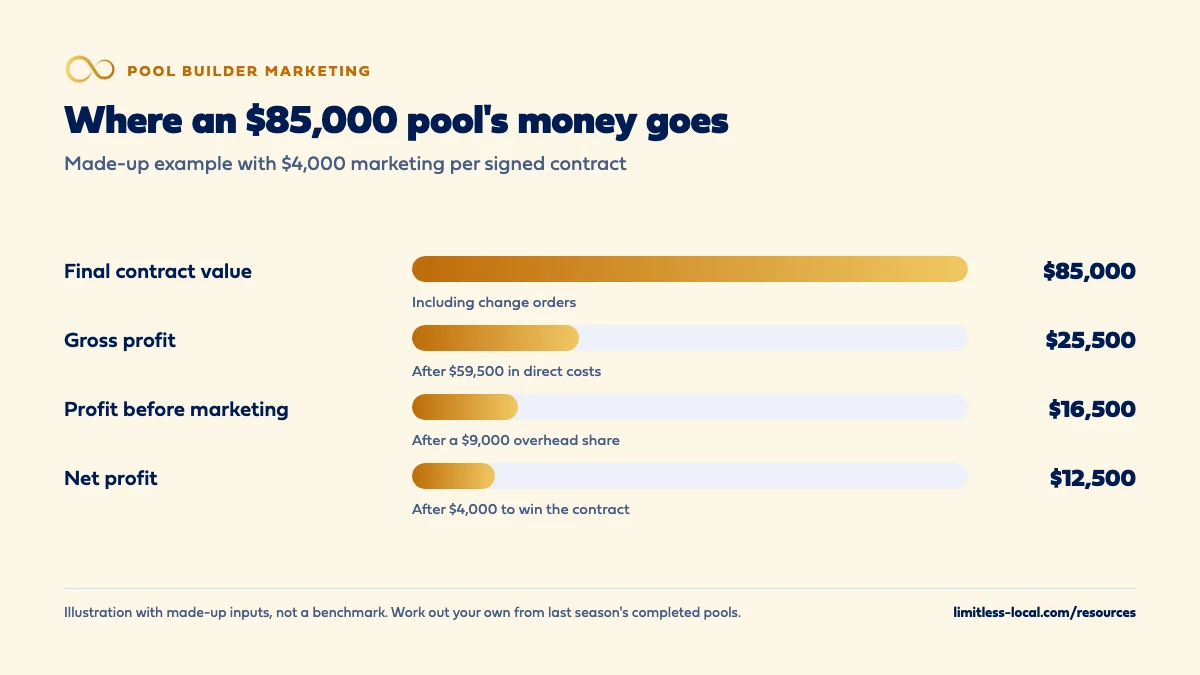
A builder signs a pool at $85,000, final value after change orders.
- Direct costs (materials, crew, subs, permits, commission): $59,500.
- Gross profit: $85,000 – $59,500 = $25,500, a 30% gross margin.
- Overhead share, not counting marketing: $9,000.
- Profit before marketing: $25,500 – $9,000 = $16,500.
If marketing costs $4,000 per signed contract, net profit on this pool is $12,500, about 15% of the contract. If a channel costs $8,500 per signed contract, net profit drops to $8,000, about 9%. Same pool, same price, same crew; only the cost of winning it changed.
Now say the dig hits rock that costs $3,000 more than the bid. At $8,500 per contract, this pool leaves $5,000. That’s why the ceiling on what you’ll pay to win a pool should sit well under profit before marketing, not right up against it.
Frequently asked questions
Is 30% a good gross margin for a pool builder?
It depends on your overhead and your market. A gross margin only means something next to what your overhead takes out; work out net profit per pool before judging it.
Should I count my own salary as overhead?
Yes. Pay yourself a fair wage in the numbers, either as overhead or as job labor when you’re on the crew. Otherwise profit per pool is overstated.
Do financing fees come out of my profit?
If you pay a fee to a lender so homeowners can finance, yes, it’s a cost of that sale. Count it on the pools where it applies.
How many pools do I need to look at?
A full season at least. If you only built a handful, use two seasons, so one unusual job doesn’t distort the average.
Should I raise my prices if profit per pool is low?
Find the cause first. Low profit can come from pricing, but it often comes from unbilled change orders, site surprises, crew delays or overhead spread across too few pools.
Can I use contract price to set my marketing budget?
Only as a rough check. Planning from net profit per pool tells you far more about what you can safely spend to win one.
Key takeaways
- No published profit-per-pool figure is safe to borrow; it depends on build type, market, site, change orders and overhead.
- Gross profit is final contract value minus that pool’s direct costs; net profit also takes off its share of overhead.
- Work profit out separately for each pool type and for remodels.
- Net profit per pool sets the ceiling on what you can spend to win one signed contract.
- Marketing can raise profit per pool by bringing in the right pools, not just more of them.
Ready to compare options?
Book a short growth call and we'll walk through the math for your service area, including when we're not the right fit.
More in this section
- How does a pool builder work out average project value and profit?
- How much should a pool builder spend on marketing?
- What share of revenue should a pool builder put into marketing?
- How much does competition change what a pool builder should spend?
- What lead-to-appointment rate should a pool builder expect?
Sources
- What is the gross profit margin — BDC
- What is Net Profit Margin Ratio — BDC
- Break-even point calculator — U.S. Small Business Administration
- Job Costing Reports — Housecall Pro Help Center
- Calculating customer lifetime value & cost of acquisition — BDC