
What percentage of revenue should a restoration firm put in marketing?

- What share of revenue should a restoration company spend on marketing each year?
- Is there a standard marketing percentage for restoration companies?
- Which revenue should I take the percentage of?
- What counts as marketing spend in the percentage?
- How do I check a percentage against my own job numbers?
- Should a new or growing restoration company spend a bigger share?
- When is a smaller percentage fine?
- What if my percentage doesn't cover what a channel needs?
- How do insurance payments change what I can afford?
- Should the percentage stay the same every month?
- How should I split the percentage across channels?
- When should I raise the percentage?
- What's different about marketing budgets for restoration companies
- A worked example: from a revenue goal to a percentage
- Frequently asked questions
- Key takeaways
- More in this section
- Sources
The short version
- No restoration-specific percentage is published; consumer businesses are often told 5–10% of revenue.
- Take the percentage of the revenue your marketing actually wins, not program or contract work.
- Build the budget from booked jobs needed times your cost per booked job, then check the percentage.
- Spend a bigger share while you're new, growing or entering a market; a smaller share when crews are full.
For restoration owners setting next year’s marketing budget who want a percentage that holds up against their own job numbers.
Get a free visibility audit · Book a growth call
What share of revenue should a restoration company spend on marketing each year?
There’s no published marketing percentage for restoration companies; general small-business guidance often puts consumer-facing businesses at 5–10% of revenue, and a firm that’s new or growing usually belongs at the higher end. Use the percentage as a check, not the plan: work out how many booked jobs marketing has to win, multiply by the most you’ll pay to win a job, and see what share of revenue that comes to. Leave out revenue your marketing doesn’t bring in, such as insurance program or commercial contract work, and base the math on what you collect, not what you invoice.
That job math is how we size a budget too: booked jobs needed, what each one can cost, and what that adds up to. Our Essentials package is $3,500 a month for one location, with Google Ads management up to $2,500 a month in spend; Growth is $4,500 a month and adds Local Services Ads management and a second location. Ad spend is paid to Google separately, and we recommend a budget after a quick audit. Compare the packages, see how we work with restoration companies, read the restoration marketing guide, or browse more restoration marketing questions.
Is there a standard marketing percentage for restoration companies?
No. Nobody publishes a reliable marketing-to-revenue figure for restoration, and the rules of thumb you’ll find cover every kind of small business at once. The Business Development Bank of Canada’s guide to small-business marketing budgets gives a common one: 2–5% of revenue for businesses that sell to other businesses, and 5–10% for businesses that sell to consumers, because consumer businesses usually need more channels to reach people. The US Small Business Administration’s 2019 article on marketing budgets says there’s no hard and fast answer, that many businesses use a percentage of revenue as a guide, and that the range is wide.
A restoration company sits on both sides of that line. Homeowner water, mold, fire and sewage calls are consumer work. Property managers, commercial accounts and insurance programs behave much more like business-to-business. So the range is a sanity check for a number you’ve built from your own jobs, not a target for your trade.
Which revenue should I take the percentage of?
Your total revenue mixes work your marketing wins with work it doesn’t touch. Split it before you apply any percentage:
- Marketing-driven work. Jobs that came from Google searches, your Google profile and Maps, ads, your website, and past customers who found you again online.
- Work marketing doesn’t drive. Insurance program assignments, commercial contracts and property-manager accounts your sales rep won face to face. Those have their own costs, like program fees or a salesperson’s pay, and belong on their own line.
- Rebuild work that follows your own mitigation. Count it with the job that started it. Marketing won the first call, so it earned the rebuild too.
If a big share of your revenue is program work, a percentage of total revenue overstates what marketing can carry. A percentage of marketing-driven revenue is the more useful number, and it’s the one to track year over year.
What counts as marketing spend in the percentage?
Everything you spend to make the phone ring, not just the ad bill:
- Ad spend paid to Google, Microsoft or Meta
- Agency or freelancer fees
- Your website, with the build cost spread over the years you’ll use it, plus hosting and updates
- Call tracking and any software you use mainly for marketing and follow-up
- Truck wraps, yard signs, door hangers and printed leave-behinds
- Sponsorships and community events
- The share of anyone’s pay that goes to marketing, including an office manager who posts to your Google profile
Leave out what the job itself costs, like equipment, crews and materials. If you’re part of a franchise, count the brand-fund fee as marketing you don’t control and plan your local spend on top of it. Owners who leave out staff time and the website usually think they spend less than they do, which makes a percentage look healthier than it is.
How do I check a percentage against my own job numbers?
- Set the revenue marketing has to win next year, from your goal minus program and contract work.
- Divide by your average collected job, mitigation plus any rebuild you keep, to get the booked jobs you need.
- Set your ceiling per booked job, the most you’re willing to pay to win one.
- Multiply jobs by that ceiling. That’s your marketing budget.
- Divide the budget by revenue to see the percentage.
If the result lands inside the consumer range, your plan and the rule of thumb agree. If it lands far above it, one of three things is off: the goal is too big for one year, the ceiling is too high, or your average job is lower than you think. If it lands well below, you may be leaving growth on the table. How many water damage jobs a month you need to hit a revenue goal walks through the job count step by step, and what a good cost per booked job is for a restoration company covers setting the ceiling.
Should a new or growing restoration company spend a bigger share?
Usually, yes. Startups are generally told to budget more while they build awareness, and to base the percentage on projected revenue, since there’s no history yet. For a restoration company the reason is concrete: with few reviews and no rankings, most early calls come from paid channels, where you pay for every click or lead. Ads can bring leads within days of launch, while SEO typically takes 3-6 months to show meaningful organic growth, so for a while you’re paying for both.
The same goes for an established company that wants a big jump in jobs, is adding a second location or is moving into fire and mold work after years of only water. Growth costs more per job at first, because you’re buying into searches and towns where you haven’t earned trust yet. Plan the higher share for a set period, then expect it to fall as rankings and reviews start bringing calls you don’t pay for one by one.
Curious what your marketing is actually booking?
Get a free visibility audit — no obligation, no sales pitch.
When is a smaller percentage fine?
A lower share makes sense when most of these are true:
- You rank well in Maps and search for your main services and towns, and your reviews keep coming.
- Referrals, repeat customers and commercial accounts fill a good part of the calendar.
- Your crews and equipment are close to full most months.
- Your cost per booked job is well under your ceiling, and more spend wouldn’t add much.
Lower isn’t zero, though. Rankings and reviews fade when the work behind them stops, and cutting marketing because jobs slowed tends to make jobs slow further. If the phones go quiet, look at what changed before you cut. What to check when the phone stops ringing is a good place to start.
What if my percentage doesn't cover what a channel needs?
A smaller company can run its percentage and find it doesn’t stretch to ads, SEO, a website and tracking all at once. Spreading a small budget across everything usually means no channel gets enough to work. Ads that run out of money by mid-afternoon bring leads in bursts and too little data to judge.
Fund it in this order instead:
- A complete Google Business Profile, steady review requests and a website with real service pages. These cost little and help every other channel.
- Tracking, so you know which calls booked.
- One paid channel, funded well enough to run all day, every day, in the towns you care about most.
- SEO and a second paid channel once the first one pays for itself.
What monthly marketing budget a restoration company needs covers the floor for each piece.
How do insurance payments change what I can afford?
Marketing gets paid this month. An insurance-paid job may not collect for weeks, and part of an invoice can come back reduced. A percentage built on what you bill can leave you short of cash in the months between.
Three habits help. Base the percentage on revenue you actually collected over the last twelve months, not invoices. Keep a cash cushion for marketing so a slow-paying month doesn’t force you to switch ads off. And check the percentage against collections each quarter, because a jump in billed work only helps the budget once the money is in the bank.

Should the percentage stay the same every month?
Set the percentage for the year and let the monthly spend move. Freezes, storms and wet seasons bring more calls and more competition at once, and quiet months bring fewer. A flat monthly amount either runs short in the busy weeks or wastes money in the slow ones.
Google Ads already works this way inside a month. Its help page on average daily budgets says spend can run over the daily budget on busy days and under it on slow ones, with a monthly limit of 30.4 times the average daily budget for most campaigns. Do the same across the year: hold back part of the annual budget for your surge months, and raise daily budgets when a freeze or storm is forecast instead of after your phones are already ringing.
How should I split the percentage across channels?
Pay the fixed pieces first: your Google profile work, website upkeep, tracking and review requests. Then size the paid channels from the jobs you need and what each job costs on that channel. Whatever is left goes to SEO at a steady amount, because SEO pays back slowly and doesn’t reward stopping and starting.
Review the split every quarter. Move money toward the channel with the lowest cost per booked job that still has room to grow. When a restoration company should split SEO, ads and reviews budgets goes further on keeping each line visible.
When should I raise the percentage?
Raise it when the numbers say more spend will buy more jobs at a price you like: your cost per booked job sits comfortably under your ceiling, your crews have room for more work, and your ads are held back by budget rather than by bids, ad copy or missed calls. Raise it in steps, check what the extra jobs cost, and keep going only while they stay under your ceiling.
How many booked jobs a month you need before raising a restoration budget covers how much tracked history to wait for.
Talk it through with someone who runs this every day
A 15-minute growth call: your market, your numbers, and what a realistic budget looks like. No pressure.
What's different about marketing budgets for restoration companies
Job value is lumpy. A small water call and a mitigation job that turns into a full rebuild can differ by many times. Use your average collected job across a full year, and count the rebuilds that follow your own mitigation, or your percentage will swing with a few big losses.
A lot of revenue doesn’t come from marketing. Program work, commercial contracts and property-manager accounts can fill a big part of the calendar. They have their own costs. Keep them out of the marketing percentage so the number tells you what your marketing is actually carrying.
Demand comes in bursts. A freeze or a storm can bring weeks of calls at once. An annual percentage with a reserve for surge months fits restoration far better than a flat monthly amount.
Cash arrives late. Insurance-paid jobs can take weeks to collect. Plan marketing from collected revenue, with a cushion.
A worked example: from a revenue goal to a percentage
These numbers are made up to show the math, not a benchmark for your market.
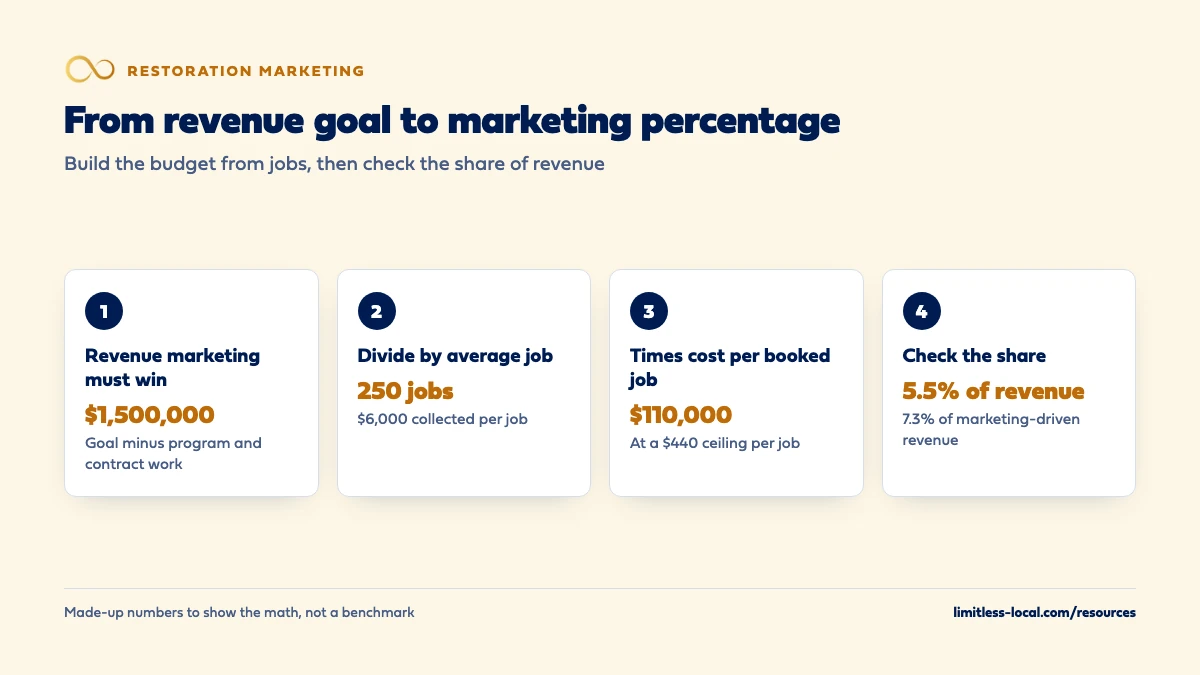
- Your goal for next year is $2,000,000 in revenue. About $500,000 of it is program and commercial contract work your marketing doesn’t bring in, so marketing has to win $1,500,000.
- Your average collected job, mitigation plus the rebuilds you keep, is $6,000. $1,500,000 ÷ $6,000 = 250 booked jobs, or about 21 a month.
- You’ve set $440 as the most you’ll pay to win a job.
- 250 × $440 = $110,000 a year in marketing, about $9,200 a month on average.
That’s 5.5% of total revenue and about 7.3% of the revenue marketing has to win. Both sit inside the consumer range, so the plan passes the sanity check. If the same math had landed well above the range, the goal, the ceiling or the average job would need a second look before you committed the money.
Frequently asked questions
Is 10% of revenue too much for a restoration company to spend on marketing?
Not if your job math supports it. A company that’s growing fast or entering a new market can justify it when each booked job still costs less than your ceiling. It’s too much when the extra spend buys jobs above that ceiling or jobs your crews can’t get to.
Should I use last year's revenue or next year's goal?
Use next year’s goal for the job math, and last year’s collected revenue to check you can afford it. A new company with no history uses projected revenue.
Does my in-house marketer's salary count?
Yes, the share of their time spent on marketing. Leaving it out makes the percentage look lower than it is and makes an agency quote look expensive next to a number that’s missing a big cost.
Does a franchise brand-fund fee count toward my marketing percentage?
Count it, but track it on its own line. You don’t control how it’s spent, so your local marketing still needs its own budget sized from the jobs you need in your territory.
How often should I revisit my marketing percentage?
Check spend against plan every month, and revisit the percentage itself every quarter with your collected revenue and cost per booked job in front of you.
Should mold and fire work get its own share of the budget?
If you want more of it, yes. Those jobs come from different searches and often cost a different amount to win, so give them a line and a ceiling of their own.
Key takeaways
- There’s no restoration-specific marketing percentage; consumer businesses are often told 5–10% of revenue.
- Apply the percentage to the revenue marketing actually wins, not to program or contract work.
- Build the budget from booked jobs needed times your cost per booked job, then use the percentage as a check.
- Spend a bigger share while you’re new, growing or entering a market, and plan for insurance payments that arrive late.
- Set the percentage for the year and let monthly spend follow your storm and freeze seasons.
Ready to compare options?
Book a short growth call and we'll walk through the math for your service area, including when we're not the right fit.
More in this section
- How profitable is a restoration company, and where does marketing fit?
- What monthly marketing budget does a restoration company need?
- How much of my time does managing a restoration marketer take?
- What should a restoration company look for in a marketing agency?
- Which marketing channel should a restoration company start with?
Sources
- What is an average marketing budget for a small business? — BDC
- How to Get the Most From Your Marketing Budget — U.S. Small Business Administration
- About average daily budgets — Google Ads Help