
What should I look for in an electrical contractor marketing agency?

- What should an electrician look for when comparing marketing agencies before signing?
- What matters most when I compare electrical marketing agencies?
- Do they ask about the electrical jobs I actually want?
- Can they tell me exactly what they'll do each month?
- Who actually does the work, and who will I talk to?
- Will their report show booked jobs and cost per job?
- Will I own my accounts if I leave?
- Is the agency fee separate from my ad spend?
- What should the contract say?
- Do they give realistic timelines instead of promises?
- Can they show references and past work?
- How do I compare two agencies side by side?
- What's different when an electrical contractor hires an agency
- A worked example: scoring two proposals
- Frequently asked questions
- Key takeaways
- More in this section
- Sources
The short version
- Fit: they ask about your jobs, towns and licensing before pitching.
- Scope: the monthly work is written down, not described.
- Reports: calls, booked jobs and cost per booked job you can check.
- Ownership and terms: your accounts, a separate fee and a clear way out.
For electrical contractors with two or three agency proposals on the desk who want a checklist for picking one, not just a list of what to run from.
Get a free visibility audit · Book a growth call
What should an electrician look for when comparing marketing agencies before signing?
Look for an agency that asks which electrical jobs you want more of before it pitches anything, writes down exactly what it will do each month, and reports calls and booked jobs you can check against your own software. You should own the Google Ads account, Google Business Profile, website domain and tracking numbers, with the agency given access. The fee should be separate from your ad spend, the contract should say how you can leave, and nobody should promise you rankings or a set number of leads.
That checklist is how we’d want to be judged too. Our packages are priced on the page, ad spend is paid to Google directly, every package includes reporting with cost-per-lead breakdowns and call tracking, and we’re month-to-month: we ask for three months in the contract, but if you want to leave, we won’t make you stay. See what’s in each tier on our packages page, how we work with electrical shops on our electrical contractor marketing page, or keep reading the electrical marketing questions library.
What matters most when I compare electrical marketing agencies?
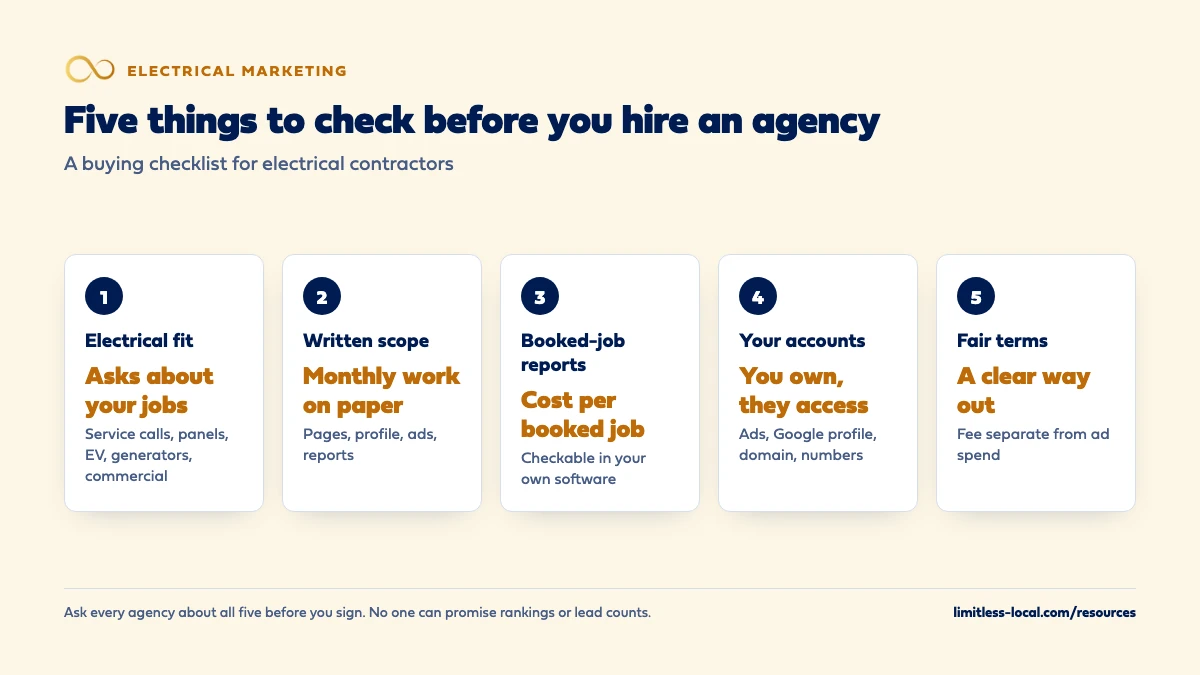
Five things separate a good agency from an expensive one, and you can check all of them before you sign:
- Fit. They ask about your work before they talk about theirs.
- Scope. The monthly work is written down in plain words.
- Reporting. Their report ends in booked jobs, not clicks.
- Ownership. Your accounts stay yours.
- Terms. The fee, the ad spend and the way out are all clear.
Price matters too, but it only means something once you know what you’re buying. A cheaper agency that leaves you without a written scope or your own Google Ads account isn’t cheaper for long. The sections below turn each of those five into questions you can ask on a sales call, and answers worth hearing.
Do they ask about the electrical jobs I actually want?
A good agency asks before it pitches. Google’s own advice on hiring an SEO says the person you hire should ask what makes your business unique, who your competitors are and how your customers find you, and that if they’re not interested in your business, you should find someone who is.
For an electrician, that means questions like these in the first conversation:
- Which jobs do you want more of: service calls, panel upgrades, EV chargers, generators, rewires or commercial work?
- Which towns do you want to work in, and which do you avoid?
- Where are you licensed, and which jobs need a permit?
- How do you handle urgent no-power calls versus planned work?
- What does a booked job look like in your software today?
If the proposal could have been sent to a roofer with the word swapped, it probably was. Whether a marketing agency will understand the electrical trade has more questions to test that.
Can they tell me exactly what they'll do each month?
They should be able to put it on one page. “We’ll handle your SEO” isn’t a scope. A scope says what gets built, how often, and what you’ll see.
Here’s what a written scope looks like in practice. Our Essentials package, for example, lists business listing cleanup and buildout, Google Business Profile management with one post a week, a content sprint of up to 10 pages, two blog posts a month, link building, review responses and basic review generation, Google Ads management up to $2,500 a month in ad spend, one landing page, call, web and form tracking, a real-time dashboard and a monthly report. You don’t have to want that exact list. You do want something that specific from whoever you hire.
Then ask how you’ll see the work happen. Will they share every change they make to your site, and explain each recommendation and the reasoning behind it? A good agency says yes without hesitating.
Who actually does the work, and who will I talk to?
Ask who builds the ads, who writes the pages and who picks up when you have a question. You’re not looking for a founder on speed dial. You’re looking for a clear answer: a named contact, a meeting schedule and a team that knows your account without you explaining it every month.
Get the cadence in writing. On our side, for example, Essentials includes quarterly strategy calls, and Growth adds monthly strategy calls and a dedicated account manager. Whatever an agency offers, you should know before signing how often you’ll review results and with whom.
It also helps to know how much of your time they’ll need. A good agency asks for a few hours up front to get access and the details it needs, then mostly leaves you to run jobs, with a short review on a set schedule.
Will their report show booked jobs and cost per job?
Ask to see a sample report before you sign. The report should answer three questions without a call to explain it: how many calls and forms came in, how many turned into booked jobs, and what each booked job cost with the agency’s fee and your ad spend included.
Look for:
- Call tracking with recordings, so you can hear whether calls were real customers.
- Source tagging, so each lead shows where it came from: ads, your Google profile, the website or a lead site.
- A cost-per-lead breakdown by channel, which you then carry through to cost per booked job using your own booking records.
Every one of our packages includes monthly reports with a cost-per-lead breakdown, call tracking with recording and transcription, form and chat tracking, source tagging and a real-time dashboard. Whoever you hire, the test is the same: can you match their numbers to the jobs in ServiceTitan, Housecall Pro, Jobber or whatever you use? How to know if your electrical marketing agency is getting results covers how to check.
Curious what your marketing is actually booking?
Get a free visibility audit — no obligation, no sales pitch.
Will I own my accounts if I leave?
You should, and you can confirm it before you sign. Ask for these four things to be set up in your name, with the agency given access:
- Google Ads. Google’s page on access levels in Google Ads shows that only Admin access can give account access, change access levels and unlink manager accounts. You want Admin; the agency can work with Standard access, which lets it edit campaigns.
- Google Business Profile. According to Google’s page on Business Profile owners and managers, the owner has full control and can add or remove users, while managers have mostly the same access but can’t add or remove users or remove the profile. Keep yourself as the primary owner.
- Your website domain. The registrant is the owner on record. ICANN’s page on change of registrant explains that a WHOIS search shows which registrar holds the domain, and that the registrar is who you contact to update or transfer it.
- Tracking phone numbers. Ask in writing what happens to them if you leave, because customers will have saved them.
Being the owner also means you can see the work. In Google Ads, change history lists changes to your account, campaigns and ad groups over the past 2 years, including who made them. How to avoid getting burned again by a marketing agency walks through getting accounts back from a past agency.
Is the agency fee separate from my ad spend?
It should be, and the proposal should say how much of your money reaches Google. When the fee and the ad spend are one number, you can’t tell whether a $4,000 month means $3,000 of ads and $1,000 of management, or the other way around.
A clear proposal lists the management fee, the recommended ad budget paid to Google or Meta directly, and anything one-time, like a website build or a landing page. That’s how we price: the package fee is on our site, ad spend is never included in it, and we recommend a budget after a quick audit.
Billing matters too. If Google bills your card for the ads, your Google Ads billing page shows exactly what was spent, which makes the agency’s report easy to check.
What should the contract say?
Read it for four things:
- Length and notice. How long you’re committing to, and how much notice you have to give to leave.
- What’s included. The written scope, attached to or quoted in the contract.
- What you keep. Your accounts, your content and your website files if you leave.
- What they promise. Effort, reporting and transparency are fair promises. Rankings, lead counts and revenue aren’t.
Here’s ours, as an example of terms you can live with: no long-term contracts. We ask for three months and put it in the contract, because month one is foundation work and it needs time to start paying off, but if you want to leave, we won’t make you stay. Month-to-month means we earn the business every month.
A long lock-in isn’t automatically a bad sign, but it’s a reason to ask why the agency needs one.

Do they give realistic timelines instead of promises?
Ask, “When will I see calls, and from what?” A good answer separates the channels. Ads can bring leads within days of launch. SEO typically takes 3 to 6 months to show meaningful organic growth. An agency that blurs the two, or promises page one by next month, is telling you what you want to hear.
No one can guarantee a #1 ranking on Google, and a claimed special relationship with Google is a reason to walk away. We don’t guarantee rankings, lead counts or revenue either. Nobody honestly can, because platforms change how they work. What we promise is transparency: you’ll know what we’re doing, why, and what it produced, and if something isn’t working, we’ll tell you and fix it.
For electrical shops, a realistic answer also mentions screening. Google treats electricians as an urgent category for Local Services Ads, with an extra level of screening that includes background checks, and its screening and verification requirements say the process takes 3–4 weeks on average after you submit documents. An agency that knows that won’t promise LSA calls in week one.
Can they show references and past work?
Ask for examples of previous work and success stories, then check references: ask past clients whether the service was useful, whether the agency was easy to work with, and whether it produced positive results.
Make the references count:
- Ask for a home-service business, ideally one with emergency calls and quoted jobs like yours.
- Call, don’t just read a testimonial. Ask what the first three months looked like and whether the reports matched their own job records.
- Ask what happened when something didn’t work.
Be careful with screenshots of rankings or traffic. They don’t tell you whether the phone rang, and a reference that talks about booked jobs is worth more than any chart.
How do I compare two agencies side by side?
Put the proposals next to each other and score each one on the five points: fit, scope, reporting, ownership and terms. Then compare price, but only for the same work. One agency’s fee can include ads management, Google profile work and pages, while another’s covers ads only.
A few tie-breakers:
- Which one asked better questions about your business?
- Which one can tell you what happens in the first month, step by step? What an agency does in month one for an electrician shows what that should look like.
- Which one told you something you didn’t want to hear, like a budget that’s too small or a channel to skip?
If you want a gut check on price, what a marketing agency costs an electrician lays out what drives the number. And keep the warning signs handy: red flags that mean an agency will waste money is the other half of this checklist.
Want to see where your company stands?
A free visibility audit shows where you show up on Google, Maps and AI answers, and what it's costing you in calls.
What's different when an electrical contractor hires an agency
Your job mix is wide. A good plan treats a breaker call, a panel upgrade and a commercial tenant job as three different targets, with different ads, pages and numbers. Ask how the agency would split them.
Urgent calls need a different setup. No-power calls go to whoever answers first, so call handling, after-hours coverage and Local Services Ads matter more than they do for planned work. An agency should ask who answers your phone.
Licensing shapes the map. Where you’re licensed decides which towns and services the ads should cover, and Local Services Ads screening for electricians can include license and background checks. An agency should ask for your license details early.
A worked example: scoring two proposals
This example is made up to show how to compare, not a description of any real agency. An electrical owner gets two proposals at about the same monthly fee.
- Agency A sends a polished deck about rankings and traffic. The scope says “SEO, ads and social.” The ad budget is rolled into the fee. The contract is 12 months, and the Google Ads account would sit under the agency’s own login.
- Agency B spent the first call asking about panel upgrades, EV chargers and service areas. The scope lists pages, profile posts, campaigns and a monthly report. Ad spend is billed to the owner’s card by Google. The owner is Admin on Google Ads and primary owner of the Google profile, and the contract can be ended with notice.
Scored on the five points, Agency A passes none and Agency B passes all five. Even if Agency A were cheaper, the owner would have no way to see what the money bought, which makes Agency B the safer bet before a single ad runs.
Frequently asked questions
Do I need an agency that only works with electricians?
Not necessarily. What matters is that it understands home-service work, asks about your job mix and sets up tracking around booked jobs. An agency focused on local service businesses usually covers that.
Should I sign with an agency that offers a free audit?
A free audit is fine if it shows you something real about your market. At the audit stage, give them read access to Search Console only, not write access.
How many agencies should I talk to before choosing?
Two or three is usually enough to see the difference in questions, scope and terms. More than that tends to blur together.
Is a bigger agency better for an electrical contractor?
Size matters less than fit. Ask who will work on your account day to day and how often you’ll review results, then judge the answer, not the headcount.
Should the agency build my website too?
It can, but make sure you own the domain and hosting, and that the site comes with you if you leave. A website built on an agency’s own platform can be hard to move.
What if an agency won't give me Admin access to Google Ads?
Treat it as a deal-breaker. The account holds your ad history and spend; you should be able to give and remove access yourself.
Key takeaways
- Pick the agency that asks about your electrical jobs, towns and licensing before it pitches.
- Get the monthly work written down, with a sample report that ends in booked jobs.
- Own your Google Ads account, Google Business Profile, domain and tracking numbers; give the agency access.
- Keep the fee separate from ad spend and know exactly how you can leave.
- Treat promised rankings or lead counts as a reason to keep looking.
Not sure what's working right now?
Start with a free visibility audit: rankings, Google profile, reviews and tracking, checked against your service area.
More in this section
- Should I hire an agency or DIY my electrical marketing?
- What does a marketing agency do for an electrician I can't?
- Does an electrical contractor need a digital marketing team?
- Will a marketing agency understand the electrical trade?
- How much does a marketing agency cost for an electrician?
Sources
- Do You Need an SEO? Tips for Hiring an SEO — Google Search Central
- About access levels in your Google Ads account — Google Ads Help
- Manage your Business Profile owners & managers — Google Business Profile Help
- About Change of Registrant — ICANN
- About change history — Google Ads Help
- Business screening and verification requirements – United States — Google Local Services Help