
How should I split budget between plumbing SEO, website and paid ads?

- How much of my plumbing marketing money should go to ads now versus SEO and the website for later?
- What exactly am I splitting the budget between?
- Why should the website come first if it's losing calls?
- Why do ads and SEO pay back on such different clocks?
- How does my cash runway change the split?
- How does crew capacity change the split?
- What's a sensible starting split for my situation?
- How should the split change over the first year?
- How do I pay for a website without starving the ads?
- Where do Local Services Ads and my Google profile fit in the split?
- What mistakes do plumbers make when splitting the budget?
- What's different about this split for plumbing companies
- A worked example: one budget across the first year
- Frequently asked questions
- Key takeaways
- More in this section
- Sources
The short version
- A website that loses calls makes every other dollar work harder, so fix it first.
- Ads carry the early months; SEO is money you commit to for at least half a year.
- Tight cash or empty schedules push the split toward ads; runway and full schedules push it toward SEO.
- Rebalance every quarter on cost per booked job, not on what each channel promises.
For plumbing owners with one marketing budget and three things asking for it: a website that needs work, SEO that pays off later, and ads that can ring the phone this week.
Get a free visibility audit · Book a growth call
How much of my plumbing marketing money should go to ads now versus SEO and the website for later?
Fix the website first if it’s losing calls, because every dollar of ads and SEO lands there. Then put most of the monthly money into paid ads while SEO builds, since ads can bring calls within days and SEO typically takes 3 to 6 months to show meaningful growth. As organic calls start booking jobs, shift money from ads toward whatever has the lower cost per booked job, and size the whole thing to the cash you can spare and the work your crew can actually run.
Most owners don’t have to split the work three ways with three vendors. Our packages put local SEO, the Google profile and Google Ads management under one monthly fee with tracking on every call, and ad spend is paid to Google directly, so you can see what each part of the budget books. Our plumbing marketing page shows how that works for plumbing companies, and the plumbing marketing questions library goes through budgets and channels one question at a time.
What exactly am I splitting the budget between?
Three things that cost money in very different ways:
- The website is mostly a one-time build, then small upkeep. It doesn’t bring calls on its own, but it decides how many visitors from ads, Maps and search actually pick up the phone.
- SEO is a monthly cost that builds over time: service pages, town pages, your Google Business Profile, reviews and links. It’s slow to start and keeps working after you stop paying for any one month of it.
- Paid ads are Google Ads, Local Services Ads and any social ads. You pay the platform for clicks or leads, plus whoever manages them. They work fast and stop the day the money stops.
The split is really a question about time. Ads buy calls now. SEO and the website buy cheaper calls later. How much of each you can afford depends on how soon you need the jobs.
Why should the website come first if it's losing calls?
Because ads and SEO both send people to it. If the site is slow on a phone, hides the number, has no page for water heaters or drain cleaning, or looks like nobody’s touched it in years, you’re paying full price for visitors who leave without calling.
Quick checks you can do yourself on your phone:
- Can you tap to call from the top of every page?
- Is there a page for each service you want more of, and one for emergency calls?
- Do your towns, reviews, license and photos of real jobs show up without hunting?
- Does a quote form actually reach someone who answers it?
If the answer to most of those is no, put the website ahead of new SEO spend. Google’s own guide, Do you need an SEO?, says a great time to bring in SEO help is when you’re redesigning or launching a site, and the earlier the better, so the site is built to be search-friendly from the start. Why a plumbing website isn’t turning visitors into calls goes deeper on the fixes.
Why do ads and SEO pay back on such different clocks?
Ads can bring leads within days of launch. SEO typically takes 3 to 6 months to show meaningful organic growth. That gap is the whole reason the split matters.
In the first months, nearly all the booked jobs that come from new marketing will come from ads. SEO money spent in those months is an investment that doesn’t show up as jobs yet. If you judge it in month two on jobs booked, it’ll look like a waste, and owners who cut it then pay for the slow part and never get the payoff.
The flip side: ads never get cheaper just because you’ve run them a long time. Once SEO and your Google profile start bringing calls, those calls don’t carry a per-click charge. That’s why the split should move over the first year rather than stay fixed. Why plumbing SEO takes months when you need jobs this month explains the wait in more detail.
How does my cash runway change the split?
Ask one question before anything else: how many months could you keep paying for SEO before it has to pay for itself?
- Less than six months of runway: lean hard on ads and the free basics, like your Google profile and asking every customer for a review. Only commit SEO money you’re sure you can keep paying through the ramp. SEO you cancel in month three pays for the slow part and gets none of the payoff.
- Six to twelve months: run ads for this year’s jobs and put a steady, smaller share into SEO and pages, so organic calls are building by the time you want to ease off ads.
- A year or more: you can afford a bigger SEO share from the start, especially if your area has lots of plumbers bidding on the same ads.
The Small Business Administration’s advice on getting the most from a marketing budget fits here: if the budget is tight, ramp up the low-cost or free methods and be very selective about the expensive ones. For a plumber, the free methods are reviews, the Google profile, repeat customers and referrals.
Curious what your marketing is actually booking?
Get a free visibility audit — no obligation, no sales pitch.
How does crew capacity change the split?
Ads are a faucet you can turn up and down. SEO isn’t. That makes capacity the second big input.
- Empty slots on the schedule: more to ads. You’re already paying your plumbers for those hours, and ads are the fastest way to fill them.
- Booked out most weeks: trim the ads, especially on small service calls, and move that money into SEO and pages for the work you want more of, like water heaters, repipes and sewer lines. You’re building next year’s calls without buying jobs you can’t reach.
- Hiring soon: start SEO now, so organic calls are growing by the time the new plumber is ready, and plan to raise ads when they start.
Google Ads makes the faucet easy to adjust. Its help page on average daily budgets explains that you set a daily average, that one day can spend up to twice that, and that you won’t pay more than 30.4 times the daily average in a month. Local Services Ads use a weekly budget instead, and you pay for each valid lead (How leads work).
What's a sensible starting split for my situation?
There’s no correct percentage, but there’s a sensible shape for each situation:
- New shop, no site or a weak one: a simple, fast website first; most monthly money to ads; a small, steady amount to the Google profile, reviews and a handful of service pages.
- Established shop, dated site, few reviews: rebuild or fix the site, keep ads running to it, and start SEO on the services you want more of.
- Established shop, good site and strong reviews: ads and SEO closer to even, with ads aimed at the jobs SEO doesn’t win yet.
- Booked out, wanting bigger tickets: fewer ads on small calls, more into pages and SEO for high-ticket work.
Whatever the shape, write down what each bucket is supposed to produce and when. “Ads: booked jobs this month. SEO: organic calls growing by month six.” That makes the quarterly review easy. For how big the total should be, see how much a plumbing company should spend on marketing.
How should the split change over the first year?
Plan for three stages rather than one fixed split:
- Build (roughly the first quarter): the website gets fixed or rebuilt, tracking goes in, ads carry the jobs, and SEO work starts on the profile and core pages.
- Ramp (the next quarter): ads keep carrying most jobs. SEO keeps going even though it’s not booking much yet. This is the stage owners are most tempted to cut, and the worst time to do it.
- Rebalance (the second half of the year): look at cost per booked job by channel. If organic and profile calls are booking jobs at a lower cost, move some ad money into more pages and towns. If they aren’t, find out why before spending more on either.
After the first year, the split should follow the numbers: put more into what has booked jobs at the best cost and phase out what hasn’t. Whether plumbers should combine paid ads, SEO and referrals covers the order to add channels in.

How do I pay for a website without starving the ads?
Spread it out. A website is a long-lived asset, so there’s no reason to pay for it out of one month’s marketing budget and leave the ads dry.
- Pick the right size of site. A plumbing site needs strong service pages, an emergency page, town pages for the areas you really cover, reviews and a clear phone number. It rarely needs custom features.
- Use a payment plan if one’s offered. Ours are 6 or 12 months. A themed site with us is $3,750, or $3,000 alongside any of our packages, and custom builds start at $5,000.
- Keep ads running during the build. Point them at your best existing page, or one solid landing page, so the phone keeps ringing while the new site is made.
Builds take time, too: ours launch in 100 days or less, and themed sites take about 60 days. Budget ads to cover that whole period. How much a plumbing company website costs compares the options.
Where do Local Services Ads and my Google profile fit in the split?
Local Services Ads belong in the paid bucket, but they behave a little differently from search ads. You pay for each valid lead instead of each click, set a weekly budget, and the cost is tied to people who actually reached out. That’s why many plumbers start with them.
Your Google Business Profile belongs in the SEO bucket, even though it costs almost nothing to run. It needs time: photos, posts, services, answering reviews and asking for new ones. Google says local results are mainly based on relevance, distance and popularity, and that more reviews and positive ratings can help your local ranking (Tips to improve your local ranking). That’s slow-build work, like SEO, and it’s the cheapest part of the whole budget.
If you’re deciding which paid channel to start with, whether to start with LSAs, Google Ads or SEO compares them.
What mistakes do plumbers make when splitting the budget?
- Spending everything on a new site, then having nothing left to send people to it.
- Running ads to a site that doesn’t convert, and blaming the ads.
- Going SEO-only when cash is tight, and running out of money before it pays.
- Cutting SEO in month two or three, after paying for the slow part.
- Never rebalancing, so a split that made sense in year one is still running in year three.
- Splitting by guesswork. Without a tracking number per channel and a source on every job, there’s nothing to rebalance on.
The last one undoes all the others. Before you move money between buckets, make sure you can see which bucket booked the jobs.
Talk it through with someone who runs this every day
A 15-minute growth call: your market, your numbers, and what a realistic budget looks like. No pressure.
What's different about this split for plumbing companies
Emergency work rewards fast channels. Someone with water on the floor calls whoever shows up first, often an ad or the map pack. That makes ads and the Google profile more important for plumbers than for trades where homeowners shop around for weeks.
Big tickets reward slow channels. Water heater replacements, repipes and sewer lines are researched. Strong service pages and reviews win them, and they pay back the SEO side of the budget fastest.
Weather moves demand. A hard freeze can fill the schedule in a day. Keep ad budgets flexible so you can turn them down when the crew is buried and back up in quiet weeks, while SEO keeps running steadily underneath.
A worked example: one budget across the first year
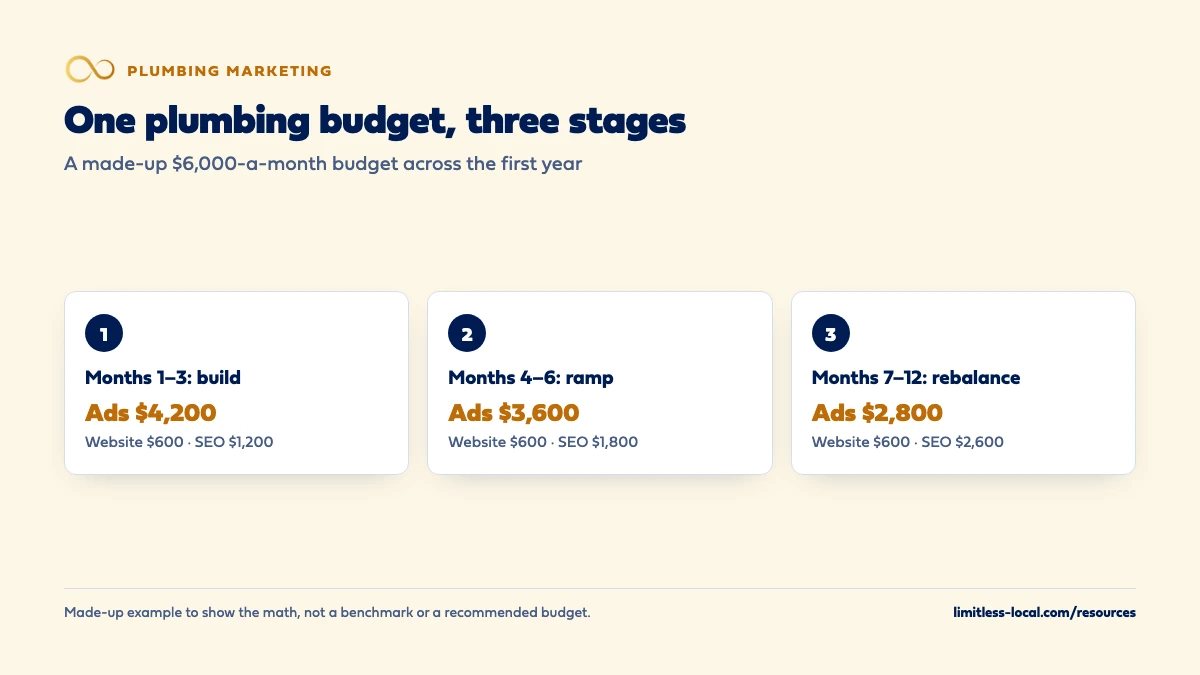
These numbers are made up to show the math, not a benchmark or a recommended budget. A two-truck plumbing shop can spend $6,000 a month on marketing. Its site is dated, and it gets few calls from Google outside the ads.
- Months 1–3 (build): a $7,200 website paid over 12 months is $600 a month. Ads get $4,200. SEO and the Google profile get $1,200.
- Months 4–6 (ramp): website $600, ads $3,600, SEO $1,800. Ads are still booking most new jobs: 15 jobs from $3,600 is $240 per booked job.
- Months 7–12 (rebalance): organic and profile calls now book 10 jobs a month on the $1,800. That’s $180 per booked job, cheaper than the ads, so the owner moves $800 from ads into SEO and pages: website $600, ads $2,800, SEO $2,600.
The total never changes. What changes is where it goes, and each move is based on cost per booked job, not on a guess. If organic calls hadn’t started booking jobs by month seven, the right move would have been to find out why before shifting a dollar.
Frequently asked questions
Should I stop ads once SEO starts working?
Usually not all the way. Organic rankings move, and ads are the fastest way to fill a quiet week or reach a town where you don’t rank yet. Trim them toward the searches and towns SEO doesn’t win.
Is SEO worth it for a one-truck plumber?
Yes, at a small, steady size you can keep paying through the ramp: your Google profile, reviews and a few strong service pages. Don’t commit SEO money you’d have to pull in month three.
Does social media belong in this split?
For most plumbers it’s a small slice. Social ads can remind past visitors you exist, but people with a burst pipe search Google, so search ads, the map pack and your site come first.
Should the website budget come out of the marketing budget?
Treat it as a separate, one-time investment if you can, paid over several months. Taking it all from one month’s marketing usually means the ads go quiet just when you need calls.
How often should I change the split?
Review it every quarter, and move money in small steps based on cost per booked job. Changing it every month doesn’t give SEO time to show anything.
What if I can only afford one of the three?
If the site is losing calls, fix that and lean on free channels like your Google profile and reviews. If the site is fine, put the money into ads for jobs now, and add SEO as soon as the cash allows.
Key takeaways
- Fix a website that’s losing calls before adding SEO spend; ads and SEO both land there.
- Ads can bring calls within days; SEO typically takes 3 to 6 months, so ads carry the early months.
- Tight cash or empty schedules push the split toward ads; runway and full schedules push it toward SEO.
- Plan three stages for the first year: build, ramp, rebalance.
- Move money between buckets on cost per booked job, and only once you can see which bucket booked the jobs.
Ready to compare options?
Book a short growth call and we'll walk through the math for your service area, including when we're not the right fit.
More in this section
- Should plumbers combine paid ads, SEO and referrals?
- Should my plumbing company start with LSAs, Google Ads or SEO?
- How should I structure my plumbing Google Ads campaigns?
- How much should a plumbing company spend on Google Ads?
- How much ad spend does a plumber need before optimizing?
Sources
- Do You Need an SEO? — Google Search Central
- About average daily budgets — Google Ads Help
- How leads work — Local Services Help
- How to Get the Most From Your Marketing Budget — U.S. Small Business Administration
- Tips to improve your local ranking on Google — Google Business Profile Help