
How does a pool builder grow from 3 jobs a week to more?

- How does a small pool company go from three jobs a week to five or more?
- What does it take to grow past 3 jobs a week?
- Step 1: Where are my 3 jobs a week coming from now?
- Step 2: Can my business handle more than 3 jobs a week?
- Step 3: How many more leads do I need?
- Step 4: Get found by homeowners who don't know you yet
- Step 5: How do I turn past customers into the next jobs?
- Step 6: When should I add paid ads?
- Step 7: Answer fast and follow up so leads become jobs
- Step 8: Track every job back to its source
- When is it time to add a crew or hire?
- What usually goes wrong when a small pool company grows?
- What's different about growing a small pool company
- A worked example: from 3 jobs a week to 5
- Frequently asked questions
- Key takeaways
- More in this section
- Sources
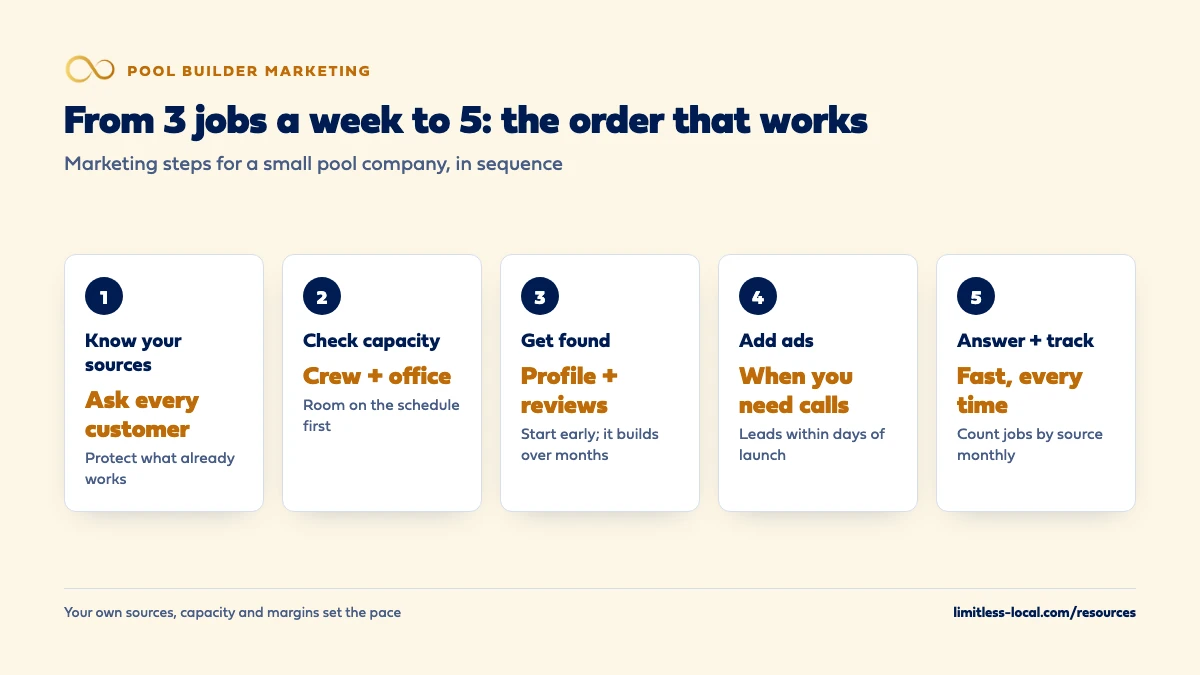
The short version
- Find out where your current jobs come from before you add anything.
- Check capacity: crew, your own time, the office and cash flow.
- Add demand in order: Google profile and reviews, past customers and referrals, then search ads.
- Answer fast, follow up, track every job to its source, and add a crew after a steady season.
For small pool operators who know the work inside out and want a clear order of marketing steps to add more jobs each week.
Get a free visibility audit · Book a growth call
How does a small pool company go from three jobs a week to five or more?
Start by finding where today’s 3 jobs a week come from and checking that your crew, office and cash flow can handle more. Then add demand in order: a complete Google Business Profile with steady reviews, a habit of asking every customer for reviews and referrals, and search ads once you need calls sooner. Answer fast and follow up on every estimate so new leads turn into jobs, track each job to its source, and add a crew only after the extra demand has held for a season.
This is the order our packages follow too: tracking and a clean online presence first, then local SEO and ads around the towns and jobs you want, then monthly improvement based on calls, leads and revenue. The Limitless Engine packages start with Essentials at $3,500 a month, with ad spend paid to Google directly. We’ve been on the owner’s side of this: the agency was an equity partner in a pool construction company, where it streamlined back-office operations, built the lead-generation engine and ran sales and marketing, and that business did $2M+ revenue in year one. See our pool builder marketing page, or browse the pool builder marketing questions library.
What does it take to grow past 3 jobs a week?
Three things, and most owners only think about the first: more homeowners asking for you, enough crew and office time to take the extra work, and a sales routine that turns inquiries into signed jobs without you on the phone at 9 pm. Three jobs a week usually means referrals and repeat customers are working. Getting past it means adding demand that doesn’t depend on who you already know, without breaking what’s working now.
If you know pools inside out but marketing is new to you, that’s normal. The steps below are in the order that tends to work for a small pool company, whether your jobs are renovations, resurfacing, equipment and repair work or smaller installs. For new builds, the same steps apply at a slower count. If your challenge is specifically moving beyond referrals with one crew, scaling a pool company past referrals and a single crew goes deeper on that.
Step 1: Where are my 3 jobs a week coming from now?
Before you add anything, find out what’s already working. Go through the last few months of jobs and write down where each customer came from: a past customer, a referral from a neighbor, a realtor or landscaper, your Google profile, your website, a truck sign, a home show. The SBA’s guide to getting the most from your marketing budget makes the same point: tracking can be as simple as asking new customers where they learned about your business.
You’ll usually find one or two sources doing most of the work. Those are the ones to protect and build on. Anything you’ve paid for that never shows up on the list is a candidate to cut.
Step 2: Can my business handle more than 3 jobs a week?
Check capacity before you turn up demand. More leads with no room on the schedule just means longer waits, rushed work and unhappy customers. Ask yourself:
- Crew time: how many jobs a week can your current crew and subs really finish well, in season?
- Your time: are you quoting, selling, ordering and working on site? Something has to come off your plate.
- The office: who answers the phone, books estimates and follows up while you’re on a job?
- Cash flow: can you carry materials and payroll for more jobs before the payments come in?
Pick a realistic target, say five jobs a week in season, and write down what has to change to hit it. Sometimes the first hire is an office person, not another tech.
Step 3: How many more leads do I need?
Work backward from your target. If you want two more jobs a week, and roughly one in three estimates turns into a job for you, you need six more estimates a week. If about two in three inquiries turn into an estimate, that’s nine more inquiries a week. Use your own rates; these are only there to show the math.
That number tells you how much new demand to build, and it keeps you from overspending. It also shows where the cheapest gains are: if your estimate-to-job rate is low, better follow-up can add jobs before you add a dollar of marketing. How many leads a pool builder needs to hit a revenue goal goes through the same math by revenue instead of job count.
Step 4: Get found by homeowners who don't know you yet
Your Google Business Profile is the cheapest source of new inquiries for most small pool companies. Google’s help page on improving your local ranking says local results are mainly based on relevance, distance and popularity, and that verified profiles with complete, accurate information are more likely to show up. In practice:
- Verify the profile and fill in every field.
- Choose the most specific category for the work you want more of.
- List the towns you serve, not a wide radius.
- Add real photos of your work every month.
- Ask every customer for a review.
Pair it with a simple website that has a page for each type of work you do, photos of real jobs and your phone number on every page. The local SEO tactics that work best for a pool builder ranks the rest. This step takes months to build, so start it first, even though ads will bring calls sooner.
Curious what your marketing is actually booking?
Get a free visibility audit — no obligation, no sales pitch.
Step 5: How do I turn past customers into the next jobs?
They’re your best source and the easiest to neglect. A few habits do most of the work:
- Ask for a review at the end of every job. Google lets you create a review link or QR code to text or email; it also prohibits offering anything in exchange for reviews.
- Ask for a referral at the same time, while the customer is happiest. Keep it simple: “If a neighbor asks about their pool, we’d love the introduction.”
- Stay in touch with past customers. A short seasonal email or text about opening, closing, equipment upgrades or resurfacing brings repeat work.
- Build relationships with realtors, landscapers and home builders who meet homeowners before you do.
If you also run service routes, your service customers are your warmest leads for renovation and equipment work. Make sure your techs know what to look for and who to tell.
Step 6: When should I add paid ads?
When you need calls sooner than the profile and referrals can deliver, and you have room on the schedule to take them. Ads can generate leads within days of launch, while SEO typically takes 3-6 months to show meaningful organic growth, so ads are how you fill the gap.
Start small and specific: search ads for the jobs you most want, in the towns closest to you. Google’s help on average daily budgets explains that you set a daily amount and that a month’s spend is capped at 30.4 times that daily budget for most campaigns, so a $1,500 monthly budget is about $49 a day. Keyword Planner’s forecasts can estimate clicks and cost for your keywords before you spend. Then judge the ads by jobs booked, not clicks. How many booked jobs a pool builder should expect from ads shows how to run that math.
Step 7: Answer fast and follow up so leads become jobs
More leads only help if someone answers. At three jobs a week, many owners take calls from the job site and return them at night, and that habit is what caps growth. Before the extra leads arrive:
- Name one person who owns new inquiries during business hours, with a backup.
- Answer calls live, and call back forms and voicemails within minutes.
- Send every estimate with a follow-up date, and actually follow up.
- Keep every lead in one place, a CRM or even a shared spreadsheet, with its source and next step.
Whether a 30-second or 2-minute callback is better for a pool builder sets the speed targets that matter.

Step 8: Track every job back to its source
Once you’re adding channels, you need to know which ones produce jobs, not just calls. Keep marking every lead’s source, and at the end of each month count jobs and revenue by source. Put more money behind what books work and cut what doesn’t. Keep a mix, though, so one source drying up doesn’t stall the whole business.
Call tracking makes this much easier once ads are running, because it shows which calls came from which ad or listing. Tracking which marketing produces signed pool contracts covers the setup.
When is it time to add a crew or hire?
When the extra demand has held up long enough that you’re turning down or delaying good work, not after one busy month. A season of steady inquiries above your capacity is a safer signal than a spike. Until then, subcontractors, overtime or a part-time helper can bridge the gap.
Often the first hire is in the office, not the field. Someone who answers the phone, books estimates and follows up frees you to sell and run jobs, which can add more weekly jobs than another tech would.
What usually goes wrong when a small pool company grows?
- Marketing before capacity. Leads arrive, the schedule slips, reviews suffer, and the growth reverses.
- Taking every job. Low-margin jobs fill the calendar and crowd out the work you want more of.
- Dropping prices to win volume. Three jobs at a fair price usually beat five at a thin one.
- Losing the referral engine. Busy owners stop asking for reviews and referrals just when they matter most.
- No tracking. Without sources, it’s impossible to tell which spending is growing the business.
Growth that lasts is boring: steady review asks, a fast phone, one channel added at a time, and a monthly look at the numbers.
Not sure which of these is costing you jobs?
A free visibility audit checks the Google profile, reviews, site and tracking, and shows what to fix first.
What's different about growing a small pool company
Seasonal capacity. Most pool work bunches into a few months. Five jobs a week in season and two in winter may be a better goal than five every week.
Mixed work. Many small pool companies do renovations, equipment, repairs and some installs. Decide which line you want more of, because each needs different marketing.
Weather and permits set the pace. Even with demand, rain delays and permit waits limit how many jobs a crew can finish, so plan capacity with buffer.
Customers come back. A pool needs equipment, resurfacing and remodeling over its life, so every customer you serve well is a future job and a referral.
A worked example: from 3 jobs a week to 5
These numbers are made up to show the method. A small pool company does three jobs a week in season, mostly from past customers and referrals. The owner wants five.
- Extra jobs needed: two a week.
- Estimates needed: about one in three estimates becomes a job, so six more estimates a week.
- Inquiries needed: about two in three inquiries get an estimate, so nine more inquiries a week.
Where the nine come from: a regular review and referral ask brings a couple more a week from past customers; the Google profile adds about one a week at first, growing over the season; search ads cover the other six. At a made-up $60 per inquiry, six a week costs $360 a week, about $1,560 a month in ad spend. Two more jobs a week, at a made-up $900 gross profit each, is $1,800 a week. Swap in your own rates, costs and margins before you commit.
Frequently asked questions
How long does it take to go from 3 to 5 jobs a week?
It depends on your market, budget and capacity. Ads can bring calls within days, while the Google profile and reviews build over months, so most owners see the first gains from ads and referrals and steadier growth over a season.
Should I spend more on marketing or hire first?
Check capacity first. If the schedule is already full, marketing will only lengthen the wait. If you have room, add demand, and hire once it has held for a season.
Do I need a website to grow past three jobs a week?
A simple one helps a lot. Homeowners who find you on Google often check your site for photos of real work before they call, and ads work better when they land on a page about the job.
Is social media worth it for a small pool company?
It can help homeowners who already know you remember you, and project photos do well. For new inquiries, the Google profile and search ads are usually more direct.
Should I take every job to grow faster?
No. Taking low-margin work fills the schedule without growing profit. Decide which jobs you want more of and aim your marketing at those.
Key takeaways
- Find out where your current three jobs a week come from before adding anything.
- Check crew, office and cash-flow capacity, and set a realistic in-season target.
- Work backward from the target to how many more inquiries you need, using your own rates.
- Add demand in order: Google profile and reviews, past customers and referrals, then search ads.
- Answer fast, track every job to its source, and add a crew only after a steady season.
Want a second set of eyes on your setup?
We'll look at how you show up locally and where calls are leaking, then send you a plain-English breakdown.
More in this section
- How does a pool builder scale past referrals and a single crew?
- How can a pool builder turn reviews and referrals into more jobs?
- Why does pool builder marketing take so long to produce jobs?
- How do pool builders keep leads coming in the off-season?
- How many hours a week does in-house pool builder marketing take?
Sources
- How to Get the Most From Your Marketing Budget — U.S. Small Business Administration
- Tips to improve your local ranking on Google — Google Business Profile Help
- Create a Google link or QR code to request reviews — Google Business Profile Help
- About average daily budgets — Google Ads Help
- About Keyword Planner forecasts — Google Ads Help