
What is a booked-job rate for plumbing leads?

- What does booked-job rate mean for a plumbing company's leads?
- What does booked-job rate mean for a plumbing company?
- How do I work out my booked-job rate?
- Which leads go into the count?
- What counts as booked?
- How is booked-job rate different from close rate and conversion rate?
- How do I compare plumbing lead sources by booked-job rate?
- Why do some lead sources book better than others?
- How many leads do I need before the rate means anything?
- How does booked-job rate turn cost per lead into cost per booked job?
- What drags a plumbing booked-job rate down?
- How can a small plumbing shop track it without new software?
- What's different about booked-job rate for plumbers
- A worked example: three lead sources, one month
- Frequently asked questions
- Key takeaways
- More in this section
- Sources
The short version
- Booked-job rate = booked jobs ÷ real leads × 100, for the same period.
- A real lead is a new customer asking for work you do, where you work.
- Booked means a date and time on the schedule, not a promise to call back.
- Work it out per lead source, then divide cost per lead by it to get cost per booked job.
For plumbing owners who track leads and cost per lead, and want one number that shows which of those leads actually land on the schedule.
Get a free visibility audit · Book a growth call
What does booked-job rate mean for a plumbing company's leads?
A booked-job rate is the share of your real plumbing leads that end up on the schedule as a job or an estimate visit: booked jobs divided by real leads from the same period, times 100. If 40 real leads came in last month and 22 got booked, your booked-job rate is 55%. Count only new customers asking for work you do in an area you serve, and work it out for each lead source, because that’s how you see whose leads actually turn into work.
Booked-job rate only works if every lead carries its source and every booking gets marked, which is the tracking side of marketing that owners skip most often. Every one of our packages includes call tracking with recording, source tagging, form and chat tracking, and a monthly report with a cost-per-lead breakdown, so the raw counts behind this number are there each month. Our plumbing marketing page shows how that fits a plumbing company, and the plumbing marketing questions library goes question by question.
What does booked-job rate mean for a plumbing company?
It’s the answer to a simple question: of the people who reached out wanting plumbing work, how many did you get on the schedule? A lead that turns into a drain cleaning on Tuesday at 10am counts. A lead that said “let me talk to my husband and call you back” doesn’t, at least not yet.
The number sits between two others you probably already watch. Cost per lead tells you what each real lead cost. Revenue per job tells you what the work was worth. Booked-job rate connects them, because a cheap lead that never books is worth nothing, and a pricey lead that books almost every time can be a bargain. If cost per lead is new to you, what cost per lead means in plumbing marketing covers it first.
When the phone rings but the trucks sit, a low rate points at the leads or how they’re handled, not at how many there are.
How do I work out my booked-job rate?
Booked-job rate = booked jobs ÷ real leads × 100
Three rules keep the number useful:
- Same period, same group. Count the leads that came in during the month, then count how many of those leads booked. Don’t divide this month’s bookings by last month’s leads.
- Same definitions every month. Decide once what counts as a real lead and what counts as booked, write it down, and don’t change it to make a month look better.
- Give late bookings a cut-off. Some customers book a week after the first call. Count a booking for the month the lead came in, and close the month out once a week or two has passed.
With the answer’s numbers: 22 booked out of 40 real leads is 22 ÷ 40 = 0.55, or 55%. The same office might book 70% of its phone calls and far fewer of its web forms, which is why the overall number is only the starting point.
Which leads go into the count?
A real lead is a new customer asking for work you do, in an area you serve. Calls, web forms, texts, chats and messages from Local Services Ads all count if they meet that test. Leave these out:
- Spam, robocalls and wrong numbers.
- Vendors, suppliers and people selling you something.
- Job seekers calling about a tech opening.
- Existing customers calling to reschedule, ask about an invoice or check on a part.
- Requests for work you don’t do, or from outside your service area.
- Duplicates: the same person calling twice and filling in a form counts once.
Software won’t sort this for you unless you set it up. ServiceTitan’s guide to call classifications warns that if you skip setting up call reasons, any call longer than 60 seconds is classified as a lead, which affects the CSR’s conversion rate and can leave your marketing reports unreliable. Housecall Pro’s call reports draw a similar line with “opportunity calls”: customer calls, not vendors or spam.
Out-of-area and wrong-service leads are worth counting separately even though they’re out of the rate. A lot of them means your ads or Google profile are pointed at the wrong places or jobs.
What counts as booked?
A lead is booked when it has a date and time on your schedule: a service call, a repair, or an estimate visit for something bigger like a repipe. Not booked yet:
- “Call me back with a price.”
- A quote emailed with no visit set.
- A voicemail you returned that hasn’t called back.
Decide whether estimate visits count, and stick with it. Counting them usually makes sense, because getting in the door is the office’s job and selling the work is the tech’s. If you count them, keep a second number for how many estimates turned into paid work, so a full calendar of estimates nobody buys doesn’t look like success.
What happens after booking matters too. A booked job that cancels or no-shows still counts as booked here, but track those separately. How many plumbing leads actually answer, book and pay follows a lead past the booking, through the visit and the invoice.
How is booked-job rate different from close rate and conversion rate?
They get mixed up all the time, and each one points at a different part of the business:
- Booked-job rate measures the office: real leads in, jobs and estimate visits on the schedule.
- Close rate measures the field: of the visits and estimates, how many became paid work. For bigger tickets like water heater replacements and sewer lines, this is the tech’s number. Whether a plumbing close rate under 30% is a worry depends on which of these you’re measuring.
- Conversion rate in Google Ads measures the ad: Google defines it as conversions divided by the ad interactions that can be tracked to a conversion. If your account counts phone calls as conversions, a call that never books still counts there.
Software adds to the confusion, because “conversion rate” means something different in each tool. In Housecall Pro, for example, the call conversion rate is the percentage of calls that turned into estimates or jobs. Before you compare a number with anyone else’s, check what’s on the top and bottom of the fraction.
Curious what your marketing is actually booking?
Get a free visibility audit — no obligation, no sales pitch.
How do I compare plumbing lead sources by booked-job rate?
Work out the rate for each source on its own: Google search ads, Local Services Ads, calls from your Google profile, your website’s organic traffic, lead-sharing sites, referrals and repeat customers. The overall rate hides the differences, and the differences are the point.
Your field software can usually do most of the counting if every job carries a lead source. Jobber’s lead source report shows, for each source, the number of leads, leads with a quote, leads with a job and leads with an invoice, plus the value of the first invoice. Housecall Pro’s conversion rate reports can group lead conversion by lead source too. Tracking which plumbing marketing books jobs covers setting up the sources so these reports mean something.
Then read the rates next to what each source cost. A source with a lower rate isn’t automatically worse; it may be much cheaper per lead. The comparison that settles it is cost per booked job, below.
Why do some lead sources book better than others?
Mostly because of what the customer was doing when they reached you:
- Someone searching “plumber” with water on the floor wants a truck now. If you answer, they usually book.
- A lead from a site that sends the same request to several plumbers is shopping. Whoever calls first and gives a straight answer on timing tends to win, so these book less often.
- A web form at 11pm might be a planned job like a water softener, or a customer who couldn’t get anyone on the phone. Fast follow-up the next morning decides it.
- A referral or a repeat customer already trusts you. These should book at the highest rate, which is why they belong in their own bucket and not mixed into paid marketing.
Handling matters as much as source. The same lead books at a different rate depending on how fast someone picks up, whether they can offer a time today, and whether they can answer “roughly what does that cost?” without dodging it. If one source looks weak, listen to a handful of its recorded calls before you cut it.
How many leads do I need before the rate means anything?
More than a week’s worth. With five leads, one booking more or less moves the rate by twenty percentage points, and that’s luck, not a trend. A source with only a handful of leads a month needs two or three months added together before you judge it.
Some practical rules:
- Look at the rate monthly, but judge a source on a rolling three months.
- Don’t compare a busy freeze month with a quiet spring month as if they’re the same.
- When you change something, like the call script or the ad’s towns, note the date so you can compare before and after.
How many plumbing leads it takes before marketing shows booked jobs goes deeper on how long to wait for a fair read.

How does booked-job rate turn cost per lead into cost per booked job?
Divide one by the other:
Cost per booked job = cost per lead ÷ booked-job rate
A source charging $80 a lead that books half its leads costs $160 per booked job. A source charging $40 a lead that books one in five costs $200 per booked job. The cheaper lead is the more expensive job.
That’s why booked-job rate should sit next to cost per lead in every monthly review. On its own, cost per lead pushes you toward cheap sources that keep the office busy and the trucks idle. The booked-job rate is what tells you whether the cheap leads are actually cheap.
What drags a plumbing booked-job rate down?
When the rate is low, the cause is usually one of these, roughly in order of how often it’s the culprit:
- Calls nobody answers, or calls that go to a voicemail box that’s full. How fast a plumbing office should answer a new call covers what to aim for.
- Slow callbacks on forms, texts and missed calls.
- No time to offer. If the schedule is full for three days, emergency callers go elsewhere.
- Dodging the price question. A range or a diagnostic fee said plainly books more than “we’ll have to see.”
- The wrong leads. Ads or listings pulling in towns you don’t serve or jobs you don’t do.
- Counting mistakes. Existing customers or vendors in the lead count make the rate look worse than it is.
The first four are fixed in the office, not in the marketing. That’s good news, because they’re cheaper to fix than buying more leads.
How can a small plumbing shop track it without new software?
A spreadsheet works. One row per new lead, with these columns:
- Date
- Source (where they found you)
- Real lead? (yes or no, and why not)
- Booked? (yes or no)
- Job type
- Invoice amount, filled in later
At month end, filter to real leads, count the yeses in the booked column, and divide. Do it by source and you have the whole picture on one tab.
If you use call tracking, mark each call as you go. CallRail, for example, lets you qualify leads by hand with a thumbs-up button, score a call with your keypad as soon as it ends, or set rules to do it automatically.
Want to see where your company stands?
A free visibility audit shows where you show up on Google, Maps and AI answers, and what it's costing you in calls.
What's different about booked-job rate for plumbers
Split emergency and planned work. A burst pipe call and a water softener inquiry behave differently. Emergency leads book fast or not at all; planned jobs often need an estimate visit and a follow-up. Mixing them in one rate hides both.
After-hours leads deserve their own line. Plumbing problems don’t wait for business hours. Track night and weekend leads separately, so you can see whether your after-hours setup is booking them or losing them to whoever answers.
Big tickets start as estimates. Repipes, sewer line replacements and water heater swaps often book as an estimate visit first. Count the visit as booked, then follow it to paid work, because one sold repipe can matter more than a month of small drain calls.
Freezes distort the month. A hard freeze floods the phones, the schedule fills, and the rate can fall simply because there’s no time left to offer. Note those weeks so you don’t blame the marketing.
A worked example: three lead sources, one month
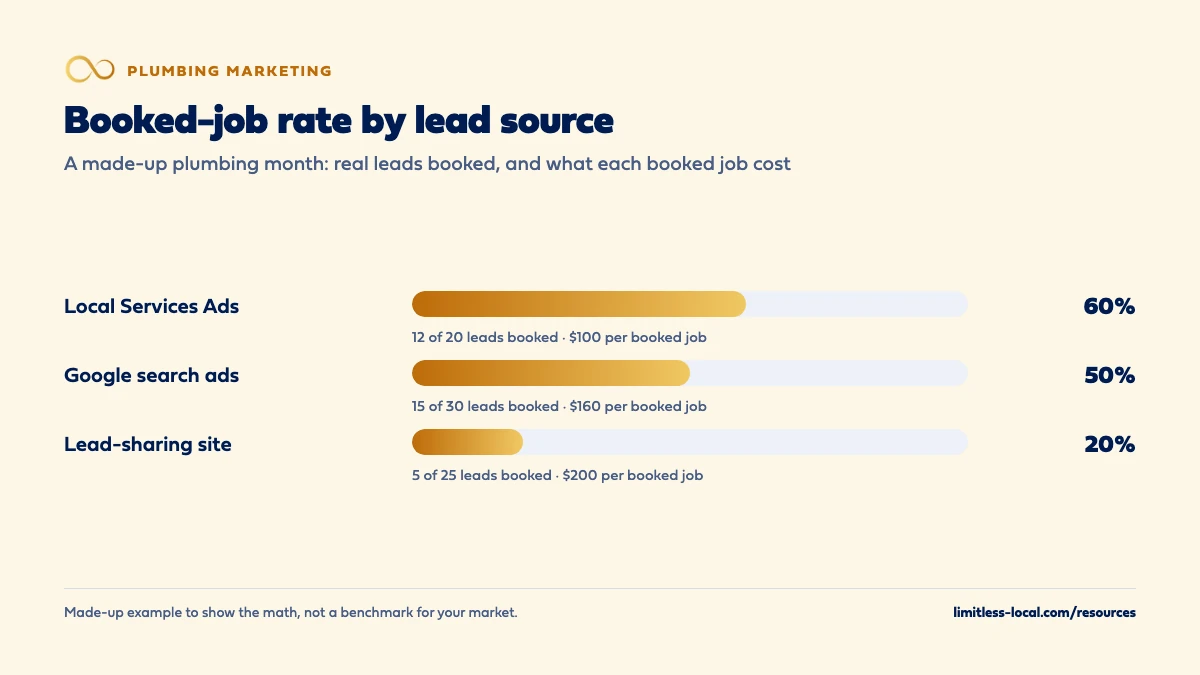
These numbers are made up to show the math, not a benchmark for your market. Say a plumbing company tracks three paid sources for a month:
- Google search ads: $2,400 spent, 30 real leads, so $80 a lead. 15 booked, a 50% booked-job rate. Cost per booked job: $2,400 ÷ 15 = $160.
- A lead-sharing site: $1,000 spent, 25 real leads, so $40 a lead. 5 booked, a 20% rate. Cost per booked job: $1,000 ÷ 5 = $200.
- Local Services Ads: $1,200 spent, 20 real leads, so $60 a lead. 12 booked, a 60% rate. Cost per booked job: $1,200 ÷ 12 = $100.
On cost per lead alone, the lead-sharing site looks like the winner. On booked-job rate and cost per booked job, it’s the most expensive of the three. The owner’s next step isn’t to cut it straight away: listen to its calls, check how fast the office followed up, and give it another two months before deciding.
Frequently asked questions
Should repeat customers count in my booked-job rate?
Not in the rate you use to judge marketing. Repeat customers and referrals book far more often than strangers, so mixing them in makes paid sources look better than they are. Track them as their own source.
Do Local Services Ads message leads count as leads?
Yes, if they’re a new customer asking for work you do in your area. Count them with the calls, but it’s worth checking their rate separately, since message leads often need a fast reply to book.
Is a higher booked-job rate always better?
Not if it comes from booking jobs you don’t want, like out-of-area calls or tiny jobs at a loss, or from quietly dropping hard leads from the count. A rising rate should come with steady or rising revenue per job.
What's a good booked-job rate for plumbing leads?
Compare it with your own trend by source first; that’s the number you can act on. For published benchmarks, what percentage of plumbing leads should turn into booked jobs covers them.
Who should keep track of it?
Whoever answers the phone marks real lead and booked on each contact as it happens, and the owner reviews the totals monthly. Leaving it all to month end means guessing.
Key takeaways
- Booked-job rate is booked jobs divided by real leads from the same period, times 100.
- Count only new customers asking for work you do in an area you serve; leave out spam, vendors and existing customers.
- Booked means a date and time on the schedule, and estimate visits count if you decide they do and stay consistent.
- Work it out for each lead source, and judge sources on a rolling three months.
- Cost per lead divided by booked-job rate gives cost per booked job, the number that settles which source wins.
Not sure what's working right now?
Start with a free visibility audit: rankings, Google profile, reviews and tracking, checked against your service area.
More in this section
- What percentage of plumbing leads should turn into booked jobs?
- How many leads and booked jobs does a plumber need monthly?
- How many plumbing leads before marketing shows booked jobs?
- What is a realistic cost per booked plumbing job by channel?
- How much do lead generation services cost for plumbers?
Sources
- Understand call classifications — ServiceTitan Help
- Conversion Rate Reporting — Housecall Pro Help Center
- Lead Source Report — Jobber Help Center
- Conversion rate: Definition — Google Ads Help
- How to qualify leads in CallRail — CallRail Help Center