
How many leads and booked jobs does a plumber need monthly?

- How many plumbing leads do I need each month to hit my growth goal?
- What's the formula for the leads and booked jobs a plumber needs?
- Step 1: How much revenue does marketing need to bring in?
- Step 2: What average ticket should I use?
- Step 3: How do I turn revenue into sold jobs?
- Step 4: What close rate should I use?
- Step 5: What booking rate should I use?
- Step 6: How do I turn the lead count into a budget?
- Can my crew handle that many booked jobs?
- Should I work out emergency and planned jobs separately?
- Which number should I improve first?
- How often should I redo the math?
- What makes this math different for plumbers
- A worked example: from a revenue goal to a lead count
- Frequently asked questions
- Key takeaways
- More in this section
- Sources
The short version
- Sold jobs = revenue goal ÷ average ticket.
- Booked jobs = sold jobs ÷ close rate.
- Leads = booked jobs ÷ booking rate.
- Use your own numbers, split by emergency and planned work.
- Check the result against what your crew can really run.
For plumbing owners with a revenue target in mind who want to turn it into a number they can manage: how many leads, booked jobs and sold jobs each month.
Get a free visibility audit · Book a growth call
How many plumbing leads do I need each month to hit my growth goal?
Work it backward from the new-customer revenue you want marketing to bring in each month: divide it by your average ticket to get sold jobs, divide that by your close rate to get booked jobs, and divide that by your booking rate to get leads. With made-up numbers, $40,000 at a $400 average ticket is 100 sold jobs; if 80% of visits turn into paid work, that’s 125 booked jobs, and if the office books 50% of real leads, that’s 250 leads a month. Use your own numbers from your field software, because a small change in any one of them moves the lead count a lot.
Once you know how many leads you need, the next question is where they come from and what each booked job costs. Every one of our packages includes call, web and form tracking with a monthly report that breaks down cost per lead, and a real-time dashboard, so the inputs to this math come from tracked calls instead of guesses. Our plumbing marketing page shows how we work with plumbing companies, and the plumbing marketing questions library covers budgets, booking and tracking one question at a time.
What's the formula for the leads and booked jobs a plumber needs?
Three divisions, starting from money and ending at leads:
- Sold jobs = new-customer revenue goal ÷ average ticket
- Booked jobs = sold jobs ÷ close rate
- Leads = booked jobs ÷ booking rate
Each step has its own definition, so keep them straight:
- A lead is a real new-customer call, text or form asking for work you do, in an area you cover. Wrong numbers, sales calls and existing customers don’t count.
- A booked job is a lead the office turned into a scheduled visit.
- A sold job is a visit where the homeowner paid for the work, beyond any trip or diagnostic fee.
The math is simple. The hard part is getting honest inputs, which is what the next few steps cover. If you’d rather start from a daily job target than a revenue goal, what marketing gets a plumbing company to two jobs a day runs the same idea from the other end.
Step 1: How much revenue does marketing need to bring in?
Not your whole revenue goal; only the part that has to come from new customers. Start with what you want to invoice in a month, then take out what arrives without marketing:
- Repeat customers who call you again on their own.
- Maintenance plan visits already on the calendar.
- Referrals from past customers, builders or property managers.
- Commercial accounts with steady work.
What’s left is the gap marketing has to fill. A shop that wants $100,000 a month and already gets $60,000 from repeat work, plans and referrals needs marketing to bring in about $40,000.
If you’re not sure what that split looks like for your shop, pull last year’s jobs by lead source and add up revenue for each one. Jobber’s lead source report, for example, tracks the number of leads from each source and the first revenue tied to them, and other field software has its own version.
Step 2: What average ticket should I use?
Your own, from new-customer jobs only, and split by job type if you can. Housecall Pro’s dashboard reports define average job size as the total revenue from completed jobs divided by the number of completed jobs. Check your own field software for its version of the same report.
Three adjustments make it more useful for this math:
- Use new customers only. Repeat customers and plan members often have a different ticket.
- Use at least a few months, ideally a full year, so one big week or one slow week doesn’t skew it.
- Split emergency and planned work. A drain clearing and a water heater replacement are very different tickets, and blending them hides the difference.
How much an average plumbing job ticket brings in walks through working it out by job type.
Step 3: How do I turn revenue into sold jobs?
Divide the revenue marketing needs to bring in by your average ticket. That’s the number of paid jobs from new customers you need in a month.
- $40,000 ÷ $400 average ticket = 100 sold jobs.
- If your ticket were higher because more of your work is water heaters and sewer lines, you’d need fewer.
- If most of your new-customer work is small service calls, you’d need more.
This step is where job mix matters most. Moving even a few jobs a month from small calls to big-ticket work can cut the number of sold jobs you need more than any marketing change. That’s one reason many plumbers aim part of their marketing at water heaters, repipes and sewer work rather than “plumber near me” searches.
Step 4: What close rate should I use?
The share of booked visits where the homeowner paid for the work, from your own jobs. If your field software tracks estimates, use its estimate conversion report, which counts the estimates approved out of all estimates, won, lost and still open.
For plumbing, it helps to work out two close rates:
- Service calls: most visits for an active problem end with a paid repair, so this rate is usually high.
- Estimates for bigger work: water heaters, repipes and sewer replacements get compared against other quotes, so this rate is usually lower.
Count trip-fee-only and no-charge visits as not sold, or the rate will look better than it is. Whether to worry if your plumbing close rate is under 30% helps you judge what your number is telling you.
Curious what your marketing is actually booking?
Get a free visibility audit — no obligation, no sales pitch.
Step 5: What booking rate should I use?
The share of real leads your office turns into a scheduled visit. The same Housecall Pro conversion report has a call version that counts the share of calls that turned into estimates or jobs, and ServiceTitan lists unbooked calls on each call taker’s scorecard so a manager can follow up on them.
Get the number right by counting only real leads. If you divide booked jobs by every call that rang, including wrong numbers, existing customers checking on a visit and sales calls, your booking rate will look worse than it is and your lead target will be too high.
This is also the step where the most money hides. Every lead the office doesn’t book is a lead you paid for and lost. What percentage of plumbing leads should turn into booked jobs shows what a good number looks like and how to lift yours.
Step 6: How do I turn the lead count into a budget?
Multiply the leads you need by what a lead costs in each channel, or multiply booked jobs by your cost per booked job. Use whichever number you track more reliably.
- By lead: leads needed × cost per lead.
- By booked job: booked jobs needed × cost per booked job.
Then check the result against what those jobs earn. If the marketing would cost more than the gross profit on the sold jobs it brings in, the plan doesn’t work as written. Lift the booking rate, raise the ticket with better job targeting, or set a smaller goal for now.
Leads that already come in for free, like Google profile calls and referrals, lower the number you need to pay for. How much a plumber should budget to book a set number of jobs covers the budget side in more detail.
Can my crew handle that many booked jobs?
Check before you buy the leads. Divide booked jobs by the days you work and the techs you have:
- 125 booked jobs ÷ 22 working days is about six new-customer visits a day.
- With three plumbers, that’s two new-customer visits each per day, on top of repeat customers, plan visits and callbacks.
If that’s more than the schedule can hold, you have three choices: hire before you scale the marketing, lower the goal, or shift toward bigger tickets so the same revenue takes fewer visits. Buying leads the crew can’t reach just pays for jobs another plumber ends up doing.
Go the other way, too. If you have a plumber with empty slots most days, that’s revenue you’re already paying for in wages. Work out how many booked jobs would fill those slots, and use that as your floor.
Should I work out emergency and planned jobs separately?
Yes, if they’re a real part of your mix. The two behave differently at every step:
- Average ticket: emergency repairs are often smaller per visit than a planned water heater or sewer replacement.
- Close rate: emergency visits usually end in a paid fix; planned estimates get compared and close less often.
- Booking rate: emergency callers book fast or call someone else; planned-job callers may take a few calls to schedule.
- Marketing: they come from different searches and often different campaigns.
Run the three divisions once for each type, then add the lead counts. You’ll often find you need lots of emergency leads to hit a revenue goal, but only a handful of extra planned-job leads would cover the same gap.
Which number should I improve first?
Usually the booking rate, because it’s the cheapest to fix and it works on every lead you already have. Using the made-up numbers from the answer:
- At a 50% booking rate, 125 booked jobs takes 250 leads.
- At a 60% booking rate, it takes about 208 leads, with no change to the marketing.
Close rate is next. Raising it from 80% to 90% turns 100 sold jobs into about 111 booked jobs instead of 125, and the lead count falls to about 222 at the same 50% booking rate.
Average ticket matters too, but it moves slower, because it depends on your pricing and the kind of work you go after. Buying more leads should be the last lever, not the first, because it’s the only one that costs more every month.
How often should I redo the math?
Every quarter, and whenever something big changes: a new plumber, a new town, a price change or a season that’s always busy for you. Plumbing demand shifts with the weather, so a lead target that’s right in a quiet spring is wrong for a freeze-heavy winter.
Keep a simple sheet with the inputs for each month: new-customer revenue, average ticket, close rate, booking rate and leads. After a few months, you’ll see which input moves most, and that’s where to focus.
Talk it through with someone who runs this every day
A 15-minute growth call: your market, your numbers, and what a realistic budget looks like. No pressure.
What makes this math different for plumbers
Big tickets swing the average. One repipe or sewer line replacement can be worth many service calls. A month with two of them makes the average ticket look better than a normal month, so use a long period, or split big-ticket work out.
Emergencies close well but are smaller. Plumbing is emergency-heavy. Emergency calls usually book and close at a higher rate than planned work, but each one often brings in less. A goal built only on emergency calls needs a lot of leads.
Repeat work is a big share. Plumbing customers call again when something else breaks, and maintenance plans bring them back on schedule. The more of that you have, the smaller the gap marketing needs to fill.
The weather moves demand. A hard freeze can send more calls in a week than a quiet month. Work out a target for normal months, and plan surge weeks separately.
A worked example: from a revenue goal to a lead count
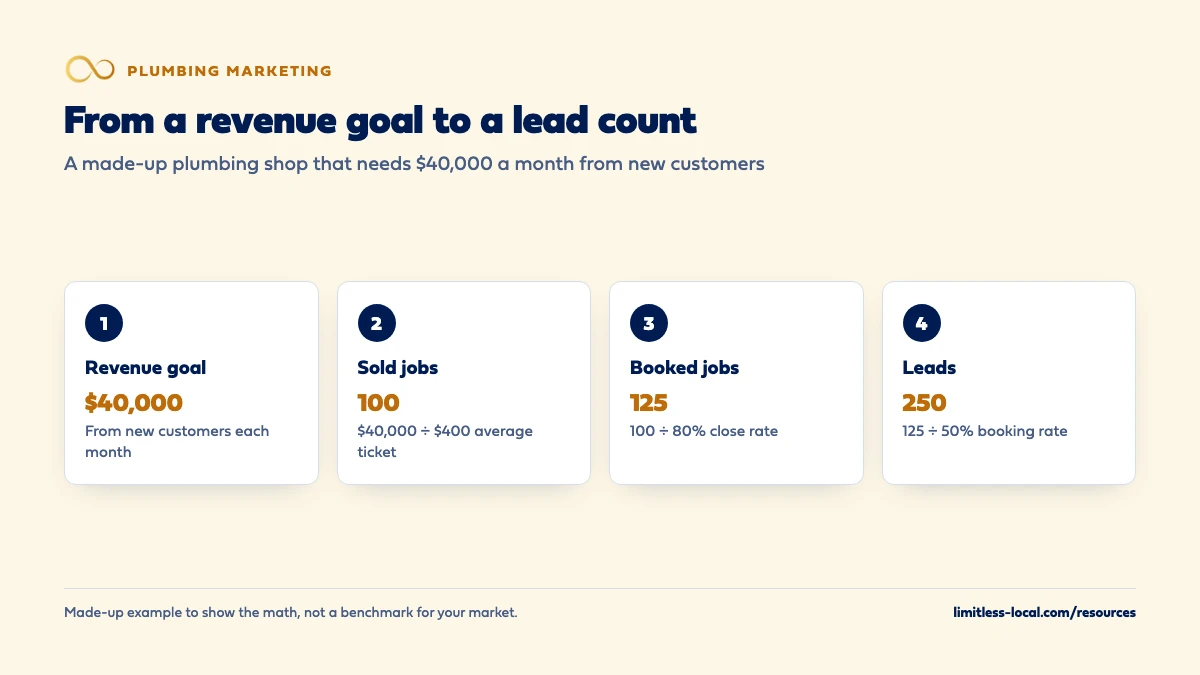
These numbers are made up to show the math, not a benchmark for your market. A three-plumber shop wants $100,000 a month. Repeat customers, maintenance plans and referrals already bring in about $60,000, so marketing needs to bring in $40,000 from new customers.
- Sold jobs: $40,000 ÷ $400 average new-customer ticket = 100.
- Booked jobs: 100 ÷ 80% close rate = 125.
- Leads: 125 ÷ 50% booking rate = 250.
- Budget: at a made-up $60 per lead, 250 leads cost $15,000, or $150 per sold job.
- Crew check: 125 booked jobs over 22 working days is about six new-customer visits a day, or two per plumber.
Now the owner sees the cheapest lever. Lifting the booking rate to 60% would cut the leads needed to about 208, saving the cost of 42 leads a month without touching the ads.
Frequently asked questions
Should I count repeat customers as leads?
Not in this math. They come in without new marketing, so count their revenue in the part you already have, and keep the lead count for new customers only.
What if I don't know my close rate or booking rate yet?
Start tracking them this month by putting a lead source and an outcome on every new-customer call and job. Until you have a few months of data, run the math with cautious guesses and replace them as your own numbers come in.
Do form fills and texts count as leads?
Yes, if they’re real new customers asking for work you do. Count them with calls, but check their booking rate separately, because forms and texts often book at a different rate than calls.
Should I set a lead target for each channel?
Set the total first, then split it by what each channel has really delivered. A channel’s share should follow its cost per booked job, not a guess at what it could do.
What if the lead count looks impossible?
Look at the inputs before the goal. A higher booking rate, a better close rate on estimates or more big-ticket work can cut the lead count a lot. If it still doesn’t fit, set a smaller goal and grow toward the bigger one.
Key takeaways
- Work backward: revenue goal ÷ average ticket ÷ close rate ÷ booking rate gives the leads you need.
- Count only the revenue marketing has to bring in, not repeat customers, plans and referrals.
- Use your own numbers, and split emergency and planned work if both matter to you.
- Check the booked-job count against what your crew can really run.
- Improve the booking rate first; it’s the cheapest way to need fewer leads.
Ready to compare options?
Book a short growth call and we'll walk through the math for your service area, including when we're not the right fit.
More in this section
- How many plumbing leads before marketing shows booked jobs?
- What percentage of plumbing leads should turn into booked jobs?
- How much should a plumber budget to book a set number of jobs?
- How do I get more plumbing leads?
- How many hours a week should a plumber spend on marketing?
Sources
- Dashboard Reports Overview — Housecall Pro Help Center
- Conversion Rate Reporting — Housecall Pro Help Center
- Find and manage abandoned and unbooked calls — ServiceTitan Help
- Lead Source Report — Jobber Help Center