
How do I get more Google reviews after a roof replacement?
- What's the best way to ask for a Google review when a roof replacement is finished?
- Why do roof replacements get fewer reviews than they should?
- Who on my team should ask for the review?
- When is the right moment to ask after a roof replacement?
- What should we actually say when we ask?
- How do we get the review link to the homeowner?
- Should we follow up if the homeowner doesn't leave one?
- What can't I offer or say to get more reviews?
- Can I ask customers from past roof replacements?
- How should I handle a review that isn't five stars?
- How do I know if the review process is working?
- What's different about reviews for roofing companies
- A worked example: what asking every time adds up to
- Frequently asked questions
- Key takeaways
- More in this section
- Sources
The short version
- Give one person the ask on every replacement, and ask at the final walkthrough after cleanup.
- Text the Google review link the same day, then send one reminder, not five.
- Ask every customer the same way: no discounts, no asking only the happy ones, no telling them what to say.
- Track whether the ask happened on each job, not how many stars came back.
For roofing company owners who finish good replacements every month but don’t see the Google reviews to show for it.
Get a free visibility audit · Book a growth call
What's the best way to ask for a Google review when a roof replacement is finished?
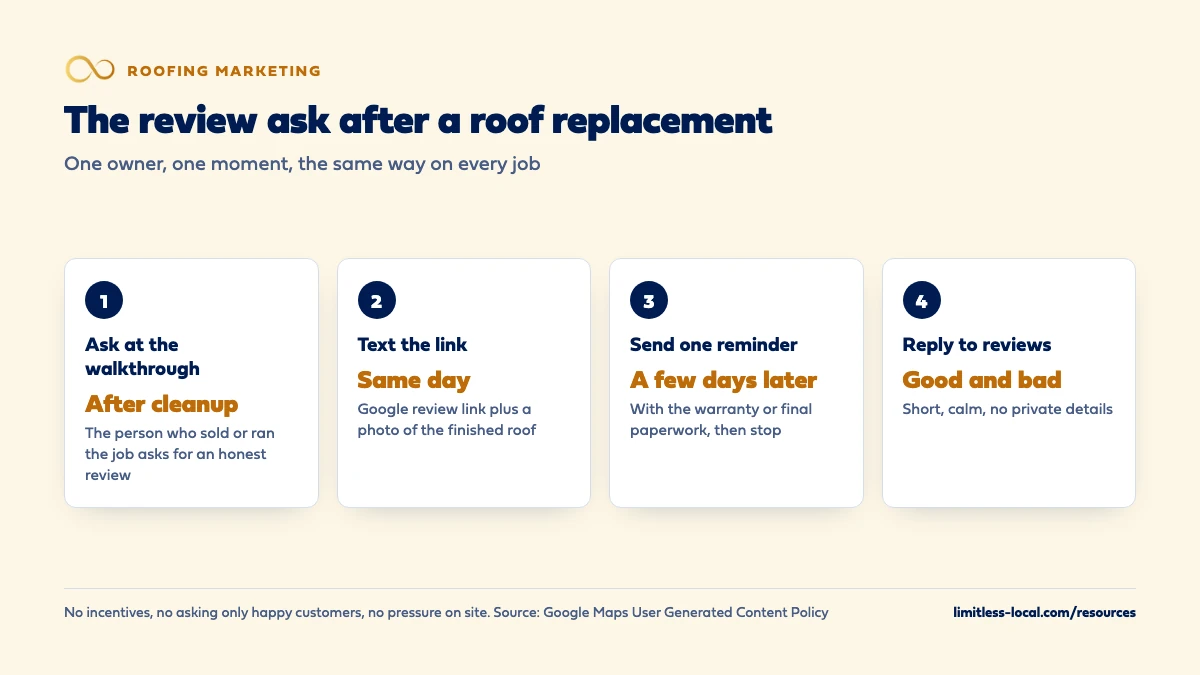
Make one person responsible for the ask on every replacement, usually whoever sold the job or ran it, and ask at the final walkthrough, once the crew has cleaned up and the homeowner has seen the finished roof. Text your Google review link the same day, with a photo of the finished roof, and send one reminder a few days later. Google lets you ask every customer for an honest review, but not offer a discount or gift for one, ask only the happy customers, pressure people on the spot, or tell them what to write.
Reviews matter twice for a roofer: they help decide who a homeowner calls, and Google lists review count and rating among the things that help local ranking. That’s why review response and review generation are part of our local SEO work for roofing companies. For where reviews fit among every other lead source, our guide on how to get roofing leads covers the full list, and the roofing marketing questions library takes them one at a time.
Why do roof replacements get fewer reviews than they should?
A roof replacement is a big, visible job, and most homeowners are happy when it’s done well. The reviews still don’t come, and in our judgement the reasons are almost always about process, not customers:
- Nobody owns the ask. The salesperson moved on to the next estimate, the crew lead doesn’t talk to the homeowner much, and the office assumes someone else did it.
- The homeowner wasn’t there. Many replacements happen while the owners are at work, so there’s no natural moment at the end of the day.
- The ask gets buried. The last conversation is about the final invoice, the warranty, or the insurance paperwork, and the review never comes up.
- The link isn’t handy. It lives on a computer in the office instead of on the phone of the person standing in the driveway.
Each of those has a fix below. None of them needs a bigger budget.
Who on my team should ask for the review?
One named person per job, decided before the job starts. For most roofing companies that’s the salesperson or project manager who sold or ran the job, because they’re the one the homeowner knows. If your crews are subcontracted or rotate between jobs, the ask belongs to your own person, not the crew.
Two rules from Google’s Maps content policy matter here. Businesses can’t ask staff to bring in a certain number of reviews, and can’t ask staff to request reviews with specific content, including content that names a staff member. That rules out the common setup where each rep has a monthly review target and asks customers to mention them by name. Reward the person for asking on every job, which is fully in their control, instead of for reviews, which aren’t.
Also keep your own people out of it. Google’s policy doesn’t allow reviews based on a conflict of interest, including current or former employment or family ties, so your crew, office staff and relatives shouldn’t be reviewing the company.
When is the right moment to ask after a roof replacement?
Google doesn’t set a timing rule, so this is our judgement. Ask when the homeowner can see the finished result and nothing is left undone:
- At the final walkthrough. After the cleanup and nail sweep, when you walk the property together and the homeowner sees the new roof from the street.
- If they weren’t home. The same evening, by text, with a photo or two of the finished roof and the review link. The photo gives them something to react to.
- Not mid-job. A torn-off roof under a tarp is not the moment, however friendly the conversation.
- Not as a condition of anything. Keep the ask separate from the final payment, the warranty paperwork and any insurance paperwork, so it never sounds like one depends on the other.
If there’s a punch list item still open, finish it first and ask after. A homeowner waiting on one missing piece of trim will tell Google about the trim.
What should we actually say when we ask?
Short, the same on every job, and with nothing that steers the rating. Something like:
“Thanks for trusting us with your roof. Reviews make a real difference for a local roofing company like ours. I’m texting you our Google review link now, and if you have a minute this week, we’d really appreciate an honest review.”
What’s left out is on purpose. No “five stars”, no “if you were happy”, no “mention Mike”, and no gift card, discount on gutters or drawing entry. Google says businesses shouldn’t request that specific content be included, and shouldn’t require or pressure people to leave ratings or write reviews while on the premises. In a homeowner’s driveway, our reading is: ask once, hand over the link, and leave them to do it on their own time instead of waiting while they type.
Curious what your marketing is actually booking?
Get a free visibility audit — no obligation, no sales pitch.
How do we get the review link to the homeowner?
Google gives every Business Profile a review link and a QR code. Google suggests putting them on receipts and in thank-you emails, and says you can also send review requests by email, WhatsApp message or Facebook post. For a roofing company, that usually means three places:
- A text from the person who asked, sent before they leave the driveway, with the link and a photo of the finished roof.
- The closing paperwork. A small QR card in the folder with the warranty and invoice.
- The thank-you email your office or job software sends when the job closes.
Two details trip people up. Review QR codes can only be created from a computer browser, not a phone, so the office should make the cards. And Google says customers must be signed into a Google Account to leave a review, though the account can use a non-Gmail email address. If a homeowner says they don’t have Gmail, that’s not a dead end.
Should we follow up if the homeowner doesn't leave one?
Once. In our judgement, one reminder a few days after the walkthrough, sent to every customer the same way, catches the people who meant to do it and forgot. Roof replacements give you a natural reason to reach out: sending the warranty registration or the final paperwork. Put the link in that message with a short line asking for an honest review.
After that, stop. Repeated reminders start to feel like pressure, and an annoyed homeowner is not who you want writing about you. If you use automated follow-up in your job software, make sure the review request and the reminder go to every completed replacement, not only to jobs someone tagged as happy.
Once the reviews are coming in, put them to work on your own site too; what a roofing website needs to get more estimate requests covers where they belong.
What can't I offer or say to get more reviews?
Google’s line is clear. Its Maps content policy says businesses must not:
- Offer incentives, such as payment, discounts or free goods or services, in exchange for posting a review, or for changing or removing a negative one.
- Discourage or prohibit negative reviews, or selectively ask only happy customers for positive ones.
- Require or pressure customers to leave reviews while on the premises, or request specific content.
Google treats incentivized reviews as fake engagement and removes them, and its help pages say reviews removed for policy violations won’t be restored.
The FTC adds its own rules of thumb in its 2022 guide to soliciting reviews: don’t ask only customers you think will be positive, don’t have staff or family review you without disclosing the connection, and know that you can be held responsible for what a reputation company does on your behalf. A company promising a flood of five-star reviews for your roofing business is a risk to your profile, not a shortcut. This is general information, not legal advice.
Can I ask customers from past roof replacements?
Yes. A homeowner whose roof you replaced last spring had a genuine experience with your company, and Google’s policy allows asking for reviews of genuine experiences. Pull the list of completed replacements from your job software and send each one the same short request with the link. Don’t filter the list down to the customers you remember being happy, since selectively asking for positive reviews is exactly what Google doesn’t allow.
Expect the reviews to trickle in rather than appear all at once. Google says reviews are checked against its policies and that this can take a few days, which can delay when a review shows up. A slow winter month is a good time to work through the list; marketing a roofing company in the slow season covers what else to do with that stretch.
How should I handle a review that isn't five stars?
Reply to it, calmly and briefly. Google’s tips for review replies say honest and balanced reviews can help potential customers decide, and that a mix of positive and negative feedback often feels more trustworthy. Acknowledge the problem, don’t share the customer’s private details, and offer to sort it out by phone.
What you can’t do is lean on the reviewer. The FTC’s reviews and testimonials rule prohibits threats or intimidation to get a review removed or changed, and making accusations about a reviewer that you know are false, or make with reckless disregard for the truth. If a review is fake or breaks Google’s rules, report it instead; what to do about an unfair Google review walks through that process.
How do I know if the review process is working?
Track the ask, not the stars. Add a yes-or-no field at job close in whatever you run the business on, and check once a month what share of completed replacements got an ask and a text with the link. That number is in your team’s control, so it’s fair to coach on.
Then watch three company-wide numbers once a month: completed replacements, new Google reviews and your average rating. Keep those totals at the company level rather than ranking reps by reviews, which drifts back toward the quotas Google doesn’t allow.
One setting helps too. Google says customers reviewing a service business may be asked to pick which tasks you did, and those choices can come from your services list. Make sure roof replacement, repair and the other work you want to be known for are listed on your Business Profile. If reviews are rolling in but you still don’t show up in Maps, why a roofing company isn’t showing up on Google Maps covers the other causes.
Not sure which of these is costing you jobs?
A free visibility audit checks the Google profile, reviews, site and tracking, and shows what to fix first.
What's different about reviews for roofing companies
Fewer jobs, so each one counts. A service trade might close dozens of small calls a week. A roofing company finishing a handful of replacements doesn’t get many chances, so in our judgement skipping the ask on even a few jobs a month shows up quickly in how recent your reviews look.
Storm seasons come in waves. After a big storm you may finish a run of replacements close together, then go quiet. Keep the ask the same on every job in a busy stretch, when it’s easiest to forget, and use the quiet months to ask past customers.
Insurance jobs. Many replacements involve a homeowner’s insurance claim. Keep the review request completely separate from the claim and from any money conversation, and never tie a discount or a deductible favor to a review. That’s both Google’s incentive rule and plain good sense.
The homeowner may never meet the crew. On many replacements the salesperson is the only face the homeowner knows. That’s why the ask belongs to them, not to whoever happens to be on the roof that day.
A worked example: what asking every time adds up to
These numbers are made up to show the math, not a benchmark for your market. Say your company finishes 14 roof replacements a month, and right now someone remembers to ask for a review on about 5 of them. If about 1 in 3 homeowners who are asked goes on to post a review, that’s roughly 20 new reviews over a year from replacements.
Now make the ask a step in closing out every replacement, with the link texted the same day and one reminder. That’s 168 asks over a year, and at the same 1 in 3, about 56 reviews. Same crews, same customers, nearly three times the reviews, and nobody was offered a discount or given a quota.
The share of asked homeowners who actually post varies a lot, so measure your own for a couple of months before you plan around it. If you’d rather have help, review response and basic review generation are part of our Essentials package at $3,500 a month, and Growth at $4,500 a month adds advanced review generation.
Frequently asked questions
Can I give homeowners a gift card for leaving a review?
Not for Google reviews. Google’s policy prohibits offering payment, discounts or free goods or services in exchange for a review, and it removes incentivized reviews.
Can I ask customers to mention my salesperson by name?
No. Google’s policy says businesses shouldn’t request specific content in reviews, and it names asking staff to get reviews that identify a staff member as something it doesn’t allow. If customers mention someone on their own, that’s fine.
Do homeowners need a Gmail address to leave a review?
They need to be signed into a Google Account, but Google says that account can be set up with a non-Gmail email address.
Can I ask for a review before the job is finished?
You can, but in our judgement you shouldn’t. The review should reflect the whole job, and a homeowner looking at a half-finished roof or an open punch list has less to say and more to worry about.
Why did a customer's review not show up on my profile?
Google checks reviews against its policies, which can take a few days. Reviews that Google removes for policy violations won’t be restored.
Do more reviews help my roofing company show up on Google Maps?
They can. Google says popularity is based partly on how many reviews you have, and that more reviews and positive ratings can help your local ranking. Reviews are one factor among several, not a switch.
Key takeaways
- Make one person responsible for the review ask on every replacement, usually whoever sold or ran the job.
- Ask at the final walkthrough after cleanup, text the link the same day, and send one reminder.
- Never offer incentives, ask only happy customers, pressure people on site or request specific wording.
- Past replacement customers can be asked too, as long as you ask all of them the same way.
- Reply calmly to every review, and never threaten or lean on an unhappy reviewer.
- Track whether the ask happened on each job, and keep review totals at the company level.
Want a second set of eyes on your setup?
We'll look at how you show up locally and where calls are leaking, then send you a plain-English breakdown.
More in this section
- How many new Google reviews a month should a roofer get?
- What should a roofer do about an unfair Google review?
- Can a roofer offer a discount in exchange for Google reviews?
- Do roofing reviews on Facebook, Yelp, or the BBB matter?
- Why isn't my roofing company showing up on Google Maps?
Sources
- Prohibited & restricted content — Maps User Generated Content Policy Help
- Tips to get more reviews — Google Business Profile Help
- Create a Google link or QR code to request reviews — Google Business Profile Help
- About missing or delayed reviews — Google Business Profile Help
- About reviews for service businesses — Google Business Profile Help
- Tips to improve your local ranking on Google — Google Business Profile Help
- Soliciting and Paying for Online Reviews: A Guide for Marketers — Federal Trade Commission
- The Consumer Reviews and Testimonials Rule: Questions and Answers — Federal Trade Commission