
Should an electrician add budget to LSAs, Google Ads, SEO or GBP?

- Where should an electrician put the next marketing dollar once LSAs, Google Ads, SEO and the Google profile are running?
- What changes once these channels are already running?
- How do I tell which channel has room to grow?
- When should the next dollar go to Local Services Ads?
- When should the next dollar go to Google search ads?
- When should the next dollar go to SEO?
- When should the next dollar go to my Google Business Profile?
- How do I compare cost per booked job fairly across channels?
- What if more budget isn't the answer at all?
- How much should I add at a time, and when do I judge it?
- What order makes sense for most electrical shops?
- What's different about this decision for electricians
- A worked example: where the next $500 goes
- Frequently asked questions
- Key takeaways
- More in this section
- Sources
The short version
- Add to the channel that runs out of budget and books jobs cheaply.
- LSAs: add when you hit the monthly limit early.
- Google Ads: add when profitable campaigns lose impressions to budget.
- Fix a weak Google profile first; add to SEO for the long run.
For electrical contractors who already have marketing running and want to know which channel deserves the next dollar, not which one to start with.
Get a free visibility audit · Book a growth call
Where should an electrician put the next marketing dollar once LSAs, Google Ads, SEO and the Google profile are running?
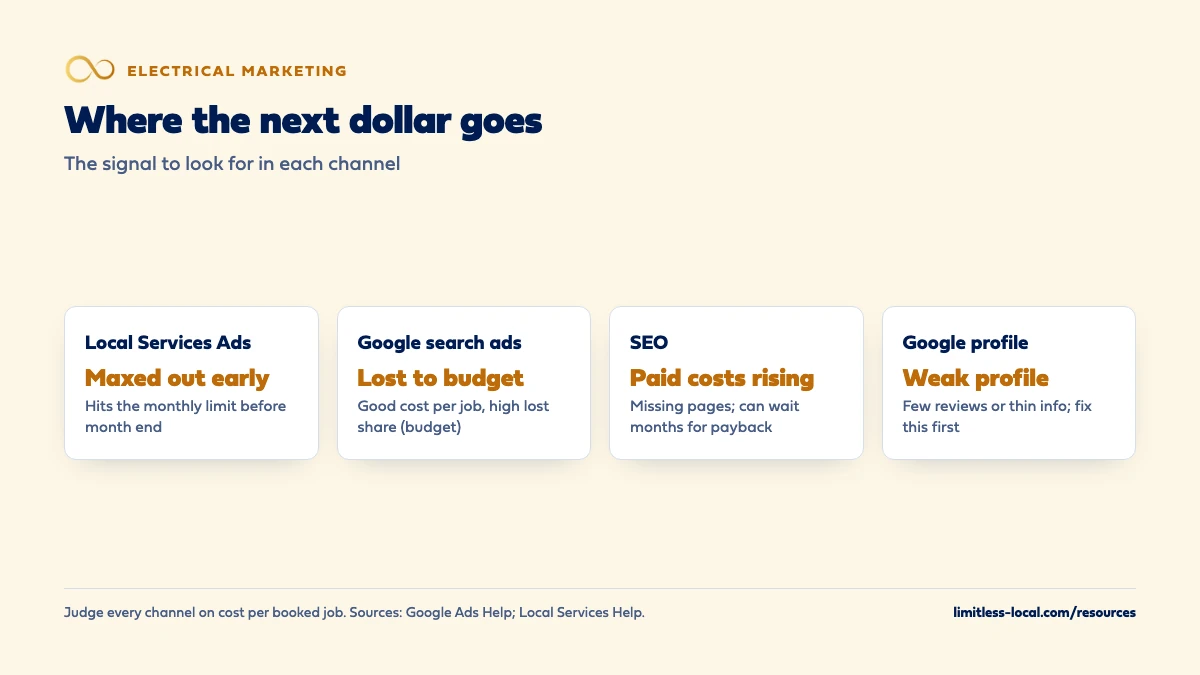
Put the next dollar where a channel is clearly running out of budget while booking jobs at a cost per job you’re happy with. That’s usually Local Services Ads if they hit their monthly limit before the month ends, or Google search ads if a profitable campaign is losing impressions to budget, not to rank. If your reviews or Google Business Profile are weak, fix those first, because they hold back both the map pack and your Local Services Ads. Add to SEO when paid leads keep getting more expensive and you can wait months for the return.
Google Ads and Local Services Ads management are part of our local ads work, with Local Services Ads from the Growth tier up. Monthly optimization based on calls, leads and revenue is how we decide where any extra money goes. Our electrical contractor marketing page explains how we work with electrical shops, and the rest of the electrical marketing questions library goes question by question.
What changes once these channels are already running?
Starting out, the question is which channel to try first, and that one’s covered in whether to start with LSAs, Google Ads or SEO. Once you’re running, the question changes. You now have numbers, and the next dollar should go where it buys the most booked jobs at a cost you’re happy with.
The four options don’t work the same way:
- Local Services Ads (LSAs) and Google search ads turn money into leads fast. Ads can bring in leads within days of launch.
- SEO turns money into pages and links that bring calls you don’t pay for one by one, but it typically takes 3-6 months to show meaningful organic growth.
- Your Google Business Profile (GBP) isn’t something you can buy placement in. Money there buys time: photos, posts, review requests and keeping your information right.
So the comparison isn’t just cost per lead. It’s cost per booked job now, plus what each channel builds for later.
How do I tell which channel has room to grow?
Each paid channel tells you when it’s held back by money rather than by something else:
- Local Services Ads: Google’s page on editing your budget says that once you hit your monthly max, your ad won’t appear for the rest of the month unless you adjust the budget. If that happens before the month ends, you’re turning away leads.
- Google search ads: a campaign marked “Limited by budget” or a high Search lost impression share (budget) means your ads are missing searches because the money ran out. Google’s page on getting impression share data defines it as the percentage of time your ads weren’t shown on the Search Network due to insufficient budget.
Then check the other side: lost impression share (rank) is the time your ads weren’t shown because of poor Ad Rank. If most of what you’re missing is rank, more budget won’t help much; better ads, keywords and landing pages will. How to read these numbers is in what impression share means for electrical Google Ads.
When should the next dollar go to Local Services Ads?
When most of these are true:
- You hit the monthly max before the month is over.
- Your cost per booked job from LSAs is at or below your other channels.
- Your job types and service area are set to the work you want, so extra leads are the right leads.
- Someone answers the phone during your listed hours, every time.
- Your rating and review count hold up against the other electricians who show up.
LSAs are often the easiest place to add money because there are no keywords to manage: raise the budget and the system tries to deliver more leads. A new budget applies to the rest of the month from the day you change it.
Keep in mind that the way you set that budget is changing. Google is moving Local Services Ads into Google Ads, with electrical in the first phase, which began in August 2026 for select advertisers. Once your account moves, the weekly budget becomes a daily average budget, and Google says monthly spend is capped at 30.4 times that daily budget.
When should the next dollar go to Google search ads?
When a campaign that’s already booking jobs at a good cost per job is losing a real share of searches to budget. That’s money left on the table on searches you already know work.
Search ads also make sense for the next dollar when you want something LSAs can’t give you:
- Specific high-value jobs. A campaign just for panel upgrades, EV chargers or generators, with its own budget and its own landing page.
- More control. You choose the keywords, the negative keywords, the ad text and the page people land on.
- More reach when LSAs are maxed out or your LSA ranking is held back by reviews you’re still building.
Don’t spread extra money evenly across every campaign. Put it on the one with the best cost per booked job and the highest lost impression share to budget, then check again after a few weeks. If you’re adding to both paid channels at once, running Google Ads and LSAs at the same time covers how to split the work between them.
Curious what your marketing is actually booking?
Get a free visibility audit — no obligation, no sales pitch.
When should the next dollar go to SEO?
When paid leads keep getting more expensive, or when you want more of your calls to come from places you don’t pay for per lead. SEO is the slow, compounding option: pages for each kind of work and each town you serve, a faster and clearer website, and links from other local sites.
It’s the right next dollar if:
- Your paid channels are working but costs are creeping up.
- Your website is missing pages for jobs you want, like panel upgrades or EV chargers, or for towns you serve.
- You can carry the cost for months before it pays back, since SEO typically takes 3-6 months to show meaningful organic growth.
It’s the wrong next dollar if you need more calls this month. In that case, add to paid first and start SEO alongside it when you can.
When should the next dollar go to my Google Business Profile?
When it’s weak, before anything else. Your Google Business Profile drives the map pack, and Google’s page on reviews and ratings in Local Services Ads says star ratings and number of reviews affect how your business is ranked there too. A thin profile holds back two channels at once.
Google’s page on improving your local ranking is clear that there’s no way to request or pay for a better local ranking, and that local results are mainly based on relevance, distance and popularity. It also says businesses with complete and accurate information are more likely to show up, and that more reviews and positive ratings can help your ranking.
So the “budget” for your profile is mostly time, yours or someone you pay: choosing the right categories, listing every service you want, adding real photos, posting updates and running a steady review routine. If that work isn’t getting done, it’s often the cheapest place for the next dollar. The checklist is in how to optimize an electrician’s Google Business Profile.
How do I compare cost per booked job fairly across channels?
Count everything a channel costs, divided by the jobs it actually booked, over the same period:
- LSAs: lead charges plus any management fee.
- Google search ads: click costs plus management and landing page costs.
- SEO: the monthly fee or your time, over a long enough stretch to be fair, since the work you pay for now keeps bringing calls later.
- Google Business Profile: the time or fee for managing it.
You need to know where each booked job came from. Call tracking and a lead source field in your field software make that possible. Without it, every channel takes credit for jobs that came from somewhere else, and you’ll add money to the wrong one.

What if more budget isn't the answer at all?
Sometimes the cheapest way to get more jobs from the same channels is to stop losing the ones you already pay for. Before you add a dollar anywhere, check:
- Are calls getting answered? Google’s page on how LSA leads work says a call you miss during business hours is charged if the caller stays on the line more than 20 seconds, and on search ads it’s a wasted click.
- Are estimates followed up? Planned work like panel upgrades often books on the second or third contact.
- Is the booking rate holding steady? If it drops when you add volume, the office is the bottleneck, not the budget.
If your marketing isn’t yet producing the jobs it should at the current budget, adding more mostly buys more of the same problem. How many jobs your marketing should produce before you add budget sets out the bar to clear first.
How much should I add at a time, and when do I judge it?
Add in steps, one channel at a time, so you can tell what the extra money did. Raise one budget, leave everything else alone, and watch booked jobs and cost per booked job.
Give paid changes a few weeks. Ads can bring leads within days, but you want enough leads to see whether the booking rate and cost per job hold. Lead prices can rise as you buy more, so the extra jobs often cost a little more than the ones before.
Give SEO and profile work months, not weeks. Judge them on the trend in calls from organic search and the map pack over a season, not on one slow month.
Before any of this, work out the budget the jobs you want actually call for. Setting your marketing budget from the service calls you need walks through the math.
What order makes sense for most electrical shops?
Every market is different, but this order fits most electricians who already have a few channels running:
- Fix the leaks: answering, follow-up and tracking.
- Fix a weak Google profile: categories, services, photos and a steady stream of reviews.
- Fill LSAs to the point they stop running out, as long as cost per booked job holds.
- Add to the best Google search campaigns that lose impression share to budget, especially for high-value jobs.
- Grow SEO for the jobs and towns you want more of, once you can carry a slower payback.
Revisit the order every season. Storm season, a new competitor or a full schedule can each change where the next dollar should go.
Not sure which of these is costing you jobs?
A free visibility audit checks the Google profile, reviews, site and tracking, and shows what to fix first.
What's different about this decision for electricians
Emergency and planned work favor different channels. Urgent no-power and burning-smell calls tend to go to whoever shows up first, which often means LSAs and the map pack. Planned work like panel upgrades, EV chargers and generators gives search ads and SEO more room, because homeowners research before they call.
Storms change the math for a week. Outages bring a rush of calls. If your LSA budget runs out mid-storm, that’s the one time to raise it fast, as long as you have crews to send.
Commercial work rarely comes from these four. If your best jobs come from builders and property managers, the next dollar may belong in relationships and referrals, not in any of these channels.
New work types mean new checks. Google’s page on editing industries, service areas and job types says adding a new industry to your LSAs prompts you to upload additional verification. If the next dollar is meant for a new kind of work, finish that step before you raise the budget.
A worked example: where the next $500 goes
These numbers are made up to show the math, not a benchmark for your market. Say an electrician spends $3,000 a month on ads: $1,600 on Local Services Ads and $1,400 on Google search ads.
- LSAs: $1,600 buys 32 leads at $50 each, and 16 book. That’s $100 per booked job. The account hits its monthly max with about ten days left in the month.
- Search ads: $1,400 brings in calls that book 7 jobs. That’s $200 per booked job. Search lost impression share (budget) is 4%, and lost impression share (rank) is 45%.
The next $500 goes to LSAs. They run out of budget, they book at half the cost, and at roughly $50 a lead and the same 50% booking rate, it could add about 10 more leads and 5 more jobs. Lead prices may rise as the budget grows, so watch the cost per booked job.
The search ads don’t need more money. They’re missing searches mostly because of rank, so the fix is better ads, keywords and landing pages, not a bigger budget.
Frequently asked questions
Should I split extra budget evenly across channels?
Usually not. Put it on the one channel that’s running out of budget and booking jobs cheaply, then check the result before moving on to the next.
Can I pay Google to rank higher in the map pack?
No. Google says there’s no way to request or pay for a better local ranking. Ads appear in their own spots; the map pack is earned through your profile, reviews and relevance.
Is more budget for LSAs always more leads?
Only if you’re hitting your limit. If you aren’t spending your current budget, raising it won’t do much; your ranking, reviews or responsiveness are the limit.
What if my Google Ads are losing impressions to rank, not budget?
Fix the ads before adding money: tighten keywords, improve the ad text and send each ad to a page about that job. More budget won’t fix a rank problem.
How long should I wait before moving money back?
Give a paid change a few weeks and enough leads to judge the booking rate. Give SEO and profile work a full season.
Key takeaways
- Add to the channel that runs out of budget while booking jobs at a cost you’re happy with.
- LSAs that hit their monthly max early are usually the easiest place for the next dollar.
- Add to Google Ads only where profitable campaigns lose impression share to budget, not rank.
- Fix a weak Google profile first, since you can’t pay for map pack ranking and it affects LSAs too.
- Add to SEO when paid costs are rising and you can wait months for the payback.
Want a second set of eyes on your setup?
We'll look at how you show up locally and where calls are leaking, then send you a plain-English breakdown.
More in this section
- Should my electrical company start with LSAs, Google Ads or SEO?
- How much should an electrician spend on Google Ads each month?
- How much ad spend does an electrician need to judge Google Ads?
- Are Google Local Services Ads worth it for electricians?
- Which keywords should an electrician bid on in Google Ads?
Sources
- How to edit your budget — Google Local Services Help
- Get impression share data — Google Ads Help
- Tips to improve your local ranking on Google — Google Business Profile Help
- Local Services Ads transition to Performance Max campaigns with pay-per-lead goals — Google Ads Help
- Edit your industries, service areas, and job types — Google Local Services Help
- Fix "Limited by budget" status — Google Ads Help
- Reviews and Ratings on Local Services Ads — Google Local Services Help
- How leads work — Google Local Services Help