
Agency, freelancer or specialists for a pool company?

- Should a pool builder hire one agency, one freelancer or a team of separate specialists?
- What's the real difference between an agency, a freelancer and specialists?
- What does each option cost a pool builder?
- When does a freelancer make sense for a pool company?
- When do separate specialists beat one agency?
- What goes wrong when nobody owns the whole picture?
- Who should own tracking when several people work on my marketing?
- How do I give several providers access without losing control?
- What should I ask an agency, freelancer or specialist before hiring?
- How do I compare one agency quote with several specialist quotes?
- Can I start with a freelancer and switch to an agency later?
- What's different about hiring marketing help for a pool company
- A worked example: a specialist stack versus one agency
- Frequently asked questions
- Key takeaways
- More in this section
- Sources
The short version
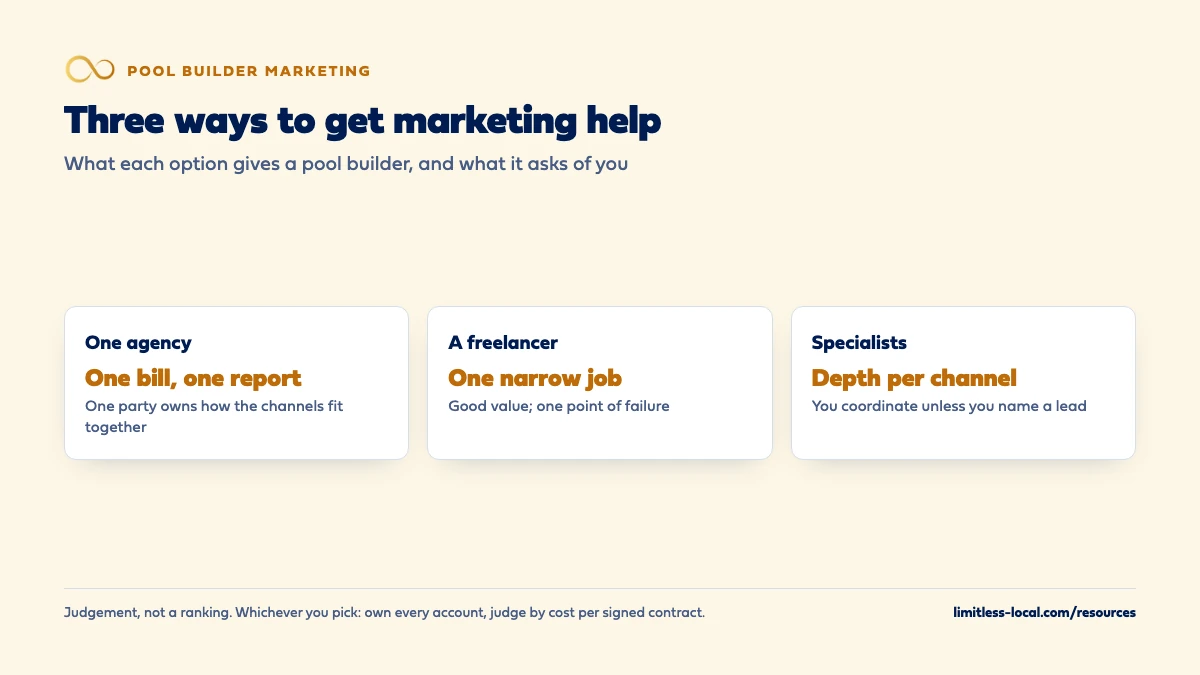
- One agency: one bill, one report, one party responsible for how the channels fit together.
- A freelancer: good value for one narrow job, but one person is one point of failure.
- Separate specialists: deeper skill per channel, but you become the coordinator unless you name one.
- Whatever you choose, keep every account in your company's name and judge it by cost per signed contract.
For pool builders comparing three ways to get marketing help: one full-service agency, one freelancer, or separate specialists for ads, SEO, the website and photos.
Get a free visibility audit · Book a growth call
Should a pool builder hire one agency, one freelancer or a team of separate specialists?
For most pool builders spending real money on ads, one agency or one clearly accountable lead is easier to run than a handful of separate specialists, because someone has to own the whole path from the first click to the signed contract. A freelancer fits a narrow, well-defined job, such as one Google Ads campaign, website pages or photos of finished pools, when someone in your company can coordinate the work. Separate specialists can bring deeper skill in each channel, but only pay off when one person, yours or theirs, is responsible for tracking and for how the pieces fit together.
We’re one of the options on this page, so here’s where we stand: an agency earns its fee when it covers the coordination and the tracking, not just the tasks. Our scope and monthly prices are public on the packages page, and the pool builder marketing page shows the work for pool companies. We’ve also been on the builder’s side: the agency was an equity partner in a pool construction company, where it streamlined back-office operations, built the lead-generation engine and ran sales and marketing. That business did $2M+ revenue in year one. More hiring questions are in the pool builder marketing questions library.
What's the real difference between an agency, a freelancer and specialists?
All three can do good work. The difference is who does what, and who answers for the whole result.
- A full-service agency runs several channels under one agreement, often Google Ads, SEO, your Google Business Profile, reviews and tracking, with one monthly report. One party is responsible for how the pieces fit together.
- A freelancer is one person, usually strong at one or two things: running ads, building websites, writing pages or shooting photos and video.
- Separate specialists means several outside people or small firms, each hired for one channel. An ads person, an SEO person, a web designer and a photographer, for example, each with their own contract and report.
Google’s page on hiring an SEO lists the work these providers can do, from reviewing your site’s structure to keyword research and content. It doesn’t say which kind to hire; that depends on your spend, your channels and who can manage outside help.
This page is about outside help only. If you’re weighing a staff hire, an in-house marketer versus an agency covers salaries and the hybrid setup.
What does each option cost a pool builder?
There’s no reliable published average for what pool builders pay freelancers or specialists, and rates vary widely by skill and region, so get quotes and compare them line by line. A few things hold across all three:
- Ad spend is separate. Whoever manages your Google or Meta ads, the money for the clicks is paid to the platform on top of the management fee.
- Software adds up. Call tracking, a CRM and hosting each carry a bill; check who pays for what.
- Your time is a cost. Every extra provider means another login, report and monthly call.
For a public reference point on agency pricing, our Essentials package is $3,500 a month for one location and includes Google Ads management up to $2,500 a month in ad spend, Google Business Profile management, content, review response and call, web and form tracking. Ad spend isn’t included in any package. The wider picture is in how much a pool marketing agency costs.
When does a freelancer make sense for a pool company?
In our judgement, a freelancer is the right call when the job has edges you can describe in a sentence and a finish line you can check. For a pool builder, the best fits tend to be:
- Photos and video of finished pools, booked around completions and handovers.
- Website pages for each pool type or town, written from notes you supply.
- One Google Ads campaign, when you already have tracking in place to judge it.
- A one-time cleanup, such as fixing your Google profile or setting up call tracking.
The trade-off: one person is one point of failure when they’re sick, booked up or gone. Write down the deliverable, the deadline and who owns the result before the work starts.
Paying a freelancer also comes with paperwork. The IRS says the first step, once you’ve determined someone is an independent contractor, is to have them complete Form W-9, and that you must use Form 1099-NEC to report payments that meet the reporting threshold. Source: Forms and associated taxes for independent contractors. Whether someone is a contractor or an employee is a legal and tax question; this isn’t legal or tax advice.
When do separate specialists beat one agency?
Specialists can outperform a single agency in a few situations, in our judgement:
- You already have a coordinator. An office manager or marketing coordinator who can run a weekly check-in, keep the lead records clean and hold each specialist to a number.
- One channel carries most of your business. If nearly all your contracts come from Google Ads, a dedicated ads specialist may give that channel more attention than a generalist would.
- The job is a one-off build. A custom website or a brand refresh is often better done by a specialist and then handed back.
- You run separate divisions. New builds, renovations and a service route can need different help.
What specialists don’t do on their own is agree with each other. If you go this way, put one person in charge of the plan, the budget split and the tracking, and make sure every specialist knows who that is. Before you start, whether to hire pool-specific or general help is worth reading too, because the same test applies to a specialist.
Curious what your marketing is actually booking?
Get a free visibility audit — no obligation, no sales pitch.
What goes wrong when nobody owns the whole picture?
The most common failure with several providers isn’t bad work. It’s work that doesn’t connect. A few patterns to watch for:
- Everyone’s report looks good. The ads person shows clicks and calls, the SEO person shows rankings, the web designer shows traffic, and nobody can say which of them produced last quarter’s signed contracts.
- Changes collide. One provider changes the website’s contact form while another is running ads that point to it, and nobody notices the form stopped sending leads.
- Tracking is duplicated or missing. Two providers each set up their own call tracking or conversion tags, so leads get counted twice or not at all.
Google’s hiring page makes a related point that applies to every provider: you are responsible for the actions of any companies you hire, so be sure you know exactly what they intend to do. With several providers, that means knowing what each one is changing, and when.
Who should own tracking when several people work on my marketing?
One person, and in our judgement it should be someone inside your company, or the one provider you’ve named as the lead. Tracking is the piece that lets you compare everyone else, so it shouldn’t belong to any one of the channels being judged.
That person keeps three things:
- The source list. Which tracking number, tagged link or form belongs to which channel, so nothing is set up twice.
- The lead record. One record per homeowner with the source and the date of each stage: inquiry, design consultation, proposal and signed contract.
- The monthly summary. Spend and signed contracts per channel, in one table, whoever did the work.
The full setup is in how to track which marketing produces signed pool contracts.
How do I give several providers access without losing control?
Give each provider their own login with only the access the job needs, and keep the top-level ownership yourself. The main platforms all work this way:
- Google Ads. Google lists several access levels, from email-only and read-only to Standard and Admin. Only Admin users can give account access, change access levels and unlink manager accounts. Google also says a manager account with ownership doesn’t take data ownership away from your account, which can remove that access by unlinking. Sources: About access levels in your Google Ads account and About ownership of client accounts.
- Google Business Profile. A profile can have several owners but only one primary owner. Managers have mostly the same access as owners, except they can’t add or remove users or remove the profile, which makes manager the right role for most providers. Source: Manage your Business Profile owners & managers.
- Search Console. Owners have full control, and full and restricted users get view rights to the data. Google’s hiring page advises giving an SEO only read access while they audit your site. Source: Managing owners, users, and permissions.
- Google Analytics. You need the Administrator role to add or change users, and someone added at the property level gets access to only that property. Source: Add, edit, and delete Analytics users.
When a provider leaves, remove their access the same week. The full checklist is in who should own a pool builder’s ad accounts and website.

What should I ask an agency, freelancer or specialist before hiring?
The same core questions work for all three. Google suggests asking an SEO to show examples of previous work, how they measure success, what results they expect and in what timeframe, what experience they have in your industry and your city, and whether they’ll share every change they make and the reasoning behind it. It also says to check business references, and that no one can guarantee a #1 ranking on Google.
For a pool builder, add a few of your own:
- How will you know whether a lead turned into a signed contract?
- Who else will you need to work with, and how will you hand things off?
- What happens to the work, the accounts and the data if we stop?
- Who covers your work when you’re away during our busy season?
A fuller list is in what a pool builder should ask before hiring a marketing agency.
How do I compare one agency quote with several specialist quotes?
Lay them side by side in one table with the same rows for each option:
- Monthly fees, excluding ad spend, which you pay to the platforms either way.
- Software each option needs and who pays for it.
- Scope: which channels, how many pages or posts, how many locations.
- Who coordinates the plan, the budget split and the tracking.
- Who reports spend against signed contracts, in one place.
- Your hours each month to manage it.
The cheapest total is only cheaper if the last three rows are covered. The worked example below shows the math with made-up numbers.
Can I start with a freelancer and switch to an agency later?
Yes, and it’s a sensible way to start when the budget is small. What makes a later switch easy is set up on day one:
- Every account, from Google Ads and your Business Profile to Analytics, Search Console, the domain and hosting, is in your company’s name, with the freelancer added as a user.
- Tracking numbers, form tools and call recordings are on your own accounts, so the history stays when the person leaves.
- Your lead records live in your CRM or spreadsheet, not the freelancer’s.
Switching the other way, from an agency to specialists, works the same: if the accounts are yours, only the logins change.
Not sure which of these is costing you jobs?
A free visibility audit checks the Google profile, reviews, site and tracking, and shows what to fix first.
What's different about hiring marketing help for a pool company
The result is months away. A pool lead can take months to become a signed contract, so whoever owns the tracking has to keep each lead’s source attached for that long. With several providers, that thread is the first thing to break.
Spring is everyone’s busy season. Freelancers and specialists who work with home-service companies tend to be busiest when you are, in our judgement. Ask who covers the work when they’re booked up, before the season starts.
Photos are a natural freelance job. Finished-pool photos and build videos feed your website, Google profile and ads.
New builds and renovations sell differently. If you run both, make sure the tracking keeps them apart.
A worked example: a specialist stack versus one agency
These numbers are made up to show the math. They aren’t market rates for freelancers or specialists, which vary widely.
- Option A, separate specialists: an ads freelancer at $1,200 a month, an SEO specialist at $1,500, website care at $300 and call tracking software at $100. That’s $3,100 a month in fees, plus about 6 hours a month of your time running calls, reading four reports and building your own summary of spend and signed contracts.
- Option B, one agency: our Essentials package at $3,500 a month, which includes Google Ads management up to $2,500 a month in spend, Google Business Profile management, content, review response, call and form tracking and one monthly report.
Option A is $400 a month cheaper on paper. Over a year, that’s $4,800 against about 72 hours of your time. Neither number settles it. What settles it is which option, after a full season, shows the lower cost per signed contract, and which one you can actually check. If nobody in Option A owns the tracking, you won’t know.
In both options, ad spend is paid to Google separately.
Frequently asked questions
Is a freelancer cheaper than an agency for a pool builder?
Often for one job, not always for the whole picture. Once you add several freelancers, their software and your coordination time, the total can land close to an agency fee, so compare full quotes side by side.
Can I hire an agency for ads and a freelancer for photos?
Yes. That’s a common split. Tell both who owns the tracking, and make sure the photos reach the agency for your Google profile and ads.
Should my web designer also run my SEO?
Only if they can show SEO work and how they measure it. Google notes that a redesign or new site is a great time to bring an SEO in, so the site is built to be search-friendly from the start.
How many marketing providers is too many for a pool company?
In our judgement, it’s too many when no one can produce one report of spend against signed contracts, or when you spend more time managing providers than meeting homeowners. The number matters less than whether someone owns the whole picture.
Do I need a contract with a freelancer?
A written scope, price, deadline and a line on who owns the work and the accounts protects both of you. What the contract should say legally depends on your state; this isn’t legal advice.
What if a provider set up my accounts under their own login?
Ask them to make you the owner or admin now, while the relationship is good. In Google Business Profile, primary ownership can be transferred to another owner or manager on the profile.
Key takeaways
- One agency trades some per-channel depth for one bill, one report and one party answerable for the whole result.
- A freelancer suits one narrow job with a clear finish line, such as photos, website pages or one ad campaign.
- Separate specialists work best when someone in your company already coordinates them and owns the tracking.
- Keep every account in your company’s name and give each provider only the access the job needs.
- Compare options on cost per signed contract over a full season, not on the monthly fee alone.
Want a second set of eyes on your setup?
We'll look at how you show up locally and where calls are leaking, then send you a plain-English breakdown.
More in this section
- Does a pool builder need a pool-specific or general marketing agency?
- Should I hire a pool marketing agency or do it myself?
- Should a pool builder hire an in-house marketer or an agency?
- What should a pool builder ask before hiring a marketing agency?
- How much does a pool marketing agency cost?
Sources
- Do you need an SEO? — Google Search Central
- About access levels in your Google Ads account — Google Ads Help
- Manager Accounts (MCC): About ownership of client accounts — Google Ads Help
- Manage your Business Profile owners & managers — Google Business Profile Help
- Managing owners, users, and permissions — Search Console Help
- Add, edit, and delete Analytics users and user groups — Analytics Help
- Forms and associated taxes for independent contractors — Internal Revenue Service