
What are the biggest marketing mistakes pool companies make?
- Why is my pool company's marketing not producing signed contracts?
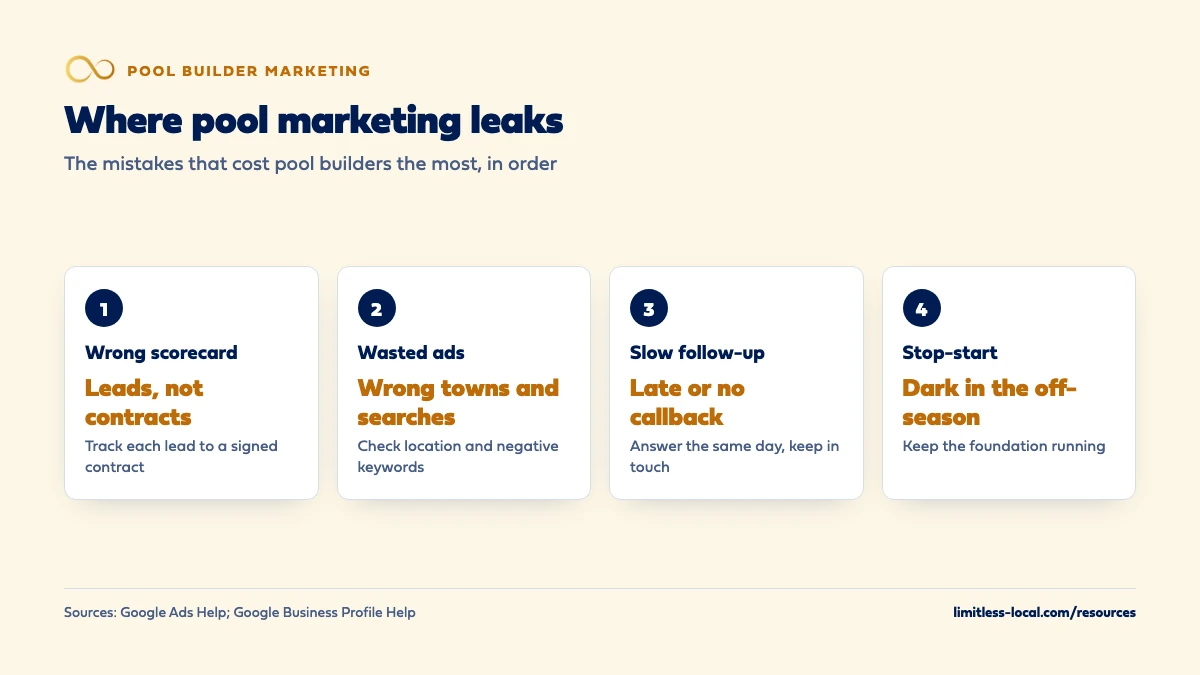
- Mistake 1: Judging marketing by leads instead of signed contracts
- Mistake 2: Ads showing in the wrong places or on the wrong searches
- Mistake 3: Answering new inquiries slowly
- Mistake 4: Dropping leads that aren't ready yet
- Mistake 5: Going dark in the off-season
- Mistake 6: A website that hides the work
- Mistake 7: A thin Google Business Profile
- Mistake 8: Spreading a small budget across too many channels
- Mistake 9: Expecting SEO to work like ads
- Mistake 10: Hiring help without owning the accounts
- What makes pool builder marketing take longer to produce jobs?
- Why these mistakes cost pool builders more
- A worked example: what one unfixed setting can cost
- Frequently asked questions
- Key takeaways
- More in this section
- Sources
The short version
- Measuring leads and clicks instead of consultations and signed contracts.
- Ads showing in the wrong towns or on pool supply and pool service searches.
- Slow follow-up on inquiries, and no follow-up through a months-long decision.
- Going dark in the off-season, a weak project gallery, and a thin Google profile.
For pool builders whose marketing is busy but not filling the build calendar, and for owners doing it themselves who want to know where the money usually leaks.
Get a free visibility audit · Book a growth call
Why is my pool company's marketing not producing signed contracts?
The biggest marketing mistakes pool companies make are judging marketing by leads and clicks instead of signed contracts, letting ads run in towns they don’t build in or on searches for pool supplies and service, and answering new inquiries slowly. Close behind are going quiet in the off-season, a website that hides the finished projects and the way to book a consultation, and a Google Business Profile that’s thin on photos and reviews. Most of these cost nothing to fix except attention.
Limitless Local has seen these mistakes from the builder’s side. The agency was an equity partner in a pool construction company, where it streamlined back-office operations, built the lead-generation engine and ran sales and marketing. That business did $2M+ revenue in year one. Our packages start with the foundation (tracking, follow-up and a clean online presence) before turning on lead flow, which is the order that avoids most of the mistakes below. The pool builder marketing page shows what we run for pool companies, and the pool builder marketing questions library goes deep on each channel.
Mistake 1: Judging marketing by leads instead of signed contracts
This is the mistake behind most of the others. A pool sale runs from first inquiry to design consultation to proposal to signed contract, often over months. A channel that produces lots of inquiries can still be the worst one you pay for if those inquiries never get past the first call.
The fix is to record, for every lead, where it came from and how far it got: consultation booked, proposal sent, contract signed. Google Ads can take that outcome back: offline conversion imports let you record a sale that started with an ad click but closed at your office or over the phone, and Google now recommends that new users start with enhanced conversions for leads, its upgraded version. Source: About offline conversion imports. Once you can see cost per signed contract by source, most budget decisions make themselves. The setup is in tracking which marketing produces signed contracts.
Mistake 2: Ads showing in the wrong places or on the wrong searches
In our judgement, two settings cause most of the wasted spend in a pool builder’s Google Ads account.
Location. Google’s broad location option, “Presence or Interest”, which it recommends as a best practice on Search, reaches people in your target area and people elsewhere who have shown interest in it. Google says to consider the “Presence” option when you only want people in your locations, not people elsewhere who are interested in them. Source: Target ads to geographic locations. For a builder who can only build within a set drive of the shop, that difference matters.
Search terms. “Pool” searches include pool supplies, chemicals, pool service, public pools and above-ground kits. Negative keywords let you exclude search terms and focus on the ones that matter to your customers. Source: About negative keywords. The pool-specific list is in negative keywords for pool builders.
Mistake 3: Answering new inquiries slowly
A homeowner who fills out a consultation form has often filled out two or three. The builder who calls back first, with a clear next step, gets the first conversation. In our judgement, a same-day response during business hours is the minimum for a sale this size, and the inquiry that arrives on a Saturday afternoon deserves an answer before Monday.
Slow follow-up is expensive because it wastes everything spent to get the inquiry. It’s also invisible in most reports, which count the lead and stop there. How fast is fast enough is covered in how fast a pool builder should respond to a new lead.
Mistake 4: Dropping leads that aren't ready yet
Many pool inquiries are from homeowners who plan to build next year, are waiting on a bonus or a refinance, or haven’t agreed with their spouse yet. Treating “not this season” as “no” throws away leads you already paid for.
In our judgement, every inquiry that doesn’t sign should go into a simple follow-up rhythm: a check-in after the consultation, a note before the next building season, and occasional finished-project updates. The homeowner who wasn’t ready in August may be ready in January, and they’ll call whoever stayed in touch.
Mistake 5: Going dark in the off-season
Many builders cut all marketing when the calendar fills or the weather turns, then restart in spring alongside every competitor. In our judgement, that’s backward for a sale that takes months. Homeowners who sign in spring often started researching in winter. A builder who stays visible then, with a maintained Google profile, steady reviews and a modest ad budget on high-intent searches, is the one they already know when they’re ready.
That doesn’t mean spending the same every month. It means keeping the foundation running and adjusting the paid spend to your capacity. When to pull back is covered in pausing marketing when the schedule is full.
Curious what your marketing is actually booking?
Get a free visibility audit — no obligation, no sales pitch.
Mistake 6: A website that hides the work
A pool is bought on what it will look like in the homeowner’s backyard. Websites that bury the project gallery, use stock photos, or make the consultation request hard to find lose people who were ready to talk. In our judgement, the most common problems are:
- No gallery of real finished projects, or one that hasn’t been updated in years.
- No clear way to request a design consultation on every page.
- No pages for the towns you build in.
- A site that’s awkward on a phone, where many homeowners first look.
None of these needs a full redesign. Whether yours does is covered in whether a pool website needs a redesign before marketing.
Mistake 7: A thin Google Business Profile
Google says local results are mainly based on relevance, distance and popularity, and that more reviews and positive ratings can help a business’s local ranking. Source: Tips to improve your local ranking on Google. A pool builder with a handful of old reviews, a few photos and a one-line description is giving away the free part of local search.
The fix is habits, not spending: ask every customer for a review at the end of a build, upload photos at every stage, and keep services and hours accurate. Don’t take the shortcut of stuffing keywords into your business name. Google says including unnecessary information in your business name isn’t permitted and could result in the suspension of your profile. Source: Guidelines for representing your business on Google.
Mistake 8: Spreading a small budget across too many channels
Home shows, Facebook ads, Google Ads, a directory subscription, a magazine ad and a mailer, each at a small amount, can add up to real money without any one of them getting enough budget or attention to work. In our judgement, a smaller builder does better by getting one or two channels working well, proven by signed contracts, before adding a third. A channel you can’t measure is one you can’t defend at budget time.

Mistake 9: Expecting SEO to work like ads
Ads can bring in inquiries within days of launch. SEO typically takes three to six months to show meaningful organic growth. Owners who start SEO in April expecting spring leads, then cancel in June, pay for the slow part and miss the payoff. In our judgement, start SEO before you need it, use ads for the near term, and judge each on its own clock.
Mistake 10: Hiring help without owning the accounts
Builders who let an agency or freelancer set up Google Ads, the Google profile, the website or the domain in someone else’s name often find out what that means when they try to leave: lost ad history, a profile they can’t edit, a domain they don’t control. Google says no one can guarantee a #1 ranking, and recommends being wary of firms that won’t explain what they intend to do. Source: Do you need an SEO?. Whoever does the work, keep ownership in your company’s name. The details are in who should own a pool builder’s ad accounts and website.
What makes pool builder marketing take longer to produce jobs?
Partly the trade itself: design, financing, permits and a seasonal calendar all sit between an inquiry and a signed contract, so even good marketing shows up in contracts later than it does in inquiries. The rest is usually the mistakes above. In our judgement, the ones that slow results most are missing tracking (so nobody can tell what’s working), slow follow-up (so paid inquiries go cold), and stop-start spending (so every restart begins from zero). Fix those first and the time from marketing to contracts usually gets shorter, though nobody can honestly promise by how much.
Not sure which of these is costing you jobs?
A free visibility audit checks the Google profile, reviews, site and tracking, and shows what to fix first.
Why these mistakes cost pool builders more
Every contract is large. Losing a few signed pools a season to slow follow-up or wasted ad spend is a bigger loss than the same mistakes cost a service trade with small tickets.
The sale is long. Mistakes in tracking and follow-up hide for months, because the cost shows up as contracts that never sign rather than as a bad week.
“Pool” is a crowded word. Searches for pool supplies, service, chemicals and public pools sit right next to searches for builders, so untended ads drift into the wrong ones.
Seasonality tempts stop-start marketing. The urge to cut everything when the calendar is full is stronger in pool construction than in most trades, and so is the cost of starting from zero in spring.
A worked example: what one unfixed setting can cost
These numbers are made up to show the math, not a benchmark. Say a pool builder spends $2,000 a month on Google Ads through a six-month selling season, and nobody has added negative keywords. Say a quarter of the clicks go to searches for pool supplies, chemicals and pool service. That’s $500 a month, or $3,000 over the season, spent on people who were never going to buy a new pool.
Now say the builder’s average gross profit on a pool is $15,000. The $3,000 isn’t fatal on its own. But stack it with the second mistake, inquiries answered a day late, and the third, no follow-up for homeowners who weren’t ready, and the season can lose more contracts than the ad budget ever cost. The fix for the first mistake is an afternoon’s work in the search terms report.
Frequently asked questions
What are the biggest mistakes pool contractors make when doing their own marketing?
In our judgement: not tracking leads to contracts, never checking the search terms report in Google Ads, and letting reviews and photos slide during the busy season.
Why is my pool company getting leads but not contracts?
Usually it’s lead quality (wrong towns, wrong searches, price shoppers), slow follow-up, or a sales process that loses people between consultation and proposal. Track how far each lead gets to see where.
Is it a mistake to use home shows?
Not by itself. It’s a mistake to spend on one without recording which signed contracts came from it.
Should I stop marketing when my build calendar is full?
Pull back paid spend if you can’t take the work, but keep the profile, reviews and follow-up going so you aren’t starting from zero next season.
Is putting keywords in my Google business name a mistake?
Yes. Google says unnecessary information in your business name isn’t permitted and could get your profile suspended.
How do I find out which mistake is costing me the most?
Start with a lead log that records source and outcome for every inquiry. The biggest gap between inquiries and signed contracts usually points to it.
Key takeaways
- Judge marketing by signed contracts by source, not by leads or clicks.
- Check ad location settings and add negative keywords for pool supply and service searches.
- Answer inquiries the same day and keep following up with homeowners who aren’t ready yet.
- Stay visible in the off-season and keep the project gallery and Google profile current.
- Own your accounts and give SEO its own, longer clock.
Want a second set of eyes on your setup?
We'll look at how you show up locally and where calls are leaking, then send you a plain-English breakdown.
More in this section
- How do I grow a pool construction business with marketing?
- How much should a pool builder spend on marketing?
- How should a pool builder prepare marketing before peak season?
- What should a pool builder ask before hiring a marketing agency?
- How should a pool builder split its marketing budget?
Sources
- About offline conversion imports — Google Ads Help
- Target ads to geographic locations — Google Ads Help
- About negative keywords — Google Ads Help
- Tips to improve your local ranking on Google — Google Business Profile Help
- Guidelines for representing your business on Google — Google Business Profile Help
- Do you need an SEO? — Google Search Central