
Can ChatGPT do SEO for a restoration company?
- How much of a restoration company's SEO can ChatGPT really handle?
- What can ChatGPT actually do for restoration SEO?
- What can't ChatGPT do for my SEO?
- Does Google penalize content written with ChatGPT?
- Can I use ChatGPT to write a page for every town I serve?
- How do I turn a ChatGPT draft into a page worth publishing?
- Can I trust ChatGPT's SEO advice?
- Should ChatGPT write my review replies, or my reviews?
- Should I put my name on pages ChatGPT helped write?
- How much time does ChatGPT really save on SEO?
- Will using ChatGPT help my company show up in ChatGPT answers?
- What's different about using ChatGPT for restoration SEO
- A worked example: what ChatGPT saves on a set of service pages
- Frequently asked questions
- Key takeaways
- More in this section
- Sources
The short version
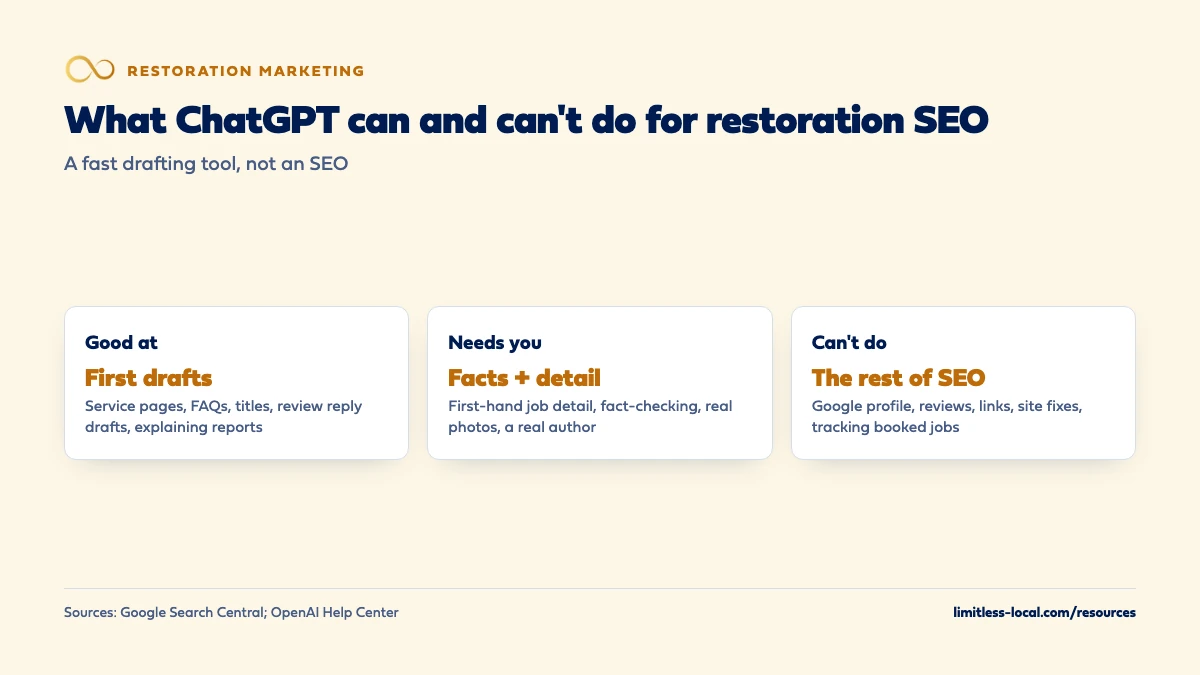
- Good for: first drafts of pages, FAQs, review replies and titles.
- Can't do: your Google profile, photos, reviews, links, site fixes or tracking.
- AI help isn't penalized; AI-made pages that add nothing are spam.
- Your first-hand detail and fact-checking are what make a draft worth publishing.
For restoration owners wondering whether ChatGPT can replace an SEO hire, or at least do the writing, and where it falls short.
Get a free visibility audit · Book a growth call
How much of a restoration company's SEO can ChatGPT really handle?
ChatGPT can do parts of SEO for a restoration company, mainly drafting service pages, FAQs, review replies and page titles from notes you give it. It can’t do the rest: it can’t manage your Google Business Profile, take job photos, earn reviews or links, fix your site, or know what your crews actually do on a water job, and it can state wrong things confidently. Google doesn’t penalize content just because AI helped write it, but mass-producing pages with AI that add nothing for readers breaks its spam policies. Use it as a fast first-draft writer, with you supplying the facts and checking every line.
Writing is one slice of local SEO. The rest is the Google Business Profile, reviews, listings, links, the site itself and tracking, and we work on all three places owners need to show up: the regular Google results, the Maps 3-pack, and AI answers like ChatGPT and Google AI Overviews. Our local SEO work covers that, and Essentials, at $3,500 a month, includes a content sprint of up to 10 pages, 2 blog posts a month, weekly Google Business Profile posts and review response. See how it fits water, fire and mold companies on our restoration marketing page, read the restoration marketing guide, or browse more restoration marketing questions.
What can ChatGPT actually do for restoration SEO?
It’s a fast writer and a patient explainer. Used well, it saves real time on the writing side of SEO:
- First drafts of service pages. Give it your notes on how you handle a burst pipe, a sewage backup or a mold job, and it will turn them into a readable page in minutes.
- FAQ ideas. Ask what homeowners worry about after water damage, and you’ll get a list to check against the calls your office actually takes.
- Page titles and descriptions. Several options for each page, which you then cut down.
- Review reply drafts. A starting point you personalize, so replies don’t all sound the same.
- Explaining reports. Paste in a Search Console table and ask what it means in plain words.
- Cleaning up your own writing. Shorter sentences, clearer headings, fewer typos.
Every one of those starts with something you know and ends with you checking the result. That’s the pattern that works.
What can't ChatGPT do for my SEO?
Most of what moves local rankings for a restoration company happens outside a text box:
- Your Google Business Profile. It can’t log in, pick categories, set your service area, add photos or answer messages.
- Reviews. Those come from customers your crews looked after, asked at the right moment.
- Photos. Real job photos from real jobs in your towns.
- Links and mentions. Plumbers, property managers, local groups and directories listing you is relationship work.
- Site fixes. It can suggest code, but it can’t see your site’s real speed, broken forms or indexing problems the way Search Console can.
- Tracking. Which calls became booked jobs lives in your job software, not in ChatGPT.
- Knowing your business. Your response times, equipment, towns, and what makes you different. It only knows what you tell it.
So the scope is narrow: ChatGPT can help with the writing. SEO is the writing plus everything on that list. Whether a restoration owner can do their own SEO covers the rest of the work and where owners usually need help.
Does Google penalize content written with ChatGPT?
Not for being AI-assisted. Google’s guidance about AI-generated content says its ranking systems focus on the quality of content rather than how it’s produced, and that appropriate use of AI or automation isn’t against its guidelines.
The line is purpose and value. Using automation, including AI, to generate content with the primary purpose of manipulating search rankings is a violation of Google’s spam policies. A service page you drafted with ChatGPT, filled with your own detail and checked line by line, is fine. A hundred near-identical pages pumped out to catch searches is not.
In practice, that means the risk isn’t the tool. It’s using the tool to skip the part only you can do.
Can I use ChatGPT to write a page for every town I serve?
Not the way most people try it. The tempting move is to ask for “water damage restoration in [town]” fifty times and publish the lot. Google’s spam policies list exactly that as an example of scaled content abuse: using generative AI tools or similar tools to generate many pages without adding value for users.
Town pages work when each one has something real on it: jobs you’ve done there, how fast your crews usually arrive, the kinds of homes and problems common in that area, and real photos. That takes your knowledge, not more prompts. Fewer, better town pages beat a stack of copies. Which cities to target without spam pages covers how to pick them.
Curious what your marketing is actually booking?
Get a free visibility audit — no obligation, no sales pitch.
How do I turn a ChatGPT draft into a page worth publishing?
Treat the draft as a skeleton and add what only your company knows:
- Start from your notes, not a blank prompt. Tell it what your crew does in the first hour on a water job, what equipment goes in, how long drying usually runs, and which towns you cover.
- Add first-hand detail it couldn’t have known. A common mistake homeowners make before you arrive, what you check behind the baseboards, how you document the job. Google’s page on helpful, reliable, people-first content asks whether content clearly shows first-hand expertise and a depth of knowledge, and whether it adds substantial value beyond rewriting other sources.
- Check every fact. Response times you actually keep, services you actually offer, certifications you actually hold.
- Cut the filler. AI drafts love vague openers and lines that could describe any company in any trade. Delete them.
- Keep insurance language general. Explain how you work with claims; never promise what a policy will cover.
- Add your own photos and read the page aloud before it goes live.
What a restoration company should publish to look like the expert has more ideas for the kind of detail that sets a page apart.
Can I trust ChatGPT's SEO advice?
Check it before you act on it. OpenAI’s own help article, Does ChatGPT tell the truth?, says it can produce incorrect or misleading outputs, sometimes sounding confident even when it’s wrong, and can make up quotes, studies or citations. It also suggests using it as a first draft, not a final source.
SEO advice is especially easy to get wrong because platforms change. Google’s badges, ad formats and profile features have all shifted recently, and an answer built from older material can be out of date. When ChatGPT tells you to do something to your Google profile or your site, look for the matching page in Google’s own help documentation before you make the change. If you can’t find one, be careful.
Should ChatGPT write my review replies, or my reviews?
Replies, yes, as drafts. A short, specific reply to each review is good practice, and ChatGPT can give you a starting point when you’re answering a dozen after a storm week. Edit each one so it mentions the actual job and sounds like you, and never copy the same reply across reviews.
Reviews, never. The FTC’s final rule on fake reviews prohibits businesses from creating or selling reviews that misrepresent that they’re by someone who doesn’t exist, such as AI-generated fake reviews, or by someone who didn’t have actual experience with the business. Write a review for yourself with ChatGPT and you’ve written a fake review. How a restoration company should reply to Google reviews covers replies in detail.
Should I put my name on pages ChatGPT helped write?
Yes, a real one. Put the name of the person who supplied the knowledge and checked the page, whether that’s you, your operations lead or your mold specialist, with a line about their experience. That’s what makes a page trustworthy to a homeowner in a hurry.
Don’t invent an author, use an AI-generated headshot or claim credentials nobody holds. A made-up author undoes the trust a real byline is there to build.
You don’t need to stamp “written by AI” on a service page you drafted with help and then rewrote. Where a reader would reasonably wonder how something was made, a short note on how you produced it is a good idea.
How much time does ChatGPT really save on SEO?
A good chunk of the writing time, and very little of the rest. The slow parts of local SEO for a restoration company are keeping the Google profile active, getting reviews after every job, building relationships that lead to links and mentions, fixing site problems, and tracking which work brings booked jobs. None of that gets faster with a chatbot.
It also doesn’t change the ramp. SEO typically takes 3-6 months to show meaningful organic growth, whoever writes the pages. ChatGPT can get the pages done sooner; it can’t make Google trust them sooner.
Google’s own advice on whether you need an SEO says a small local business can probably do much of the work itself. ChatGPT makes the writing part of that easier. It doesn’t make the time to do the rest.
Will using ChatGPT help my company show up in ChatGPT answers?
Not by itself. Writing your pages with ChatGPT doesn’t tell ChatGPT to recommend you.
The work that gets a restoration company named in AI answers is the same work that helps in Google: clear, first-hand pages, consistent business facts and a site AI crawlers can reach. How a restoration company gets cited in ChatGPT and AI answers walks through it step by step.
Want to see where your company stands?
A free visibility audit shows where you show up on Google, Maps and AI answers, and what it's costing you in calls.
What's different about using ChatGPT for restoration SEO
Generic content fails emergency searchers. Someone with water coming through the ceiling wants to know how fast you’ll arrive and what happens next. AI drafts default to vague reassurance. Replace it with specifics.
Health and insurance topics need care. Mold, sewage and smoke pages touch on health, and many jobs involve a claim. Keep health statements to what a source like the EPA or CDC actually says, keep insurance language general, and check anything ChatGPT writes on either topic line by line.
Every company has the same tool. If your competitors use ChatGPT too, the drafts all start out sounding alike. The page that wins is the one with the details only your crews could have written.
A worked example: what ChatGPT saves on a set of service pages
These numbers are made up to show the math, not a benchmark.
Say you need 8 service pages: water extraction, burst pipes, sewage cleanup, mold, fire and smoke, storm damage, commercial water damage and rebuild. Written from scratch, each takes you about 3 hours, so 24 hours in total.
With ChatGPT drafting from your notes, each page takes about 1 hour of notes and prompting plus 1 hour of adding detail, fact-checking and editing. That’s 2 hours a page, or 16 hours, and the time saved is 8 hours. If your time is worth a made-up $100 an hour, that’s $800 of your time back.
Notice what didn’t shrink: the hour per page of adding real detail and checking it. Skip that hour, and you get the 8 hours back but publish 8 pages that sound like everyone else’s. The Google profile, reviews, photos, links and tracking still need doing on top, every month.
Frequently asked questions
Is it OK to use ChatGPT for my Google Business Profile posts?
Yes, as drafts. Keep each post about a real job, offer or update, add your own photo, and check that every detail is true before it goes up.
Can ChatGPT do keyword research for a restoration company?
It can suggest phrases people might use, but it doesn’t have your local search volumes or know what’s ranking in your towns. Check its ideas against Search Console and the calls your office actually takes.
Can ChatGPT fix technical SEO problems on my website?
It can explain an error and suggest a fix, but it can’t see your site. Find the problem in Search Console first, and have whoever manages the site make and test the change.
Will Google know my pages were written with AI?
It matters less than you’d think. What counts is whether a page is helpful and original, not how it was produced, so put your effort into making the page better than the draft.
Should I pay for an AI SEO tool instead of an SEO?
A tool speeds up tasks; it doesn’t decide what to do or do the work outside your website. If the Google profile, reviews and tracking aren’t being handled, a tool won’t change that.
Key takeaways
- ChatGPT can draft service pages, FAQs, titles and review replies; it can’t do the rest of local SEO.
- Google doesn’t penalize AI-assisted content, but mass-producing pages without added value breaks its spam policies.
- Your first-hand detail and fact-checking are what make an AI draft worth publishing.
- Never use ChatGPT to write reviews; the FTC’s rule bans AI-generated fake reviews.
- SEO still takes months to show results, whoever writes the pages.
Not sure what's working right now?
Start with a free visibility audit: rankings, Google profile, reviews and tracking, checked against your service area.
More in this section
- How does a restoration company get cited in ChatGPT and AI answers?
- Is paying for SEO worth it for a restoration company?
- Do Google Ads help a restoration company's SEO rankings?
- Which SEO work produces leads first for a restoration company?
- Can a restoration owner do their own SEO instead of hiring someone?
Sources
- Google Search's guidance about AI-generated content — Google Search Central
- Spam policies for Google web search — Google Search Central
- Creating helpful, reliable, people-first content — Google Search Central
- Does ChatGPT tell the truth? — OpenAI Help Center
- Federal Trade Commission Announces Final Rule Banning Fake Reviews and Testimonials — Federal Trade Commission
- Do you need an SEO? — Google Search Central