
How long until HVAC map pack rankings move after new reviews?
- How long does it take new Google reviews to move an HVAC company up the map pack?
- Do new Google reviews move map pack rankings right away?
- How long before a new review shows up on my Google profile?
- How long until my HVAC map rankings start to move?
- Why haven't my rankings moved after a bunch of new reviews?
- How many reviews does it take to move up?
- Does the pace of new reviews matter more than the total?
- Does my star rating matter as much as my review count?
- Do my replies to reviews help my rankings?
- What else moves HVAC map rankings alongside reviews?
- What should I avoid when trying to speed things up?
- How do I tell if my map rankings are actually moving?
- What's different about reviews and map rankings for HVAC companies
- A worked example: how long it takes to close a review gap
- Frequently asked questions
- Key takeaways
- More in this section
- Sources
The short version
- New reviews can take a few days to appear; rankings respond more slowly than that.
- Small moves can show within weeks; closing a big gap on competitors takes months.
- Reviews feed prominence, but relevance and distance still decide a lot.
- A steady pace from real customers beats a burst, and incentives are off-limits.
For HVAC owners who’ve started asking every customer for a Google review and want to know when it should show up in where they rank on Maps.
Get a free visibility audit · Book a growth call
How long does it take new Google reviews to move an HVAC company up the map pack?
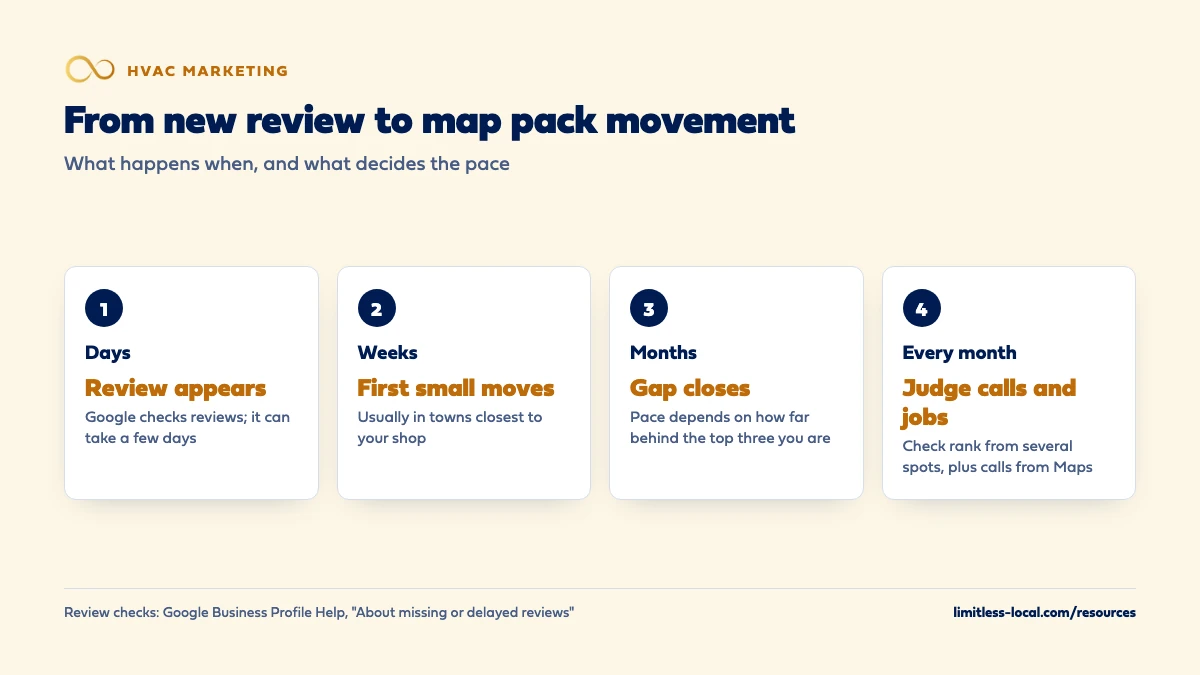
Google doesn’t publish a timeline, so expect weeks for small moves and several months for big ones, not days. A new review can take a few days to appear while Google checks it, and reviews are only one part of prominence, which sits alongside relevance and distance in how Google ranks local results. How fast you climb depends mostly on the gap between you and the companies above you: if they have three times your reviews, a steady pace of new ones takes months to close it.
We won’t promise you a spot in the map pack by a date, because nobody honestly can. What we can do is keep the review flow, replies and profile work steady every month: review response and review generation are part of every HVAC marketing package, along with Google Business Profile management. For the bigger picture, the HVAC marketing guide covers every channel, and the rest of the HVAC marketing questions library goes question by question.
Do new Google reviews move map pack rankings right away?
No. There’s no switch that flips when review number 50 lands. Google’s own page, Tips to improve your local ranking on Google, says local results are mainly based on relevance, distance and popularity, and that prominence (how well-known a business is) draws partly on how many reviews you have. It says more reviews and positive ratings can help your local ranking. It doesn’t say how much, or how fast.
It also says there’s no way to request or pay for a better local ranking, and that Google keeps the details of the algorithm confidential. So anyone quoting you an exact number of days is guessing. What you can know is how far you are from the companies above you, and how fast you’re closing that gap.
How long before a new review shows up on my Google profile?
Usually soon, but not always instantly. Google’s page About missing or delayed reviews says reviews are checked to make sure they follow its policies, and in some cases that can take a few days, which delays when the review appears. Reviews removed for policy violations, like spam, won’t be restored.
So if a customer says they left a review and you can’t see it, give it a few days before you worry. If several in a row never appear, look at how you’re asking. Have customers leave the review on their own phone, in their own words, rather than on a tablet at the office or from wording you gave them.
How long until my HVAC map rankings start to move?
Think in weeks for the first small shifts and in months for big ones. Local SEO, the work behind map rankings, typically takes 3 to 6 months to show meaningful growth, and reviews are one piece of that work.
A few things decide where you land in that range:
- The size of the gap. If you have 60 reviews and the top three have 70, a few good months can do it. If they have 400, it’s a much longer road.
- Your pace. Ten new reviews a month closes a gap twice as fast as five.
- Where the searcher is. You’ll usually move first in the towns closest to your address and last in the far edge of your service area.
- Everything else on your profile. Reviews help most when your categories, services and details already match what homeowners search.
Why haven't my rankings moved after a bunch of new reviews?
A few common reasons, roughly in order:
- Distance. Google weighs how far your business is from the person searching. Reviews can’t move your shop closer to a town 25 miles away.
- Relevance. If your profile’s primary category, services and description don’t match “AC repair” or “furnace installation,” more reviews won’t fix the mismatch.
- The gap is still big. Going from 30 to 60 reviews feels like a lot, but it may still leave you well behind the top three.
- Competitors are collecting too. If they add reviews as fast as you, the gap doesn’t shrink.
- Something else is wrong, like an unverified profile, a pending edit or a duplicate listing.
Why other HVAC companies are ranking above you walks through how to check each one.
How many reviews does it take to move up?
There’s no fixed number, because it’s relative. The useful benchmark is the companies already in the top three for your main searches, checked from a few spots in your service area. Write down their review counts and ratings, then compare them with yours every month.
If you’re within reach of the third spot, a steady few months of reviews plus a tidy profile can be enough to start showing up. If you’re far behind, plan for a longer climb and use ads to keep the phone ringing while it happens. How many Google reviews an HVAC company needs covers the target in more detail.
Curious what your marketing is actually booking?
Get a free visibility audit — no obligation, no sales pitch.
Does the pace of new reviews matter more than the total?
Both matter, for different reasons. The total feeds prominence, how well-known your business looks to Google. The pace matters to homeowners, who notice when the newest review is six months old, and it’s what closes the gap on competitors over time.
The practical goal is a steady flow from real jobs, every week, rather than a big push once a year. A steady pace is also easier to keep up, because asking becomes part of how every job closes. What review velocity is and whether it matters for HVAC goes deeper on pace.
Does my star rating matter as much as my review count?
Both count: more reviews and positive ratings can help your local ranking. For the homeowner choosing between three companies in the map pack, the rating is often the first thing they compare.
Don’t chase a perfect 5.0. A long run of real reviews with a few honest 3- and 4-star ones in the mix reads as more believable than a short list of perfect scores. What helps most is fixing whatever causes the low ratings, like missed appointments or surprise prices, and replying calmly to the ones you get.
Do my replies to reviews help my rankings?
Replying shows customers you value their feedback, and positive reviews and helpful replies can help your business stand out. Google doesn’t say replies move your ranking, so treat them as a way to win the click once you’re in the map pack, not a way to get there.
That still matters. A homeowner comparing three HVAC companies reads the replies, especially on the bad reviews. Short, specific, calm replies within a day or two make you the easier call. How an HVAC company should reply to Google reviews has examples for good and bad ones.
What else moves HVAC map rankings alongside reviews?
Reviews work best on top of a profile that already matches what homeowners search. While the reviews build, make sure:
- Your primary category fits your main work, with extra categories for the rest.
- Your services list covers repair, installation, maintenance, heating and cooling as you actually offer them.
- Your business name, address and phone match everywhere you’re listed.
- Your hours are accurate, including emergency hours if you have them.
- Your website has a page for each main service and the towns you serve, and links to your profile.
- You post real photos of your trucks, crew and jobs.
Optimizing your HVAC Google Business Profile for more calls covers each of these in order.
What should I avoid when trying to speed things up?
Anything that trades a faster bump for a bigger problem later:
- Incentives. Google’s page on creating a review link or QR code says offering incentives, like free or discounted services, in exchange for reviews is fake engagement and strictly prohibited.
- Bought or fake reviews. The Federal Trade Commission’s rule on consumer reviews and testimonials took effect on October 21, 2024, and its questions and answers say businesses can be liable for fake reviews, for incentives conditioned on a particular sentiment, and for review suppression. The rule authorizes courts to impose civil penalties for knowing violations.
- Reviews written for customers, or posted by staff and family.
- Big bursts from a single event or a single device.
None of that is needed. Asking every customer, every time, works.
How do I tell if my map rankings are actually moving?
Not by searching from your own office. You’ll almost always look better near your shop than you do across town. Instead:
- Check from several points in your service area, or use a rank-tracking tool that checks a grid of locations, for the same handful of searches each month.
- Watch calls from your profile, not just rankings. Your Business Profile’s performance view counts how many times customers tapped the call button on your profile.
- Track booked jobs from Maps in your field software, so you can see whether the movement is paying off.
Compare month to month, and season to season. A July jump in calls might be the heat wave, not your reviews.
Talk it through with someone who runs this every day
A 15-minute growth call: your market, your numbers, and what a realistic budget looks like. No pressure.
What's different about reviews and map rankings for HVAC companies
Peak season is review season. You run the most jobs in the hottest and coldest weeks, which means the most chances to ask. Build the ask into the job then, and your pace stays high for months.
Maintenance visits keep the flow going. Tune-ups in spring and fall give you happy customers to ask when emergency calls are slow, so the newest review on your profile never gets old.
Emergency searches get compared fast. A homeowner with no heat picks from the map pack in a minute or two, often by rating and how recent the reviews are. Even before your ranking moves, fresh reviews can win you more of the calls you already show up for.
A worked example: how long it takes to close a review gap
These numbers are made up to show the math, not a benchmark for any market.
Say your HVAC company has 40 reviews with a 4.6 rating. Checked from a few spots in your main town, the top three for “AC repair” have 80, 95 and 120 reviews.
You start asking every customer and land 10 new reviews a month. If those competitors stood still, you’d match the third company’s 80 in about 4 months and the leader’s 120 in about 8 months. They won’t stand still, though. If the third company adds 4 a month, you’re only closing the gap by 6 a month, so catching it takes about 7 months.
That’s why there’s no single answer to “how long.” Reviews are one input, and in the meantime you might move in the towns closest to your shop first, while the far side of your area takes longer. Keep the pace steady, keep the profile tidy, and judge it by calls and booked jobs from Maps every month.
Frequently asked questions
Can I pay Google to rank higher in the map pack?
No. There’s no way to request or pay for a better local ranking. Ads can show above or alongside the map results, but they don’t change your free ranking.
Do reviews on Facebook or Yelp help my Google map ranking?
Google’s ranking guidance doesn’t say that reviews on other sites count toward your map ranking. They still help homeowners who check those sites, so they’re worth having, but put most of your asking into Google.
Will one bad review knock me out of the map pack?
Rarely on its own, if you have a healthy run of good ones. Reply calmly and fix the cause; a steady flow of new positive reviews outweighs one bad day.
Should I ask customers to mention the service and town?
You can ask them to say what you did, like a furnace repair or a new AC install. Don’t write it for them; the review has to be their own words.
Does a QR code on the invoice help?
Yes, it makes leaving a review easier. Google lets you create a review link or QR code for your profile, and putting it on the invoice or a leave-behind card catches customers right after the job.
Key takeaways
- Google doesn’t publish a timeline; expect weeks for small moves and months for big ones.
- New reviews can take a few days to appear while Google checks them.
- How long it takes depends on the gap to the top three, your pace and how far the searcher is from you.
- Reviews help most on a profile whose categories, services and details already match the search.
- Never offer incentives or buy reviews; a steady ask after every job is what works.
Ready to compare options?
Book a short growth call and we'll walk through the math for your service area, including when we're not the right fit.
More in this section
- What does map pack mean for an HVAC company, and how do I rank?
- How do I get my HVAC company back into the Google Map Pack?
- How long does it take a new HVAC company to show up on Google Maps?
- How do I get HVAC service pages to rank for repair and install?
- How many Google reviews a month should an HVAC company collect?
Sources
- Tips to improve your local ranking on Google — Google Business Profile Help
- About missing or delayed reviews — Google Business Profile Help
- Create a Google link or QR code to request reviews — Google Business Profile Help
- The Consumer Reviews and Testimonials Rule: Questions and Answers — Federal Trade Commission
- Understand your Business Profile performance & insights — Google Business Profile Help