
How many hours a week can a roofer spend on marketing?

- How much weekly time can a roofing owner give marketing before it costs estimates and jobs?
- How much time does roofing marketing actually take each week?
- What can a roofer get done with two hours a week?
- What fits in four or five hours a week?
- Which marketing tasks take only minutes but matter most?
- Which marketing tasks eat the most hours?
- When does marketing time start costing you estimates and jobs?
- How should a roofer's marketing time change between storm season and winter?
- How do I find marketing time without dropping the ball?
- How much of my time does marketing take if I hire it out?
- How do I know my marketing hours are paying off?
- What's different about marketing time for roofers
- A worked example: what an owner's marketing hours really cost
- Frequently asked questions
- Key takeaways
- More in this section
- Sources
The short version
- About two to four hours a week is a realistic, sustainable budget for most owner-operators.
- Spend it on what only you can do: reviews, photos, replies, profile updates, lead checks.
- Running Google Ads or SEO yourself takes skill and more hours than most owners have.
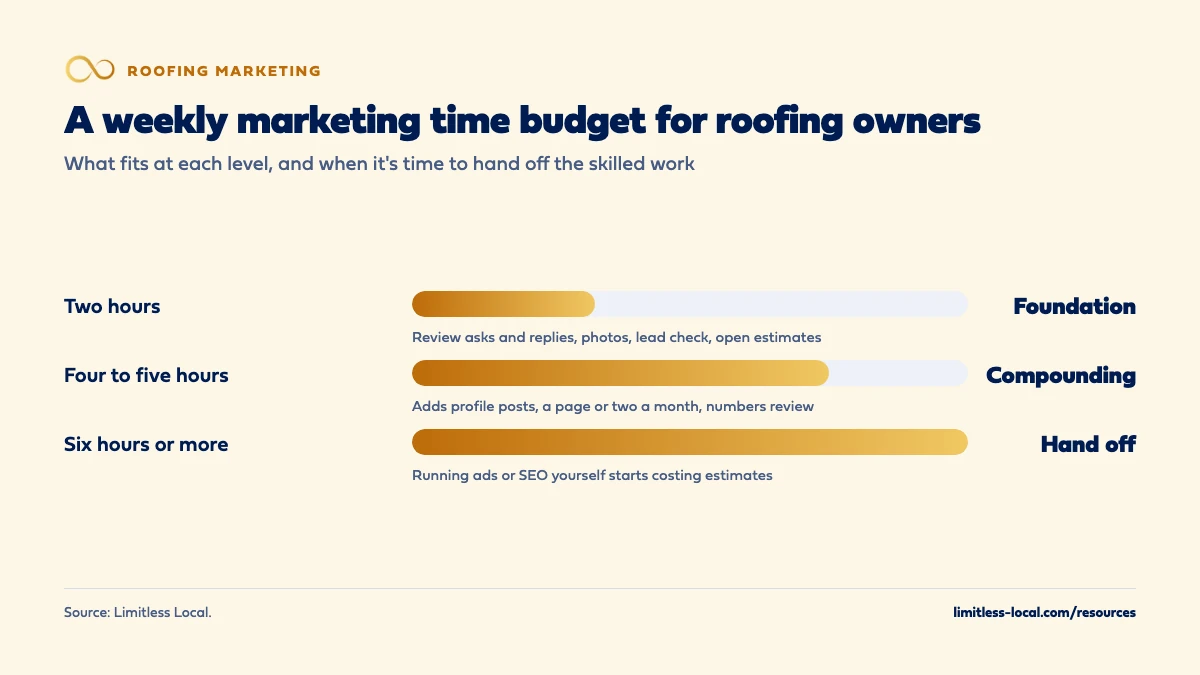
- Past about five hours a week, or if it stops in storm season, hand off the skilled work.
For roofing owners who still run estimates or crews and need a realistic weekly time budget for marketing that won’t eat into the work that pays.
Get a free visibility audit · Book a growth call
How much weekly time can a roofing owner give marketing before it costs estimates and jobs?
Most roofing owners who still run estimates or crews can keep up about two to four hours of marketing a week without it cutting into job time. Spend those hours on the work only your company can do: asking for reviews, taking job photos, replying to reviews, updating your Google profile and checking which leads turned into inspections. If keeping your marketing running takes more than about five hours a week of your own time, or it stops every time storms hit, hand off the skilled work like ads, SEO and the website, and keep a short weekly check-in for yourself.
The hours that are hardest for a roofing owner to find are the skilled ones: ads, SEO, the website and the tracking behind them. That’s the work our roofing marketing packages take off your plate, while your team keeps the parts only it can do. The packages page lists what each tier covers. For the bigger picture across every channel, read the roofing marketing guide, and the roofing marketing questions library has the follow-ups.
How much time does roofing marketing actually take each week?
There are two different numbers here, and owners often mix them up. One is how much work your marketing needs in total. The other is how much of that has to come from you.
The total can be a lot. A roofer running Google Ads, Local Services Ads, a Google Business Profile, a website with SEO and a review program has hours of work every week between them, before anyone answers a phone. The U.S. Small Business Administration’s guide to making a marketing plan opens with the point that marketing takes time, money and preparation.
Your share can be small, if you’re deliberate about it. Some marketing tasks need you or your crews because nobody else was on the roof. Others need a skill, not you specifically. A realistic weekly budget only has to cover the first kind. How much work each roofing marketing channel takes from you breaks it down channel by channel.
What can a roofer get done with two hours a week?
Two focused hours a week is enough to keep the foundation healthy if someone else handles anything technical, or if you’re only running your Google profile and reviews:
- Review asks and replies (30 minutes). Make sure every finished job got a review request, and reply to every new review.
- Photos (20 minutes). Pick the best before-and-after shots your crews took this week and add a few to your Google profile.
- Lead check (30 minutes). Look at last week’s calls and forms. Did every one get reached? Did any inspection slip through the cracks?
- Open estimates (30 minutes). Look at which estimates are waiting for follow-up and who’s on them.
- One profile update (10 minutes). A post about a recent job or a seasonal note.
None of that needs marketing skill. It needs consistency, which is the part owners usually can’t buy.
What fits in four or five hours a week?
With four or five hours you can do everything above and start building things that compound:
- A website page or two a month. A page for a town you want more work in, or a service you want to sell more of, written from what your crews actually do.
- Weekly Google profile posts. Google’s help page on Business Profile posts explains that posts can share updates, offers and events with customers on Search and Maps, and can include photos, videos and a button linking to your website. Posts older than six months are archived unless you set a date range, so a steady habit beats a one-time burst.
- A monthly numbers review. Leads, inspections and signed roofs by source.
- Referral outreach. A call or note to realtors, inspectors and past customers.
That’s about the ceiling for most owners who also run estimates. Past this point, marketing starts competing directly with the work that signs roofs.
Which marketing tasks take only minutes but matter most?
The highest-value marketing tasks for a roofer are short, and they all happen on the job site or the phone:
- Asking for the review at the final walk-through, in person, while the homeowner is looking at their new roof. Google lets you share a review request link or QR code so the homeowner can leave one in a minute.
- Replying to reviews. A short, specific reply shows the next homeowner you’re responsive.
- Snapping before-and-after photos from the same angle on every job.
- Answering the phone, or making sure someone does. No marketing hour pays off if the call it brings rings out.
Notice that these are the tasks you can’t really outsource, because someone has to be there. That’s why your weekly time is best spent on them. Which marketing tasks a roofer should keep in-house has the full list.
Curious what your marketing is actually booking?
Get a free visibility audit — no obligation, no sales pitch.
Which marketing tasks eat the most hours?
The time sinks are the skilled tasks, and they’re the ones most likely to go wrong quietly when an owner fits them in at night:
- Google Ads. Beyond the setup, ads need regular checks of what people actually searched. Google’s search terms report shows the real searches that triggered your ads and how each performed, so you can spot money going to searches you don’t want, like DIY questions or jobs you don’t do. Skip it for a few busy weeks and the waste piles up.
- SEO and website content. Writing pages that rank takes research, writing and patience, and the payoff takes months.
- Tracking setup. Getting call tracking, forms and lead sources to agree takes technical time up front.
- Learning. Platforms change. Keeping up with Google’s changes is a job in itself.
If these are where your hours are going, that’s usually the sign to hand them off. Which roofing marketing tasks to do yourself or hand off goes through each one.
When does marketing time start costing you estimates and jobs?
The moment it pushes out an estimate appointment, a sales call or a crew problem only you can solve. For most roofing owners, the most valuable hour of the week is the one spent in front of a homeowner with a roof that needs replacing.
Watch for these signs:
- You’re doing marketing at ten at night because the day was full of jobs.
- Estimates go out later than they used to because you were stuck in an ads account.
- Follow-up calls slip because you spent the afternoon on the website.
- You avoid looking at the numbers because there’s no time to act on them.
Any of those means your marketing hours are now coming out of your selling hours. The worked example below puts a rough number on what that costs.
How should a roofer's marketing time change between storm season and winter?
Roofing work has seasons, and your marketing time should follow them. The Bureau of Labor Statistics’ roofer profile notes that in northern states roofing work may be limited during the winter months, while roofers may work overtime to complete jobs during the busy summer months.
- Busy season and after storms: cut your marketing time to the minimum: review asks, photos and making sure every call is answered. This is when calls are easiest to lose and hardest to replace.
- Slow season: this is when your extra marketing hours belong. Write the website pages, clean up the Google profile, set up tracking, follow up on old estimates and plan next year’s budget.
An owner who can give four hours a week on average might give one in July and eight in January. That’s fine, as long as the slow-season hours actually happen.

How do I find marketing time without dropping the ball?
- Put it on the calendar. The same block every week, like Monday at 7 a.m. Marketing that waits for spare time doesn’t happen.
- Batch the small stuff. Do review replies, photo uploads and the lead check in one sitting instead of scattered through the week.
- Give the crews one job. Before-and-after photos on every roof, sent to one place. It takes them a minute and saves you an hour.
- Give the office one job. Logging every lead with its source and booking inspections. That’s your funnel’s most important work, and it shouldn’t depend on you.
- Keep a one-page checklist. So the routine survives a busy week, and someone else can run it if you can’t.
How much of my time does marketing take if I hire it out?
Less, but not zero. Handing off the skilled work still leaves a few things that need you:
- Onboarding. With us, your team spends about 2 to 3 hours up front getting us access and the details we need, and campaigns go live in weeks 1 to 2.
- Approvals and input. Details about your materials, warranties and towns for website pages, and a quick look before they go live.
- A monthly report. Every package includes a monthly performance report with a cost-per-lead breakdown and a real-time dashboard. Reading it takes a few minutes.
- Strategy calls. Quarterly on Essentials, monthly on Growth.
Your crews still take photos and ask for reviews, and your office still answers the phone. Those stay with you no matter who runs the rest. The risks of running your roofing marketing yourself lays out the trade-off on the other side.
How do I know my marketing hours are paying off?
Check two things each month. First, whether people are finding and contacting you: if your Google Business Profile is verified, its performance report shows how many people viewed your profile, which searches they used, and how many tapped to call or clicked through to your website. Second, whether those contacts are turning into roofs: inspections booked and estimates signed, by source.
If your hours go up and neither number moves over a few months, the hours are going to the wrong tasks. Move them toward reviews, follow-up and the lead check, and hand off anything technical. If both numbers are climbing, protect that weekly block. How a roofer sets up a funnel for roofing leads shows how to count each step so you can tell.
Not sure which of these is costing you jobs?
A free visibility audit checks the Google profile, reviews, site and tracking, and shows what to fix first.
What's different about marketing time for roofers
The owner is often the closer. In many roofing companies the owner still runs the inspections and sells the replacements. That makes the owner’s hour unusually expensive, and every hour of marketing has to be weighed against a roof that might not get sold.
Demand comes in bursts. A hailstorm can fill a month’s calendar in a week. A time budget that works in a quiet month falls apart in a storm month, so plan for both.
The best content is on the roof. Photos and job details from your crews make your Google profile and website stand out. Building that habit into the job costs minutes; recreating it later costs hours.
A worked example: what an owner's marketing hours really cost
These numbers are made up to show the trade-off, not a benchmark. Say an owner spends six hours a week running Google Ads and writing website pages, and has more estimate requests than they can get to. Each estimate appointment, with travel, takes about 90 minutes, about one in three estimates signs, and a signed replacement leaves about $4,000 after materials and labor.
Six hours a week is four estimate slots. Over a four-week month, that’s 16 estimates the owner could have run, which at one in three is about 5.3 signed roofs, or roughly $21,000 in profit left on the table.
Compare that with handing off the skilled work. Our Essentials package is $3,500 a month and covers local SEO, Google Business Profile management, Google Ads management and tracking; ad spend is paid to Google separately. The math won’t look like this for every owner. If you don’t have more estimate requests than time, your marketing hours aren’t displacing sales, and doing more yourself may be the right call.
Frequently asked questions
Can a roofer do all their own marketing in one hour a week?
One hour covers review asks, replies and a quick lead check, which is worth doing. It won’t cover running ads or writing website pages, so either keep things simple or hand those off.
Should my office manager do the marketing?
An office manager is ideal for logging leads, booking inspections, chasing estimates and sending review links. Running ads or SEO is a separate skill, so don’t add it to their job without training or help.
Is it worth learning Google Ads myself?
It can be, if you’ll give it steady weekly time, including busy weeks. The usual problem isn’t difficulty; it’s that the checks stop when storm season fills the calendar.
How long does it take to set up a Google Business Profile properly?
The setup itself is an afternoon or two, plus verification. After that it’s a few minutes a week of photos, posts and review replies.
Do I need to spend time on social media?
Not much. A few job photos a month is plenty for most roofers. Your Google profile and reviews usually deserve the time first.
What if I have zero time for marketing right now?
Protect two habits: every call gets answered or returned fast, and every finished job gets a review request. Then use the next slow stretch to build the rest or hand it off.
Key takeaways
- Most owner-operators can sustain about two to four hours of marketing a week.
- Spend your hours on what only your company can do: reviews, photos, replies and lead checks.
- Google Ads, SEO and tracking eat the most time and need skill; they’re the first to hand off.
- Shift marketing time to the slow season, and keep storm-season time to the essentials.
- Past about five hours a week, marketing usually starts costing estimates and signed roofs.
Want a second set of eyes on your setup?
We'll look at how you show up locally and where calls are leaking, then send you a plain-English breakdown.
More in this section
- How many extra jobs must a roofer book to cover marketing cost?
- What share of revenue should a roofer put into marketing?
- What ROI should a roofer expect from a monthly marketing budget?
- How does a roofer run a profitable business with marketing?
- How much work does each roofing marketing channel take from me?
Sources
- Manage your business: Marketing and sales — U.S. Small Business Administration
- Create & manage posts on your Business Profile — Google Business Profile Help
- Manage customer reviews — Google Business Profile Help
- About the search terms report — Google Ads Help
- Roofers: Occupational Outlook Handbook — U.S. Bureau of Labor Statistics
- Understand your Business Profile performance & insights — Google Business Profile Help