
How much work does each roofing marketing channel take from me?
- How much owner time and know-how do SEO, Google Ads, LSAs and reviews each need?
- Why does each roofing channel ask something different of me?
- How much work do Local Services Ads take from me?
- How much work does Google Ads take from me?
- How much work does SEO take from me?
- How much work does my Google Business Profile take?
- How much work do reviews take?
- Which roofing channel needs the most expertise?
- Which channel needs the most of my time, no matter who runs it?
- What does handing a channel off still leave on my plate?
- How do I pick channels that fit the time I actually have?
- What happens when nobody does the work?
- What's different for roofers
- A worked example: one roofer's week, with and without help
- Frequently asked questions
- Key takeaways
- More in this section
- Sources
The short version
- LSAs: little skill to run, but someone must answer every call and message fast.
- Google Ads: the most skill, with weekly checks that waste money when skipped.
- SEO and your Google profile: steady monthly work, with photos and job details from you.
- Reviews: minutes per job, but only your crews can ask at the right moment.
For roofing company owners weighing which channels they can actually keep up with, on top of running crews and inspections.
Get a free visibility audit · Book a growth call
How much owner time and know-how do SEO, Google Ads, LSAs and reviews each need?
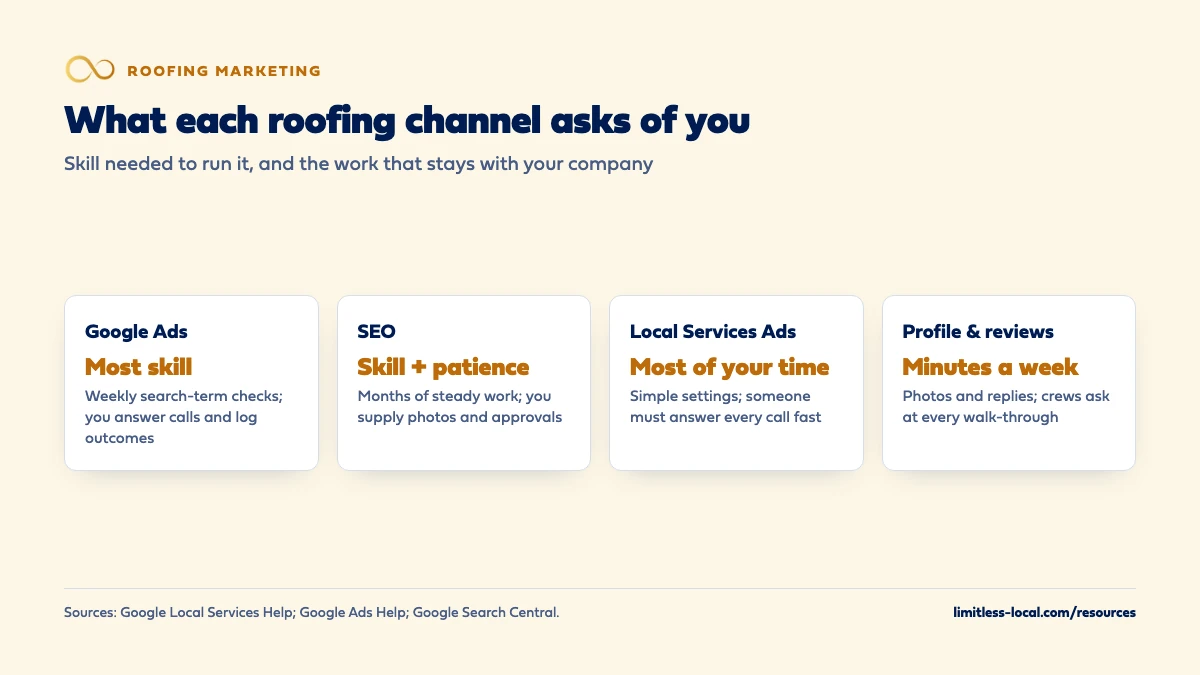
Each roofing channel asks for a different kind of work. Local Services Ads and reviews need the least expertise but the most of you and your crews, because someone has to answer every call fast and ask every customer for a review. Google Ads needs the most skill: weekly search-term checks, negative keywords and tracking that cost money quietly when they’re skipped. SEO and your Google Business Profile sit in between: steady, unglamorous work for months, with the owner supplying photos, job details and approvals even when someone else does the rest.
Most of the skilled, weekly work on that list is what our roofing marketing takes off your plate: Google Ads, Local Services Ads on Growth and Scale, your Google profile and local SEO, plus call tracking and a monthly report. Onboarding takes your team about 2 to 3 hours, and the packages page spells out what each tier covers. For the bigger picture across every channel, read the roofing marketing guide, and the roofing marketing questions library has the follow-ups.
Why does each roofing channel ask something different of me?
Every channel has two kinds of work in it. There’s work only your company can do: answering the phone, taking photos on the job, asking for reviews, telling a marketer which jobs and towns you want. And there’s work that takes skill: building campaigns, reading reports, fixing a website, cleaning up listings.
Hiring help moves the skilled work off your plate. It never moves all of the first kind. So the real question for each channel is two questions:
- How much know-how does it take to run well?
- How much of my time, and my crews’ time, does it need no matter who runs it?
A channel that’s light on both is easy to keep going. A channel that’s heavy on skill is the one to hand off first. A channel that’s heavy on your time only works if you can commit that time every week, including in storm season when you’re slammed. The sections below take each channel in turn.
How much work do Local Services Ads take from me?
Setup is paperwork. Before your ads can run, Google screens your business. Its page on screening and verification requirements says the process takes 3 to 4 weeks on average after you submit your documents, and that background checks, business registration, license and insurance checks are required for select users. You’ll be gathering documents, not learning software.
Running them is mostly answering the phone. Local Services Ads have no keywords to manage. You pick job types and towns, set a budget, and the homeowner contacts you straight from the ad. What decides whether you get leads is how you respond: Google’s page on how Local Services Ads rank says missed calls may hurt your responsiveness, and that your rating, number of reviews and average response time feed into your profile quality.
Day to day, that means:
- Someone picks up during your listed hours, every time.
- Messages get a reply the same day, ideally within the hour.
- Each lead gets marked so you know which ones booked.
- Bad leads get flagged in the feedback survey.
Low skill, high discipline. If your phone already goes to voicemail half the day, fix that before you turn LSAs on. How fast a roofing company should call back a new lead covers the habits that help.
How much work does Google Ads take from me?
This is the most skilled channel on the list. Setting up campaigns, choosing keywords and match types, building a landing page and getting calls and forms tracked correctly takes real know-how, and small mistakes waste money without any warning.
The ongoing work is weekly. The biggest piece is the search terms report, which shows the actual searches that triggered your ads. For a roofer that means spotting “roofing jobs”, “DIY roof repair” or “shingles wholesale” and blocking them before they eat the budget. On top of that come bid and budget checks, location settings, ad testing and making sure tracked calls still work.
If you run it yourself, plan on a few hours a week once it’s built, plus learning time at the start. If you hand it off, your part shrinks to:
- Telling your marketer which jobs and towns matter most right now.
- Answering the calls the ads bring in.
- Recording which leads became inspections and signed roofs.
- Reading the monthly report and asking questions.
That last list is short, but skipping it is how good campaigns drift. Without job outcomes, nobody can tell which searches bring roofs and which bring tire-kickers. What a roofing marketer actually does each month shows the work on the other side.
How much work does SEO take from me?
SEO is slow, steady work: website pages for your services and towns, fixing technical problems, earning links from local sites, and keeping your business details consistent everywhere they’re listed. Most of that takes skill, and none of it pays off fast. Google’s SEO Starter Guide says some changes take effect in a few hours and others could take several months, and that you’ll likely want to wait a few weeks to assess whether your work helped.
Even when someone else does it, SEO needs things only you have:
- Job photos from real roofs, with the town noted.
- Plain answers to questions about how you work: materials you install, warranties you offer, how inspections go.
- Approval on new pages, so nothing says you do work you don’t.
- The towns and jobs you want, so pages get built for the right ones.
For most owners that’s an hour or two a month once the site is set up, more in the first couple of months. The hard part isn’t time; it’s patience while the work builds.
How much work does my Google Business Profile take?
Less than any other channel, once it’s set up right. Verifying the profile, picking categories, listing services and drawing your service area is a one-time job. After that, Google’s tips to improve your local ranking point to the same small habits: keep your hours and details accurate, add photos, and reply to reviews.
A realistic weekly rhythm:
- Add a few job photos from the week.
- Reply to any new reviews.
- Update hours before holidays and storm-season extended hours.
That’s minutes a week, not hours. Owners often do this part themselves even when they hand off everything else, because the photos are on their phone anyway. The skilled side, like categories, service areas and fixing duplicate or suspended listings, is worth handing off when something goes wrong.
Curious what your marketing is actually booking?
Get a free visibility audit — no obligation, no sales pitch.
How much work do reviews take?
Very little per job, and a lot of discipline overall. A review request takes a minute at the final walk-through, when the homeowner is looking at a new roof and happy about it. A text with a direct review link afterward catches the ones who said “sure” and forgot.
This is the one channel nobody can fully do for you. Software can send the follow-up text, but the ask lands best from the crew lead or the salesperson the homeowner trusts. Reviews also feed other channels: they count toward your Local Services Ads profile quality, and more reviews and positive ratings can help your local ranking on Maps.
What it takes from you is making it a habit: a step on the job-completion checklist, a quick reminder in the morning meeting, and a reply to every review within a few days. How to get more Google reviews after a roof replacement has scripts and timing that work for crews.
Which roofing channel needs the most expertise?
Ranked from most skill to least:
- Google Ads. Keywords, match types, bidding, tracking and landing pages, all changing over time. Mistakes cost money every day they run.
- SEO. Technical website work, content and links. Mistakes cost time, which hurts less day to day but is slow to undo.
- Local Services Ads. Simple settings, but job types, service areas and budget still need care, and the move into Google Ads adds new screens to learn.
- Google Business Profile. Easy once it’s set up correctly; setup and fixing problems need know-how.
- Reviews. A habit, not a skill.
That order is a good guide to what to hand off first if you can only hand off one thing.
Which channel needs the most of my time, no matter who runs it?
Local Services Ads and reviews, by a long way. Both depend on things only your company can do: answer the phone, reply to messages, and ask happy customers for a review. No agency can pick up your phone at 4 p.m. while you’re on a roof, and no software can stand in the driveway after a final walk-through.
Google Ads and SEO are the opposite. Hand them off and your weekly share drops to answering the leads and logging outcomes. The Google profile sits in between: little time, but the best photos come from you.
So if you’re short on office help, look hard at whether you can answer fast enough to make LSAs pay before you turn them on. And if you can’t commit to asking for reviews, every other channel works harder than it should.

What does handing a channel off still leave on my plate?
More than most owners expect at the start, less than doing it yourself. Even with every skilled task handed off, your company still owns:
- Speed to lead. Answering and calling back.
- Outcomes. Marking which leads booked inspections and which signed.
- Decisions. Which jobs, towns and budget levels you want this month.
- Raw material. Photos, reviews and answers about how you work.
- Access. Owner-level access to your Google profile, ad accounts and website.
Setup is the heaviest stretch. After that, a good handoff should cost you a short monthly review and the daily habits above. Which marketing tasks a roofer should keep in-house goes task by task.
How do I pick channels that fit the time I actually have?
Match the channel to the capacity you really have, not the one you plan to have:
- One truck, no office help: start with your Google profile and reviews. They take minutes a week. Add LSAs only once someone can answer calls during the day.
- Office manager in place: LSAs fit well, because the person answering the phone is doing the main work. Hand off Google Ads rather than learning it from scratch.
- Several crews and a sales team: run all of them, with the skilled work handed off and your team owning speed, reviews and outcomes.
- Storm season: your time vanishes. Set up review requests and call handling before the season, not during it.
Whether to run them together or one at a time is its own question. Whether a roofer should use SEO, Google Ads and LSAs together or pick one walks through it by cash flow and goals.
What happens when nobody does the work?
Each channel decays in its own way, and usually quietly:
- Google Ads: junk searches creep in, the budget runs out on the wrong clicks, and cost per lead climbs.
- Local Services Ads: missed calls pile up, responsiveness drops, and fewer leads come in.
- SEO: pages go stale, competitors add theirs, and rankings slip over months.
- Google profile: old hours, no new photos, unanswered reviews.
- Reviews: the stream dries up, and your newest review is from last year.
None of these shows up as an error message. That’s why tracking leads and signed roofs by source matters: it’s the early warning that a channel stopped getting its share of the work.
Not sure which of these is costing you jobs?
A free visibility audit checks the Google profile, reviews, site and tracking, and shows what to fix first.
What's different for roofers
Your busiest weeks are your worst weeks for marketing. After a hailstorm, the phone rings nonstop and nobody has time to answer every LSA call, ask for reviews or check search terms. Build the habits and handoffs in the slow season so they hold up when it counts.
Your crews are on roofs, not near phones. Calls that come in while everyone is up a ladder need a plan: an office person, a call service, or message leads turned on.
Photos are your edge. Before-and-after shots of real roofs in real towns help your Google profile, LSA profile and website pages at once. A crew lead who snaps them on every job saves your marketer hours.
A worked example: one roofer's week, with and without help
These numbers are made up to show the trade-off, not a benchmark. A two-crew roofer with one office manager runs all four channels.
Doing it all in-house: about 4 hours a week on Google Ads, 2 on SEO and the website, 1 on the Google profile, plus the office manager’s time answering LSA calls and messages and the crews’ minute per job asking for reviews. That’s 7 hours of the owner’s week before any phone time, much of it on the skilled work.
With the skilled work handed off: the office manager still answers calls and logs outcomes, the crews still ask for reviews, and the owner spends about 1 hour a week on photos and review replies plus a monthly report call. The 7 hours drop to roughly 1, and the hours that remain are the ones only the company can do.
Our Essentials package is $3,500 a month and covers SEO, Google profile management and Google Ads; Growth, at $4,500 a month, adds Local Services Ads management. Ad spend is paid to Google separately.
Frequently asked questions
Can I run Local Services Ads without an office manager?
You can, but it’s harder. Missed calls can hurt your ranking, so if you’re on roofs all day, turn on message leads and make sure someone checks them often.
Is it realistic for a roofer to learn Google Ads?
Yes, if you can give it steady weekly time and learn from the search terms report. The usual problem is finding the time in storm season, not the difficulty.
How long does it take to set up a Google Business Profile properly?
The setup itself is an afternoon or two of work, plus verification. Getting it to bring steady calls takes longer, because reviews and photos build up over months.
Do I need to write my own website content for SEO?
No, but someone needs your input. A writer can draft pages, while you supply details about your materials, warranties, towns and how you run inspections, and approve the result.
Which channel is easiest to pause in a busy season?
Paid ads are the easiest to pause and restart. Reviews and your Google profile shouldn’t pause at all, since a busy season is when you finish the most roofs to ask about.
Can review requests be automated?
The follow-up text can be. The first ask works best in person at the final walk-through, from someone the homeowner has met.
Key takeaways
- Every channel splits into work that takes skill and work only your company can do.
- Google Ads takes the most skill; hand it off first if you can only hand off one thing.
- Local Services Ads and reviews take the most of your company’s time, no matter who runs them.
- SEO needs photos, details and approvals from you, plus months of patience.
- Build the habits in the slow season so they hold up when storms hit.
Want a second set of eyes on your setup?
We'll look at how you show up locally and where calls are leaking, then send you a plain-English breakdown.
More in this section
- How quickly can each roofing marketing channel produce leads?
- What does a roofing marketer actually do each month?
- Which roofing marketing tasks should I do myself or hand off?
- What share of revenue should a roofer put into marketing?
- What does roofing marketing cost: agency, employee or DIY?
Sources
- Business screening and verification requirements – United States — Google Local Services Help
- About ad rankings — Google Local Services Help
- About the search terms report — Google Ads Help
- SEO Starter Guide: The Basics — Google Search Central
- Tips to improve your local ranking on Google — Google Business Profile Help