
Should a roofer use SEO, Google Ads and LSAs together or pick one?

- Should I run SEO, Google Ads and LSAs at once, or add them one at a time as cash allows?
- Do I need all three to grow a roofing company?
- What does each channel do that the others can't?
- How do the three help each other when I run them together?
- If I already rank well, do I still need ads?
- When should a roofer pick just one channel?
- If I can only afford one, which should it be?
- How should cash flow decide the order?
- What's a sensible way to add the channels one at a time?
- How do I run all three without paying twice for the same homeowner?
- When is it time to add the next channel?
- What's different for roofers
- A worked example: one roofer, two ways to add channels
- Frequently asked questions
- Key takeaways
- More in this section
- Sources
The short version
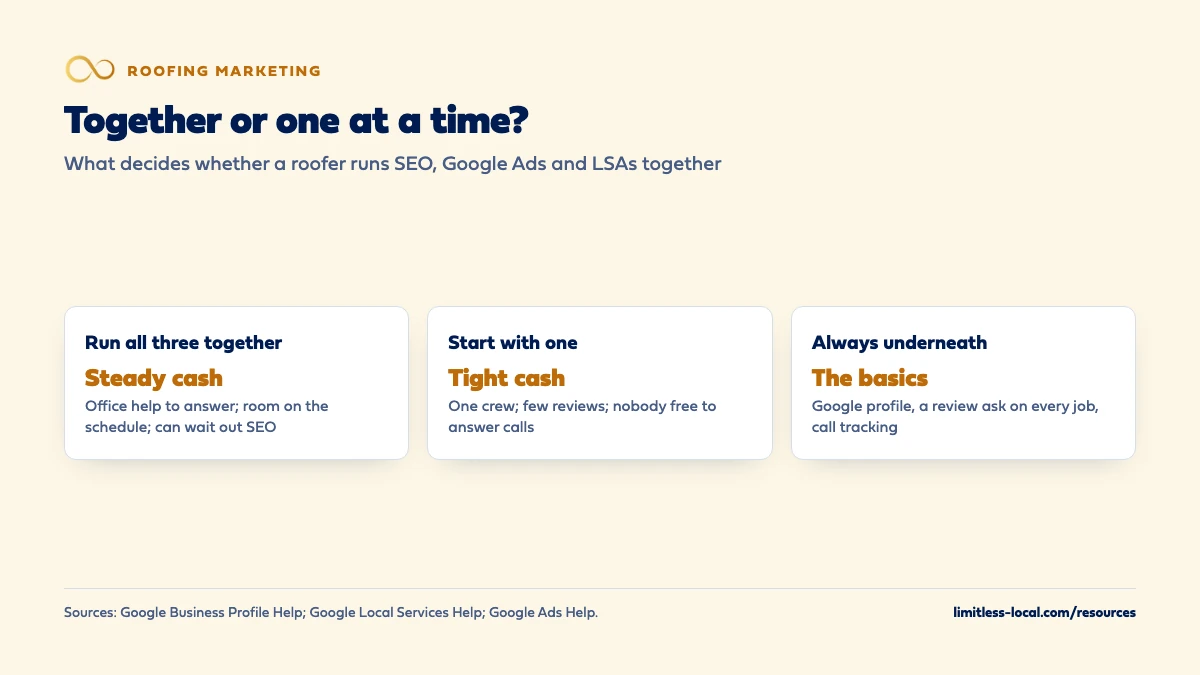
- All three together suits roofers with steady cash, office help and room on the schedule.
- Each covers a gap: SEO builds free calls, Google Ads picks the jobs, LSAs bring pay-per-lead calls.
- Tight cash or one crew: start with one paid channel plus your Google profile and reviews.
- Add the next channel when the current one is paying for itself.
For roofing company owners deciding whether to run all three Google channels at once, or start with one and add the rest as cash flow allows.
Get a free visibility audit · Book a growth call
Should I run SEO, Google Ads and LSAs at once, or add them one at a time as cash allows?
Most established roofers do best running SEO, Google Ads and Local Services Ads together, because each covers a gap the others leave and the reviews and profile work behind SEO also help your Local Services Ads rank. But together only works if you can fund all three properly, answer every call and wait out SEO’s ramp. If cash is tight or you’re one crew, start with one paid channel that brings calls now, keep your Google profile and reviews going, and add SEO and the second paid channel as the first one pays for itself.
Running all three well is the setup our roofing marketing packages are built around: Essentials covers local SEO, your Google profile and Google Ads, and Growth adds Local Services Ads, all with call tracking so you can see which channel signs roofs. The packages page shows what each tier includes. For every channel in context, read the roofing marketing guide, and browse the roofing marketing questions for the follow-ups.
Do I need all three to grow a roofing company?
No. Plenty of roofers grow on one channel, especially in a small market or with a strong referral base. But the three Google channels show up in different places on the same search, and a roofer who’s in all three places tends to get more of the homeowners searching in their towns.
The real question isn’t “all three or one”. It’s three smaller questions:
- Can I fund each one properly? Three underfunded channels usually do worse than one well-funded one.
- Can I handle the calls? More channels means more leads, and unanswered leads waste money on every channel.
- Can I wait? SEO typically takes 3 to 6 months to show meaningful growth. Ads can bring leads within days.
If the answer to all three is yes, run them together. If any answer is no, sequence them, and the rest of this page shows how.
What does each channel do that the others can't?
- SEO (your website and Google Business Profile) earns you a place in the map pack and the regular results, with no fee per click or lead. Google’s tips to improve your local ranking are clear that there’s no way to pay for a better local ranking, so this is the only route into those free spots. It’s slow, and it keeps working after the money stops.
- Google Ads let you pick the exact searches you show up for. That’s how you go after “roof replacement” in your best towns and skip repair-only work, and how you show up in towns where you don’t rank yet.
- Local Services Ads charge per lead instead of per click, show at the top of the page with the Google Verified badge, and need no keywords. They’re the simplest of the three to run, and they reward fast answering and strong reviews.
None of the three does the others’ job. SEO can’t target a town you’re far from, Google Ads can’t make you rank for free, and Local Services Ads can’t pick specific searches. Which roofing companies get the best results from SEO versus ads covers who leans which way.
How do the three help each other when I run them together?
This is the strongest case for running them together. The work for one feeds the others:
- Reviews feed Local Services Ads. Google’s page on how Local Services Ads rank says your rating, number of reviews and response time count toward profile quality, and that higher-quality profiles may rank higher and may pay lower costs per lead. The review habit you build for SEO pays off in your LSA results too.
- Your Google profile feeds your LSA campaign. As Local Services Ads move into Google Ads, Google’s transition page says your business name, address and hours sync one way from your Business Profile into the campaign. A clean profile is now part of your LSA setup.
- Ad searches feed your website. The search terms report in Google Ads shows the real searches that triggered your ads, and Google notes it can give you ideas for landing page content. Those searches tell you which service and town pages to build for SEO.
- One tracking setup serves all three. Once calls and forms are tracked by source, you can move money toward whichever channel signs roofs cheapest.
If I already rank well, do I still need ads?
Maybe less than you’d think, and maybe more. Google’s researchers published a study on organic ranking and ad clicks in 2012, a meta-analysis of 390 tests where advertisers paused their search ads, measured in clicks rather than sales. It found that when the advertiser’s own organic result ranked first, on average 50% of ad clicks were incremental, meaning they weren’t replaced by organic clicks once the ads stopped. When the organic result sat between positions 2 and 4, it was 82%, and below position 4 it was 96%.
That’s an old, broad study across all kinds of advertisers, not roofers, and the researchers note results for individual advertisers vary. But the shape is useful: if you rank at the very top for a search, ads on that search add less; if you rank lower or not at all, ads add most of what they bring.
For a roofer, that suggests checking where you actually rank in each town before cutting ads there. Ranking first in your home town says nothing about the next town over.
Curious what your marketing is actually booking?
Get a free visibility audit — no obligation, no sales pitch.
When should a roofer pick just one channel?
Start with one when any of these is true:
- Cash is tight. You can fund one channel properly, but splitting the money three ways leaves each too thin to learn anything.
- Nobody’s free to answer. If calls go to voicemail while you’re on a roof, more channels just means more missed leads.
- You’re brand new. No reviews and no website yet means Local Services Ads and SEO both start from behind.
- Your crews are already booked out. More leads won’t help if you can’t install them.
One channel isn’t a forever choice. It’s a way to get one source working and paying for itself before you spread out. Mistakes roofers make choosing SEO, Google Ads or LSAs covers the traps on the way.
If I can only afford one, which should it be?
It depends on what you need most right now:
- Calls this month, and you have solid reviews: Local Services Ads, if you’re eligible. Pay-per-lead pricing keeps waste down, and setup is simple. Allow for the screening, which can take weeks.
- Calls this month, few reviews, or you want replacements specifically: Google search ads, with tight keywords and a good landing page.
- You can wait, and you’ve worked the same towns for years: SEO and your Google profile, since you’re already close to the homeowners you want and the work compounds.
Whatever you pick, keep the basics going underneath it: a complete Google Business Profile, a review ask on every finished job, and tracking on every call. Those cost little and make every channel you add later work better. What marketing a roofing company should add first lays out the full order.
How should cash flow decide the order?
The three channels spend money in very different patterns, and that matters as much as which one is “best”:
- Paid channels are pay-as-you-go. Spend goes up and down with your budget, you can pause in a slow month, and the leads arrive within days. Cash out, leads back, fast.
- SEO is a fixed monthly cost with a delayed return. You pay for months before the leads arrive, and you can’t pause it without losing ground.
That points to a common order for cash-tight roofers: start with a paid channel that brings work now, and once it’s reliably paying for itself, use part of that profit to fund SEO through its ramp. When SEO starts producing, its leads come at no per-lead cost, which frees money to add the second paid channel or scale the first.
The roofer who starts SEO with money they need for payroll usually quits in month three, right before it would have paid off.
What's a sensible way to add the channels one at a time?
A path that suits most roofers starting small:
- Foundation: claim and complete your Google Business Profile, start asking every customer for a review, and set up call tracking.
- First paid channel: Local Services Ads or Google search ads, whichever fits your reviews and the jobs you want.
- SEO: service and town pages on your website, once the first channel is covering its cost.
- Second paid channel: the other one of the pair, to fill gaps the first can’t reach, like specific replacement searches or towns where you don’t rank.
Give each step enough budget and time to judge before adding the next. For paid channels, that’s usually a couple of months of steady leads. For SEO, it’s longer.
How do I run all three without paying twice for the same homeowner?
Some overlap is normal. A homeowner might see your Local Services Ad, click your search ad, read your reviews on Maps and then call the number on your website. Three channels touched that lead; you only want to count it once.
- Track by source. Separate tracking numbers for your Google profile, website and ads, with LSA leads in their own campaign.
- Count each homeowner once in your CRM, with the first source that brought them in, and note others if you know them.
- Split jobs between paid channels. Let Local Services Ads cover general roofing leads and point Google Ads at the specific high-value jobs, like full replacements, that LSAs can’t target by keyword.
- Check search terms for your own business name. If your ads mostly catch people already searching for you, that spend may be better used elsewhere.
Cost per lead for roofing SEO, Google Ads and LSAs covers comparing them on a fair basis.
When is it time to add the next channel?
Add the next one when all of these are true:
- Your current channel has a steady cost per signed roof you’re happy with, over at least a couple of months.
- Your crews have room for more work, or you’re ready to add a crew.
- Someone is answering calls and messages fast, and that won’t break with more volume.
- You have cash to fund the new channel properly, and for SEO, to carry it through the ramp.
If the current channel isn’t paying for itself yet, fix it before adding another. More channels won’t fix a slow phone answer, a weak landing page or missing tracking; they’ll multiply the waste. How much work each roofing channel takes from you helps you check whether your team can carry the next one.
Not sure which of these is costing you jobs?
A free visibility audit checks the Google profile, reviews, site and tracking, and shows what to fix first.
What's different for roofers
Storms change the mix overnight. After hail, paid channels are the ones you can turn up fast in the affected towns. SEO can’t react in a week, but it keeps calls coming in the quiet months after the storm crews leave.
Replacements reward the targeting only Google Ads gives you. If full replacements are the jobs you want most, search ads are where you can aim at those searches directly.
Reviews carry more weight for roofers. Homeowners are trusting you with a large, once-in-years purchase, and your reviews show up in your map listing and your Local Services Ads. The review habit is the one piece every channel shares. A roofing client of ours got 3x map pack visibility in its target towns; better presence and consistent info across the web increased inbound calls.
A worked example: one roofer, two ways to add channels
These numbers are made up to show the trade-off, not a benchmark for your market. A one-crew roofer has $3,000 a month to spend on marketing.
All three at once: $1,000 each to Local Services Ads, Google Ads and SEO work. The ad budgets are thin enough that both run out early most weeks, and SEO at that level moves slowly. After four months, the owner can’t tell which channel is working.
One at a time: $2,000 to Local Services Ads, $1,000 to the Google profile, reviews and tracking. By month three, LSAs are bringing steady leads at a cost per signed roof the owner likes. The profit from those roofs funds SEO from month four, and Google Ads for replacements come in once SEO starts producing.
Same money, but the second roofer knows what each dollar did and has a channel paying for the next one.
Our Essentials package is $3,500 a month and covers local SEO, Google profile management and Google Ads up to $2,500 in spend; Growth, at $4,500 a month, adds Local Services Ads management and raises Google Ads to $5,000 in spend. Ad spend is paid to Google separately.
Frequently asked questions
Do Google Ads or Local Services Ads help my map pack ranking?
No. There’s no way to request or pay for a better local ranking on Google. Ads can sit above the map pack, but your free ranking comes from your profile, reviews and website.
Can I run Local Services Ads and Google Ads in the same towns?
Yes. Many roofers do, with LSAs covering general roofing leads and search ads aimed at specific jobs like replacements.
Should I stop SEO once ads are bringing enough leads?
Usually not. Ad leads stop the day you stop paying, while SEO keeps bringing calls. Cutting SEO makes you fully dependent on ad prices.
Is it worth running all three in a small town?
Sometimes not. In a small market with few competitors, a strong Google profile and one paid channel may cover most of the searches. Check how much demand is left before adding the third.
What if my LSA account moves into Google Ads?
Your ads still show in the same places and you still pay per lead. You’ll manage them in Google Ads, and your business details sync from your Google Business Profile.
Key takeaways
- Run all three together if you can fund each properly, answer every call and wait out SEO.
- Each channel covers a gap the others can’t: free rankings, chosen searches, pay-per-lead calls.
- Reviews and a clean Google profile help SEO and Local Services Ads at the same time.
- Cash-tight roofers do better starting with one paid channel and adding SEO from its profits.
- Add the next channel only when the current one pays for itself.
Want a second set of eyes on your setup?
We'll look at how you show up locally and where calls are leaking, then send you a plain-English breakdown.
More in this section
- What mistakes do roofers make choosing SEO, Google Ads or LSAs?
- How should a roofer split budget between Google Ads and LSAs?
- What is the cost per lead for roofing SEO, Google Ads and LSAs?
- Which roofing companies get the best results from SEO versus ads?
- Are Google Local Services Ads worth it for a roofing company?
Sources
- Tips to improve your local ranking on Google — Google Business Profile Help
- About ad rankings — Google Local Services Help
- Local Services Ads transition to Performance Max campaigns with pay-per-lead goals — Google Ads Help
- About the search terms report — Google Ads Help
- Impact of Organic Ranking on Ad Click Incrementality — Google Research