
What is the cost per lead for roofing SEO, Google Ads and LSAs?

- How does cost per lead compare across roofing SEO, Google Ads and Local Services Ads?
- Why can't I compare cost per lead across the three channels directly?
- How is cost per lead counted for Local Services Ads?
- Where do I see my LSA cost per lead now that LSAs are moving into Google Ads?
- How is cost per lead counted for Google Ads?
- How is cost per lead counted for SEO?
- Which channel usually has the lowest cost per lead?
- Should agency and management fees count in my cost per lead?
- How do I set one lead definition across all three?
- Why does cost per lead stop being the right number?
- What should I do if one channel's cost per lead is much higher?
- What's different for roofers
- A worked example: three channels, one lead definition
- Frequently asked questions
- Key takeaways
- More in this section
- Sources
The short version
- LSAs: Google charges per valid lead, so cost per lead is close to what you're billed.
- Google Ads: you pay per click; cost per lead depends on what you count as a lead.
- SEO: no lead fee; cost per lead is monthly cost divided by organic leads, and falls over time.
- Compare all three with one lead definition, then on cost per signed roof.
For roofing company owners trying to compare three channels that each count a lead, and a cost, in a different way.
Get a free visibility audit · Book a growth call
How does cost per lead compare across roofing SEO, Google Ads and Local Services Ads?
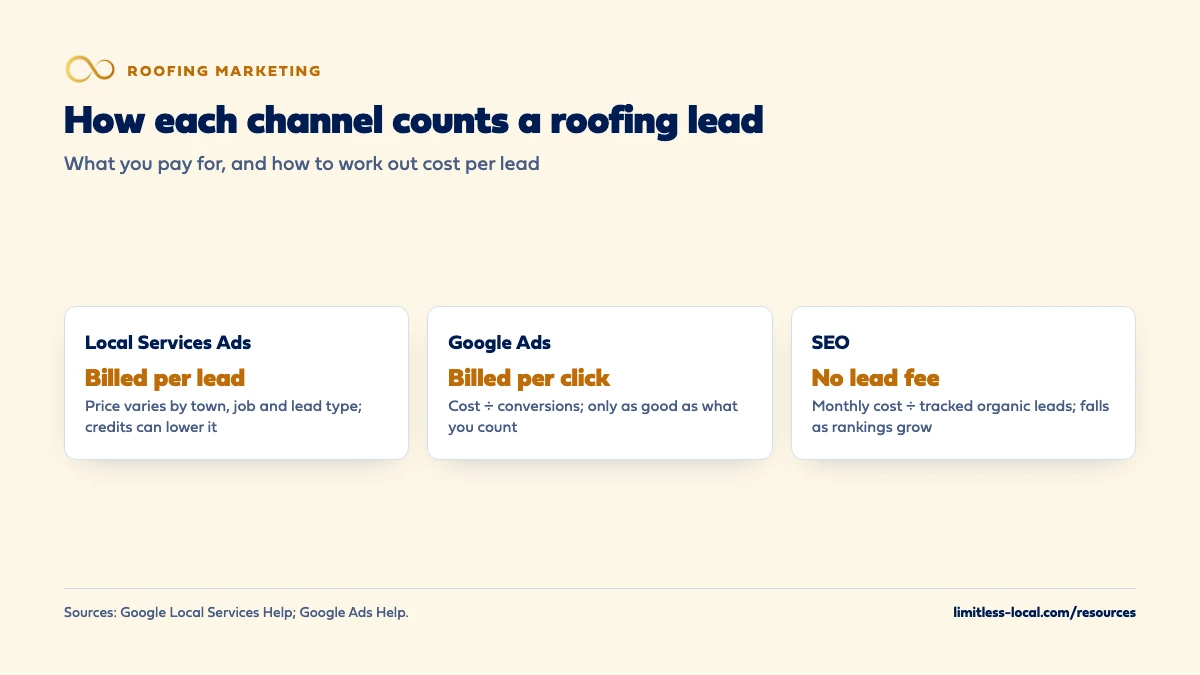
There’s no standard cost per lead for roofing SEO, Google Ads or Local Services Ads, because each one is priced and counted differently. Local Services Ads charge per valid lead, so the price per lead is set by Google and varies by town, job type and lead type; Google Ads charge per click, so cost per lead is your spend divided by the calls and forms you count; SEO has no per-lead charge, so cost per lead is your monthly SEO cost divided by organic leads, which starts high and falls as rankings grow. To compare them fairly, use one definition of a lead for all three, from your own tracking, and carry it through to cost per signed roof.
Comparing channels fairly is mostly a tracking problem, and that’s built into every one of our roofing marketing packages: call tracking with recording, form tracking, source tagging and a monthly report with a cost-per-lead breakdown. Our local ads management covers Google Ads on every tier and Local Services Ads on Growth and Scale, alongside local SEO. For what a roofing marketing budget looks like overall, read roofing marketing cost, and browse the roofing marketing questions for the follow-ups.
Why can't I compare cost per lead across the three channels directly?
Because the three numbers aren’t measuring the same thing. Each channel bills differently and counts a lead differently:
- Local Services Ads bill you per lead, using Google’s definition of a valid lead.
- Google Ads bill you per click, and a lead is whatever conversion actions you set up to count.
- SEO doesn’t bill per anything. You pay for work, and leads arrive on their own schedule.
Put the three cost-per-lead numbers from three different reports side by side and you’re comparing a price list, a calculation and a guess. One may count missed calls. Another may count the same homeowner twice. The third may include calls that actually came from your ads.
The fix is simple to say and takes some setup: decide what a lead is for your company, count it the same way for every channel, and use your own tracking rather than each platform’s report. The sections below show how each channel counts, so you know what to adjust.
How is cost per lead counted for Local Services Ads?
This is the most straightforward of the three, because Google charges per lead. Its page on how leads work says you’re charged for each valid lead, and that lead prices may vary depending on your location, the job type, the type of lead and your bidding. Valid leads include:
- A call you answer, or a call you return and speak on.
- A missed call during your business hours where the homeowner stays on the line for more than 20 seconds.
- A text message or email, a voicemail, or a booking request.
Two things make the billed number differ from your real cost per lead. Leads Google decides are invalid or low quality aren’t charged, and charged leads are reassessed over a 30-day period and may be credited, so the cost per lead can drop after the month closes. And a missed call that you were charged for may never become a conversation, so by your own definition it might not be a lead at all.
Message leads are typically priced lower than phone leads, though not always. Your mix of calls and messages moves your average.
Where do I see my LSA cost per lead now that LSAs are moving into Google Ads?
Google is moving Local Services Ads into Google Ads as Performance Max campaigns with pay-per-lead goals, and roofing is in the first phase, which began in August 2026 for select advertisers. Its page on the transition says that in the new campaign view, the Conversions column displays the total number of leads you were charged for. Divide cost by that number and you have your billed cost per lead.
Two practical notes from that page: your old Local Services Ads performance reports don’t carry over, so download or screenshot your history before your account moves. And manual bidding, such as setting a maximum cost per lead, is no longer supported after the move, so you’ll steer cost per lead through budget, targeting and a campaign-level target instead.
If you’re deciding how much budget should go to each of the two paid channels, how a roofer should split budget between Google Ads and LSAs covers that.
How is cost per lead counted for Google Ads?
With search ads you pay per click, so cost per lead is a calculation. Google’s page on understanding conversion tracking data says the Cost / conv. column is your total cost divided by the number in your Conversions column. That’s your cost per lead, but only if Conversions counts what you mean by a lead.
Three settings decide whether it does:
- Which actions count. Calls from ads, calls from your website, form fills, clicks on your phone number. If a click on the number counts as a lead, you’ll see more leads than real conversations.
- How many count per click. Google’s guide to conversion counting says the “One” setting counts only one conversion per ad click, which suits leads, while “Every” counts each one. A homeowner who calls twice and fills a form shouldn’t be three leads.
- Minimum call length. Short calls, wrong numbers and hang-ups shouldn’t count.
Conversions are also reported against the date of the click, not the date of the call, so last month’s cost per lead can shift slightly after the month ends. What a good cost per lead is for roofing Google Ads covers that channel in depth.
Curious what your marketing is actually booking?
Get a free visibility audit — no obligation, no sales pitch.
How is cost per lead counted for SEO?
SEO has no per-lead price, so you build the number yourself: what you spent on SEO in a month, divided by the calls and forms that came from organic search and your Google Business Profile that month.
Both halves need care:
- The cost includes whatever you pay for SEO work, website updates and content, plus your own time if you do it yourself.
- The leads should come from tracking, such as a dedicated tracking number on your website and profile and source tagging on forms.
Be careful with your profile’s own numbers. Google’s page on Business Profile performance says performance data includes actions from both organic results and Google Ads, and that Calls counts clicks on the call button, not answered calls. So the profile report can overstate organic leads.
SEO typically takes 3 to 6 months to show meaningful organic growth, so its cost per lead looks terrible early and improves as rankings come in. How long SEO takes to bring a roofer their first leads covers what to expect in those months.
Which channel usually has the lowest cost per lead?
There’s no fixed winner, because your town, your reviews, your website and your competition decide it. But the three tend to follow a shape:
- SEO tends to have the highest cost per lead in the first months and the lowest once it’s working, because the monthly cost stays roughly flat while organic leads grow.
- Local Services Ads tend to be the most predictable, because you’re paying a per-lead price instead of a click price. Google’s page on how Local Services Ads rank says higher-quality profiles, including those with images, may rank higher and may also pay lower costs per lead, which ties your LSA cost to your reviews and response time.
- Google Ads tend to have the widest range, because cost per lead depends on click prices, your keywords, your landing page and your tracking. A well-run campaign can beat the other two; a neglected one can cost the most.
That’s why many roofers run more than one. Which roofing companies get the best results from SEO versus ads covers who tends to lean which way.
Should agency and management fees count in my cost per lead?
Yes, if you want a true comparison. Leaving them out makes some channels look cheaper than they are:
- Local Services Ads: lead fees plus whatever you pay someone to manage the campaign and handle lead disputes.
- Google Ads: ad spend plus management fees and landing page costs.
- SEO: the whole monthly cost of the work is the cost, since there’s no ad spend.
If one fee covers several channels, split it in a way you can defend, such as by the share of time each channel takes, and stick to that split month to month. Consistency matters more than precision here.
Also count your own office time if it’s heavy. Two channels with the same cost per lead aren’t equal if one needs an hour of disputing junk leads every week.
How do I set one lead definition across all three?
Write down what a lead means for your company, then apply it everywhere. A workable roofing version: a real conversation, by phone, text or form, with a homeowner in your service area about a job you do.
Then set up tracking so every channel can be measured against it:
- Use separate tracking numbers for your Google profile, your website’s organic visitors and your Google Ads, and keep LSA leads in their own campaign.
- Tag forms with their source.
- Log every lead in one place, such as your CRM, with its source.
- Mark each one as a real lead or not: spam, wrong number, out of area, a job you don’t do.
- Count only real leads when you divide.
How a roofer can track calls and forms from Google walks through the setup.
Why does cost per lead stop being the right number?
Because the three channels don’t send the same kind of lead. A Local Services Ads lead, a search ad lead for “roof replacement” and an organic call from someone who read three of your reviews can close at very different rates. A channel with a higher cost per lead can still be the cheapest per signed roof.
So carry each channel through to three more numbers:
- Cost per booked inspection.
- Cost per signed roof.
- Average signed job value, since one channel may sign replacements and another mostly repairs.
Roofing sales cycles are long, so judge these over two or three months, not one. And compare like with like: SEO’s cost per signed roof in its third month says little about where it’ll be in its ninth.
What should I do if one channel's cost per lead is much higher?
Check whether it’s real before you cut it:
- Is it counted the same way? A channel that counts phone-number clicks will always look cheaper than one that counts real conversations.
- Is it early? SEO and newly launched ads cost more per lead in their first months.
- Is it the season? Storm weeks raise competition and prices for paid channels.
- Does it sign better? A higher cost per lead with a much higher close rate can be the better deal.
If it’s still high after that, look at the usual fixes: search terms and landing pages for Google Ads, reviews, response time and job types for Local Services Ads, and the pages and profile work for SEO.
Not sure which of these is costing you jobs?
A free visibility audit checks the Google profile, reviews, site and tracking, and shows what to fix first.
What's different for roofers
Repairs and replacements need separate numbers. A channel full of cheap repair leads can show a low cost per lead and a poor return. Track cost per lead by job type wherever you can.
Storms distort the month. After hail, paid channels get more leads and more competition at once, and organic calls jump too. Note storm weeks when you compare months, or one storm can make a channel look better or worse than it is.
Insurance and retail work close differently. If you do both, tag them, because a lead mix that shifts between them changes every channel’s cost per signed roof.
A worked example: three channels, one lead definition
These numbers are made up to show the math, not a benchmark for your market. A roofer counts only real conversations with homeowners in their area, and tracks one month:
- Local Services Ads: $2,000 in lead fees for 22 charged leads, about $91 each on the bill. But 4 were missed calls that never turned into a conversation, so real leads: 18, about $111 each. Signed roofs: 4, or $500 each.
- Google Ads: $2,400 in spend. The account showed 28 conversions, about $86 each, but after removing phone-number clicks and duplicates there were 19 real leads, about $126 each. Signed roofs: 5, or $480 each.
- SEO: $1,800 in monthly work, month seven, with 24 tracked organic leads, so $75 per lead. Signed roofs: 6, or $300 each.
On the platforms’ own numbers, Google Ads looked cheapest per paid lead. On one definition, it was the most expensive per lead, yet it still signed roofs slightly cheaper than Local Services Ads. SEO won on both, but only because it had been running for months.
Our Essentials package is $3,500 a month and covers Google Ads up to $2,500 in spend; Growth, at $4,500 a month, adds Local Services Ads management and Google Ads up to $5,000 in spend. Ad spend is paid to Google separately.
Frequently asked questions
Is a Local Services Ads lead the same as a Google Ads conversion?
No. An LSA lead is a contact Google judges valid and bills you for. A Google Ads conversion is whatever action you set up to count, so it depends on your settings.
Do Google Business Profile calls count as SEO leads?
Partly. The profile’s performance data mixes in actions from Google Ads, and the call count is clicks on the call button, so use your own tracking number to count real organic calls.
How long should I measure before comparing channels?
At least two or three months for the paid channels, and longer for SEO, which typically takes 3 to 6 months to show meaningful growth.
Can I lower my LSA cost per lead?
You can influence it. Higher-quality profiles may pay lower costs per lead, so reviews, photos and fast responses matter, and tight job types and towns keep you from paying for work you don’t want.
Should I stop the channel with the highest cost per lead?
Not until you’ve checked its cost per signed roof. A pricier lead that closes more often can be the cheaper job.
Why does my Google Ads cost per lead change after the month ends?
Conversions are reported against the date of the click, so a call that comes in days after a click is added back to the earlier date.
Key takeaways
- LSAs bill per valid lead; Google Ads bill per click; SEO bills in monthly work.
- Each platform counts a lead differently, so their own reports don’t compare.
- Pick one lead definition, count it with your own tracking, and include management fees.
- SEO’s cost per lead starts high and falls; paid channels depend on settings and season.
- Carry every channel through to cost per signed roof before moving money.
Want a second set of eyes on your setup?
We'll look at how you show up locally and where calls are leaking, then send you a plain-English breakdown.
More in this section
- What is a good cost per lead for roofing Google Ads?
- What mistakes do roofers make choosing SEO, Google Ads or LSAs?
- Should a roofer use SEO, Google Ads and LSAs together or pick one?
- How should a roofer split budget between Google Ads and LSAs?
- How do I get commercial roofing leads with Google Ads?
Sources
- How leads work — Google Local Services Help
- About ad rankings — Google Local Services Help
- Local Services Ads transition to Performance Max campaigns with pay-per-lead goals — Google Ads Help
- Understand your conversion tracking data — Google Ads Help
- About conversion counting options — Google Ads Help
- Understand your Business Profile performance & insights — Google Business Profile Help