
What does roofing marketing cost: agency, employee or DIY?

- What's the full monthly cost of an agency, a marketing hire or doing it yourself for a roofer?
- What goes into the real cost of roofing marketing?
- What does a marketing agency cost a roofing company?
- What does a full-time marketing employee cost a roofing company?
- What does one marketing hire still need to buy from outside?
- What does doing roofing marketing yourself really cost?
- How do I put a price on my own hours?
- What costs the same no matter who runs the marketing?
- How do I compare an agency, an employee and DIY fairly?
- When is each route the cheapest for a roofer?
- What hidden costs do roofing owners forget?
- What's different about this decision for a roofing company
- A worked example: what each route has to sign to pay for itself
- Frequently asked questions
- Key takeaways
- More in this section
- Sources
The short version
- Ad spend is the same under every route; compare the labor and tools on top of it.
- Agency: a monthly fee plus ad spend, with little of your time.
- Employee: salary plus benefits, tools, outside specialists and your management time.
- DIY: no fee, but your hours have a price, and ad mistakes cost money quietly.
- Compare the routes on cost per signed roof, not on the monthly bill.
For roofing owners weighing who should run their marketing and wanting every cost on the table, including their own time.
Get a free visibility audit · Book a growth call
What's the full monthly cost of an agency, a marketing hire or doing it yourself for a roofer?
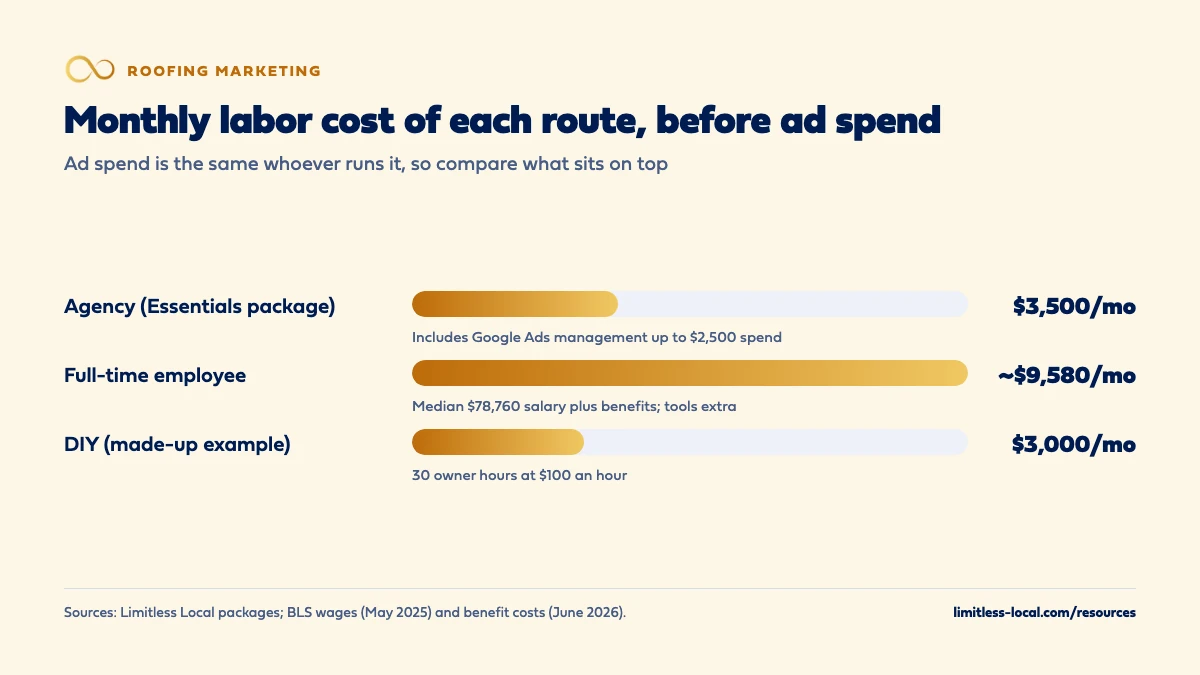
Ad spend costs the same whichever route you pick; what changes is the labor on top of it. An agency is a monthly fee plus ad spend, and takes little of your time. A full-time marketing employee earning $78,760 a year, the federal median for the closest job category, costs roughly $9,580 a month once benefits are added, before tools, outside help and your time managing them. Doing it yourself has no fee but costs your hours, which are only free if they wouldn’t otherwise be selling roofs.
If you want to price the agency route against your own numbers, our marketing packages list what’s included at each tier, and our roofing marketing page shows how it fits a roofing company. The roofing marketing cost guide covers budgets by channel, and the roofing marketing questions library takes the follow-ups one at a time.
What goes into the real cost of roofing marketing?
Every route has the same three buckets:
- Ad spend. What you pay Google, Meta or a lead platform. This is the same whether an agency, an employee or you run the ads, so set it aside when you compare.
- Labor. The agency fee, the employee’s salary and benefits, or your own hours.
- Tools and extras. Call tracking, software, design, photography, a website.
Then add up each route over the same stretch of time and weigh it against what it brings in. That’s the cost-benefit math the SBA describes for decisions like hiring: total the benefits and the costs over a set period, then subtract the costs. For marketing, the benefit is gross profit from signed roofs, which is why the last step on this page is always cost per signed roof.
What does a marketing agency cost a roofing company?
Agency pricing varies a lot, from flat monthly retainers to pay-per-lead deals; paying per lead versus a monthly retainer weighs those two models. To give you a real number, here’s ours:
- Essentials, $3,500 a month: one location, Google Business Profile management, a content sprint of up to 10 pages, blog posts, link building, review responses and basic review generation, Google Ads management for up to $2,500 a month in ad spend, call and form tracking, and a monthly report.
- Growth, $4,500 a month: everything in Essentials, plus SEO for up to 2 locations, Local Services Ads management, Meta remarketing, Google Ads management for up to $5,000 in spend and a dedicated account manager.
- Scale: custom pricing for multiple locations and markets.
Ad spend isn’t included in any package; you pay it straight to Google or Meta. Automation add-ons such as after-hours answering and AI website chat are priced on the discovery call, and clients who pay annually get a lower monthly rate.
The owner’s time is the smallest cost on this route. Onboarding takes your team about 2 to 3 hours, and after that it’s a monthly report and regular strategy calls.
What does a full-time marketing employee cost a roofing company?
Start with salary. Nobody publishes a “roofing marketer” wage, so the closest yardstick is the federal market research analysts category, which puts the median annual wage at $78,760 in May 2025, with the lowest 10 percent earning less than $43,390 (Bureau of Labor Statistics). If you want a marketing manager to run strategy, the median wage for marketing managers was $166,790 in May 2025 (Occupational Outlook Handbook).
Then add benefits. For full-time private-industry workers, benefits made up 31.5% of employer compensation costs in June 2026, with wages and salaries the other 68.5% (Employer Costs for Employee Compensation). Applied to the median salary above, that’s $78,760 divided by 68.5%, or about $115,000 a year, roughly $9,580 a month.
That’s before the things the salary doesn’t cover: software and tracking tools, any design or web work they can’t do, recruiting, a few months of ramp-up while they learn your market, and your time managing them. When a roofing company is ready for a full-time marketing hire covers the workload side of that decision.
What does one marketing hire still need to buy from outside?
Roofing marketing is several trades in one: Google Ads, the Google Business Profile, SEO, website work, tracking, review requests, photos and follow-up. One person is rarely strong at all of them. The usual pattern is a generalist who handles content, reviews, social posts and coordination, while the technical pieces go out to a specialist anyway.
Budget for that from day one. A marketing employee plus a part-time ads specialist or a web developer is common, and it’s often the right setup for a bigger roofer. It just means the employee route rarely costs only the salary.
Curious what your marketing is actually booking?
Get a free visibility audit — no obligation, no sales pitch.
What does doing roofing marketing yourself really cost?
No fee, but three real costs:
- Your hours. Keeping a Business Profile active, asking for reviews, writing pages, running ads and reading the reports adds up to several hours a week if it’s done properly.
- The learning curve. Google Ads and tracking are where mistakes cost money without telling you: broad searches you didn’t mean to pay for, calls nobody can trace, budgets spent by lunchtime.
- Gaps. Marketing stalls when you’re busiest. Storm season is when you have the least time and the most to gain.
Whether a roofing company can do its own SEO lists the parts an owner can realistically handle.
How do I put a price on my own hours?
Ask what you’d be doing with that time instead. If it’s a Sunday you’d otherwise spend on the couch, your marketing hours are cheap. If it’s running estimates, meeting adjusters, walking job sites or selling roofs, they’re the most expensive hours in the company.
A simple way to price them: take the gross profit you make in a typical month, divide by the hours you work, and use that as your hourly rate. It won’t be exact, but it stops you treating your own time as free when you compare DIY with an agency or a hire.
What costs the same no matter who runs the marketing?
A few costs don’t move with the route, so don’t let them tilt the comparison:
- Ad spend. Google charges the same whoever clicks the buttons. What changes is how well it’s spent.
- Your website. Whoever runs marketing needs one that works on a phone and turns visits into calls.
- Answering the phone. No route fixes slow callbacks. Someone in your office still has to pick up and follow up.
- Asking for reviews. Your crews and office still have to ask at the end of every job.
When owners say one route “didn’t work”, it’s often one of these, not the route itself.
How do I compare an agency, an employee and DIY fairly?
Use the same yardstick for all three: total monthly cost (labor, tools and ad spend) divided by roofs signed from marketing. That’s your cost per signed roof, and it’s the only number that accounts for both what you paid and what came back. What cost per booked job a roofer should aim for shows how to set a target from your own margins.
Compare over at least three months, because roofs sign weeks after the first call, and compare like with like. A route that costs more but signs twice the roofs is the cheaper one.
When is each route the cheapest for a roofer?
The cheapest route is the one whose labor cost is smallest next to what it signs, and that shifts with your size:
- DIY is cheapest while the work fits in hours that wouldn’t otherwise sell roofs and your ad budget is small enough that a mistake stays small.
- An agency gets cheaper as ad spend and the number of channels grow, because one fee covers several specialists you’d otherwise pay separately.
- An employee only gets cheaper once their full cost, benefits and outside help included, is spread over enough signed roofs to beat a fee.
Plenty of roofers mix them: the owner keeps reviews and photos, and hands off ads and tracking. Hiring a roofing specialist agency or running it yourself covers the agency-or-DIY choice in full.
What hidden costs do roofing owners forget?
- Switching. Changing agencies or losing an employee can mean lost access, lost history and a few slow months. Keep your Google profile, ad account, website and tracking numbers in your company’s name. Switching agencies without losing leads covers the handover.
- Contracts. A long contract turns a bad fit into a bill you keep paying. We ask for three months and put it in our contract, but if you want to leave, we won’t make you stay.
- Turnover. When a marketing employee leaves, the knowledge leaves with them unless it’s written down.
- Wasted ad spend. The least visible cost of all, and the one most likely to dwarf any fee.
Talk it through with someone who runs this every day
A 15-minute growth call: your market, your numbers, and what a realistic budget looks like. No pressure.
What's different about this decision for a roofing company
High tickets change the math. One signed replacement can carry a month of marketing costs, so a route that signs even one extra roof a month can be worth far more than its fee. The reverse is true too: a route that loses you one roof a month is expensive however cheap it looks.
Storm season breaks DIY. The weeks after a hailstorm are when you need marketing running hardest, and when an owner who runs it alone has the least time.
Insurance work needs care in ads. Whoever runs your ads needs to know what roofing ads can and can’t say about insurance claims, which is another reason specialist knowledge has a price.
Long sales cycles hide results. Roofs sign weeks after the first call, so any route judged after one month will look worse than it is.
A worked example: what each route has to sign to pay for itself
These numbers are made up to show the math, not a benchmark. Say a roofer makes $4,000 in gross profit on an average signed roof and plans $2,500 a month in Google Ads spend under every route.
- Agency (Essentials): $3,500 a month in fees. With ad spend, $6,000 a month. The fee alone takes 0.875 roofs a month to cover, so under one roof.
- Employee: about $9,580 a month at the median wage with benefits. With ad spend, $12,080 a month. The labor alone takes about 2.4 roofs a month to cover, before any outside help.
- DIY: 30 hours a month of the owner’s time at $100 an hour is $3,000. With ad spend, $5,500 a month. That’s 0.75 roofs a month, as long as those 30 hours wouldn’t have sold a roof on their own.
On paper DIY is cheapest here, but it only stays that way if the owner runs the ads as well as a specialist and keeps it going through storm season. If DIY signs 3 roofs a month from marketing and the agency route signs 5, the agency route costs $1,200 per signed roof ($6,000 divided by 5) against about $1,833 for DIY ($5,500 divided by 3). Compare on your own signed roofs, not on the fee.
Frequently asked questions
Is a part-time marketer or freelancer cheaper than an agency?
Often on the monthly bill, yes. The catch is the same as with an employee: one person rarely covers ads, SEO, tracking and web work, so you may still pay for specialists, and you’ll spend time managing them.
Can I start DIY and switch to an agency later?
Yes, and many roofers do. Set up your accounts in your company’s name from day one and keep your tracking clean, so whoever takes over starts with your history instead of from scratch.
Does ad spend count toward the agency's fee?
Not with us. Ad spend is paid directly to Google or Meta and isn’t part of any package. Our Essentials package covers managing up to $2,500 a month of Google Ads spend.
How much of my time does an agency still need?
Some, and that’s healthy. You’ll approve budgets and messaging, answer questions about jobs and towns, and review results. How much control a roofer should keep covers which calls stay yours.
Should I count my office manager's time in the cost?
Yes, if they spend real hours on marketing tasks like posting, chasing reviews or updating listings. Those hours come out of answering phones and scheduling, which have their own value.
What's a reasonable total marketing budget for a roofer?
It depends on your revenue, your goals and how competitive your towns are. Start from the number of signed roofs you need and work backward to a budget, rather than picking a monthly figure first.
Key takeaways
- Ad spend is the same under every route; compare the labor and tools on top of it.
- An agency is a fee plus ad spend; our packages start at $3,500 a month with ad spend paid separately.
- A full-time hire at that $78,760 median wage runs about $9,580 a month with benefits, before tools and outside help.
- DIY is only cheap if your hours wouldn’t otherwise sell roofs and the ads are run well.
- Judge every route on cost per signed roof over at least three months.
Ready to compare options?
Book a short growth call and we'll walk through the math for your service area, including when we're not the right fit.
More in this section
- Hire a roofing-specialist agency or run marketing myself?
- Which roofing marketing tasks should I do myself or hand off?
- How should a roofing company choose a marketing agency?
- What does a roofing marketer actually do each month?
- What share of revenue should a roofer put into marketing?
Sources
- Market Research Analysts: Occupational Outlook Handbook — U.S. Bureau of Labor Statistics
- Advertising, Promotions, and Marketing Managers: Occupational Outlook Handbook — U.S. Bureau of Labor Statistics
- Employer Costs for Employee Compensation Summary — U.S. Bureau of Labor Statistics
- Manage your business — U.S. Small Business Administration