
What are the risks of running my roofing marketing myself?

- What can go wrong long term when a roofing owner runs all the marketing?
- What are the biggest risks of running roofing marketing yourself?
- What happens to my marketing when I get busy?
- Can I waste money running my own roofing Google Ads?
- What if I can't tell which marketing is working?
- What happens if only one person has the logins?
- Which rules can a roofer break by accident?
- Why does do-it-yourself marketing advice go out of date?
- Is my time really free when I do the marketing myself?
- When is running roofing marketing yourself the right call?
- How do I lower the risks if I keep doing it myself?
- Doesn't hiring someone have risks too?
- What's different about DIY marketing risks for roofing companies
- A worked example: what do-it-yourself marketing really costs
- Frequently asked questions
- Key takeaways
- More in this section
- Sources
The short version
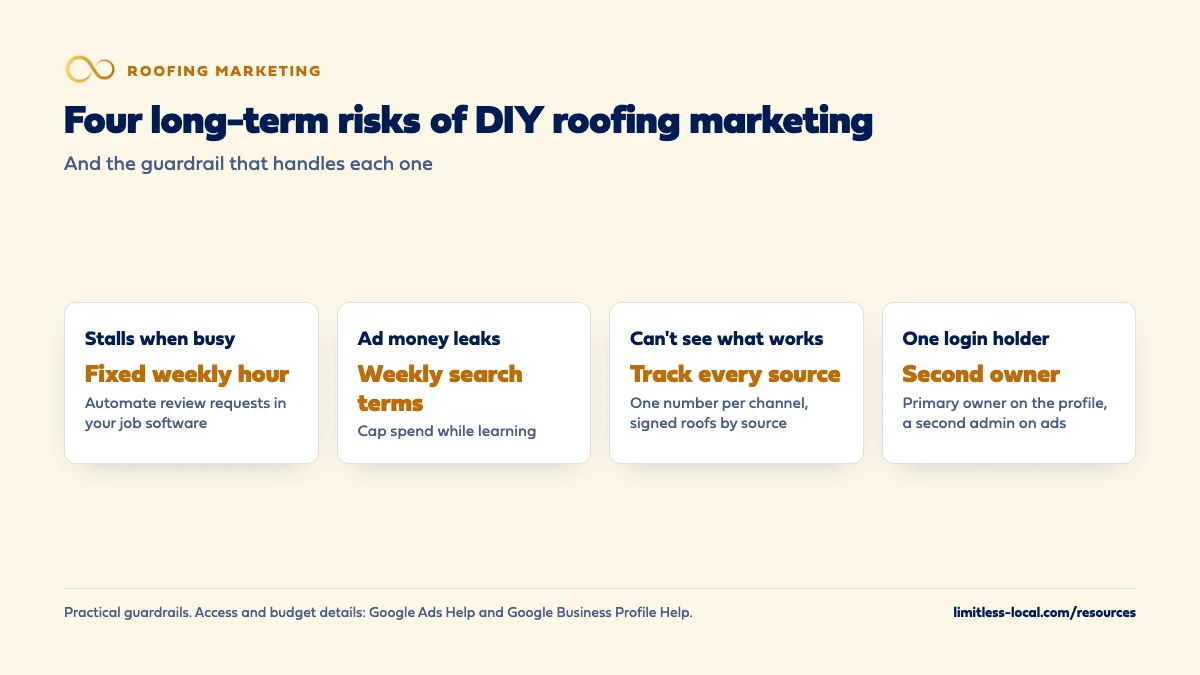
- Marketing stalls when you're busiest, then the phone goes quiet a few months later.
- Ad budgets leak on junk searches when nobody checks them weekly.
- Without tracking you can cut the channel that was actually signing roofs.
- One login holder is one point of failure; add a second owner or admin.
- Your time isn't free: count the estimates you're not running.
For roofing owners who handle their own marketing today and want to know what tends to go wrong over a year or two, and how to guard against it without necessarily hiring anyone.
Get a free visibility audit · Book a growth call
What can go wrong long term when a roofing owner runs all the marketing?
The biggest risks of running your own roofing marketing show up over time, not on day one: the work stalls the moment your crews get busy, ad money leaks without anyone noticing, you can’t tell which channel actually signs roofs, and your accounts end up tied to one person’s login. Smaller risks include breaking review or link rules you didn’t know existed and following advice that’s out of date. None of these means you have to hire help, because each one has a guardrail, but every one of them costs signed jobs if it’s left alone.
Running it yourself is a fair choice, and plenty of the work suits an owner. When it stops making sense, our Limitless Engine packages take over local SEO, Google Ads and tracking, with a real-time dashboard and a monthly report; the roofing marketing page shows how that works for roofers. The roofing marketing guide covers every channel, and more owner questions are in the roofing marketing questions library.
What are the biggest risks of running roofing marketing yourself?
Most owners who run their own marketing don’t fail because they’re bad at it. They run into the same handful of problems that show up after the first few months:
- It stops when you get busy.
- Ad money leaks on searches and clicks that never had a chance of becoming a roof.
- You can’t see what’s working, so budget decisions are guesses.
- One person holds the keys to the Google profile, ad account or website.
- Rules you didn’t know about, on reviews and links, get broken by accident.
- Advice goes stale, because platforms change and forum tips don’t.
- Your own time gets spent at a desk instead of on roofs and estimates.
Each one is fixable. The sections below take them one at a time, with the guardrail that handles it.
What happens to my marketing when I get busy?
It stops, and that’s the most common risk of all. Spring hits, a storm rolls through, crews are booked three weeks out, and the review requests, profile photos and ad checks fall off the list. Nothing seems wrong because the phone is still ringing from work you did months ago.
Then the busy season ends and the phone goes quiet, right when you need it. Marketing works on a delay: the review you didn’t ask for in May is the one a homeowner didn’t read in August. Owners who run their own marketing often live in that feast-and-famine cycle without connecting it to the months they skipped.
Guardrail: pick the three tasks that must happen even in your busiest week, put them on a fixed day, and give them to someone in the office if you can’t do them. Asking for reviews should be automatic, a text or email from your job software when a job closes. Which roofing marketing tasks to do yourself or hand off sorts the list.
Can I waste money running my own roofing Google Ads?
Yes, quietly. Google Ads spends what you allow it to spend, whether the clicks are good or not. Google explains that on any given day most campaigns can spend up to twice your average daily budget, though you won’t pay more than 30.4 times your average daily budget in a month. That’s normal and evens out, but it means one bad day of junk clicks can cost twice what you expected.
The usual leaks for a roofer running ads alone:
- Searches for roofing jobs, DIY repairs, shingle prices and supply stores.
- A service area drawn far wider than your crews drive.
- Ads running at 2 a.m. to nobody who answers.
- Clicks landing on a homepage with no clear way to book an inspection.
- Conversion tracking that counts page visits as leads, so the campaign optimizes toward nothing.
Guardrail: check the search terms report weekly for the first months, set a budget you can afford to lose while learning, and judge on calls that became inspections. If you’re getting clicks and no calls, why roofing ads get clicks but no calls covers the usual causes.
What if I can't tell which marketing is working?
Then every budget decision is a guess, and guesses tend to cut the wrong thing. An owner who “feels like” Facebook is working and Google isn’t may be looking at Facebook’s many cheap form fills and missing that the Google calls signed three roofs. Without tracking, the loudest channel wins, not the most profitable one.
This is the risk that compounds most over time, because every month without data is a month you can’t learn from. A year in, you still can’t say what a signed roof costs from each channel.
Guardrail: give each channel its own tracking phone number, tag every lead’s source in your job software, and record which ones signed. Ask every caller how they found you too. How marketing attribution works for a roofing company explains the setup in plain terms.
What happens if only one person has the logins?
This one can cost you years of work in a day. The office manager who set up the Google profile leaves. The nephew who built the website stops answering texts. The ad account sits under a personal email nobody can open.
Google’s help pages are clear about how access works. A Business Profile can have several owners but only one primary owner, and an owner has full control: they can add or remove users and even delete the profile. And Google Ads warns that if an account has only one administrator, you may lose access to your tags if that user becomes unavailable, recommending at least one more admin.
Guardrail: make yourself the primary owner of the Google profile and an admin on the ad account, add a second trusted owner or admin, register the domain in the company’s name, and keep a list of every account and who can get in. How much control a roofer should keep over their marketing covers what to own no matter who does the work.
Curious what your marketing is actually booking?
Get a free visibility audit — no obligation, no sales pitch.
Which rules can a roofer break by accident?
The two that catch owners most are reviews and links.
Reviews. The Federal Trade Commission’s rule on consumer reviews and testimonials took effect on October 21, 2024, and authorizes courts to impose civil penalties for knowing violations. It covers writing or buying fake reviews, and it bars offering compensation or other incentives on the condition that a review expresses a particular sentiment. “$50 off if you leave us five stars” is the kind of offer to avoid. Review sites and Google have their own rules on top, so read them before running any review promotion.
Links. Owners trying to rank sometimes buy links or trade services for them. Google’s spam policies list buying or selling links for ranking purposes, including exchanging goods or services for links, as link spam. A “free gutter cleaning for a link on your blog” deal falls right into it.
Guardrail: ask every customer for an honest review, the same way, with no strings attached, and earn links through real relationships like sponsorships, suppliers and local news.
Why does do-it-yourself marketing advice go out of date?
Platforms change faster than the advice about them. A video from a few years ago will tell you to get “Google Guaranteed.” That badge is now Google Verified, and the money-back guarantee that came with it was discontinued. Local Services Ads are moving into Google Ads, which changes how budgets and bidding work. Tactics that worked in 2019 forum threads, like stuffing city names into page footers, now look like spam.
An owner who learned marketing once and runs it on autopilot is running on old information. That’s not a skills problem. It’s a time problem, because keeping up is a job in itself.
Guardrail: when a tip involves money or rules, check the platform’s own help pages before acting on it, and look at your settings once a quarter for anything that changed.
Is my time really free when I do the marketing myself?
It’s the risk owners count least. Every hour at the computer adjusting ads or writing a service page is an hour not spent running an inspection, meeting a homeowner at the kitchen table, or checking a crew’s work. For an owner who is also the best closer in the company, that trade can cost more than any agency fee.
It works the other way too. If your evenings are free and you’d otherwise spend them on the couch, the cost is low, and doing it yourself builds knowledge you’ll keep even if you hand it off later. The worked example below puts numbers on both sides.
When is running roofing marketing yourself the right call?
More often than you might think. Google itself says that if you run a small local business, you can probably do much of the work yourself. Running it yourself makes sense when most of these are true:
- You’re a one- or two-crew company in a small market with few active competitors.
- You have a few steady hours a week, even in busy season, or someone in the office who does.
- Your ad spend is small enough that a mistake won’t sink a month.
- You track leads to signed jobs, so you’ll know when something stops working.
Many owners land in the middle: the owner keeps reviews, photos and follow-up, and hands off the technical work. Whether a roofing company can do its own SEO covers which parts of SEO suit an owner.
How do I lower the risks if I keep doing it myself?
- Own every account: primary owner on the Google profile, admin on ads, domain in the company’s name, a second trusted owner on each.
- Automate review requests through your job software so they go out even in storm season.
- Track every source: a call tracking number per channel and a lead source on every job.
- Cap ad spend at what you can afford to lose while learning, and check search terms weekly.
- Block a fixed hour each week on the calendar for marketing, and don’t move it.
- Review the numbers monthly: leads, inspections and signed roofs by channel.
- Check the platform’s help pages before acting on any tip that involves money or rules.
Doesn't hiring someone have risks too?
It does, and some are the same ones. An agency or freelancer can also leave accounts in their own name, report activity instead of signed jobs, lock you into a long contract, or stop paying attention once the contract is signed. Handing off marketing moves the risk; it doesn’t remove it.
The guardrails carry over. Keep ownership of your accounts, ask for reporting that shows leads and signed jobs by channel, and ask what happens to everything if you leave. How to choose a roofing marketing agency lists the questions to ask before you sign anything.
Not sure which of these is costing you jobs?
A free visibility audit checks the Google profile, reviews, site and tracking, and shows what to fix first.
What's different about DIY marketing risks for roofing companies
The busy season is when marketing matters most. Storm season is when roofers are least able to do marketing and when homeowners are searching hardest. Owners who do everything themselves often miss their biggest window of the year.
High tickets raise the stakes of a leak. A wasted month of ad spend hurts, but a missed replacement because the profile showed an old number hurts more. One lost roof can outweigh a lot of saved fees.
Storm marketing has rules of its own. After a storm, roofing ads and pages draw scrutiny from homeowners wary of out-of-town crews. Keep every claim about your company accurate and specific, and make sure your local address and reviews are easy to find.
Office staff turn over. Many roofers lean on one office manager for marketing logins. When that person leaves mid-season, the profile and ads can sit untouched for months.
A worked example: what do-it-yourself marketing really costs
These numbers are made up to show the math, not a benchmark and not a client result. A roofing owner spends 5 hours a week on marketing: ads, the Google profile, the website, replying to reviews. That’s 260 hours a year.
Say an hour of the owner running estimates is worth $150 to the business in signed work. Those 260 hours are then worth $39,000 a year. If the owner would actually spend that time selling roofs, doing marketing personally costs about that much, on top of any ad spend. If the time would otherwise go unused, it costs far less, and doing it yourself may be the smart move.
Now compare outside help. Our Essentials package is $3,500 a month, or $42,000 a year, and covers local SEO, Google profile management, review response, Google Ads management and call tracking, with ad spend paid directly to Google. That’s close to the made-up time cost above, so the deciding questions are whether you’d turn those hours into signed roofs and whether the work would get done more consistently. There are no long-term contracts. We ask for three months, and we won’t make you stay.
Frequently asked questions
Is it risky to have my office manager run our marketing?
Only if they’re the only one with access or the only one who knows how it works. Keep yourself as primary owner on every account and write down what they do each week.
Can I get penalized for asking customers for Google reviews?
Asking for honest reviews is fine. The FTC rule targets fake reviews and incentives tied to a review saying something positive or negative, so ask everyone the same way and attach no conditions.
How much ad money do owners usually waste running their own ads?
It varies too much to give a fair number. Check your own search terms report: every click from a search that could never become a roof is money you can stop spending.
Should I let my web designer own my domain name?
No. Register the domain in your company’s name with an account you control, and give the designer access. A lapsed or withheld domain takes your whole site down.
What's the first sign my DIY marketing is slipping?
Fewer new reviews and fewer calls from your Google profile, usually a few months after a busy stretch. Check both monthly.
Key takeaways
- The biggest DIY risks show up over time: stalled work, leaking ad spend, no tracking and single-person logins.
- Marketing skipped in busy season shows up as a quiet phone a few months later.
- Own every account and add a second owner or admin before anything goes wrong.
- Review incentives tied to positive reviews and bought links break rules owners often don’t know about.
- Running it yourself is a fair choice in small markets if you put the guardrails in place.
Want a second set of eyes on your setup?
We'll look at how you show up locally and where calls are leaking, then send you a plain-English breakdown.
More in this section
- Hire a roofing-specialist agency or run marketing myself?
- Which roofing marketing tasks should I do myself or hand off?
- How does a roofer run a profitable business with marketing?
- How much work does each roofing marketing channel take from me?
- How do I know a roofing marketing agency is worth the cost?
Sources
- About average daily budgets — Google Ads Help
- About access levels in your Google Ads account — Google Ads Help
- Manage your Business Profile owners & managers — Google Business Profile Help
- Consumer Reviews and Testimonials Rule: Questions and Answers — Federal Trade Commission
- Spam Policies for Google Web Search — Google Search Central
- Do You Need an SEO? Tips for Hiring an SEO — Google Search Central