
Should an in-house coordinator manage an outside restoration agency?

- Is it worth having one person on staff run the relationship with a restoration marketing agency?
- What does an in-house coordinator actually do with an agency?
- Who makes a good coordinator at a restoration company?
- What should the coordinator decide, and what stays with me?
- What access should the coordinator have?
- How much time does the coordinator role take?
- How does the coordinator keep the agency honest?
- What does the agency need from the coordinator each week?
- What goes wrong with a coordinator setup?
- When should I manage the agency myself instead?
- Is a coordinator better than hiring a full in-house marketer?
- How do I set up the coordinator role in the first month?
- What's different about this setup for restoration companies
- A worked example: coordinator time vs owner time
- Frequently asked questions
- Key takeaways
- More in this section
- Sources
The short version
- The coordinator is the agency's one contact and your eyes on the numbers.
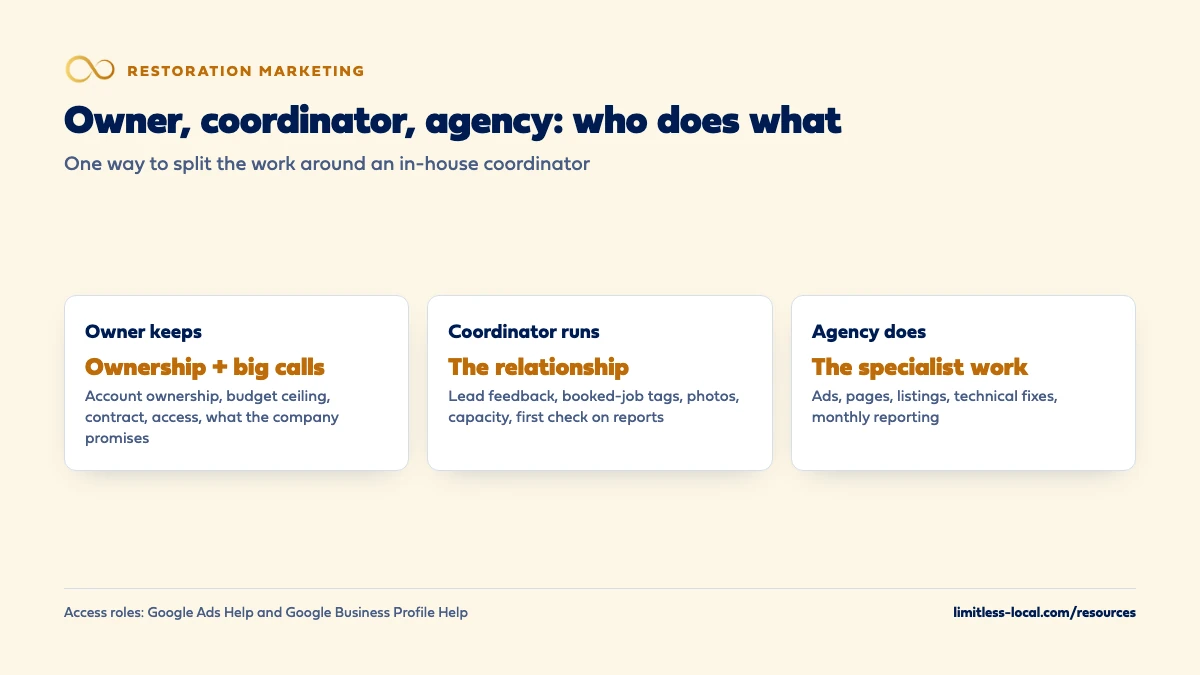
- You keep account ownership, budget, contract and the big decisions.
- Write down what the coordinator can approve without you.
- Judge the setup by cost per booked job, checked against your own job software.
For restoration owners who’ve hired, or plan to hire, an agency and don’t have the hours to manage it themselves.
Get a free visibility audit · Book a growth call
Is it worth having one person on staff run the relationship with a restoration marketing agency?
Often, yes, once a restoration company is busy enough that the owner can’t keep up with the agency week to week. One coordinator becomes the agency’s single point of contact: tagging which leads became booked jobs, sending job photos and lead feedback, passing on capacity and storm news, and checking the monthly numbers. It works when the owner keeps account ownership, the budget and the big decisions, and the coordinator has written authority for the day-to-day calls. It fails when the coordinator has responsibility without authority, or only forwards emails.
A coordinator is exactly who we’d want on the other side of the table. Onboarding takes the owner’s team about 2-3 hours, campaigns go live in weeks 1-2, and every package includes call tracking with recording, source tagging, a real-time dashboard and a monthly report with a cost-per-lead breakdown, so your coordinator isn’t chasing anyone for numbers. Essentials includes quarterly strategy calls; Growth adds monthly strategy calls and a dedicated account manager, so your coordinator has one person to deal with. Compare the packages, see our restoration marketing page, read the restoration marketing guide, or browse more restoration marketing questions.
What does an in-house coordinator actually do with an agency?
They run the relationship so you don’t have to. In a restoration company, the job usually looks like this:
- Single point of contact. The agency calls or messages one person, not you, the dispatcher and the estimator in turn.
- Lead feedback. Each week, which calls were real jobs and which were junk, out of area, the wrong service or price shoppers.
- Booked-job tagging. Making sure every job in your job software has a lead source and a booked-or-not mark.
- Raw material. Job photos, crew details, new certifications, service changes.
- Business news. Crews out, a storm on the forecast, a service to pause, a big commercial account that came in.
- First check on the report. Comparing the agency’s numbers with your own before you see them.
What they don’t do is run the ads or build the pages. That’s what the agency is for. Splitting marketing between in-house and an agency covers how the tasks divide; this page is about the person in the middle.
Who makes a good coordinator at a restoration company?
Someone close to the calls and the jobs, not necessarily someone with marketing on their résumé. Good candidates are usually already on your payroll:
- An office manager who sees every call and every invoice.
- A dispatcher or operations lead who knows crew capacity hour by hour.
- An estimator or project manager who knows which jobs are worth chasing.
The traits matter more than the title: organized, comfortable asking the agency “why?” and waiting for a real answer, and trusted to speak for the company. A coordinator who’s afraid to push back, or too junior to be taken seriously, ends up forwarding emails, and the agency effectively manages itself.
One thing to watch: dispatchers and office managers are the people busiest in a storm week. Plan who covers the agency then, or the coordinator role disappears exactly when it’s needed most.
What should the coordinator decide, and what stays with me?
Write it down. Most coordinator setups fail on this one point: the coordinator gets the responsibility but has to check with you on everything, so the agency waits and nothing moves.
The coordinator can decide, within rules you set once:
- Approving posts, photos and routine page edits.
- Marking leads as junk and asking for them to be filtered out.
- Pausing a service for a few days when crews are full, and turning it back on.
- Small budget moves inside a range you’ve agreed, such as raising spend ahead of a forecast freeze.
You decide:
- The monthly budget ceiling and any change to it.
- New channels, a new website or new phone numbers.
- Anything the company promises about insurance, pricing or response times.
- The contract, renewals and who has access to which account.
With that list agreed, a storm-day message to the agency takes two minutes instead of a day waiting for you.
What access should the coordinator have?
Enough to see and check, not enough to give the company away. Every account stays in the company’s name, with you at the top.
- Google Ads. Google’s page on access levels sets out the options: Read-only users can view campaigns and run performance reports, Standard users can also edit campaigns, and only Admins can give access, change access levels and unlink manager accounts. Keep Admin yourself. Read-only is often enough for a coordinator whose job is checking, not editing.
- Google Business Profile. Make the coordinator a manager. Managers can edit info, respond to reviews and manage posts, but can’t add or remove users or remove the profile, according to Google’s page on Business Profile owners and managers. You stay primary owner.
- Call tracking and job software. Enough access to hear recordings and see lead sources.
- Everyone on their own login. Coordinator, agency and you each have separate accounts, so nobody shares a password and access can be removed cleanly.
How much time does the coordinator role take?
A few hours a week in a normal week, more at the start and in storm weeks. A typical rhythm:
- Weekly: a short call or message with the agency, checking the week’s lead sources, flagging junk, and sending photos.
- Monthly: reading the report against your own numbers, then a short review with you.
- First month: more time on access, the written brief, tracking numbers and getting lead tagging into a habit.
- Storm weeks: fast, short decisions on budget and services, inside the rules you agreed.
For most restoration companies, that fits inside an existing role. If it starts to need a full day every week, either the agency isn’t organized or the coordinator is doing work the agency should. How much time managing a restoration marketer takes breaks down where the hours go.
Curious what your marketing is actually booking?
Get a free visibility audit — no obligation, no sales pitch.
How does the coordinator keep the agency honest?
By counting independently. The coordinator’s most useful job is making sure the company has its own record of where jobs came from, so the agency’s report has to match it.
- Lead source on every job, entered by your office, not the agency. The U.S. Small Business Administration’s guide to getting the most from your marketing budget makes the same basic point: tracking can be as simple as having employees ask new customers where they heard about the business.
- Listening to a handful of calls each week to check lead quality.
- Change history. Google Ads lists the changes made to your account over the past two years, including the email of the user who made each change in the Google Ads interface, so the coordinator can see the account is being worked. See Google’s About change history.
- Booked jobs fed back into Google Ads. With offline conversion imports, Google lets you measure what happens offline, such as over the phone, after your ad results in a click or call. The coordinator’s job tags are what make that possible, and the agency can set it up so the ads learn from booked jobs, not just calls.
What does the agency need from the coordinator each week?
The things it can’t get anywhere else:
- Which leads were junk, and why.
- Which leads booked, and roughly what they were worth.
- Crew capacity for the week ahead.
- New job photos, ideally with the town and type of job.
- Anything changing in the business: a new service, a pause, a new certification, a big commercial account.
An agency that gets those five every week can do far better work than one guessing from clicks. If your agency never asks for them, that’s worth raising. Managing a restoration agency without losing control covers what a good agency should be asking for.
What goes wrong with a coordinator setup?
- Responsibility without authority. The coordinator can’t approve anything, so they become a messenger and the agency waits on you anyway.
- The owner goes around them. You call the agency directly with new instructions, and the coordinator and agency end up working from different plans. Keep one channel.
- The coordinator is the busiest person in a storm. Name a backup before the season.
- The agency hides behind the coordinator. If you never see the numbers yourself, a weak agency can coast. Keep the monthly review with you in it.
- Everything lives in one head. If the coordinator leaves, the logins, the rules and the history go too. Keep the written brief, the decision list and the access list somewhere the company owns.

When should I manage the agency myself instead?
When the company is small enough that it’s genuinely quicker. A one- or two-truck company where the owner answers the phone already has the lead feedback and capacity information in their head, and a weekly check-in takes fifteen minutes. Adding a go-between there slows things down.
It also makes sense to stay hands-on for the first few months with a new agency, or right after a bad one, until you trust the reporting. Then hand over the routine. What to control after a bad agency covers what to keep in your own hands no matter who coordinates.
Is a coordinator better than hiring a full in-house marketer?
For many restoration companies, yes, because it’s cheaper and it covers the part of marketing an agency can’t: knowing your jobs, calls and crews. The coordinator role usually fits inside an existing job, while a full-time marketer is a new salary, plus benefits and tools, and still rarely covers ads, SEO, the website and tracking equally well.
A full in-house marketer starts to make sense at a bigger size, with several locations, steady commercial programs or enough work to keep a specialist busy all year. Below that, coordinator plus agency gives you most of the control for a fraction of the cost. In-house marketer vs agency for a restoration company compares the full costs, and managing an in-house marketer with no experience covers the other route.
How do I set up the coordinator role in the first month?
- Pick the person and tell the agency, in writing, that they’re the main contact.
- Write the decision list: what the coordinator can approve, what needs you.
- Set up access: the coordinator’s own logins at the right level, with you still at the top of every account.
- Hold a kick-off with you, the coordinator and the agency: jobs and towns you want, capacity, storm plan, and how reports will be checked.
- Start the tagging habit: every new job gets a lead source and a booked-or-not mark from day one.
- Put the weekly slot and the monthly review on the calendar, with you at the monthly one.
Not sure which of these is costing you jobs?
A free visibility audit checks the Google profile, reviews, site and tracking, and shows what to fix first.
What's different about this setup for restoration companies
The phones drive everything. Your best lead feedback comes from whoever answers calls. That’s why office managers and dispatchers usually make better coordinators than someone hired from outside.
Storm weeks need fast answers. When a freeze hits, the agency needs a yes or no on budget and towns within the hour. A coordinator with written authority can give it; an owner on a roof can’t.
Referral and commercial work runs alongside. Plumbers, property managers and insurance agents send work too. A coordinator who also tracks those sources gives the agency a truer picture of where jobs come from.
A worked example: coordinator time vs owner time
These numbers are made up to show the math, not a benchmark.
Say managing the agency takes 3 hours a week, plus a 1-hour monthly review. That’s 3 times 4, plus 1, or about 13 hours a month.
If your office manager does it, and their time costs you a made-up $30 an hour including payroll costs, that’s 13 times $30, or $390 a month. If you do it yourself, and your time is worth a made-up $150 an hour, the same 13 hours costs $1,950 a month, and that’s time not spent on estimates, crews or commercial accounts.
You’d still spend the monthly hour yourself, so the real saving is a little less. But the bigger gain is usually speed: the coordinator answers the agency the same day, and the work doesn’t wait for a gap in your week.
Frequently asked questions
Does the coordinator need marketing experience?
No. They need to know your jobs, calls and crews, and be organized enough to keep the weekly routine. The agency brings the marketing skills.
Should the coordinator have Admin access to Google Ads?
Usually not. Keep Admin with the owner. Read-only or Standard is enough for a coordinator, depending on whether they need to make edits.
Should I pay the coordinator extra for the role?
If it adds real hours and responsibility to their week, it’s fair to recognize it. A small bonus tied to the routine getting done can help it stick.
Can a coordinator manage more than one vendor?
Yes, and it’s often useful when you have separate help for ads, the website and call tracking. The same rules apply: one contact per vendor and one set of numbers you own.
How often should I still talk to the agency myself?
At least once a month, in the review with the coordinator, and any time a big decision comes up. You shouldn’t need to be in the weekly calls.
Key takeaways
- An in-house coordinator works well once the owner can’t keep up with the agency week to week.
- Write down what the coordinator can approve and what stays with you, or the role stalls.
- Keep every account in the company’s name with you at the top; give the coordinator their own login.
- The coordinator’s most valuable job is an independent count of booked jobs by source.
- Name a backup for storm weeks, and keep the monthly review with you in it.
Want a second set of eyes on your setup?
We'll look at how you show up locally and where calls are leaking, then send you a plain-English breakdown.
More in this section
- Should a restoration company hire an in-house marketer vs agency?
- Can I manage an in-house restoration marketer with no experience?
- Should a restoration company split marketing in-house and agency?
- Can one in-house person keep up with storm restoration marketing?
- Can I switch my restoration marketing agency or go in-house?
Sources
- About access levels in your Google Ads account — Google Ads Help
- Manage your Business Profile owners & managers — Google Business Profile Help
- How to Get the Most From Your Marketing Budget — U.S. Small Business Administration
- About change history — Google Ads Help
- About offline conversion imports — Google Ads Help