
Do people search for pool builders in winter, or does SEO slow?
- Do homeowners still search for pool builders in the off-season, and what happens to my SEO?
- Do homeowners really search for pool builders in winter?
- How can I see how pool searches change through the year in my area?
- Does SEO slow down or stop working in the winter?
- Why did my website traffic drop in winter if my rankings didn't?
- Who is searching for a pool builder in the off-season?
- Is winter a good time to work on SEO for a pool company?
- What SEO work should a pool builder do over the winter?
- Does my Google Maps ranking change in the winter?
- How should I judge my SEO results during the slow months?
- Should I stop paying for SEO over the winter?
- Why winter search matters more for pool builders than most trades
- A worked example: reading a winter drop in Search Console
- Frequently asked questions
- Key takeaways
- More in this section
- Sources
The short version
- Searches for pool builders usually dip in the colder months, and how far depends on your climate and market.
- Google keeps crawling and indexing all year; your rankings don't reset when the season ends.
- Fewer clicks in winter usually means fewer searches, not that your SEO stopped working.
- Winter is the time to add the pages, photos and reviews that spring searches will find.
- Compare winter numbers with the same months last year, not with June.
For pool builders watching website visits and calls fall off after the season, and wondering whether SEO is still doing anything until spring.
Get a free visibility audit · Book a growth call
Do homeowners still search for pool builders in the off-season, and what happens to my SEO?
People still search for pool builders in winter, but in most markets fewer of them do, and the ones searching are usually planning next season’s pool rather than ready to sign this week. SEO itself doesn’t pause: Google keeps crawling and ranking pages all year, so pages, photos and reviews you add in winter can be in place before searches pick back up. What slows is the traffic, so judge winter SEO against the same months last year, not against your peak.
The slow months are when the work that spring searches find gets built, which is how we approach SEO for pool builders: pages for the pools you build and the towns you build in, a Google Business Profile kept current, and steady reviews, with results judged on design consultations and signed contracts, not traffic. Our local SEO service explains the work, and the pool builder marketing page shows how it fits with ads and follow-up for pool companies. More answers on seasons, budgets and leads are in the pool builder marketing questions library.
Do homeowners really search for pool builders in winter?
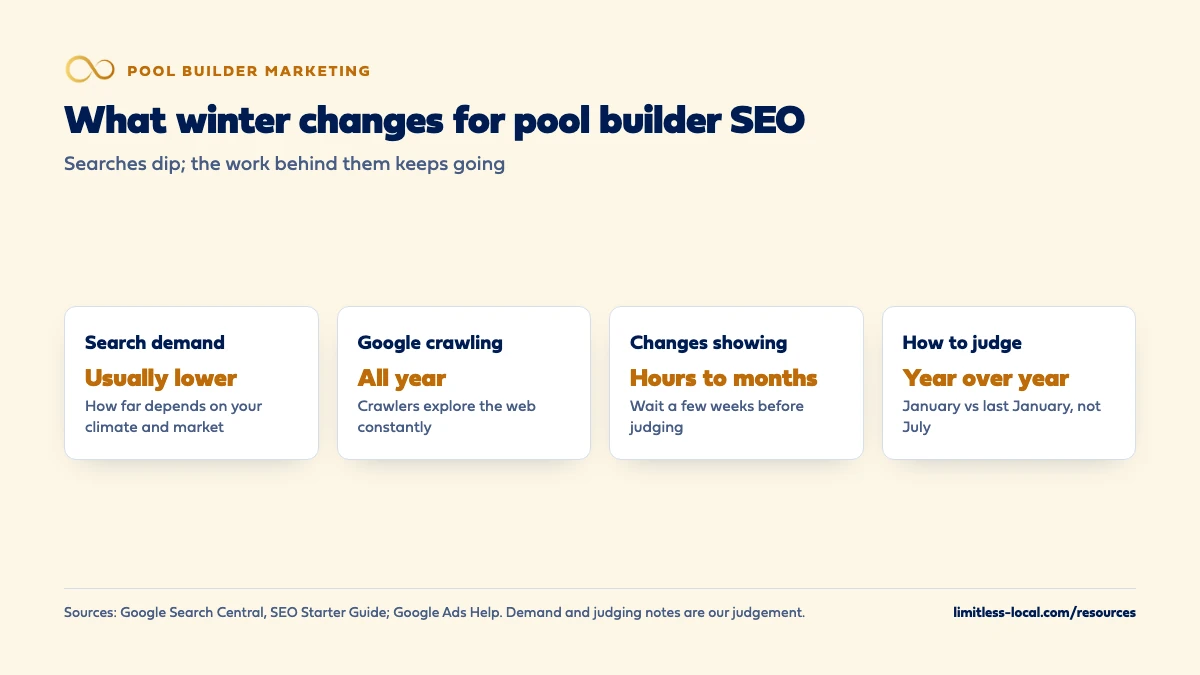
Yes, but usually fewer of them. Google’s own Keyword Planner help says the number of searches on your keywords is constantly fluctuating, and that web traffic is influenced by seasonality, current events and a number of other factors. Source: About Keyword Planner forecasts. Pool searches are a clear case of that.
In our judgement, how deep the dip goes depends on where you build. In a northern market where pools sit under covers for months, searches for a new pool can fall a long way after the season ends. In a warm market where people swim most of the year, the dip is usually shallower, and some builders stay busy straight through. The holidays tend to be the quietest stretch almost everywhere, and planning searches often start climbing again soon after.
How can I see how pool searches change through the year in my area?
Two free Google tools show it, and they measure different things.
- Keyword Planner (inside Google Ads) shows average monthly searches for a keyword and its close variants for the location you choose. Google says you can use this to see how popular your keywords are during different times of the year, and by default the figure is averaged over a 12-month period. Source: About Keyword Planner forecasts. You need to have finished your account setup, including billing information, to use it. Source: Use Keyword Planner.
- Google Trends shows relative interest, not counts. Google says each data point is divided by the total searches for that place and time, then scaled on a range of 0 to 100, and it can show interest down to city level. Low-volume terms show as zero, and Google says Trends is not a perfect mirror of search activity and should be treated as one data point among others. Source: FAQ about Google Trends data.
In our judgement, the useful way to read either one is to look for the shape of the year in your own area: which months rise, which months fall, and when the climb starts. That tells you when to have your pages and profile ready, which matters more than the exact numbers.
Does SEO slow down or stop working in the winter?
The work doesn’t stop. Google describes its search engine as fully automated, using crawlers that explore the web constantly, looking for pages to add to its index. Source: SEO Starter Guide. Nothing about that changes with the weather. A new project page you publish in January can be found, indexed and ranked the same way it would be in May.
What changes is how many people see the result. If your site ranks in the same places in January as it did in June but half as many homeowners are searching, you’ll get fewer visits and fewer calls from the same rankings. In our judgement, that’s the most common reason owners think their SEO “stopped” in winter: the searches dropped, not the rankings.
There is one real slowdown: anything you change takes time to show up. Google says some changes might take effect in a few hours, others could take several months, and that you’ll likely want to wait a few weeks to assess whether your work had an effect. Source: SEO Starter Guide. That delay is the reason to do the work before spring, not during it.
Why did my website traffic drop in winter if my rankings didn't?
Because traffic is rankings times searches. Google Search Console shows both sides. Its Performance report gives clicks (how many times someone clicked through to your site from Google Search), impressions (how many times your site appeared in results) and average position. The default view covers the past three months, and you can change the date range and group the chart by day, week or month. Google says the weekly and monthly views help smooth out daily swings and show longer-term trends. Source: Performance report (Search results).
In our judgement, a builder checking whether winter is a ranking problem or a demand problem should look at three things in that report:
- Average position on your main pool searches. If it held steady, your rankings are fine.
- Impressions. If they fell along with clicks, fewer people searched.
- The same months a year ago. If this winter’s clicks are level with or above last winter’s, the SEO is doing its job.
If position fell sharply at the same time, that’s a different problem, and worth a closer look before spring. Why pool builder leads suddenly dry up walks through how to tell the difference.
Curious what your marketing is actually booking?
Get a free visibility audit — no obligation, no sales pitch.
Who is searching for a pool builder in the off-season?
In our judgement, winter searchers fall into a few groups, and each wants something different from your site:
- Planners. Homeowners who want to swim next summer and know a pool takes design, financing and permits first. They want to see your finished pools, how your process works and when they’d need to sign.
- Renovation shoppers. Owners of older pools thinking about resurfacing, new tile or equipment before the season. They need a page that speaks to renovation, not only new builds.
- New homeowners. People who just bought a house with space for a pool, or with an old pool that needs work.
- Researchers. People reading about pool types, costs and timelines who aren’t ready to call anyone yet.
Each of these is a lead that can turn into a contract months later. The off-season playbook for converting them, including follow-up and ads, is in how pool builders keep leads coming in the off-season.
Is winter a good time to work on SEO for a pool company?
In our judgement, it’s the best time. SEO typically takes 3-6 months to show meaningful organic growth, and Google itself says changes can take anywhere from hours to several months to show. Work started in November or December has time to be crawled, indexed and settle in before homeowners start searching in earnest in spring. Work started in April is chasing a season that’s already under way.
Winter also tends to be when you have time. Your crews are slower, you have a full season of finished pools to photograph and write about, and the customers you built for are fresh enough to ask for a review. The full timeline for how SEO builds up is in how long pool builder SEO takes to bring in leads.
What SEO work should a pool builder do over the winter?
In our judgement, the winter list for most pool builders looks like this:
- Turn this season’s builds into pages. Each finished pool is a project you can show, with photos, the town, the pool type and the features. A project gallery with a page or section per build gives planners what they came for.
- Fill gaps in your service pages. If you build in towns you don’t have a page for, or offer renovations with no page about them, winter is when to fix it.
- Ask this season’s customers for reviews. They’re still happy and the pool is still new to them.
- Update your Google Business Profile. Add new photos, check your categories and services, and make sure your hours are right, including any changes over the holidays. Google lists complete, accurate info, including hours, among its tips for local ranking. Source: Tips to improve your local ranking on Google.
- Fix what slows the site down, especially large photo files on gallery pages.
- Check the contact path. Test every form and phone number before the first spring inquiry arrives.
The full pre-season checklist, including ads and office readiness, is in how to prepare marketing before peak season.

Does my Google Maps ranking change in the winter?
Not because of the season itself. Google says local results are mainly based on relevance, distance and popularity: how well your profile matches the search, how far you are from the person searching, and how well known your business is, which takes in things like reviews and links to your business. It also says there’s no way to request or pay for a better local ranking. Source: Tips to improve your local ranking on Google. None of those factors is tied to the month.
What you’ll see in winter is fewer calls and direction requests from your profile, because fewer people are searching. Your Business Profile performance report shows views, searches, calls and website clicks, and lets you set a date range. Google notes the searches figure is updated at the start of each month and can take up to five days to appear. Source: Understand your Business Profile performance & insights. In our judgement, compare each winter month with the same month last year rather than with the month before.
How should I judge my SEO results during the slow months?
In our judgement, use these checks instead of raw traffic:
- Year over year. January against last January, not against July.
- Position on the searches that matter. Your main pool builder and town searches should hold or improve.
- Impressions on planning searches. Searches about pool types, costs and timelines show the planners are finding you.
- Consultation requests and where they came from. Fewer is normal; none at all from organic search is worth a look.
- Signed contracts by source, counted over the full season, since a winter inquiry can sign in spring.
That last check needs tracking that follows a lead from first contact to signed contract. Tracking which marketing produces signed pool contracts covers how to set it up.
Should I stop paying for SEO over the winter?
In our judgement, pausing SEO in winter usually costs more than it saves, because winter is when the pages and reviews that spring searches find get built. If the work stops in November and restarts in March, the new pages go live just as the season starts and spend their first months catching up.
That doesn’t mean every SEO bill is worth paying. If you can’t see what was done each month, or nothing ties the work to consultations and contracts, that’s a reason to ask hard questions any time of year. When a pool builder should stop paying for SEO covers how to make that call.
Want to see where your company stands?
A free visibility audit shows where you show up on Google, Maps and AI answers, and what it's costing you in calls.
Why winter search matters more for pool builders than most trades
The sale starts months before the build. A homeowner who wants to swim in June has to choose a builder, settle a design, line up financing and get permits first. In our judgement, many of those decisions start in the off-season, which makes winter searchers more valuable than their numbers suggest.
Climate shapes how deep the dip goes. In our judgement, a builder in a warm market and one in a northern market can see very different winter search patterns. Check your own area rather than going by another builder’s experience.
Renovation and new builds move on different clocks. In our judgement, renovation work can often be planned and sold on a shorter timeline than a new pool, so a renovation page can earn inquiries in months when new-build searches are quiet.
A worked example: reading a winter drop in Search Console
These numbers are made up to show the math, not a benchmark for your market. Say your website got 400 clicks from Google Search in July and 120 in January. That’s a 70% drop, and on its own it looks alarming.
Now look at the other columns. Your average position on your main pool builder searches is about the same in both months, and impressions fell by a similar share. That points to fewer searches, not lost rankings.
Then compare January with last January. If last January brought 90 clicks, this January’s 120 is a 33% increase on the same month, which means the work is building even though the season is slow. If last January brought 160, you’ve lost ground and should look at positions and pages before spring.
Swap in your own numbers. The comparison that matters is the same month a year apart.
Frequently asked questions
Can Google Trends tell me how many people search for pool builders in my town?
No. Trends shows relative interest scaled from 0 to 100, not search counts, and low-volume terms show as zero. Keyword Planner’s average monthly searches are closer to a count, though Google rounds them.
Should I write blog posts about pools in the winter?
In our judgement, yes, if they answer what planners are asking, such as pool types, timelines and what happens between signing and swimming. Project write-ups of this season’s builds usually do more for you than general articles.
Should I change my Google Business Profile hours in the off-season?
If your office hours change, update them. Google lists accurate hours, including special hours, among the business info that helps your profile show up for relevant searches.
How long until changes I make in winter show up in Google?
Google says some changes take effect in a few hours and others can take several months, and suggests waiting a few weeks before judging whether a change helped. That’s why winter work is timed for spring.
I build year-round in a warm state. Does any of this apply to me?
Less of it. Your dip may be shallow, but searches still move with the year. Check your own pattern in Keyword Planner or Trends and plan your content around the months that rise.
Should I run Google Ads in winter instead of relying on SEO?
Ads can bring inquiries within days, while SEO builds slowly, so some builders run a smaller ad budget through winter. The trade-offs are covered in how long Google Ads take to bring a pool builder calls.
Key takeaways
- People still search for pool builders in winter, but usually fewer, and more of them are planning next season.
- Google crawls all year, so SEO work done in winter can be in place before spring searches rise.
- A winter traffic drop with steady positions means fewer searches, not lost rankings.
- Judge winter months against the same months last year, and count contracts over the full season.
- Use the quiet months for project pages, reviews and profile updates that spring searchers will see.
Not sure what's working right now?
Start with a free visibility audit: rankings, Google profile, reviews and tracking, checked against your service area.
More in this section
- How long does pool builder SEO take to bring in leads?
- What happens if a pool builder decides to stop paying for SEO?
- What keywords should a pool builder target?
- How does a pool builder show up in AI search results?
- How do pool builders keep leads coming in the off-season?
Sources
- SEO Starter Guide: The Basics — Google Search Central
- About Keyword Planner forecasts — Google Ads Help
- Use Keyword Planner — Google Ads Help
- FAQ about Google Trends data — Trends Help
- Performance report (Search results): Overview and basic setup — Search Console Help
- Understand your Business Profile performance & insights — Google Business Profile Help
- Tips to improve your local ranking on Google — Google Business Profile Help