
How should a pool builder write website content for local keywords?
- How do I work my town and pool-type keywords into my website copy?
- What does writing for local keywords actually mean?
- Where should the town and pool type go on the page?
- How do I write a page title for a local pool keyword?
- How should I use headings on a pool builder page?
- How many times should the keyword appear?
- Can I list all the towns I serve at the bottom of every page?
- What makes local pool content specific enough?
- How should I write about the pool types and services I offer?
- How do project photos carry local keywords?
- Can I use AI or a template to write my local pages?
- How do I know if the new content is working?
- What's different about local content for pool builders
- A worked example: rewriting a stuffed paragraph
- Frequently asked questions
- Key takeaways
- More in this section
- Sources
The short version
- One page, one kind of pool work, in the area you really build in.
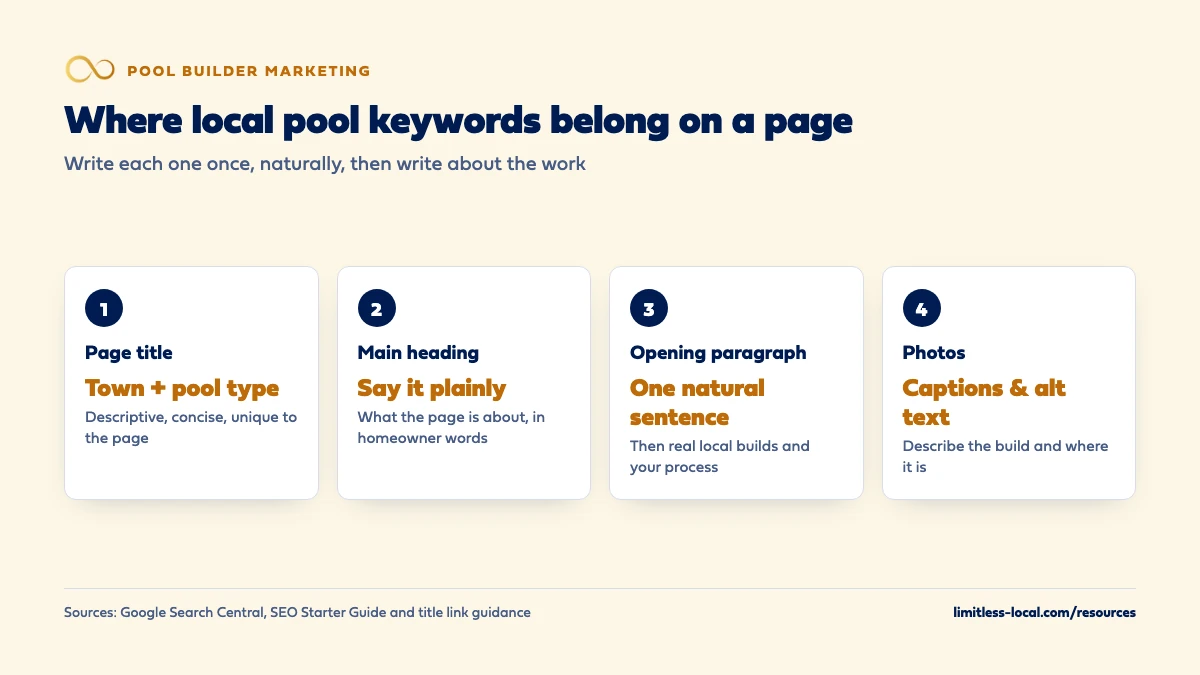
- Put the town and pool type in the title, main heading, opening paragraph and photo descriptions.
- Fill the page with real local builds and how you work, not repeated keywords.
- Lists of towns pasted onto a page count as keyword stuffing to Google.
For pool builders who already know which searches they want and need to know how to put those words on the page without it reading like spam.
Get a free visibility audit · Book a growth call
How do I work my town and pool-type keywords into my website copy?
Write each page about one kind of pool work in the area where you build it, and use the words homeowners there actually search for in the few places that say what the page is about: the page title, the main heading, the opening paragraph and the descriptions of your project photos. Then fill the page with what only you can say, such as builds you’ve done nearby, how your process works and what building a pool there involves. Don’t repeat the town name or paste in lists of towns you want to rank for; Google’s spam policies name blocks of text listing cities and regions a page is trying to rank for as keyword stuffing.
Writing these pages is the slow, specific part of local SEO, and it’s included in our packages: Essentials, at $3,500 a month, includes a content sprint of up to 10 pages and 2 blog posts a month, alongside Google Business Profile management and review response. How that fits a builder’s sales cycle is on our pool builder marketing page, and the pool builder marketing questions library covers keyword choice, city pages and the rest question by question.
What does writing for local keywords actually mean?
It means writing pages in the words homeowners in your area use when they’re looking for a builder, and making it clear where you build. Google’s SEO Starter Guide puts it as thinking about the words a user might search for to find your content, and notes that people who know a lot about a topic search differently from people who are new to it. It also says not to worry if you don’t anticipate every variation, because Google’s language matching systems can understand how a page relates to many queries even without the exact terms. Source: SEO Starter Guide: The Basics.
So the job isn’t to fit every keyword onto a page. It’s to pick the searches that matter, which the keywords a pool builder should target covers, and then write a page a homeowner would find genuinely useful for that search.
Where should the town and pool type go on the page?
In the few places that say what the page is about, written once and naturally:
- The page title (the title element, one of the sources Google uses for the headline of your search result).
- The main heading at the top of the page.
- The opening paragraph, in a sentence a homeowner would actually read.
- Photo descriptions and captions for the builds you show.
- The page address, kept short and readable.
Google says the title link in search results is generated from sources including the title element and other headings on the page. Source: SEO Starter Guide: The Basics. The same guide says keywords in a domain name or URL path alone have hardly any effect beyond appearing in breadcrumbs, so a readable address is for people first. In our judgement, once the town and pool type are in those places, the rest of the page should simply be about the work.
How do I write a page title for a local pool keyword?
Google’s title link guidance asks for titles that are descriptive and concise, unique to each page, and free of keyword stuffing; it says there’s no reason to have the same words appear multiple times. It also warns against long boilerplate titles that vary by only a single piece of information. Source: Influencing Title Links in Google Search. The Starter Guide adds that a good title could include your business name, important information like the physical location of the business, and what the page offers. Source: SEO Starter Guide: The Basics.
For a pool builder, that might read like “Fiberglass Pool Installation in Oak Hollow | Your Company” for a page about fiberglass work in one town. What breaks the guidance is the pattern “Pool Builder Oak Hollow, Pool Builders Oak Hollow, Best Pool Company Oak Hollow”, or a hundred pages titled “Custom Pools in [Town]” with only the town name changed.
How should I use headings on a pool builder page?
Google’s Starter Guide says to break up long content into paragraphs and sections and provide headings to help users navigate the page. It also says there’s no ideal number of headings, and that from Google Search’s point of view it doesn’t matter if they’re out of order. Source: SEO Starter Guide: The Basics.
In our judgement, the best headings on a pool page are the questions a homeowner asks during a consultation: how long a build takes, what happens during permitting, what affects the price, what maintenance looks like, how financing works. Those headings carry natural local and pool-type wording without forcing it, and they’re the same questions people type into Google and AI assistants.
How many times should the keyword appear?
There’s no target. Google’s Starter Guide says excessively repeating the same words, even in variations, is tiring for users and that keyword stuffing is against its spam policies. It also says content length alone doesn’t matter for ranking, and that varying your words naturally gives you more chances to show up because you’re using more keywords. Source: SEO Starter Guide: The Basics. Google’s helpful content guidance lists writing to a particular word count because you’ve heard Google prefers one as a warning sign, and answers its own question: it doesn’t. Source: Creating Helpful, Reliable, People-First Content.
In practice, write the page for the homeowner, then read it out loud. If the town name sounds forced, it is. Swap it for what a person would say, such as “here”, “on your street” or the name of the neighborhood.
Curious what your marketing is actually booking?
Get a free visibility audit — no obligation, no sales pitch.
Can I list all the towns I serve at the bottom of every page?
Not as a block of town names meant to rank. Google’s spam policies define keyword stuffing as filling a page with keywords or numbers to manipulate rankings, and the examples include blocks of text that list cities and regions a web page is trying to rank for. Source: Spam Policies for Google Web Search.
Telling homeowners where you build is still useful. In our judgement, the honest version is one service-area page that names the towns you work in, with something real about each where you can, linked from the menu or footer, instead of the same list pasted onto every page. Which towns deserve a page of their own is answered in whether a pool builder should make a page for every city it serves.
What makes local pool content specific enough?
Detail only you have. Google’s helpful content guidance asks whether content shows first-hand expertise and depth of knowledge, such as expertise from having actually used a product or service or visited a place, and whether it provides original information, reporting, research or analysis. Source: Creating Helpful, Reliable, People-First Content.
For a pool builder, in our judgement, that means:
- Builds you’ve finished in or near that town, with the yard, the challenge and the result.
- What building there is like: lot sizes and access, HOA approvals, the local permit and inspection steps as you’ve experienced them.
- Your real timeline from design to first swim, and what tends to slow it down.
- Answers to the questions homeowners from that area ask you most.
A competitor can copy the keywords on your page. It can’t copy the backyard you built on Maple Street last spring.
How should I write about the pool types and services I offer?
Use both the trade word and the homeowner word. Google’s own example is that some people search for “charcuterie” and others for “cheese board”. Source: SEO Starter Guide: The Basics. In the pool trade, in our judgement, the same split shows up between gunite or shotcrete and “concrete pool”, between plaster and “pool finish”, and between renovation and “redoing an old pool”. Say both once, then write normally.
If you build more than one type and want more of each, a page per type usually serves the homeowner better than one page covering everything; whether a pool builder needs separate pages for each pool type covers when that’s worth it.
How do project photos carry local keywords?
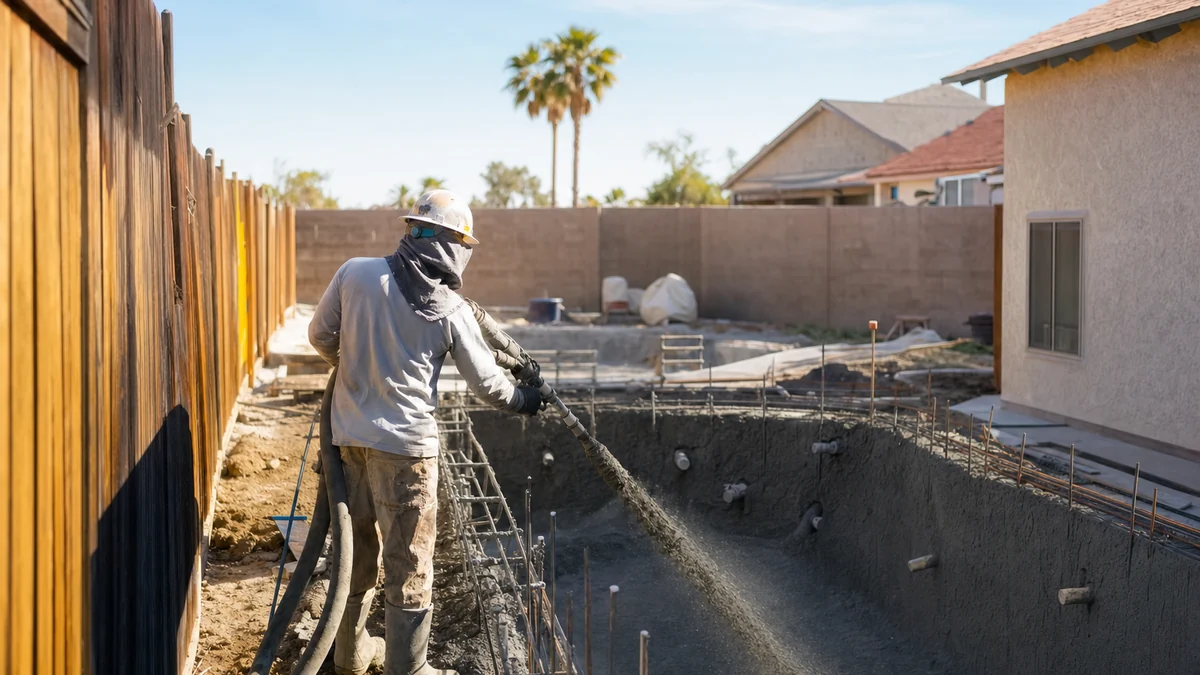
Through the words around them. Google’s Starter Guide says to place images near relevant text, because that text helps Google understand what the image is about, and to add descriptive alt text that explains how the image relates to the page. Source: SEO Starter Guide: The Basics.
For a pool builder, a caption and alt text like “Freeform gunite pool with a tanning ledge, built in Oak Hollow” does more than “pool1.jpg” or “best pool builder Oak Hollow”. It describes the photo for someone who can’t see it, and it puts the town and pool type next to proof that you built there. How a pool builder should use project photos and videos covers the rest of the photo side.
Can I use AI or a template to write my local pages?
As a starting point, with care. Google’s helpful content guidance lists using extensive automation to produce content on many topics, and mainly summarizing what others have said without adding much value, among the warning signs of content made for search engines first. Source: Creating Helpful, Reliable, People-First Content. Its spam policies separately list scaled content abuse. Source: Spam Policies for Google Web Search.
In our judgement, a draft is fine if a person who knows the builds rewrites it with the details above. A stack of pages that differ only by town name is the pattern to avoid, whether a person or a tool wrote it.
How do I know if the new content is working?
Watch which searches the page starts to show up for. Search Console’s Performance report shows the queries most likely to show your site and which queries bring traffic. Source: Performance report (Search results): Overview and basic setup. If a page about fiberglass pools in one town starts appearing for searches with that town and “fiberglass pool” in them, the wording is doing its job.
Then look past the visits to the calls and consultation requests the page produces, because a page can win the right searches and still not ask clearly for the next step. The difference between website traffic and pool quote calls explains which numbers to watch.
Not sure which of these is costing you jobs?
A free visibility audit checks the Google profile, reviews, site and tracking, and shows what to fix first.
What's different about local content for pool builders
Two vocabularies. In our judgement, pool buyers range from first-timers who search “inground pool” to homeowners who have read enough to search for a specific build method or finish. A pool page has to make sense to both.
Long research, so pages get read closely. In our judgement, a homeowner planning a purchase this size often comes back to your site more than once before calling, and depth on process, timeline and what’s included earns more trust on a pool page than on a page for a quick repair.
Construction words overlap with service words. Pool cleaning, openings and repairs share words with construction. If you only build, say so plainly on the page so the copy points at the work you want.
A worked example: rewriting a stuffed paragraph
The town and details here are made up. A builder’s town page opens like this:
“Looking for the best pool builder in Oak Hollow? As the top Oak Hollow pool builder, we build pools in Oak Hollow, Pine Ridge, Cedar Falls, Mill Creek and Lakeview. Call the Oak Hollow pool builders today!”
It repeats the town, lists other towns to rank for, and says nothing a homeowner can use. A rewrite:
“We’ve built gunite and fiberglass pools in Oak Hollow since we opened, mostly on the newer lots east of the highway, where narrow side yards mean planning how the excavator gets in before anything else. Most Oak Hollow builds also need HOA approval, so we put together the drawings your board will ask for during design. Below are some of the pools we’ve finished nearby, with what each yard needed.”
The town appears twice, the pool types once, and every sentence tells the homeowner something only a builder who works there would know.
Frequently asked questions
Should I write a meta description with my town and pool type?
It can be worth writing one. Google says the snippet under a result usually comes from the page’s content and occasionally from the meta description, and that a good one is short, unique to one page and includes the page’s most relevant points.
Does putting my town in my domain name help me rank there?
Google’s Starter Guide says keywords in a domain name or URL path alone have hardly any effect beyond appearing in breadcrumbs, and recommends choosing a name that’s best for your business.
Do I need to use "near me" in my content?
In our judgement, no. Homeowners type it, but it’s not how anyone talks, and Google says its language matching can relate a page to many queries without the exact words.
How long should a local pool page be?
As long as it takes to answer the homeowner’s questions. Google says content length alone doesn’t matter for ranking and that it has no preferred word count.
Should every page mention every pool type I build?
In our judgement, no. Mention what’s relevant to that page and link to your pool type pages, so each page stays about one thing.
Is it a problem if two of my pages are very similar?
Google says duplicate content isn’t a spam violation on its own but can be a bad user experience. Copying other sites’ content is a different matter.
Key takeaways
- Choose the searches first, then write one page per kind of pool work and area.
- Put the town and pool type in the title, main heading, opening paragraph and photo descriptions, once and naturally.
- Lists of towns and repeated keywords count as keyword stuffing under Google’s spam policies.
- Local builds, permits, HOA steps and real timelines make a page specific enough to earn trust.
- Check Search Console queries, then judge the page by the calls and consultation requests it brings.
Want a second set of eyes on your setup?
We'll look at how you show up locally and where calls are leaking, then send you a plain-English breakdown.
More in this section
- What keywords should a pool builder target?
- Does local SEO bring a pool builder enough leads to be worth it?
- What should a pool builder website include to get more consultations?
- Which online listings should a pool builder have besides Google?
- How long does pool builder SEO take to bring in leads?
Sources
- SEO Starter Guide: The Basics — Google Search Central
- Creating Helpful, Reliable, People-First Content — Google Search Central
- Spam Policies for Google Web Search — Google Search Central
- Influencing Title Links in Google Search — Google Search Central
- Performance report (Search results): Overview and basic setup — Search Console Help