
Does local SEO bring a pool builder enough leads to be worth it?
- Is local SEO and a Google Business Profile worth the money for a pool company?
- What does local SEO actually get a pool builder?
- How many signed contracts does local SEO need to pay for itself?
- Why does deal size change the answer for pool builders?
- How does the long sales cycle change whether SEO is worth it?
- When is local SEO worth it for a pool builder?
- When is local SEO not worth it yet?
- Can I do local SEO myself instead of paying for it?
- How do I measure whether local SEO is paying off?
- Is local SEO worth it compared with Google Ads for a pool builder?
- What should I be wary of when buying local SEO?
- What's different about local SEO's value for pool builders
- A worked example: the break-even math
- Frequently asked questions
- Key takeaways
- More in this section
- Sources
The short version
- Work out how many signed contracts a year would cover the cost.
- One pool contract can cover months of local SEO, so the bar can be low.
- SEO typically takes 3-6 months to show meaningful organic growth; contracts come later.
- Track leads to signed contracts, or you'll never know if it paid.
For pool builders weighing a monthly local SEO bill against how many signed contracts it would take to pay for itself, and how long that takes.
Get a free visibility audit · Book a growth call
Is local SEO and a Google Business Profile worth the money for a pool company?
For most pool builders, local SEO is worth it if it can plausibly bring in a few extra signed contracts a year, because one pool contract can cover months of the cost; the number of leads matters less than whether the right homeowners in your area find you. Nobody can promise how many leads it will bring, since Google doesn’t sell local rankings and SEO typically takes 3-6 months to show meaningful organic growth, with contracts arriving later because of the long sales cycle. It’s a weaker bet if you’re booked solid, can’t track which leads sign, or need new contracts this month, when ads or referrals fit better.
We’ve been on the builder’s side of that decision: the agency was an equity partner in a pool construction company, where it streamlined back-office operations, built the lead-generation engine and ran sales and marketing. That business did $2M+ revenue in year one. That’s one company’s past result, not a forecast for yours, and we don’t guarantee rankings, lead counts or revenue. Our local SEO is part of every package, which is laid out for builders on our pool builder marketing page, and the pool builder marketing questions library covers budgets, timelines and tracking question by question.
What does local SEO actually get a pool builder?
Two things: a place in the Google Maps results for searches near you, and website pages that show up in the regular search results when homeowners look for the pools you build. Neither is bought per click. Google says it never accepts money to include or rank sites in its search results and that it costs nothing to appear in organic results; advertising with Google won’t affect your site’s presence there. Source: Do You Need an SEO? Tips for Hiring an SEO. For Maps, Google says there’s no way to request or pay for a better local ranking. Source: Tips to improve your local ranking on Google.
What you pay for is the work: the Google profile, reviews, listings and pages that help Google match you to searches. What that work earns is visibility you don’t pay for per lead. What shapes Maps results is covered in what signals decide which pool builders show in Google Maps.
How many signed contracts does local SEO need to pay for itself?
You can work it out from three inputs:
- What local SEO costs you a year, including your own time if you do part of it.
- What one signed contract is worth to you, as gross profit after materials, subs and crew, not the contract price.
- How many SEO leads it takes to sign one, from your own close rate.
Divide the yearly cost by the gross profit per contract, and you have the contracts a year it needs to break even. Multiply by leads per contract, and you have the leads a year. If that lead count is small next to the searches for pool builders in your area, the bet is reasonable. How much a pool builder can afford to spend to win one customer goes deeper on the gross profit side.
Why does deal size change the answer for pool builders?
Because the bar is set in contracts, not leads. In our judgement, a trade that books small service calls needs a steady stream of leads every week for SEO to pay; a pool builder may only need a handful of extra signed contracts a year. That makes local SEO easier to justify for a builder, even though it’s slower to show results.
It also changes what “enough leads” means. Ten leads a month from homeowners who were never going to build are worth less than two from homeowners in the right neighborhoods with the budget for the pool you sell. In our judgement, the right question isn’t “how many leads will SEO bring?” but “will the right homeowners in my area find me when they’re ready?”
How does the long sales cycle change whether SEO is worth it?
It doesn’t change the answer, but it changes when you’ll know it. Ads can generate leads within days of launch; SEO typically takes 3-6 months to show meaningful organic growth. On top of that, each organic lead still takes as long to sign as any other lead. Google’s own guidance says some changes may take effect in a few hours and others could take several months, and that not every change will have a noticeable impact. Source: SEO Starter Guide: The Basics.
So the first contracts you can trace to SEO may land well after the six-month mark. That’s why a builder who judges SEO by contracts in month four will usually call it a failure too early. How a long pool sales cycle changes when SEO pays off walks through the timing in detail.
Curious what your marketing is actually booking?
Get a free visibility audit — no obligation, no sales pitch.
When is local SEO worth it for a pool builder?
In our judgement, when most of these are true:
- One extra signed contract would cover several months of the cost.
- You plan to keep building in the same area for years, so visibility you earn keeps paying.
- You can ask every homeowner for a Google review at handover and show real project photos.
- Someone answers the phone and follows up on consultation requests quickly.
- You can track which leads came from Maps and organic search and which of them signed.
- You can give it at least one full selling season before judging it on contracts.
If you’re spending on ads too, local SEO is often what lowers your dependence on them over time; in our judgement, a builder with steady Maps and organic leads can run ads more selectively.
When is local SEO not worth it yet?
In our judgement, it’s a weak bet, or the wrong first step, when:
- You need contracts this month. SEO won’t fix a cash-flow gap; ads, referrals and following up old leads are faster.
- You’re booked solid for the next season. Leads you can’t build for don’t help, though keeping your profile and reviews current costs little.
- Nobody can tell which leads signed. You’ll pay for SEO and never know whether it worked.
- The basics are missing. No verified Google profile, no reviews, no project photos. Fix those first; they’re cheap.
None of these is a reason to rule it out for good. Each is something to sort out before paying monthly for it.
Can I do local SEO myself instead of paying for it?
Partly, and Google says as much: if you run a small local business, you can probably do much of the work yourself, and it recommends starting with its SEO Starter Guide. Source: Do You Need an SEO? Tips for Hiring an SEO.
In our judgement, the parts a builder can usually handle in-house are verifying and filling out the Google profile, asking for reviews at every handover and replying to them, and adding project photos. The parts that take more time or skill are writing strong pages for each pool type and town, keeping listings consistent across the web, and connecting leads to signed contracts. Paying for those makes sense when your time is worth more on sales and builds.

How do I measure whether local SEO is paying off?
Watch it in layers, from early signs to the result that matters:
- Google profile actions. Business Profile performance shows calls from the profile’s call button, website clicks, direction requests and the searches people used to find you. Google notes that this data includes actions from both organic results and Google Ads, so it isn’t a pure SEO number. Source: Understand your Business Profile performance & insights.
- Search queries. Search Console’s Performance report shows which queries bring traffic to your site. Source: Performance report (Search results): Overview and basic setup.
- Leads by source, recorded on every call and form the day it comes in.
- Signed contracts, grouped by the month each lead first came in.
The last one is the only one that answers “was it worth it?”. How to track which marketing produces signed pool contracts covers the setup.
Is local SEO worth it compared with Google Ads for a pool builder?
They do different jobs. In our judgement, ads buy visibility you can turn on quickly and that stops when you stop paying; SEO builds visibility slowly that keeps working for a while after the work stops. Google is explicit that the two don’t mix: advertising won’t affect your organic search presence. Source: Do You Need an SEO? Tips for Hiring an SEO.
In our judgement, running both often makes sense: ads to fill the next season while SEO ramps up, and SEO to lower the cost of each contract over the long run. Whether Google Ads are worth it for pool builders covers the ad side, and what happens if a pool builder stops paying for SEO covers how long the SEO side lasts.
What should I be wary of when buying local SEO?
Google’s own hiring advice lists the warning signs: no one can guarantee a #1 ranking on Google, so beware of anyone who claims to guarantee rankings or a special relationship with Google; be careful with companies that are secretive or won’t clearly explain what they intend to do; and if an SEO offers an audit, it should give realistic estimates of improvement. Google also suggests asking what results they expect, in what timeframe, and how they measure success. Source: Do You Need an SEO? Tips for Hiring an SEO.
For a pool builder, in our judgement, add one more: ask how they’ll show you which leads became signed contracts. A report that stops at rankings and traffic can’t answer whether local SEO was worth it.
Not sure which of these is costing you jobs?
A free visibility audit checks the Google profile, reviews, site and tracking, and shows what to fix first.
What's different about local SEO's value for pool builders
High value per contract. In our judgement, the break-even point for a builder is a few contracts a year, which makes SEO easier to justify than in trades that live on small tickets.
A seasonal, planned purchase. In our judgement, many homeowners plan a pool months ahead, and organic pages that answer their cost, design and timeline questions can catch them early, long before they’re ready to call, which pays off in contracts a season later.
Reviews arrive slowly. A builder finishes far fewer jobs a year than a service company, so in our judgement each review counts for more, and asking at every handover matters more.
Fewer, bigger competitors in Maps. In our judgement, many markets have fewer pool builders than plumbers or HVAC companies, so a well-run profile can stand out, but the builders already in the map pack often have years of reviews.
A worked example: the break-even math
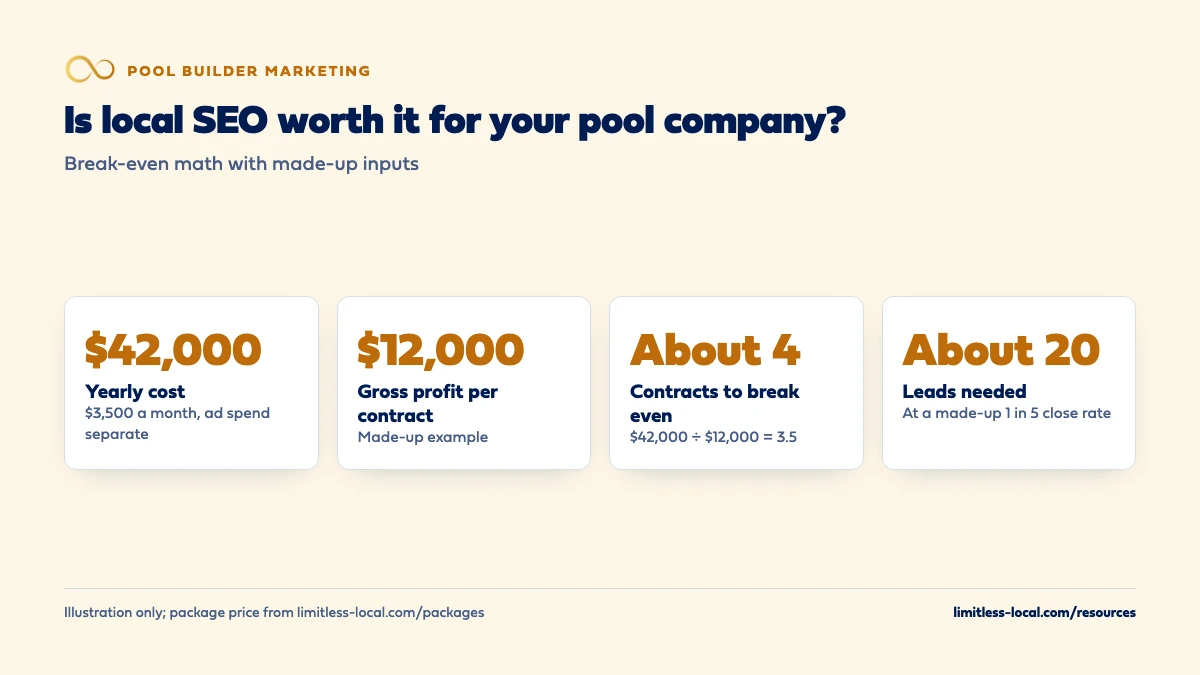
These numbers are made up to show the math, except our package price. Say a builder pays $3,500 a month for our Essentials package, which includes local SEO along with Google Business Profile management, Google Ads management and tracking; ad spend is paid to Google separately. Over a year that’s $42,000.
Say each signed contract leaves $12,000 in gross profit after materials, subs and crew. The package covers its cost at $42,000 divided by $12,000, or 3.5 contracts, so about 4 a year. If the builder signs about 1 in 5 qualified organic and Maps leads, that’s about 20 such leads a year to break even, before counting the contracts the ads in the same package produce.
Whether 20 leads a year is realistic depends on the market, the competition and the starting point, which is what a free visibility audit is for. What the math does show is that the bar is a handful of contracts, not a flood of leads.
Frequently asked questions
Is a Google Business Profile alone enough for a pool builder?
It’s the place to start, since local results on Google Maps and Search are built from Business Profiles and there’s no way to pay for a better local ranking. In our judgement, a profile without a website that describes your pool work leaves out the organic search side, where many homeowners do their research.
Can local SEO guarantee a spot in the map pack?
No. Google says there’s no way to request or pay for a better local ranking, and its hiring advice says no one can guarantee a #1 ranking. Be wary of anyone who promises one.
How soon should I expect leads from local SEO?
SEO typically takes 3-6 months to show meaningful organic growth, and pool contracts follow later because of the sales cycle, so judge it over at least one full selling season.
Should I stop local SEO in the winter?
In our judgement, usually not, because many homeowners research pools in the off-season and visibility built then pays off in spring. Our packages are month-to-month, with no long-term contracts, so it’s your call.
What if a competitor has years of reviews?
You won’t catch up in a season. In our judgement, a builder in that spot does better pairing a steady review habit and strong pool type pages with ads in the meantime.
Key takeaways
- Judge local SEO by contracts a year needed to break even, not by lead volume.
- One pool contract can cover months of the cost, so the bar is often a handful of contracts.
- SEO typically takes 3-6 months to show meaningful organic growth; contracts come later.
- It’s a weak first step when you need contracts this month or can’t track which leads sign.
- Nobody can guarantee rankings or leads; ask how any provider will show you signed contracts.
Want a second set of eyes on your setup?
We'll look at how you show up locally and where calls are leaking, then send you a plain-English breakdown.
More in this section
- How long does pool builder SEO take to bring in leads?
- Are Local Services Ads worth it for pool builders?
- How should a pool builder write website content for local keywords?
- Do people search for pool builders in winter, or does SEO slow?
- Are Google Ads worth it for pool builders?
Sources
- Do You Need an SEO? Tips for Hiring an SEO — Google Search Central
- SEO Starter Guide: The Basics — Google Search Central
- Tips to improve your local ranking on Google — Google Business Profile Help
- Understand your Business Profile performance & insights — Google Business Profile Help
- Performance report (Search results): Overview and basic setup — Search Console Help