
How does a pool builder rebuild Google reviews after a drop?
- What should a pool company do when its Google reviews drop or stall?
- Why did my pool company's Google reviews drop?
- Step 1: How do I find out what actually changed?
- Step 2: What if Google removed reviews or restricted my profile?
- Step 3: Which customers should I ask first?
- Step 4: How do I make sure reviews don't stall again?
- Step 5: How should I handle low reviews while I rebuild?
- Step 6: How fast should I try to rebuild?
- What should I never do to get reviews back quickly?
- Does a drop in reviews hurt my Google Maps ranking?
- My reviews dropped and my website is old. Which do I fix first?
- How do I know the rebuild is working?
- What's different about rebuilding reviews for pool builders
- A worked example: rebuilding after removed reviews
- Frequently asked questions
- Key takeaways
- More in this section
- Sources
The short version
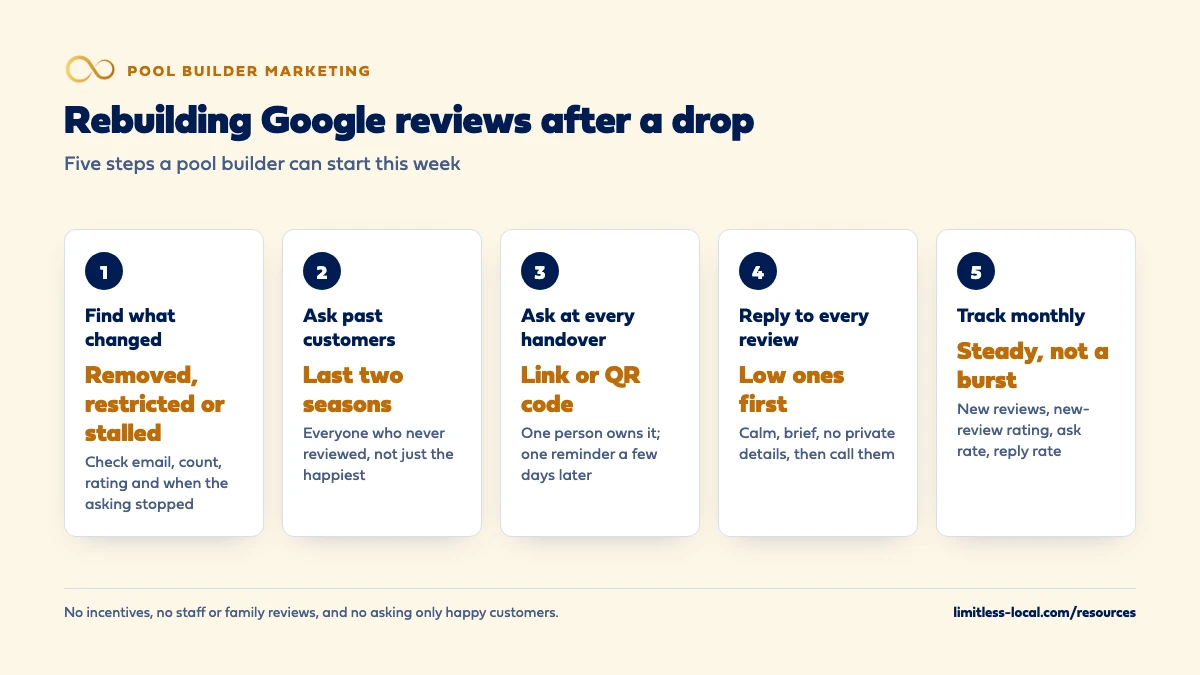
- Find out first whether reviews were removed, restricted or just stopped coming.
- Ask recent customers who never reviewed, then make the ask part of every handover.
- Reply to every review, and handle low ones calmly and in public.
- Rebuild steadily; no incentives, no family or staff reviews, no asking only happy customers.
For pool builders who’ve lost reviews, watched their rating slip or gone months without a new one, and want them back without breaking Google’s rules.
Get a free visibility audit · Book a growth call
What should a pool company do when its Google reviews drop or stall?
Start by finding out what changed: whether Google removed reviews, restricted your profile, or you simply stopped asking. Then ask the customers from your last season or two who never left a review, put a review request into every pool handover so it can’t stall again, and reply to every review, especially the low ones. Rebuild at a steady pace, never with incentives, family, staff or only your happiest customers, because those reviews get removed and can bring restrictions on your profile.
Reviews are part of every package we run: review response and basic review generation in Essentials, advanced review generation in Growth, and automated review requests in Scale, alongside the Google profile work they feed. Our local SEO page covers that side, our pool builder marketing page covers the trade, and the pool builder marketing questions library has the rest of the review pages.
Why did my pool company's Google reviews drop?
A drop usually has one of a handful of causes, and the fix depends on which. Google’s page on missing or delayed reviews lists the main ones:
- Removed for policy violations. Usually spam or content that breaks the rules. These won’t be restored.
- Still being checked. New reviews can take a few days to appear while they’re checked against policy.
- A profile merge. Reviews from both profiles can take a few days to show.
- A reinstated profile. Reviews sometimes go missing after a profile is reinstated; Google says to contact support if that happens.
Two other causes aren’t on that list. A restriction for fake engagement can stop new reviews or unpublish existing ones for a set period. And the most common one of all: you stopped asking. The count didn’t fall, but nothing new has arrived since last season, and your newest review is a year old.
Step 1: How do I find out what actually changed?
Spend half an hour on this before doing anything else.
- Check your email. Google notifies business owners by email if it plans to restrict a profile. Search the inbox tied to your Google profile.
- Count, rating or pace? Work out which one moved. Fewer total reviews means removals. A lower rating with the same count means a few low reviews landed. No new reviews in months means the asking stopped.
- Look at what disappeared. If you kept a list or screenshots, compare. Removed reviews that share a pattern (posted the same week, from people connected to your staff, or after a discount or gift) point to a policy problem.
- Check your process. When did someone last send a review link? Who used to do it, and are they still with you?
- Check for duplicates. A second profile for the same business, from an old address or a past manager, can split or merge reviews.
Often the answer is simply that the person who asked left, or the ask stopped when the season got busy.
Step 2: What if Google removed reviews or restricted my profile?
Don’t try to replace removed reviews by reposting them or asking the same people to write them again. Reviews removed for policy violations won’t be restored, and repeating whatever triggered the removal makes things worse.
If Google decides a business has broken its fake engagement policy, its page on profile restrictions lists what can follow, in addition to removing the reviews:
- The profile can’t receive new reviews or ratings for a set period.
- Existing reviews or ratings are unpublished for a set period.
- The profile shows a warning that fake reviews were removed.
You can appeal if you believe Google got it wrong, and Google will re-review the profile with whatever context you give it. If it was right, say a past office manager offered a discount for reviews or relatives of staff left five stars, stop the practice, wait out the restriction and rebuild the honest way. Asking customers for genuine reviews without incentives is allowed, so the steps below are all fine during a rebuild.
Step 3: Which customers should I ask first?
Your best source of new reviews is the pools you’ve already built.
- Last season’s customers who never reviewed. They’ve had a full summer in the pool, which is when most owners are happiest with it. Start here.
- The season before. Still worth asking, with a short note that mentions their build so it doesn’t feel like a blast.
- Current builds, at handover (more in the next step).
Ask all of them, not just the ones you think will be glowing. Google’s review policy doesn’t allow businesses to selectively solicit positive reviews, discourage negative ones or offer anything in exchange. In the US, the FTC’s guidance on its reviews rule says the rule doesn’t specifically ban asking only happy customers, but that the practice could violate the FTC Act.
If a build had real problems, call that customer rather than texting a link. Sort out what you can first. A review that mentions how you fixed something often does more for you than a bland five stars. How to get more Google reviews for a pool company has wording you can use.
Step 4: How do I make sure reviews don't stall again?
Stalls happen because asking depends on someone remembering. Make it part of the build instead.
- Pick the moment. The startup or handover walkthrough, when the homeowner first sees the finished pool running, is the natural one. When to ask for a review during a build covers the options.
- Name one owner of the task. The project manager who does the handover, or the office, but one person.
- Make it easy. Google lets you create a review link or QR code from your Business Profile and suggests putting it on receipts, in thank-you emails or on a printed card. A card in the handover folder and a text the same evening covers most people.
- One reminder, a few days later, then leave it.
- Add it to the checklist. If your job software has a closeout checklist, add “review link sent” as a line, so a skipped ask shows up.
Don’t pressure anyone to write it on the spot while you’re standing there. The rules say businesses shouldn’t require or pressure people to leave reviews while on the premises, and it reads badly anyway.
Curious what your marketing is actually booking?
Get a free visibility audit — no obligation, no sales pitch.
Step 5: How should I handle low reviews while I rebuild?
Reply to every review, and give the low ones the most care. Prospective customers read your replies as closely as the reviews.
- Reply calmly and briefly. Thank them, acknowledge the specific problem, say what you did or will do, and invite them to call.
- Keep private details out. No contract amounts or personal information about their project.
- Then pick up the phone. When you reply, Google notifies the reviewer, and customers can still change their review after reading your reply.
The FTC rule doesn’t prohibit contacting a customer who left a negative review to resolve the problem, or simply asking a satisfied customer to update their review. What you can’t do is offer anything in exchange for changing or removing a review: it’s against Google’s rules, and paying to change or remove truthful negative reviews may violate the FTC Act.
How a pool builder should respond to negative Google reviews has example replies for delays, change orders and price complaints.
Step 6: How fast should I try to rebuild?
Steadily, not in one burst. Unusual volumes or patterns of reviews that suggest an effort to manipulate a rating count as rating manipulation, which isn’t allowed and gets removed. A sudden flood of reviews in a week from a profile that normally gets a couple a month is the kind of pattern that draws attention.
A sensible pace:
- Past customers: spread the asks over several weeks rather than one mass text, which also lets you personalize each one.
- Handovers: ask every one, as they happen. In season, that alone keeps a steady flow.
- Off-season: keep asking the last builds of the year and anyone who reaches their first full summer with the pool.
The goal is a profile where new reviews keep arriving month after month. That pace is what homeowners notice when they check how recent your reviews are, and it’s what review velocity means for a pool builder.
What should I never do to get reviews back quickly?
Every one of these is a shortcut that tends to end with reviews removed and a restricted profile:
- Buying reviews, or using a service that “delivers” them.
- Incentives such as a discount on the final payment, a free cover or a gift card in exchange for a review.
- Reviews from staff, family or friends. Current or former employment and family relationships count as a conflict of interest.
- Review quotas for staff. The rules specifically name businesses asking staff to solicit a certain number of reviews.
- Asking for specific content, such as a salesperson’s name or particular words.
- Screening first: sending a survey and only passing the happy customers a review link.
- Multiple accounts or anyone posting on a customer’s behalf.
A rebuild done honestly takes longer, but it can’t be undone by the next policy sweep.

Does a drop in reviews hurt my Google Maps ranking?
It can. Google’s local ranking help says local results are mainly based on relevance, distance and popularity, and that how many reviews you have counts toward how well-known a business is: more reviews and positive ratings can help your local ranking. Losing a chunk of them, or letting them go stale while competitors keep collecting, can cost you visibility in the towns you want.
The bigger cost is often with homeowners. A pool is a large purchase, and buyers read reviews closely, including how recent they are. A profile whose newest review is a year old raises the question of whether you’re still busy, even if you’re booked solid.
There’s no magic number that guarantees a spot, and the right count depends on your market and competitors. How many Google reviews a pool builder needs shows how to size it up against the builders you compete with.
My reviews dropped and my website is old. Which do I fix first?
Reviews, almost always. They’re faster, cheaper and they work in more places: your Google profile, Maps and the homeowner’s first impression all lean on them. A review rebuild costs hours, not a project budget, and you can start this week.
That said, an old website and thin reviews feed each other. While the reviews come back:
- Show your best reviews on the site, with the town and pool type where you can.
- Add recent project photos so the site doesn’t look like you stopped building.
- Make the consultation request easy to find and short to fill out on a phone.
Those three changes don’t need a redesign. Whether your site needs one before you spend more on marketing is a separate question; whether a pool company website needs a redesign before marketing works through it.
How do I know the rebuild is working?
Track four numbers once a month:
- New reviews this month, compared with the same month last year.
- Average rating of new reviews, separate from your overall rating, which moves slowly.
- Ask rate: how many handovers this month got a review link, out of how many pools were handed over.
- Reply rate: every review answered, ideally within a few days.
The ask rate is the one that predicts everything else. If it’s close to every handover, the reviews follow. If it slips, you’ll see the stall a month or two later.
Over the following seasons, watch calls and website clicks in your Google Business Profile performance figures too, comparing like months.
Not sure which of these is costing you jobs?
A free visibility audit checks the Google profile, reviews, site and tracking, and shows what to fix first.
What's different about rebuilding reviews for pool builders
Few customers a year. A pool builder hands over far fewer jobs than a plumber or HVAC company finishes calls, so every customer who isn’t asked is a bigger share of your potential reviews. Missing one season of asks can leave a visible gap.
The best moment is late in a long job. The homeowner has lived with a dig, crews and inspections for weeks or months. The handover, with the pool finally running, is when they’re most likely to say yes.
Problems are more visible. Delays from weather, permits or inspections are common, and a frustrated homeowner on a long build is more likely to write a long review. Handling those calmly in public matters more here than in quick-turn trades.
Seasons create stalls. Asks bunch up with handovers, so reviews can go quiet over winter unless you also ask past customers in the off-season.
A worked example: rebuilding after removed reviews
These numbers are made up to show how a rebuild adds up, not a benchmark for your market. A builder had 52 Google reviews. Google removed 11 that relatives of a former office manager had posted, leaving 41.
Past customers: the builder handed over 30 pools in the last two seasons, and 14 of those homeowners never left a review. The owner calls or texts each one personally over six weeks. About half respond: 7 new reviews.
Handovers: over the next season, 12 pools are handed over, each with a review card and a same-day text. Again about half leave a review: 6 more.
By the end of the season the profile has 54 reviews, 41 + 7 + 6, every one from a real customer, with new ones arriving most months instead of a burst followed by silence. The count is back above where it started, and the restriction risk that came with the old reviews is gone.
Frequently asked questions
Will Google restore reviews it removed by mistake?
Reviews removed for policy violations won’t be restored. If reviews went missing after your profile was reinstated, contact Google Business Profile support.
Can I ask a past customer to repost a review that disappeared?
Only if it was removed for a reason unrelated to them, such as a profile merge issue, and even then just ask; never offer anything. If it was removed for a policy reason, leave it.
Can my sales team have a review target?
Make the target the ask, not the review. The review rules name businesses requesting that staff solicit a certain number of reviews, so track whether every handover got a link instead.
Should I ask for reviews on Yelp or Houzz too?
Check each platform’s rules first. Yelp, for one, asks businesses not to ask for reviews at all, and its software may not recommend reviews that look requested.
Can I offer a raffle entry to every customer who leaves a review?
No. Incentives such as payment, discounts or free goods or services in exchange for reviews count as fake engagement, and those reviews are removed.
How long does a profile restriction last?
Restrictions last for a set period, and owners are notified by email. You can appeal if you think it got the decision wrong.
Key takeaways
- Find out whether reviews were removed, restricted or simply stopped before you act.
- Ask past customers who never reviewed, all of them, not just the happiest.
- Build the ask into every handover, with one person responsible.
- Reply to every review and handle low ones calmly, then call the customer.
- Rebuild steadily; incentives, staff and family reviews and bursts get removed.
Want a second set of eyes on your setup?
We'll look at how you show up locally and where calls are leaking, then send you a plain-English breakdown.
More in this section
- How should a pool builder respond to negative Google reviews?
- How do I get more Google reviews for my pool company?
- How do I manage Google reviews across multiple pool crews?
- How can a pool builder turn reviews and referrals into more jobs?
- How do reviews affect a pool builder in Maps and AI search?
Sources
- About missing or delayed reviews — Google Business Profile Help
- Business Profile restrictions for policy violations — Google Business Profile Help
- Prohibited & restricted content — Maps User Generated Content Policy Help
- Create a Google link or QR code to request reviews — Google Business Profile Help
- Manage customer reviews — Google Business Profile Help
- The Consumer Reviews and Testimonials Rule: Questions and Answers — Federal Trade Commission
- Tips to improve your local ranking on Google — Google Business Profile Help
- Don't Ask for Reviews — Yelp for Business