
What decides the cost to rank for local water damage searches?
- How much does it cost to rank on Google for water damage keywords in my area?
- Is there a set price to rank for water damage searches?
- How much does local competition change the cost?
- Does my starting point change the cost?
- How many towns and services am I paying to rank for?
- How does distance from my address change the cost?
- Am I paying to rank in Maps or in the organic results?
- What does the content cost, and why does cheap content cost more?
- What do links and reviews cost?
- How does time turn into cost?
- How do I estimate my own cost to rank?
- What's different about ranking costs for water damage searches
- A worked example: same quote, very different total cost
- Frequently asked questions
- Key takeaways
- More in this section
- Sources
The short version
- There's no set price: you pay for work, and the market decides how much work.
- Competition in your area is the biggest driver.
- Your starting point, and how many towns and services you want, come next.
- Distance from your address makes far-off towns cost more.
- Total cost is the monthly cost times the months it takes.
For restoration owners comparing SEO quotes and wondering why ranking for water damage costs one company far more than another.
Get a free visibility audit · Book a growth call
How much does it cost to rank on Google for water damage keywords in my area?
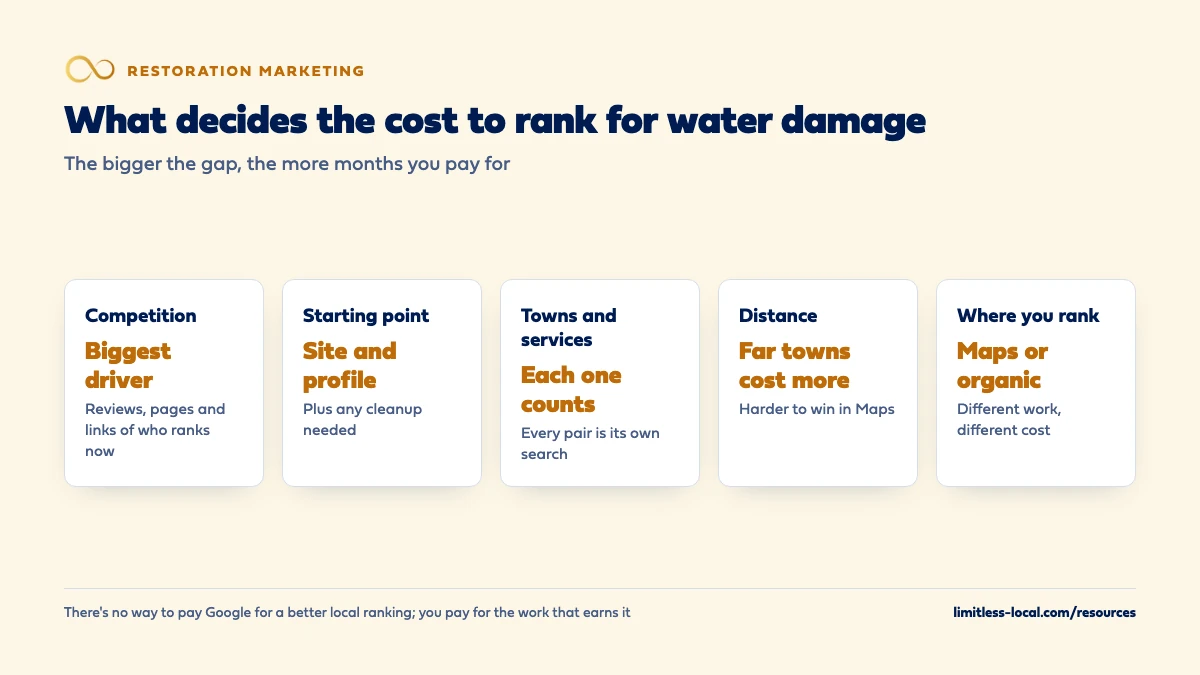
The cost to rank for local water damage searches is set by how much work your market demands and how many months it takes, not by a fixed price, because there’s no way to pay Google for a better local ranking. The biggest drivers are how strong the companies already ranking in your area are, where your website and Google profile start, how many towns and services you want to rank for, how far those towns are from your address, and whether you’re after the Maps results, the organic results or both. A company going after one town near its shop with a solid site pays far less in total than one chasing several services across a metro from a new website.
When we price restoration SEO, we size it the same way: services, towns, locations and how strong the competition is. Local SEO and Google Business Profile work start with Essentials at $3,500 a month for one location; Growth at $4,500 a month covers SEO for up to two locations, and Scale prices unlimited multi-location SEO to the job. The work covers the three places you need to show up: the regular Google results, the Maps 3-pack and AI answers. We don’t guarantee rankings; nobody honestly can, because platforms change how they work. See our local SEO work, how it fits restoration companies, the restoration marketing guide, or more restoration marketing questions.
Is there a set price to rank for water damage searches?
No. Google’s own page of tips to improve your local ranking says there’s no way to request or pay for a better local ranking. What you pay for is the work that earns it: pages, profile work, reviews, links and fixes. How much of that work your market needs, and how long it takes, is what sets your cost.
That’s why two restoration companies can get very different quotes for what sounds like the same goal. “Rank for water damage” in a small town where three companies compete is a different job from “rank for water damage” across a big metro full of established companies and national networks.
Be wary of anyone who prices a specific position. Google’s page on hiring an SEO says no one can guarantee a #1 ranking on Google. A fair quote prices the work and explains why that amount of work fits your market.
How much does local competition change the cost?
More than anything else. The work you need is roughly the gap between where you are and where the companies already ranking are. To size that gap, search your main terms from inside your service area, on a phone, and look at who shows up:
- In Maps: how many reviews the top three have, how recent they are, and how complete their profiles look.
- In the organic results: whether the top spots are local companies with strong service pages, national networks, or directories.
- On their sites: whether they have separate pages for water, sewage, mold and fire, with real photos and real detail.
If the top Maps spots have a few dozen reviews and thin websites, the gap is small and the cost is lower. If they have hundreds of reviews, years of content and strong local links, you’re paying for a longer climb. How competitive a local restoration market is walks through sizing it up in more detail.
Does my starting point change the cost?
Yes, and it’s the part you can see before you spend anything. Things that make ranking cheaper:
- An older website with real service pages, even if they need work.
- A verified Google profile with the right category and a steady stream of reviews.
- Your business name, address and phone the same everywhere they’re listed.
- Some existing links from local organizations, partners or press.
Things that make it more expensive:
- A brand-new domain with no history.
- A slow site, broken pages or a site that’s hard to edit.
- Duplicate Google profiles, old addresses or mismatched phone numbers across directories.
- Leftover spammy links or near-copy city pages from a past SEO effort, which have to be cleaned up first.
Cleanup work costs money but doesn’t feel like progress, so ask any quote to separate one-time fixes from monthly work.
How many towns and services am I paying to rank for?
Each combination of service and town is its own search. “Water damage” in your home town is one target. Water, sewage, mold and fire across a dozen towns is dozens of targets, and each one needs a page or a section that genuinely answers it.
This is where cheap shortcuts get expensive. Google’s spam policies list doorway abuse, which includes having pages targeted at specific regions or cities that funnel users to one page, and creating substantially similar pages. A set of near-copy city pages with the town name swapped is cheap to make and can hold a site back. Real town pages, with the neighborhoods you work in, local job photos and what’s different about the housing there, cost more to write and are the ones worth paying for.
The cheapest way to start is usually narrow: your main service in the towns closest to you, then add services and towns as those start to rank. How a restoration company should build city pages that rank covers what goes on them.
Curious what your marketing is actually booking?
Get a free visibility audit — no obligation, no sales pitch.
How does distance from my address change the cost?
For the Maps results, distance is one of the main factors, along with relevance and popularity. Distance is how far your business is from the person searching. You can’t change it, so it shapes what each town costs to win.
- Towns close to your shop: the cheapest to win in Maps. A strong profile and steady reviews do much of the work.
- Towns further out: much harder to win in Maps, even with a great profile, because closer companies have the edge. Organic pages carry more of the load there, and they take more content and links.
- Towns across a metro: often the most expensive, because you’re competing against companies based in each of them.
If the towns you most want are far from your address, factor that into what you expect to pay and how long it takes. Never list a fake address to get closer; it puts your profile at risk.
Am I paying to rank in Maps or in the organic results?
They’re different spots, earned by different work, so they cost different amounts:
- Maps: mostly your Google profile, your reviews and your distance from the searcher. Lower content cost, steady effort on reviews.
- Organic results: mostly your website’s pages and the links pointing to it. Higher content and link cost.
Most restoration companies need both, because emergency callers tap whatever is near the top. Before you pay to chase a search, check how often people actually make it. Keyword Planner shows average monthly searches for a keyword in the location you choose, and the Keyword Planner forecasts help page notes that these numbers are rounded and that searches swing with seasons and events. A town too small to show many searches may not be worth paying a premium to win in the organic results, while its Maps results still matter.
What does the content cost, and why does cheap content cost more?
Content is often the largest single cost in ranking for water damage, because each service and town needs a page that genuinely helps a homeowner in trouble. Google’s guide to helpful, reliable, people-first content asks whether content clearly demonstrates first-hand expertise and a depth of knowledge, and whether readers leave having learned enough to reach their goal.
For a restoration company, first-hand expertise means things only you can supply: photos from your jobs, how your crews handle the first hours, what you see in local homes, how you document damage for insurance. That’s why good content costs more than generic writing, and why it also costs some of your time. Pages written by someone who’s never been on a water job tend to read like every other site, and they compete like it.
When you compare quotes, ask how many pages a month you’ll get, who writes them, and how they’ll get your photos and knowledge into them. How to rank in Google for water damage restoration in your city covers what a strong water damage page includes.

What do links and reviews cost?
Links from other websites are part of how Google judges how well-known you are. Good local links come from real relationships: plumbers and property managers you work with, local trade and business associations, community sponsorships, and local news when you help after a storm. They take time to earn, which is what you’re paying for.
The cheap version is a trap. Buying links for ranking purposes, including exchanging money, goods or services for links, is link spam. A bargain link package can leave you with links that have to be cleaned up later.
Reviews cost little money and a lot of habit. More reviews and positive ratings can help your local ranking, and they help homeowners choose you once they see you. The cost is building the ask into every finished job and answering reviews as they come in. A company that already does this has a head start that would otherwise take months to build.
How does time turn into cost?
Your total cost to rank is roughly the monthly cost times the number of months it takes, plus your own time. That’s why the factors above matter: each one adds months, not just effort.
SEO typically takes 3-6 months to show meaningful organic growth. In a light market with a good starting point, that may be enough to reach your main goals. In a crowded metro, starting from scratch, with many towns and services, the climb to the most competitive water damage searches runs well beyond that. A realistic 3, 6 and 12 month restoration SEO timeline lays out what to expect at each stage.
Don’t forget the cost of the wait. Most restoration companies pay for ads while SEO builds, so a longer climb also means more months of buying calls one click at a time. That’s a reason to start SEO sooner, not a reason to skip it.
How do I estimate my own cost to rank?
You can get close before you talk to anyone:
- List your targets: the services you want and the towns you want them in, starting with the closest.
- Check the competition for your top few targets: reviews in Maps, pages and strength in the organic results.
- Score your starting point: site, profile, reviews, listings and any cleanup needed.
- Decide where you need to show up: Maps, organic or both for each target.
- Ask for a written monthly work list from anyone quoting, matched to those targets, with one-time and monthly work separated.
A quote that can’t explain how its work list closes your gap is pricing a guess. Whether paying for SEO is worth it for a restoration company helps you weigh the number once you have it.
Talk it through with someone who runs this every day
A 15-minute growth call: your market, your numbers, and what a realistic budget looks like. No pressure.
What's different about ranking costs for water damage searches
Water damage is the crowded one. It’s usually the most valuable search in restoration, so it draws the most ads, Local Services Ads and national networks. Mold, fire and sewage searches can be less crowded in some markets, so check each one instead of assuming.
Emergencies favor the top of the screen. Someone with water on the floor taps one of the first results, so a middling position is worth much less than for a slower-buying trade.
Service areas are wide. Restoration companies often drive far for a big job, which tempts owners to chase many towns at once and makes the cost jump.
Storms bring new competitors. After a big event, out-of-town companies sometimes advertise and set up pages in your area, which can make a market look more crowded for a while.
A worked example: same quote, very different total cost
These numbers are made up to show the math, not a benchmark or a forecast for your market. Two restoration companies sign up for the same monthly SEO package.
Company A wants water damage in its home town and two neighboring towns. It has a five-year-old site with decent pages and 80 Google reviews, and the top Maps competitor has 120. Its gap is small. Say it reaches its main goals in about six months.
Company B wants water, sewage, mold and fire across nine towns spread over a metro. It has a new website, 12 reviews, and competitors with 300+ reviews and years of content. Say it takes 18 months or more to reach its main goals.
Same monthly price, but B pays for three times as many months, plus more of its own time on content and reviews. That’s the real cost to rank, and it’s why the first question in any quote should be about your market, not the package.
Frequently asked questions
Can I pay Google to rank higher in Maps?
No. There’s no way to request or pay for a better local ranking. Ads, including Local Services Ads, are paid placements; a better Maps position comes from your profile, reviews, relevance and distance.
Is it cheaper to rank for "water damage" plus my town name?
Usually, yes. Town-specific searches have fewer companies competing for them, though they also have fewer searches. They’re the sensible place to start.
Why do SEO quotes for the same goal vary so much?
Because the scope behind them differs: pages per month, profile work, links, cleanup and reporting. Ask each one for a written monthly work list and compare those, not the price alone.
Do cheap SEO packages work for water damage searches?
Rarely. They tend to rely on generic content and bought links, which can hold a site back. In a competitive market, cheap usually means more months, not less money.
Will I keep paying once I rank for water damage?
Some ongoing work keeps you there: new reviews, fresh content, profile updates and new links, because competitors keep working too. It usually costs less than the climb.
Does ranking for mold or fire cost the same as water damage?
It depends on your market. Check who ranks for each service in your area; sometimes mold or fire is far less crowded and a cheaper first win.
Key takeaways
- There’s no set price to rank: you pay for work, and your market decides how much.
- Competition in your area is the biggest cost driver, so size it up first.
- Your starting point, and the number of towns and services, come next.
- Distance makes far-off towns harder to win in Maps and more expensive overall.
- Avoid cheap shortcuts like near-copy city pages and bought links.
- Total cost is the monthly cost times the months it takes, plus your time.
Ready to compare options?
Book a short growth call and we'll walk through the math for your service area, including when we're not the right fit.
More in this section
- How do I rank in Google for water damage restoration in my city?
- Should I spend more on paid ads vs local SEO for water damage leads?
- Does local SEO work faster for water damage than mold or fire?
- Which Google Ads keywords should a water damage company target?
- Do Angi or HomeAdvisor listings help restoration companies rank?
Sources
- Tips to improve your local ranking on Google — Google Business Profile Help
- Do You Need an SEO? Tips for Hiring an SEO — Google Search Central
- Spam policies for Google web search — Google Search Central
- Creating helpful, reliable, people-first content — Google Search Central
- About Keyword Planner forecasts — Google Ads Help