
When does $5000 a month in marketing make sense for a roofer?

- Is a roofing company ready to spend $5,000 a month on marketing?
- What does $5,000 a month actually cover for a roofing company?
- What signs say my roofing company is ready for $5,000 a month?
- How many signed roofs does $5,000 a month need to pay for?
- Can my crews and office handle what $5,000 a month brings in?
- How should a roofer split $5,000 a month?
- When is $5,000 a month too much for a roofing company?
- Should I jump straight to $5,000 or work up to it?
- What should $5,000 a month get me that a smaller budget can't?
- How long before I know whether $5,000 a month is working?
- What should I ask for in return for $5,000 a month?
- What's different about a $5,000 budget for roofers
- A worked example: does $5,000 a month pay off?
- Frequently asked questions
- Key takeaways
- More in this section
- Sources
The short version
- Step up to $5,000 only after a smaller budget has signed roofs at a cost you can live with.
- Work out how many signed roofs a month the $5,000 has to pay for, using gross profit, not contract price.
- Make sure crews, inspections and phones can handle more work before more leads arrive.
- Ask what share of the $5,000 is management and what share reaches Google.
For roofing owners thinking about a big step up in monthly marketing, and wondering whether their company is ready for it.
Get a free visibility audit · Book a growth call
Is a roofing company ready to spend $5,000 a month on marketing?
$5,000 a month in marketing makes sense for a roofer once a smaller budget has already proven it can sign roofs at a cost you’re happy with, and you have the crews, the sales time and the phone coverage to handle more work. It also helps to know your gross profit on a typical job, because that tells you how many signed roofs the $5,000 has to pay for each month. If you can’t yet say what a signed roof costs you, or calls already go unanswered, fix that before you spend more.
We size every budget the same way: what each signed roof costs, against what it earns you. Our marketing packages start at $3,500 a month for Essentials and $4,500 for Growth, with ad spend paid to Google directly on top, so a $5,000 month means something different depending on who runs it. The roofing marketing cost guide lays out what each channel tends to cost, our roofing marketing page shows how we work with roofers, and the rest of the roofing marketing questions library goes question by question.
What does $5,000 a month actually cover for a roofing company?
Start by pinning down what the number means, because owners use it two ways. For some, $5,000 is the whole marketing bill: management, content, tools and ad spend together. For others, it’s only the money that goes to Google, with any fees on top. Those are very different budgets.
If someone runs it for you, ask them to split the $5,000 into what they keep and what reaches Google. On our Essentials package, for example, management is $3,500 a month and ad spend is paid to Google separately, so a $5,000 all-in month leaves $1,500 for ads. On Growth, which adds Local Services Ads management, management is $4,500, which would leave just $500 for ads in the same total. Either can be a sensible plan, but neither is the same as $5,000 of pure ad spend.
If you run it yourself, all $5,000 can go to ads and tools. You trade the fee for your own hours, and for a roofer in storm season, those hours are expensive.
What signs say my roofing company is ready for $5,000 a month?
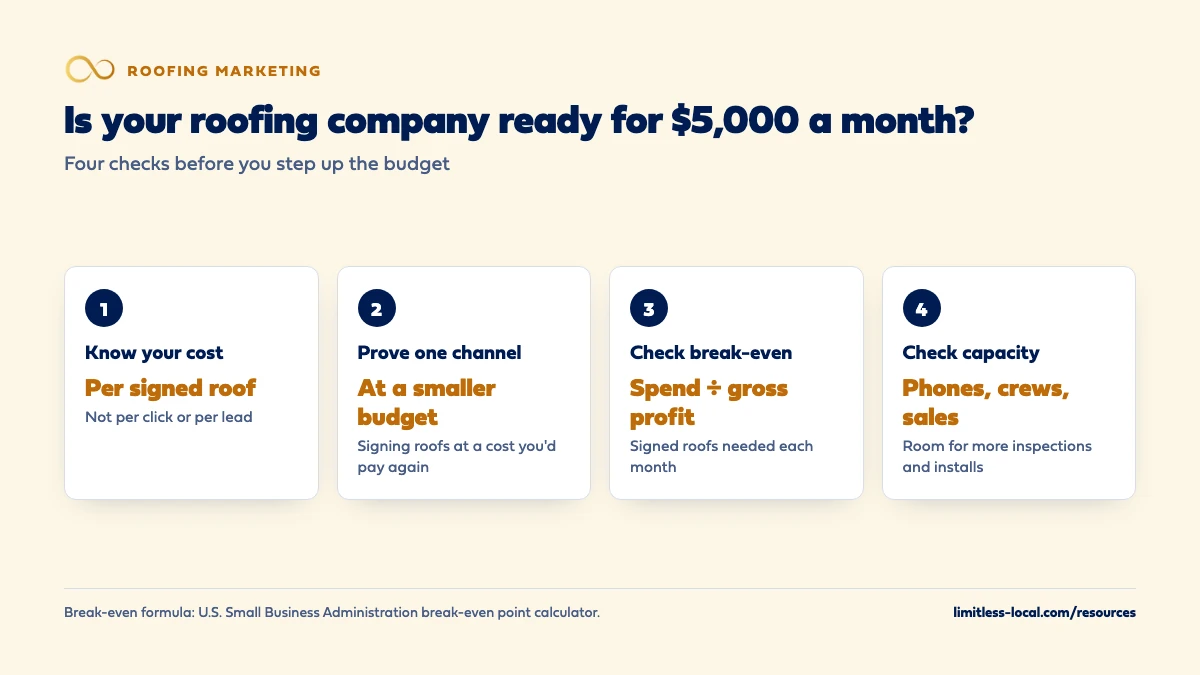
You’re usually ready when most of these are true:
- You know your cost per signed roof. Not cost per click or cost per lead. You can name, for last quarter, roughly what each signed job cost in marketing.
- A smaller budget is already working. At least one channel has signed roofs at a cost you’d happily pay again.
- The phone gets answered. Someone picks up during business hours, and missed calls get a callback within minutes.
- You have room on the schedule. Crews can take more jobs in the next few months, and someone can run the extra inspections.
- Your Google profile and reviews are in good shape. More money sends more homeowners to check you out. They should like what they find.
- You have a reason to grow. A new crew, a new town, a push into replacements or commercial work.
If two or three of those are missing, a bigger budget mostly buys you a bigger version of the same problem. If you can’t yet tell which leads turned into jobs, start with tracking which roofing leads turn into signed jobs.
How many signed roofs does $5,000 a month need to pay for?
Fewer than you might think, and that’s why roofing can carry a bigger budget than lower-ticket trades. The math is the same break-even idea behind the SBA’s break-even point calculator: fixed costs divided by what each sale leaves you after its own costs.
For marketing, that becomes: monthly marketing spend ÷ gross profit on an average signed job = signed jobs you need each month to stand still. Use gross profit, not the contract price. Materials, labor, dumpsters and permits all come out first.
If your typical replacement leaves a healthy gross profit, $5,000 a month might only need one or two signed roofs to pay for itself. If your mix is mostly small repairs, the same $5,000 might need a dozen, and that’s a much harder bar. Write your break-even number down before you raise the budget. Anything you sign above it is what the money earned you. What ROI to expect from a monthly marketing budget takes that math further.
Can my crews and office handle what $5,000 a month brings in?
This is the question most owners skip, and it’s the one that decides whether a bigger budget pays off. More leads don’t help if they sit for two days before anyone calls back, or if the next open inspection slot is three weeks out.
Before you step up, walk through a busy week on paper:
- Who answers the phone when the office is full and the owner is on a roof?
- How many inspections can your team run in a week without rushing them?
- Who writes and presents estimates, and how quickly?
- How many jobs can your crews actually install next month?
If any of those is already stretched, plan the fix alongside the budget, not after it. Keeping up with leads coming in fast covers how to handle a rush without dropping anyone.
Curious what your marketing is actually booking?
Get a free visibility audit — no obligation, no sales pitch.
How should a roofer split $5,000 a month?
There’s no single right split. It depends on what’s already working and which channels your towns respond to. A few ways it commonly goes:
- Ads-first. Most of the money goes to Google Ads search campaigns aimed at replacement and repair searches, with part of it on Local Services Ads. This suits a roofer who needs steady calls now.
- Ads plus SEO. Part of the money keeps ads running while the rest pays for ongoing work on your Google profile, website and town pages. SEO typically takes 3 to 6 months to show meaningful organic growth, so this is the mix for owners who plan to work the same towns for years.
- Managed program. A fee covers the work across channels, and the rest goes to Google. Ask how much of each month reaches the ads.
Whatever the mix, give each channel enough to learn something. Canada’s Business Development Bank (BDC), in small-business budgeting guidance updated in 2023, suggests planning for at least $1,000 a month for search advertising to be effective (What is the average marketing budget for a small business?). For Local Services Ads, Google recommends a budget of at least 10 leads a week on its Maximize leads setting (How bidding works for Local Services Ads). Splitting a roofing budget between Google Ads and LSAs walks through how to divide the ad money itself.
When is $5,000 a month too much for a roofing company?
When the money would arrive before the business is ready for it. Common signs:
- You can’t say what a signed roof cost you last quarter.
- Calls go to voicemail during the day, and callbacks wait until evening.
- You’ve never had one channel work, and the plan is to try four at once.
- You only work one small town, and there aren’t enough searches there to spend it well.
- Your crews are booked out for months already.
None of those means never. Each is a fix to make first. If your crews are the bottleneck, read whether to pause marketing when crews are booked out before you add a dollar.
Should I jump straight to $5,000 or work up to it?
Work up to it. Raise the budget in steps, give each step a few weeks, and check cost per signed roof before the next one. If cost per job holds steady as you spend more, keep going. If it climbs sharply, you’ve found the edge of what your towns and keywords can absorb.
Budget changes are low-risk to make in Google Ads. Google says updates to budgets take effect in the next auction and never trigger the “Learning” status on a bid strategy (About Smart Bidding learning). So you can step up gradually, without betting the whole $5,000 on day one.
A good signal that a campaign could use more: it shows as Limited by budget, and it’s signing roofs at a cost you like. Google also notes that slightly lowering bids in a budget-limited campaign could stretch the money to more clicks, as long as the bids stay competitive (Tips for optimizing your average daily budget). Trim waste before you add spend.

What should $5,000 a month get me that a smaller budget can't?
A bigger budget should buy reach and consistency, not just more of the same clicks. At this level, it’s fair to expect:
- More towns covered properly, instead of one or two at the edge of your budget.
- More than one channel running at full strength, such as search ads and Local Services Ads together, or ads plus steady SEO work.
- Work aimed at the jobs you want, like separate campaigns or pages for replacements, repairs, metal or commercial roofs.
- Tracking that ties leads to signed jobs, so you can see which part of the $5,000 is earning its keep.
If a bigger budget just spreads the same campaign across a wider area with no better tracking, it isn’t buying you much.
How long before I know whether $5,000 a month is working?
It depends on where the money goes. Ads can generate leads within days of launch, so you’ll know quickly whether the phone rings more. Signed roofs take longer, because a roofing lead usually needs an inspection and an estimate first, and insurance jobs can stay open for weeks. SEO typically takes 3 to 6 months to show meaningful organic growth.
Set a review date before you start, and judge on signed jobs over a full quarter, not on the first few weeks of calls. We ask for three months and put it in our contract for the same reason, but if you want to leave, we won’t make you stay. Whether a smaller budget is enough covers the other end of the ladder, if you decide to start lower.
What should I ask for in return for $5,000 a month?
At this level you should see exactly where every dollar goes and what it produced. Ask for:
- Ad accounts in your company’s name, with your own login.
- A monthly report that shows leads, cost per lead and, ideally, signed jobs by source.
- Call recordings, so you can hear how leads are being handled.
- A plain-English reason for every change, and what it’s meant to do.
Every one of our packages includes reporting and attribution: monthly reports with a cost-per-lead breakdown, call tracking with recording and transcription, form and chat lead tracking, source tagging and a real-time dashboard. Whoever you hire, don’t settle for less detail than that at $5,000 a month.
Not sure which of these is costing you jobs?
A free visibility audit checks the Google profile, reviews, site and tracking, and shows what to fix first.
What's different about a $5,000 budget for roofers
Storms change the month. After hail or high wind, roofing searches can jump overnight. Google Ads can spend up to twice your average daily budget on a busy day, though over a month it won’t charge more than 30.4 times that daily average (About average daily budgets). A storm week can use up a big share of a $5,000 month early, so watch spend daily while storm work lasts.
High tickets, small samples. One more or one fewer signed replacement swings your cost per job a lot. Judge a bigger budget over a quarter, not a single month.
Replacements carry the margin. A bigger budget aimed at every roofing search can fill the calendar with small repairs. Point the money at the job types that make you money, and track which kind each lead became.
Insurance jobs run long. Estimates waiting on an adjuster can sit for weeks, so a month’s spend often shows up as signed jobs a month or two later.
A worked example: does $5,000 a month pay off?
These numbers are made up to show the math, not a benchmark for your market. Say the gross profit on your average signed roof is $4,000. Your break-even is $5,000 ÷ $4,000, or one and a quarter signed roofs a month.
Now say the $5,000 month brings 30 leads. Your team books 10 inspections from them, and 4 homeowners sign. Your cost per signed roof is $5,000 ÷ 4, or $1,250. Those 4 roofs leave $16,000 in gross profit, so after the $5,000, the month earned you about $11,000.
Change one input and the picture changes. If only 1 homeowner signs, you’re slightly under break-even. If your crews were already full, those 4 jobs may have pushed other work back, and the real gain is smaller. That’s why the readiness checks above matter as much as the math. A free visibility audit runs these numbers with your real close rate and towns.
Frequently asked questions
Does $5,000 a month include ad spend?
Only if you decide it does. Ad spend isn’t included in any of our packages; it’s paid directly to Google, and we recommend a budget after a quick audit. Whoever you hire, ask how much of the $5,000 reaches the ads.
Is $5,000 a month a lot for a roofing company?
It depends on revenue. A common small-business rule of thumb is that companies selling to consumers spend 5% to 10% of revenue on marketing. $5,000 a month is $60,000 a year, which lands in that range for a company doing roughly $600,000 to $1.2 million in sales. Treat that as a rough check, not a roofing benchmark.
Can a one-crew roofer justify $5,000 a month?
Sometimes, if replacements carry a good margin and the crew has room. But a single crew fills up fast, so check capacity first. A smaller, tighter budget in your best towns often fits a one-crew company better until a second crew is on the way.
Should I drop below $5,000 in winter?
Many roofers do. Searches usually slow in the off-season, and lowering a daily budget doesn’t reset Google Ads learning. How to change your roofing ad budget from storm season to winter covers the timing.
Will $5,000 a month get me to the top of Google Maps?
No budget can promise that. Google says local results are mainly based on relevance, distance and popularity (Tips to improve your local ranking on Google), and ads don’t buy organic Maps rankings. What the money can do is fund the profile, review and website work that helps over time, plus ads that show while that work builds.
Do I need a long contract to spend $5,000 a month?
No. Month-to-month means an agency has to earn the business every month. Whether a roofer should sign a 12-month marketing contract covers what to watch for in the paperwork.
Key takeaways
- $5,000 a month makes sense after a smaller budget has already signed roofs at a cost you’d happily pay again.
- Divide the monthly spend by gross profit per job to see how many signed roofs it needs to break even.
- Check phones, inspections and crew capacity before more leads arrive.
- Ask what share of the $5,000 is management and what share reaches Google.
- Step up in stages and judge on signed jobs over a full quarter.
Want a second set of eyes on your setup?
We'll look at how you show up locally and where calls are leaking, then send you a plain-English breakdown.
More in this section
- Is $1,000 a month enough for roofing marketing?
- What ROI should a roofer expect from a monthly marketing budget?
- What share of revenue should a roofer put into marketing?
- What does a roofing marketer actually do each month?
- When is a roofing company ready for a full-time marketing hire?
Sources
- About average daily budgets — Google Ads Help
- About Smart Bidding learning — Google Ads Help
- Tips for optimizing your average daily budget — Google Ads Help
- How bidding works for Local Services Ads — Google Local Services Help
- Tips to improve your local ranking on Google — Google Business Profile Help
- What is the average marketing budget for a small business? — BDC (Business Development Bank of Canada)
- Break-even point calculator — U.S. Small Business Administration