
Which marketing tasks should a pool builder do in-house?
- Which pool company marketing tasks can I handle myself, and which need a specialist?
- Which pool marketing tasks belong in-house?
- Why should project photos and videos stay in-house?
- Should I ask for reviews myself or let someone else do it?
- Who should answer new leads and run design consultations?
- Can I keep my Google Business Profile in-house?
- Which tasks are worth handing to a specialist?
- Should a pool builder run Google Ads in-house?
- What about the website and SEO content?
- Should social media stay in-house?
- Who should track which leads turn into signed contracts?
- How do I split the work so nothing falls through the cracks?
- How does the split change through the pool season?
- What's different about the in-house split for pool builders
- A worked example: one pool builder's split
- Frequently asked questions
- Key takeaways
- More in this section
- Sources
The short version
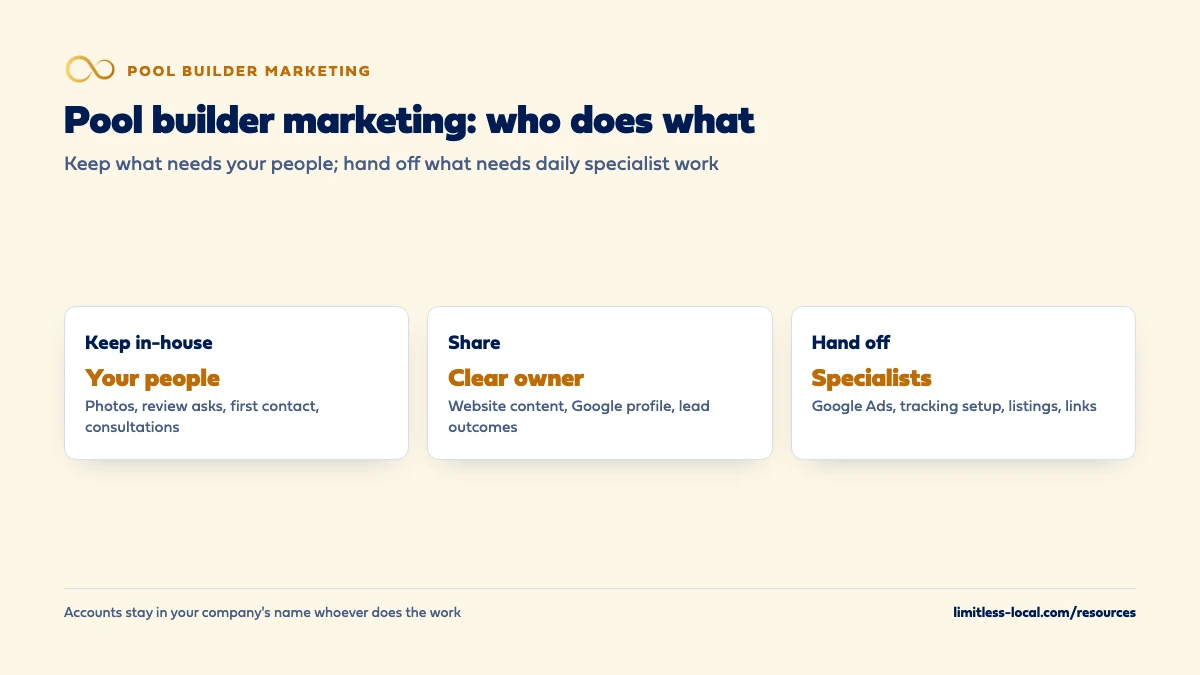
- Keep in-house: photos, review asks, first contact with leads, consultations and the lead outcome log.
- Hand off: Google Ads, tracking setup, technical website work, listing cleanup and link building.
- Share: website content, Google profile upkeep and lead tracking, with a clear owner for each part.
- Your company owns every account; outside help gets access, not ownership.
For pool builders who already know they’ll split the work and want a task-by-task answer on what to keep and what to hand off.
Get a free visibility audit · Book a growth call
Which pool company marketing tasks can I handle myself, and which need a specialist?
Keep the tasks that need your knowledge, your customers or your job sites: project photos, the review ask at handover, answering new leads, design consultations and recording which leads signed. Hand off the tasks that need daily attention or technical setup, such as Google Ads management, call and form tracking, technical website work, listing cleanup and link building. Whoever does each task, every account should stay in your company’s name.
That’s also how our packages split the work. We take the parts that need daily attention and technical setup, including Google Ads management, call, web and form tracking, listing cleanup, link building, content and monthly reporting, and you keep the parts only your company can do: the photos, the handover, the phone and the consultation. We’ve been on the builder’s side of this split, too: we were an equity partner in a pool construction company, where we built the lead-generation engine and ran sales and marketing. The packages page shows what each tier covers, our pool builder marketing page shows how we work with pool companies, and the pool builder marketing questions library goes question by question.
Which pool marketing tasks belong in-house?
Keep the work that only your company can do. You’re the one on the job site every week, you know which homeowners loved their build, and you’re the one at the kitchen table for the design consultation. Nobody outside your company can take those photos, make the review ask feel personal or close the sale.
Hand off the work that needs daily attention, specialist tools or technical setup: running Google Ads, wiring up call and form tracking, technical website fixes and building links. Those reward someone who does them every day and they’re where a mistake quietly costs money for months.
Here’s a quick test for any task. Does it need your knowledge, your customers or your job sites? Keep it. Does it need hours at a screen and know-how you’d have to learn from scratch? That’s where outside help usually earns its fee.
Why should project photos and videos stay in-house?
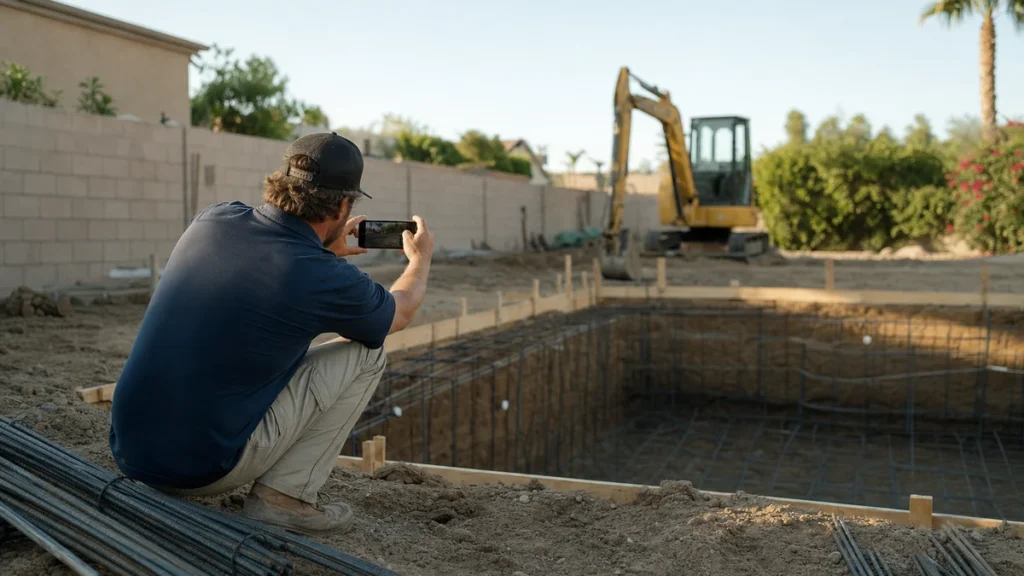
Because your crews are the only people standing in the backyard on dig day, steel day, shotcrete day and the day the water goes in. No agency can send a photographer to every stage of every build, and stock photos of somebody else’s pool won’t sell yours.
Make it part of the job, not a marketing chore. Ask each project lead to grab a few wide shots at every stage and a short clip at startup, from the same corner of the yard each time so the before-and-after lines up. Get the homeowner’s okay before you post anything that shows their house. Drop everything into one shared folder named by job, and whoever handles your website, Google profile and social posts can pull from it.
How a pool builder should use project photos and videos covers what to shoot and where it goes.
Should I ask for reviews myself or let someone else do it?
Make the ask yourself, or have whoever ran the build do it, at handover, while the homeowner is standing next to a finished pool. A text from a stranger weeks later doesn’t land the same way. Google lets you send customers a review link or have them scan a QR code, so keep a card with yours in every truck.
The follow-up is where help fits. A reminder a few days after handover, an ask to customers from past seasons and a reply to every review can all run on a schedule, whether that’s your office manager, your CRM or an agency. Keep it clean: Google’s tips to get more reviews say that offering incentives, like free or discounted goods or services, in exchange for reviews is strictly prohibited.
The full playbook, including what to say, is in how to get more Google reviews for your pool company.
Who should answer new leads and run design consultations?
Your team, every time. This is the one job that should never leave the building. The person who answers a new inquiry gives the homeowner their first taste of what building with you will feel like, and the design consultation is where the contract is won or lost.
Outside help can bring leads in, route them to the right phone or inbox and flag one that hasn’t been called back. It can’t explain your warranty, walk the yard or know whether your schedule has room for a spring start. So decide who owns first contact, how fast they reply, and what they ask to qualify a homeowner before booking a consultation.
Speed matters more than most owners expect. How fast a pool builder should respond to a new lead covers what to aim for.
Can I keep my Google Business Profile in-house?
The day-to-day, yes. Changing hours when your season shifts, adding photos from the shared folder, posting a finished project and replying to reviews are all quick jobs you can do from your phone. Google’s local ranking tips say businesses with complete and accurate info are more likely to show up in local search results. Keeping it that way is a habit, not a specialist skill.
The setup and cleanup are worth handing off if they’re messy: picking categories and services, fixing duplicate profiles, or untangling a profile an old agency created under its own login.
Whoever does it, stay in charge. Google’s page on Business Profile owners and managers says a profile can have several owners but only one primary owner, and that managers have mostly the same access as owners, except they can’t add or remove users or remove the profile. Make yourself the primary owner and give outside help manager access.
Curious what your marketing is actually booking?
Get a free visibility audit — no obligation, no sales pitch.
Which tasks are worth handing to a specialist?
- Google Ads management. Bids, search terms, negative keywords and budgets need checking every week, and spring is when you have the least time to do it.
- Tracking setup. Call tracking, form tracking and sending signed contracts back to your ad accounts are technical jobs that are easy to get wrong.
- Technical website work. Speed, mobile layout, page structure and fixing whatever breaks.
- Listing cleanup. Finding and fixing old addresses, old numbers and duplicate listings across directories.
- Link building. Earning mentions and links from real local websites takes steady outreach most owners never get around to.
- Reporting. Pulling cost per lead and cost per signed contract out of several logins every month.
These have something in common: they reward someone who does them every day, and doing them badly is invisible until you look. An ad account that’s been spending on the wrong searches all season doesn’t send you a warning.
Should a pool builder run Google Ads in-house?
Only if someone on your team has real time for it every week, including in April and May. Ads are the task where neglect costs money fastest, because the budget keeps spending whether anyone checks the search terms or not. If you have an office manager who enjoys the work and will learn it properly, a small, tightly focused campaign run in-house can work. Most owners hand it off.
Either way, the account belongs to your company. Google’s page on access levels in Google Ads lists Admin as the level that can give account access and change other users’ access levels, while Standard access can edit campaigns. Keep Admin for yourself, and give an agency or freelancer the access they need to do the work. Who should own your ad accounts and website walks through every login.
What about the website and SEO content?
Split it. You hold the knowledge that makes pool content worth reading: how your build process runs, what each pool type is like to own, which towns you build in, what your local permit office and HOAs tend to ask for, and the questions homeowners ask at every consultation. A writer can turn that into pages, but nobody can make it up.
Google’s Do you need an SEO? says that if you run a small local business, you can probably do much of the work yourself, and it points owners to its SEO starter guide. The parts owners usually hand off are the technical side, building the pages and keeping a steady publishing schedule.
A good middle ground: record yourself answering homeowner questions on the drive home from consultations, and let someone else turn those recordings into pages.

Should social media stay in-house?
The organic posting, mostly yes. Social posts for a pool company come from the same photos and clips your crews already shoot, and posts that look like they came from your job site are more believable than polished graphics. Once the photo habit is in place, posting a few times a week from your phone is very doable.
Paid social is different. Running Meta ads, building audiences and showing ads to people who already visited your website is closer to Google Ads work, and it’s usually worth handing off along with it.
Who should track which leads turn into signed contracts?
This one is shared, and the split matters. The technical side, call tracking numbers, form tracking and connecting everything to your ad accounts, is a specialist setup job. But only your team knows which homeowner held a consultation, which one went quiet and which one signed in February after first calling in August. That has to be marked in your CRM or lead log by whoever runs sales.
If nobody on your side records the outcome, no agency can tell you what a signed contract cost, and you’re left judging your marketing on calls and clicks. Pick one place where every lead’s source and outcome live, and make updating it part of the sales routine, not an extra job. Tracking which marketing produces signed pool contracts covers the setup.
How do I split the work so nothing falls through the cracks?
Write it down. List every recurring marketing task, put one name next to each one, whether that’s you, someone on your team or an outside company, and note how often it happens. The tasks that slip are almost always the ones two people each assumed the other was doing, like the review ask after handover or the reply to a new review.
Then hold to three rules:
- Your company owns every account: Google Business Profile, Google Ads, Search Console, analytics, the website and the domain.
- Outside help gets access, not ownership.
- Check the list once a month and ask whether each task actually happened.
If you want to know how much time your share will take, how many hours a week in-house pool marketing takes breaks it down task by task.
How does the split change through the pool season?
In spring, protect the in-house tasks only you can do and let everything else run without you: answer leads fast, run consultations, keep the photo habit and ask for a review at every handover. That’s when owners drop marketing first, and it’s when outside help that runs on its own schedule is worth the most.
Winter is when in-house work catches up. Sort the season’s photos into the shared folder, record answers to the questions homeowners asked all year, ask past customers who never left a review, and look back at which sources produced signed contracts.
Want to see where your company stands?
A free visibility audit shows where you show up on Google, Maps and AI answers, and what it's costing you in calls.
What's different about the in-house split for pool builders
The sale is the consultation. A plumbing call can turn into a job on the same visit. A pool lead turns into a design consultation, a proposal, a financing conversation and often weeks of back-and-forth before a contract signs. That whole stretch is sales, and it stays in-house.
Builds run for weeks. That gives you more photo moments than almost any trade: layout, dig, steel, plumbing, shotcrete, tile, coping, plaster and startup. Only your crews see them.
Follow-up runs long. Plenty of homeowners are planning a pool for next season. Keeping in touch over months can be automated, but the messages should sound like your company, because they’re choosing who’ll be in their backyard for weeks.
The calendar is seasonal. Your in-house hours shrink exactly when demand peaks, so build the split around spring, not around an average week.
A worked example: one pool builder's split
This example is made up to show how a split can look, not a template for your company. Say a builder runs two crews and the owner sells every pool. In-house, they keep about four hours a week:
- Photos at each build stage, shot by the crew leads: about an hour across both jobs.
- Review asks at handover, plus replies: about half an hour.
- Google profile updates and a project post: about half an hour.
- Marking each lead’s outcome in the CRM: about two hours, done as part of sales.
Everything else, Google Ads, tracking setup, listing cleanup, link building, content and reporting, goes to outside help. If that help is our Essentials package, it’s $3,500 a month and includes Google Ads management up to $2,500 a month in ad spend, which is paid to Google separately. Over a year that’s $42,000 before ad spend. If the builder’s gross profit on an average pool is $20,000, then $42,000 divided by $20,000 is 2.1, so the outside help has to sign a little more than two extra pools a year to cover its fee. Add the ad spend to the $42,000 before you divide.
Frequently asked questions
Can my office manager handle our pool company's marketing?
For the in-house list, often yes: review follow-ups, Google profile updates, sorting photos and keeping the lead log current. Google Ads and tracking setup are a bigger ask unless they have real weekly time and want to learn them properly.
Should I let an agency post on my Google Business Profile?
Yes, as a manager on a profile you own. You stay the primary owner, so you keep control of who has access.
Is it worth learning Google Ads basics even if I hand it off?
Yes. Knowing how to read the search terms and the cost per lead in your own account lets you check the work and ask better questions.
What should a pool builder never outsource?
First contact with new leads, the design consultation, the review ask at handover, and recording which leads signed. Account ownership never leaves your company either.
Can I bring a task back in-house later?
Yes, if the accounts are in your name and whoever did the work hands over notes on how it’s set up. Ask for that documentation before you need it.
Do I need to hire a marketing employee to cover the in-house part?
Usually not. Most of the in-house list fits into jobs your team already does: crew leads take photos, the person who runs handover asks for the review, and whoever sells keeps the lead log.
Key takeaways
- Keep the tasks that need your knowledge, customers or job sites: photos, review asks, first contact, consultations and lead outcomes.
- Hand off tasks that need daily attention or technical setup: Google Ads, tracking, technical website work, listing cleanup and link building.
- Website content works best split: you supply the knowledge, someone else builds and publishes the pages.
- Give every task one named owner and check the list monthly.
- Your company owns every account; outside help gets access, not ownership.
Not sure what's working right now?
Start with a free visibility audit: rankings, Google profile, reviews and tracking, checked against your service area.
More in this section
- Should a pool builder hire an in-house marketer or an agency?
- How should a pool builder prepare marketing before peak season?
- How do I grow a pool construction business with marketing?
- How many hours a week does in-house pool builder marketing take?
- How should a pool builder split its marketing budget?
Sources
- Do you need an SEO? — Google Search Central
- Tips to get more reviews — Google Business Profile Help
- Tips to improve your local ranking on Google — Google Business Profile Help
- Manage your Business Profile owners & managers — Google Business Profile Help
- About access levels in your Google Ads account — Google Ads Help