
Is $5,000 a month too much marketing for a growing electrical shop?

- Is $5,000 a month too much to spend on marketing for an electrical company that wants steady booked jobs?
- Is $5,000 a month a lot for an electrical company?
- How many booked jobs does $5,000 a month have to pay for?
- Is the $5,000 the whole marketing bill or just ad spend?
- What can $5,000 a month actually buy for an electrician?
- Can my crews handle the work $5,000 a month brings in?
- When is $5,000 a month the right budget?
- When is $5,000 a month too much?
- When is $5,000 a month not enough?
- Should I jump straight to $5,000 or work up to it?
- How should $5,000 a month be split across channels?
- How long should I give $5,000 a month before judging it?
- What's different about a $5,000 budget for electricians
- A worked example: does $5,000 a month pay?
- Frequently asked questions
- Key takeaways
- More in this section
- Sources
The short version
- Break-even = $5,000 ÷ gross profit per booked job.
- At $500 profit a job, that's 10 extra booked jobs a month.
- First decide whether $5,000 is the whole bill or the ad spend alone.
- Check crew capacity before spend: calls you can't take are wasted money.
- Judge it on cost per booked job by channel, not clicks or leads.
For electrical contractors weighing a $5,000 monthly marketing budget, whether that’s the whole bill or the ad spend alone, and wanting to know if it will pay.
Get a free visibility audit · Book a growth call
Is $5,000 a month too much to spend on marketing for an electrical company that wants steady booked jobs?
Not if it books enough profitable jobs and your crews can take them. Divide $5,000 by the gross profit on an average booked job to find your break-even, so at $500 a job you need 10 extra booked jobs a month. It’s too much when the crews are already full, when you can’t see which calls turned into jobs, or when most of the $5,000 goes to fees instead of reaching homeowners. For a shop with room on the schedule and a mix of service calls and bigger installs, it’s a workable budget for two or three channels run properly.
If you want someone else to run it, our packages start with Essentials at $3,500 a month, which covers Google Ads management up to $2,500 a month in ad spend, plus Google Business Profile work, review generation and call tracking. Ad spend isn’t included and is paid directly to Google, so a $5,000 all-in budget with us would mean the $3,500 fee and $1,500 of ads. If you want Local Services Ads managed too, Growth is $4,500 a month. Our electrical contractor marketing page explains how we work with electrical shops, and the rest of the electrical marketing questions library goes question by question.
Is $5,000 a month a lot for an electrical company?
It depends on what you invoice. The SBA’s guide How to Get the Most From Your Marketing Budget says there’s no hard and fast answer to how big a marketing budget should be, that many businesses use a percentage of revenue as a guide, and that businesses selling to consumers generally need to budget more than ones selling to other businesses.
Run your own numbers. $5,000 a month is $60,000 a year. For a shop doing $800,000 in revenue, that’s 7.5%. For one doing $2,000,000, it’s 3%.
Treat the percentage as a gut check, not the decision. What percent of revenue an electrician should spend on marketing covers that method in depth. At $5,000, the better question is how many jobs the money has to book, and whether you can do them.
How many booked jobs does $5,000 a month have to pay for?
One line of math tells you:
Break-even jobs per month = $5,000 ÷ gross profit per booked job
Gross profit is the invoice minus materials and the labor to do the work. Pull it from recent jobs in ServiceTitan, Housecall Pro or Jobber, split by job type, because electrical work swings so widely:
- Mostly service calls. Troubleshooting, outlets and fixture swaps leave a few hundred dollars each, so break-even takes a lot of them.
- A real mix. At $500 of gross profit on an average booked job, you need 10 extra booked jobs a month to cover $5,000.
- Bigger installs. Panel upgrades, EV chargers and generators carry far more per job, so a handful of them can cover the month.
Count only the jobs this money brought in. Repeat customers, builder work and word-of-mouth referrals that would have called anyway don’t count toward break-even.
Is the $5,000 the whole marketing bill or just ad spend?
Owners mean two different things by “$5,000 a month,” and the answer changes with each:
- $5,000 all-in. Ad spend, management fees, website and tools together. Part of it pays someone to run the work, and only the rest reaches Google as ads.
- $5,000 in ad spend alone. Every dollar goes to Google or another platform, and management is on top, whether that’s your own time, a staff member or an outside team.
Both can work. But when someone quotes you $5,000, ask how much of it reaches homeowners as ads and how much is fees. If the answer is that most of it is fees and the ads get a small slice, you’re paying for activity more than for calls.
If you mean $5,000 in ad spend with management on top, the break-even math uses the total of both, not the ad spend alone.
What can $5,000 a month actually buy for an electrician?
Picture three ways the same money could go:
- All of it as Google search ads, run in-house. Google’s article on average daily budgets says your monthly spending limit is 30.4 times your average daily budget for most campaigns, so $5,000 works out to an average daily budget of about $164. That funds search ads for several job types across your core towns, as long as someone has the time to run them well.
- Management plus a smaller ad budget. Someone else runs ads, your Google Business Profile, reviews and tracking, and the rest goes to Google. Less reaches ads, but the ads are less likely to leak money on wrong searches.
- Mostly building work. Service pages, Google profile work, reviews and SEO, with little or no paid spend. It costs less per call over time but takes months to build.
What a click costs in your towns decides how far the ad portion goes. Keyword Planner shows estimates of the searches a keyword gets and the cost to target it, so check searches like “electrician near me,” “panel upgrade” and “EV charger installation” for your area before you settle on a split.
Can my crews handle the work $5,000 a month brings in?
This is the question owners skip. Ten extra booked jobs a month is two or three more a week on top of what you already do. If your techs are booked out a week or more, new calls turn into long waits, lost jobs and unhappy reviews, and you’ve paid full price for every one of them.
Before you commit, check three things:
- Open slots. How many more jobs a week can you schedule without overtime or pushing existing customers back?
- People. If the work needs another licensed electrician or an apprentice, are they hired, or still a plan?
- The office. Someone has to answer more calls, quote more panel upgrades and follow up on estimates that don’t book on the first visit.
If you’d need to hire first, grow the budget and the team together.
Curious what your marketing is actually booking?
Get a free visibility audit — no obligation, no sales pitch.
When is $5,000 a month the right budget?
It tends to fit when most of these are true:
- You can see results. Calls and forms are tracked by source, and you can tie them to booked jobs in your field software.
- A smaller budget already worked. You ran less, it booked jobs at a cost you were happy with, and it ran out of room.
- There’s room on the schedule, or a new hire is starting soon.
- Your job mix includes bigger tickets such as panels, EV chargers, generators or rewires, which carry the math faster than service calls alone.
A useful signal that the budget, not the setup, was holding you back: the campaign showed a Limited by budget status, which Google gives a campaign that’s underperforming because of a limited budget.
When is $5,000 a month too much?
- The crews are full. Fix capacity first: hire, raise prices or both.
- Nobody tracks booked jobs. If you can’t say what a booked job cost from each channel, cut back until you can.
- Calls go to voicemail. Paid calls that ring out while you’re in a crawlspace are paying for someone else’s job.
- You’re a one-truck shop. One electrician rarely has room for 10 extra jobs a month on top of existing work. A smaller, focused budget usually fits better.
- Budget isn’t the limit. Impression share is the share of eligible impressions your ads actually got. If it’s already high, there are few extra searches left for more budget to reach.
- Most of it is fees. If very little reaches the ads, you’re paying for reports, not calls.
- Cash flow can’t carry a slow start. Only commit what you can keep spending while it ramps up.
When is $5,000 a month not enough?
For some electrical companies, $5,000 is a middle budget, not a high one:
- A large, crowded metro where electrician clicks are expensive and dozens of shops bid on the same searches.
- Many job types at once, such as residential service, solar tie-ins, generators and commercial work, each needing its own ads and pages.
- Several towns or a second location, each needing its own Google profile, pages and budget.
- A hiring plan that adds trucks faster than the current budget can keep them busy.
The math stays the same, just bigger: work out the booked jobs each new truck needs and what each booked job costs. Whether $10,000 a month is too much for electrical marketing walks through the next step up.

Should I jump straight to $5,000 or work up to it?
Work up to it. Going from a small budget to $5,000 overnight makes it hard to tell what’s working, and it hits the phones and the schedule all at once.
A steadier path, using made-up steps: $3,000 a month, then $4,000, then $5,000, moving up only when the last step held its cost per booked job and the crews kept up. Give each step about a month of tracked results, longer if you’re adding SEO or a new channel.
If cost per booked job jumps at a step, stop there. That usually means you’ve bought most of the easy searches in your towns and the next dollars are going to pricier clicks, farther towns or job types that book less often. Whether $1,000 a month is enough ad spend for an electrician covers the smaller starting point.
How should $5,000 a month be split across channels?
Fund the channels that book work soonest, then the ones that build:
- Search ads for the jobs you want most, in the towns your trucks reach easily, each sent to a page about that job.
- Local Services Ads, if you’re verified and have a healthy set of reviews. With Local Services Ads you pay for valid leads rather than clicks, and each lead counts toward your budget. Google is also moving Local Services Ads into Google Ads as Performance Max campaigns with pay-per-lead goals, starting with select home service advertisers, including electrical, in August 2026.
- Your Google Business Profile and reviews, so the calls you get from Maps keep growing.
- Service pages and SEO for the job types you want more of. Slower to start, but it keeps paying when you pull back on ads.
- Tracking that ties it together, so every call and form is tagged by source and job type.
At $5,000 you can usually run two or three of these well. Trying to run all of them on the same money tends to leave each one too thin to judge.
How long should I give $5,000 a month before judging it?
Ads can generate leads within days of launch, so you’ll know quickly whether the phone rings. Whether it pays takes longer: the first weeks go to cutting wrong searches and checking tracking, and quoted work like panel upgrades and generators can take weeks to sell.
Judge the paid channels on two to three months of tracked booked jobs. Give SEO longer, since it typically takes 3-6 months to show meaningful organic growth.
Each month, track by channel and by job type: total cost, booked jobs, gross profit on those jobs and cost per booked job next to your break-even. A channel that books cheap service calls and one that books panel upgrades at a higher cost can both be good, and cost per lead alone would cut the wrong one. How to track which electrical marketing brings in real jobs shows the setup in your field software.
Not sure which of these is costing you jobs?
A free visibility audit checks the Google profile, reviews, site and tracking, and shows what to fix first.
What's different about a $5,000 budget for electricians
Job values swing more than in most trades. The same $5,000 can be covered by a few panel upgrades or need a long list of small service calls. Point the biggest share at the job types with the best gross profit.
Licensing and drive time set the map. Ads can reach any town, but spend only where your license, permits and drive time let you serve well. A budget spread across too many towns raises cost per booked job fast.
Emergency calls need coverage. If ads run on evenings and weekends, someone has to answer. Otherwise, schedule the ads around the hours you cover.
Builder and commercial work runs on relationships. Ads rarely win a general contractor’s trust. Keep that sales effort separate from the $5,000.
A worked example: does $5,000 a month pay?
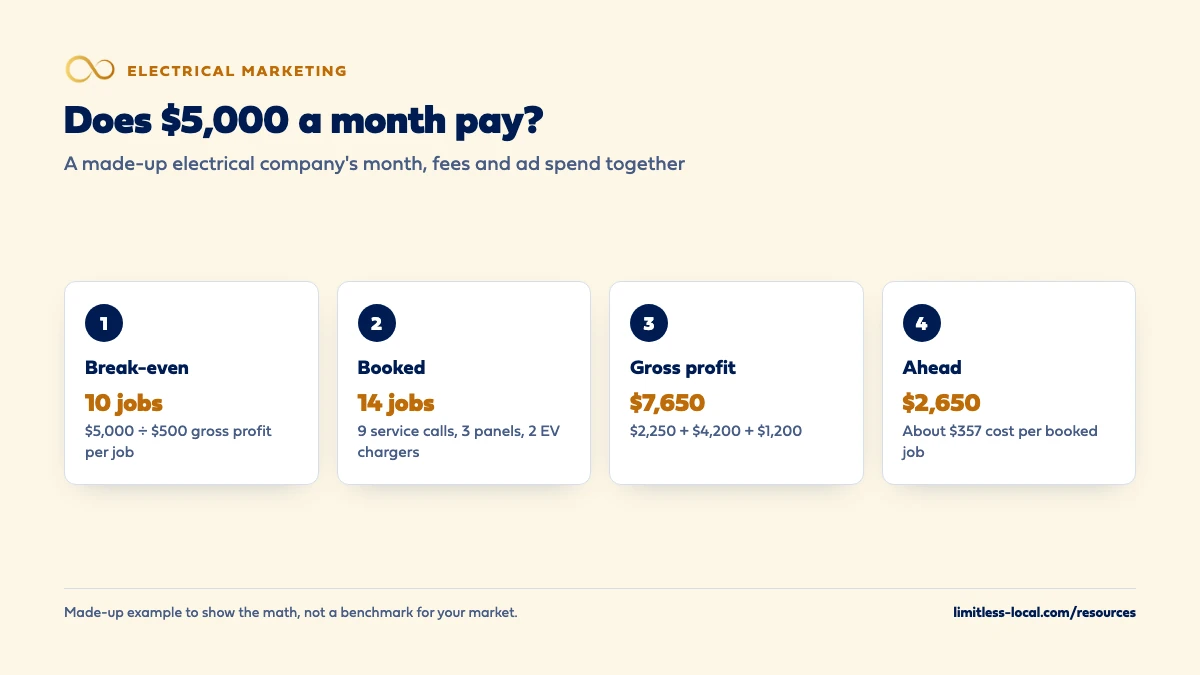
These numbers are made up to show the math, not a benchmark for your market. Say an electrical company spends $5,000 a month in total, fees and ad spend together, and its tracking shows the marketing booked 14 jobs in a month:
- 9 service calls at $250 gross profit each: $2,250.
- 3 panel upgrades at $1,400 gross profit each: $4,200.
- 2 EV charger installs at $600 gross profit each: $1,200.
Total gross profit is $7,650, so the company is $2,650 ahead for the month. Cost per booked job is $5,000 divided by 14, or about $357, and the average job left about $546, which clears the $500 break-even line.
Now take out the three panel upgrades. The month drops to $3,450 of gross profit and the company is behind. That’s why the job mix matters as much as the budget, and why the campaigns for bigger installs deserve their own tracking.
Frequently asked questions
Does $5,000 a month include ad spend?
On this page it means the total, fees and ad spend together, unless stated otherwise. When anyone quotes you a monthly price, ask whether ad spend is on top, because it’s usually paid to Google separately.
Can a one-truck electrician make $5,000 a month work?
Rarely. One truck usually can’t fit the 10 or so extra jobs a month needed to cover it at $500 of gross profit a job. Start smaller and grow the budget as you add people.
Should I lower my budget in slow months?
You can lower search ad spend when demand drops, but keep Google profile, review and SEO work going, since stopping and restarting them throws away months of building.
What if $5,000 a month isn't paying after three months?
Look at where the leak is before cutting everything: wrong searches, missed calls, slow quotes or the wrong job mix. If the cost per booked job is still above break-even after those fixes, scale back to the channel that does pay.
Is $5,000 a month enough ad spend to book steady jobs?
In most mid-sized markets it’s enough to run search ads for several job types in your core towns. In a large metro, check click prices first; it may cover only one or two job types well.
Key takeaways
- Break-even on $5,000 a month is $5,000 divided by gross profit per booked job; at $500 a job, that’s 10 extra jobs.
- Decide whether $5,000 is the whole bill or ad spend alone, and ask how much reaches the ads.
- Check crew and office capacity before spending, or new calls turn into lost jobs.
- Work up to $5,000 in steps and stop where cost per booked job jumps.
- Run two or three channels properly and track cost per booked job by channel and job type.
Want a second set of eyes on your setup?
We'll look at how you show up locally and where calls are leaking, then send you a plain-English breakdown.
More in this section
- Is $500 a month too much for electrician marketing?
- Is spending 10k a month too much for electrical marketing?
- Is $1500 a month too much for electrician marketing past referrals?
- Is $1,000 a month enough ad spend for an electrician?
- How much should an electrical contractor spend on marketing?
Sources
- How to Get the Most From Your Marketing Budget — U.S. Small Business Administration
- About average daily budgets — Google Ads Help
- Use Keyword Planner — Google Ads Help
- Fix “Limited by budget” status — Google Ads Help
- About impression share — Google Ads Help
- How leads work — Google Local Services Help
- Local Services Ads transition to Performance Max campaigns with pay-per-lead goals — Google Ads Help