
What should an electrician fix first after losing the map pack spot?
- I lost my electrical company's map pack spot. Where do I start?
- What's the right order to work through after losing the map pack?
- How do I know I actually lost the spot?
- Is my profile suspended or disabled?
- Did something change on my profile without me noticing?
- Did I change my category or business details recently?
- Did my reviews change?
- Did a competitor just get stronger?
- Could my website or listings be the problem?
- What shouldn't I do to get the spot back?
- How do I get it back with one truck and a tight budget?
- What changes for a 10-truck electrical company?
- How long does it take to get the map pack spot back?
- What's different when an electrician loses the map pack
- A worked example: what a lost spot costs per month
- Frequently asked questions
- Key takeaways
- More in this section
- Sources
The short version
- Confirm the drop from the right towns before changing anything.
- Check for a suspension, then for recent edits by anyone, including Google.
- Check your reviews for removals or a restriction.
- Then compare competitors and your website; never stuff your name or open a second profile.
For electrical contractors who used to show up in Google’s map pack and don’t anymore, and need to find the cause before changing anything.
Get a free visibility audit · Book a growth call
I lost my electrical company's map pack spot. Where do I start?
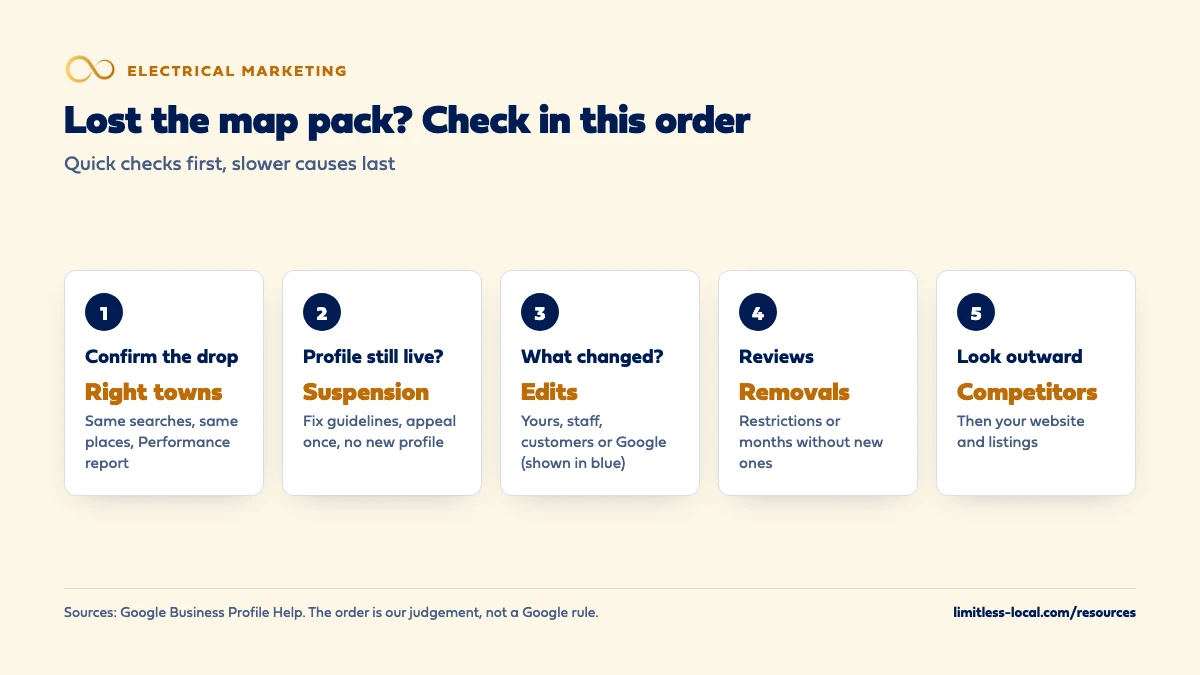
First confirm the drop from the towns and searches that matter, because map results change with where the searcher is. Then check, in this order, whether your Business Profile was suspended, whether someone (you, a staff member, a customer or Google) changed your category, hours, phone or address, and whether you lost reviews or got a review restriction. Only after those quick checks should you look outward at a stronger competitor or your website, and avoid fixes that break Google’s rules, like adding keywords to your name or making a second profile.
Finding the cause before changing things is how we’d approach a lost spot for an electrical contractor: the quick checks first, then the slower review and link work, with paid search covering the gap if the phone has gone quiet. Map pack recovery is part of our local SEO for electrical contractor marketing, and the rest of the electrical marketing questions library goes question by question.
What's the right order to work through after losing the map pack?
In our judgement, the order is: confirm the drop, check the profile is still live, check what changed on it, check reviews, then look outward at competitors and your website. The first three take minutes and catch the problems that can knock you out overnight. The last two take longer and usually explain a slow slide rather than a sudden one.
- Confirm you really lost it, from the towns and searches that matter.
- Check whether the profile is suspended, disabled or restricted.
- Check for recent edits: yours, a staff member’s, Google’s or a customer’s.
- Check your reviews for removals, a restriction or a run of bad ones.
- Compare yourself with whoever took the spot.
- Check your website and your business details elsewhere online.
Work down the list and stop when you find the cause. Changing five things at once makes it impossible to tell which one helped.
How do I know I actually lost the spot?
Distance is measured from the person searching, so a phone check from a different street can make it look like you’ve dropped when you haven’t. Google says local results are mainly based on relevance, distance and popularity, and that if someone doesn’t share their location, Google uses what it knows about it. Source: Tips to improve your local ranking on Google.
So check the way you’d check a breaker before replacing a panel: the same searches (“electrician”, “electrician near me”, your main jobs), from the same towns, compared with what you saw before. Then look at your Business Profile Performance report. Calls counts taps on the call button on your profile, and Searches shows the terms people used to find you. If calls and searches held steady, you may have moved in one spot rather than lost the market. Note that Performance data includes activity from both organic results and Google Ads, and the searches metric updates at the start of each month. Source: Understand your Business Profile performance & insights.
Is my profile suspended or disabled?
If your profile vanished from Maps entirely, check this before anything else. Google says it may suspend or disable Business Profiles that don’t follow its guidelines, and you can appeal through its appeals tool, which shows the date of the decision, the reason, a link to the policy and whether it can be appealed.
Three rules from Google’s page matter here:
- Fix the guideline problem first. Make sure the profile follows every guideline before you appeal.
- Appeals can only be submitted once, so send your evidence the first time: business registration, a business license, tax certificates or utility bills, with a name and address that match the profile. Your state electrical license is the kind of document that can help, if the name matches.
- Don’t create a new profile for the same business.
Source: Fix suspended or disabled profiles.
Did something change on my profile without me noticing?
This is the most common sudden cause, in our experience, and the easiest to miss. Google gathers information from different sources, like user reports and licensed content, and may update your profile if those sources say your information is wrong. In the profile editor, information Google changed shows in blue, and a notification appears at the top of the page. Customers can suggest edits too: when one needs your review, you have 4 days to accept or reject it, after which Google may publish it if other public information, such as your website, supports it. Google can also apply some user edits without asking you first, in cases where it says the edits are needed to meet its policy guidelines. Source: Understand Google updates on your Business Profile.
Check every field: name, primary category, hours, phone number, service area, website link. An hours change that says you’re closed on Saturdays, or a phone number swapped for an old one, can cost calls the same day. Then ask whoever else has access, an office manager or a former vendor, whether they changed anything.
Did I change my category or business details recently?
Your own edits count too. Google says the categories you select affect your local ranking, and that adding or editing a category might trigger a request to verify your business again. Source: Manage your business category.
If you switched your primary category from Electrician to something narrower or broader in the weeks before the drop, that’s a strong suspect. The same goes for moving the address, changing the business name or redrawing the service area. In our judgement, if the change wasn’t a correction, put it back, then wait a few weeks before touching anything else. Bouncing a category back and forth only makes the picture harder to read. Choosing your categories covers which ones fit an electrical company.
Curious what your marketing is actually booking?
Get a free visibility audit — no obligation, no sales pitch.
Did my reviews change?
Google says prominence, how well-known a business is, is based partly on how many reviews you have, and that more reviews and positive ratings can help your local ranking. So look for three things:
- Reviews that disappeared. A drop in your count can follow Google removing reviews it judges fake.
- A restriction. If Google decides a business broke its Fake Engagement policy, it can stop the profile receiving new reviews for a set period, unpublish existing reviews for a set period, or show customers a warning that fake reviews were removed. It notifies owners by email and lets them appeal.
- A slow fade. No new reviews for months while competitors keep collecting them.
Sources: Tips to improve your local ranking on Google and Business Profile restrictions for policy violations. If the problem is the fade, the fix is a steady ask after every job; getting more Google reviews covers how.
Did a competitor just get stronger?
If your profile is live, unchanged and your reviews are steady, look at who took your spot. A new electrical company may have opened closer to the searchers you want, or an existing one may have added services, photos and a burst of reviews. Google doesn’t publish the weighting, so compare what you can see: category, services, review count and recency, replies, photos and website.
The side-by-side method is in why a competitor ranks above you. If you find a clear rule break, such as a keyword-stuffed name or a virtual office, Google lets you report it, but in our judgement that’s one step, not the plan.
Could my website or listings be the problem?
They can. Google says the information in business profiles is compiled from several sources, including publicly available information such as a business’s official website, licensed data from third parties and contributions from users. Source: Understand how Google sources & uses info in Business Profiles.
So check the boring things: is the site up, does the link on your profile still work, did a redesign remove your service pages or change your phone number, and do your name, address and phone match across your site and the directories you’re listed in? If you changed numbers or moved shops in the past year, old details floating around the web are worth cleaning up. An old site that’s slow, broken on phones or missing the jobs you want can hold you back too; what to fix on your website covers that list.

What shouldn't I do to get the spot back?
Some fixes make it worse. Per Google’s guidelines:
- Don’t add keywords to your name. Unnecessary information in the business name isn’t permitted and could get your profile suspended.
- Don’t make a second profile. There should be only one profile per business, and a service-area business without a storefront gets one.
- Don’t add an address you don’t work from. A virtual office isn’t eligible.
- Don’t use categories as keywords. Google says to use as few as possible, as specific as possible.
- Don’t buy or trade reviews. That’s what triggers the restrictions above.
Source: Guidelines for representing your business on Google. Google also says there’s no way to request or pay for a better local ranking, so be wary of anyone who promises to put you back by a set date.
How do I get it back with one truck and a tight budget?
Most of the recovery work costs time, not money. In our judgement, a one-truck shop should spend its hours in this order: fix anything wrong on the profile today, set up an automatic review request after every job, reply to every review, add real photos of recent panel, EV charger and service work, and make sure the services list names the jobs you want. Then pursue a few real links from the suppliers, builders and associations that already know you. Optimizing your Google profile covers each field. If the phone has gone quiet, a small paid search campaign can bridge the gap while the profile recovers.
What changes for a 10-truck electrical company?
The same checklist, with two differences. First, more people touch the profile, so access is the usual culprit: check who has manager access and what changed. Second, multiple offices raise profile questions. Google allows one profile per location for a service business with different locations, separate service areas and separate staff at each, and if you manage more than ten profiles, its appeals tool handles bulk reinstatement. Sources: Google Business Profile guidelines and Fix suspended or disabled profiles. In our view, a larger shop should also track calls by location, so it can tell which office lost the spot.
How long does it take to get the map pack spot back?
It depends on the cause. A wrong phone number, wrong hours or a reverted category can recover once Google processes the correction. A suspension waits on the appeal decision. A popularity gap, where a competitor has more reviews or links, is the slow kind: local SEO typically takes 3 to 6 months to show meaningful growth, and nobody can honestly promise a date you’ll be back.
That’s why, in our judgement, an electrician who’s lost the calls the map pack used to bring should cover the gap with paid search while the profile work catches up, rather than waiting it out.
Want to see where your company stands?
A free visibility audit shows where you show up on Google, Maps and AI answers, and what it's costing you in calls.
What's different when an electrician loses the map pack
Your address is usually hidden. Most electricians are service-area businesses with no storefront. If someone added a shop address, or you moved and your old address is still out there, it can confuse what Google shows. Google says a service-area business should hide its address from customers.
You may have lost one job type, not all of them. “Electrician” might still show you while “EV charger installation” or “generator installer” doesn’t. Check the searches for the work you care about most, and make sure those services are on your profile.
Your license is evidence. If a suspension needs an appeal, Google asks for documents like a business license and business registration with a matching name and address. If you hold an electrical license, keep the business name on it consistent with your profile.
A worked example: what a lost spot costs per month
These numbers are made up to show the math, not a benchmark for your market. Say your Business Profile Performance report showed 60 calls a month before the drop and 36 after. That’s 24 fewer calls a month.
If about 1 in 3 calls books, that’s 8 fewer booked jobs. At a made-up average of $450 a job, the lost spot is costing roughly $3,600 a month in work, before you count the panel upgrade that one of those calls might have turned into.
That number does two things. It tells you how urgently to work the checklist. And it gives you a ceiling for bridging the gap with paid search while you fix the profile: if search ads can book some of those jobs for well under what they’re worth, they’re paying their way while the slower fixes take hold.
On our side, every package includes Google Business Profile management, listing cleanup and review response, and Essentials ($3,500 a month) includes Google Ads management up to $2,500 a month in ad spend, so the profile work and the bridge can run together. Ad spend is paid to Google separately.
Frequently asked questions
Should I make a new Google profile if mine was suspended?
No. Google says not to create a new Business Profile for the same business. Fix what breaks the guidelines and use the appeals tool, which takes one appeal per decision.
Can a customer change my Google profile?
They can suggest edits. Google notifies you about certain suggestions and gives you 4 days to accept or reject them, may publish them after that if other public information supports them, and can apply some edits without asking first when it says they’re needed to meet its policies.
Will changing my primary category back fix the drop?
If the change caused it, reverting is the first step. Google says category changes can affect your local ranking and may trigger a request to verify the business again, so make one change and give it time.
Does running Google Ads help me get back into the map pack?
No. Google says there’s no way to pay for a better local ranking. Ads can replace some of the lost calls while you fix the profile, but they don’t move the map results.
How do I find out if Google restricted my reviews?
Google says it notifies business owners by email if it plans to apply a restriction, such as blocking new reviews or showing a warning about removed fake reviews, and you can appeal the decision.
Should I add more service areas to get back in?
Usually not. Service areas show customers where you work; listing more towns doesn’t make you closer to the searchers there. Keep the area to where your trucks really go.
Key takeaways
- Confirm the drop from the right towns and searches before changing anything.
- Check for a suspension first; fix the guideline problem, appeal once, and never open a second profile.
- Look for recent edits by anyone, including Google’s updates, which show in blue in your profile editor.
- Check reviews for removals or restrictions, then compare competitors and your website.
- Quick fixes can recover fast; a gap in reviews or links takes months, so bridge it with paid search if calls dropped.
Not sure what's working right now?
Start with a free visibility audit: rankings, Google profile, reviews and tracking, checked against your service area.
More in this section
- How do I get my electrical company into the Google map pack?
- What should an electrician's website have to get more calls?
- How should a new electrical contractor get its first customers?
- What marketing should I pause while I'm hiring electricians?
- What should I fix on my electrical website before investing in SEO?
Sources
- Tips to improve your local ranking on Google — Google Business Profile Help
- Fix suspended or disabled profiles — Google Business Profile Help
- Understand Google updates on your Business Profile — Google Business Profile Help
- Manage your business category — Google Business Profile Help
- Business Profile restrictions for policy violations — Google Business Profile Help
- Understand your Business Profile performance & insights — Google Business Profile Help
- Guidelines for representing your business on Google — Google Business Profile Help
- Understand how Google sources & uses info in Business Profiles & local search results — Google Business Profile Help