
Do I need call tracking numbers for my electrical business?
- Are call tracking numbers worth it for an electrical contractor?
- What is a call tracking number?
- Do I actually need them?
- How many tracking numbers does an electrician need?
- How do tracking numbers work on my website?
- Can I put a tracking number on my Google Business Profile?
- Will tracking numbers mess up my name, address and phone listings?
- Does Google Ads already track calls for me?
- Should I put a tracking number on my trucks and yard signs?
- Who owns the tracking numbers if I change agencies?
- Should I record the calls that come through tracking numbers?
- What's different about call tracking for electricians
- A worked example: why "Google" isn't an answer
- Frequently asked questions
- Key takeaways
- More in this section
- Sources
The short version
- A tracking number forwards to your main line and tags each call with its source.
- Worth it once you pay for two or more channels; optional if referrals bring nearly all your work.
- One number per source you want to judge, plus a swapping pool on your website.
- Make sure you own the numbers, so they follow you if you change agencies.
For electrical contractors spending on more than one kind of marketing who want to know what call tracking numbers are, where they belong and what can go wrong with them.
Get a free visibility audit · Book a growth call
Are call tracking numbers worth it for an electrical contractor?
A call tracking number is a separate phone number that forwards to your main line and records which ad, listing, website visit or truck sign the caller came from. You need them once you’re paying for more than one kind of marketing and want to know which one books jobs; if nearly all your work comes from referrals and repeat customers, you can probably wait. Use them only where you’re measuring, keep your main number consistent everywhere else, and make sure the numbers are yours to keep if you change vendors.
Call tracking is one piece we don’t leave out: every one of our packages includes call tracking with recording and transcription, form and chat lead tracking and source tagging, and we keep your name, address and phone synced across 50+ directories so the tracking numbers don’t muddy your listings. Our electrical contractor marketing page shows how it fits together, and the rest of the electrical marketing questions library goes question by question.
What is a call tracking number?
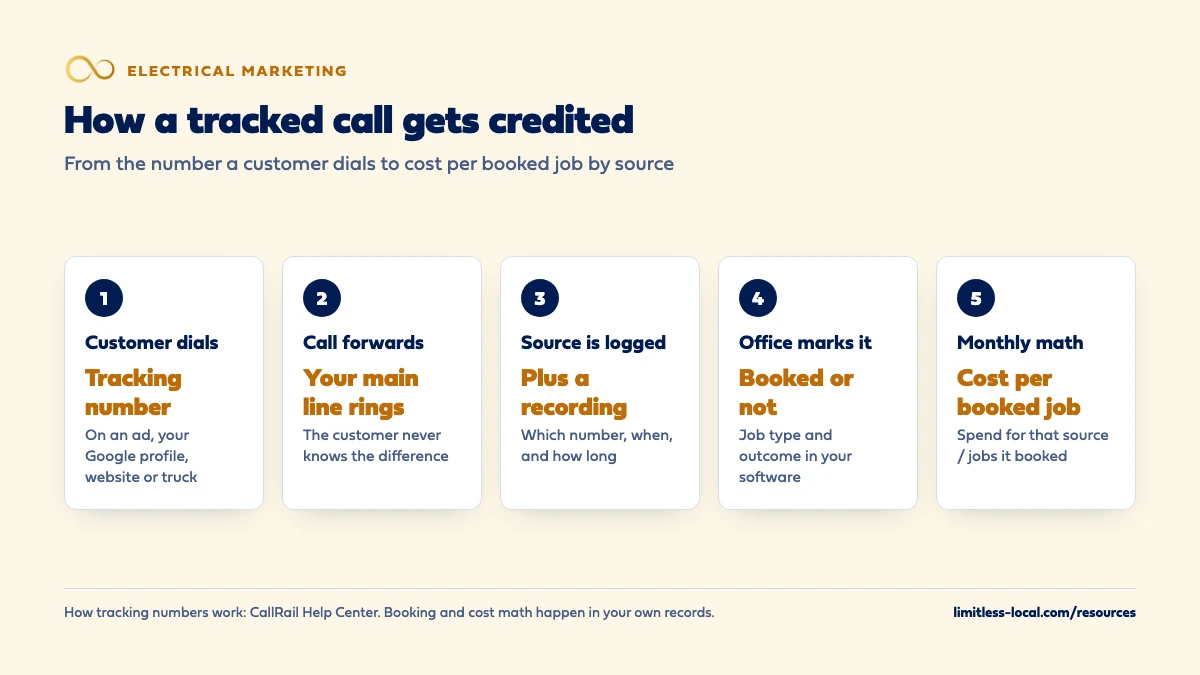
It’s a real, working phone number that you put on one piece of marketing. When someone calls it, the call rings straight through to your normal business line, and the tracking system logs which number was dialed, and therefore which ad, listing or sign the caller saw.
CallRail’s dynamic number insertion overview uses a few terms worth knowing:
- Destination number: the number that rings at your business, usually your main line.
- Source tracking number: a single, fixed number for one source, such as a billboard or a Google ad.
- Website pool: a set of numbers that swap on your website depending on how the visitor arrived, which can also capture the pages they visited and the ad keywords that brought them.
To the customer, it’s just your phone number. To you, it’s the difference between knowing where a call came from and guessing.
Do I actually need them?
In our judgement, you need tracking numbers when both of these are true:
- You pay for more than one kind of marketing (Google Ads, Local Services Ads, SEO, mailers, a lead service), so there’s a real decision about where the next dollar goes.
- Most of your new work starts with a phone call, which is true for most electrical service work.
You can probably skip them for now if almost all your work comes from referrals, repeat customers and builders who already have your cell number, or if you spend on only one channel and its own reporting already counts the calls. Asking callers how they heard about you is better than nothing, but answers like “I found you on Google” can’t tell your ads from your free Google listing, and that’s usually the question that matters.
If you’re not sure whether you’re at that point, the bigger picture is in tracking which marketing brings in real jobs.
How many tracking numbers does an electrician need?
One for each source you want to judge separately, and no more. CallRail’s source tracking basics recommend one tracking number per campaign so your reports stay accurate, and list online sources (paid search, social ads, organic search, directory listings) and offline ones (flyers, signs, business cards) alike.
For a typical electrical shop, that’s a short list:
- Google Ads (or your call tracking tool’s numbers on the website for ad visitors)
- Your Google Business Profile
- Your website, using a swapping pool rather than one fixed number
- Trucks and yard signs, and each mailer you want to measure
- Any paid directory or lead service that lets you list your own number
In our judgement, Local Services Ads are better judged in Google’s own lead reporting than with an extra number. Resist splitting further than you’ll actually look at. A number nobody reviews is just another bill.
How do tracking numbers work on my website?
With a small script, not a separate site. CallRail’s dynamic number insertion works by installing a JavaScript snippet on every page. When a visitor arrives from a source you track, the script finds your phone number on the page and swaps it for the matching tracking number, then stores the visitor’s source in a cookie so they keep seeing that number as they move around the site.
Two practical requirements: your number has to appear on the page as text or an image the script can find, and it has to be written in a format the script recognizes, with the usual dashes, dots or parentheses CallRail lists. If your web designer put the phone number inside a graphic or a format the script misses, the swap fails quietly and those calls show up as untracked. Test it by visiting your site from a Google ad and from a plain search, and check that the number changes.
Curious what your marketing is actually booking?
Get a free visibility audit — no obligation, no sales pitch.
Can I put a tracking number on my Google Business Profile?
Yes, within Google’s rules. Google’s guidelines for representing your business say the phone number must connect to your individual business location and be under your direct control, that you shouldn’t use numbers that redirect people to numbers other than the actual business’s, that a local number is preferred over a central call-center line whenever possible, and that additional phone numbers can be used. A local tracking number that rings your own shop fits that description.
The common setup puts the tracking number in the primary phone field and your main number as an additional number. CallRail’s Google Business Profile integration does exactly that automatically. It also warns that if a listings service syncs your profile, it can overwrite the tracking number and your calls won’t be tracked, so turn off phone-number syncing there first. More on the rest of the profile is in optimizing your electrician Google Business Profile.
Will tracking numbers mess up my name, address and phone listings?
Not if you keep them in their lane. Your main number should stay the same everywhere you aren’t measuring: directories, citation sites, your invoices, your email signature. Tracking numbers go only on the marketing you’re judging.
CallRail’s own integration reflects this: when it puts a tracking number in your profile’s primary phone field, it sets your actual business number as a secondary number, which it says is to keep your name, address and phone consistent. We’d go a step further: inconsistent numbers confuse customers as much as search engines, so a past customer looking you up should find the same number on every listing.
Does Google Ads already track calls for me?
Partly. With Google Ads call reporting turned on, Google assigns a Google forwarding number to your call assets and call ads so it can record call details and count calls as conversions. That covers calls straight from the ad. Calls from people who clicked through to your website and dialed from there need website call tracking as well, either Google’s own website call conversion setup or a tracking tool’s number pool.
Know two limits. Google says its forwarding numbers belong to Google and can change or be reassigned, so you can’t put one on a truck or a mailer. And if you’d rather your ads show your own number or a third-party tracking number, Google says to turn call reporting off in account settings, which shows your direct number but stops Google Ads from tracking those calls itself. Pick one system to be the record for ad calls, so calls aren’t counted twice. Which campaigns deserve that budget is covered in which Google Ads campaigns work best for electricians.

Should I put a tracking number on my trucks and yard signs?
If you want to know what they bring in, yes. A truck wrap or a job-site sign is often one of the most-seen pieces of marketing an electrician owns, and without its own number its calls get credited to whatever the caller remembers, usually “Google.”
Think about it longer than you would for an ad, though, because a wrap stays on the truck for years. In our judgement, use a local number rather than toll-free, give each type of sign its own number only if you’ll really compare them, and make certain the number is one you own and can move, which the next question covers.
Who owns the tracking numbers if I change agencies?
Ask before anything gets printed. CallRail’s help page on porting a number away says you own the numbers you create in its system, that it won’t block a port-out approved by an administrator on your account, that porting a US or Canadian number away is free, and that the process typically takes four to six weeks. The FCC’s guide to porting adds that if you stay in the same area, you can generally keep a number when you switch providers, though companies may charge a fee.
The catch is whose account the numbers live in. If an agency or lead company created the numbers in its own account, getting them out may depend on its cooperation. Get it in writing that the numbers are yours, that you’re an administrator on the account, and that they come with you if you leave. It’s one of the questions worth asking in judging whether your marketing agency is getting results.
Should I record the calls that come through tracking numbers?
Usually, yes, because the recording is where you learn whether a call was a real lead and whether your office booked it. CallRail’s inbound call recording page says recording is included at no extra cost and recordings can be transcribed.
Get the legal side right first. The same page notes that call recording laws differ across US states, with some requiring both parties to consent and others requiring only one party or none, and it lets you play a greeting telling callers the line is recorded. We can’t tell you your state’s rule and this isn’t legal advice, so check it, and if in doubt, use the greeting. Then actually listen: a weekly spot check of a few calls per number tells you more about your booking than any report. If what you hear is calls that go unanswered, whether to use an AI receptionist after hours is worth a read.
Want to see where your company stands?
A free visibility audit shows where you show up on Google, Maps and AI answers, and what it's costing you in calls.
What's different about call tracking for electricians
Calls carry most of the work. Plenty of electrical work starts with a phone call, often an urgent one, rather than a form, so call tracking covers more of an electrician’s leads than it would for a business where people mostly fill in forms.
One number can’t separate a service call from a panel upgrade. A tracking number tells you where the call came from, not what kind of job it became. Your office still has to mark the job type and whether it booked, or a channel full of small service calls and one full of upgrades look the same.
Builders and general contractors call your cell. Contractor and commercial relationships often run on direct numbers that no tracking system sees. Track that work by lead source in your field software instead of trying to force it through a tracking number.
Trucks and job sites do real marketing. Few trades park branded vehicles in as many driveways. That’s a reason to give truck and sign calls their own number, so they get the credit they earn.
A worked example: why "Google" isn't an answer
These numbers are made up to show the math, not a benchmark for your market. Say last month you spent $1,800 on Google Ads, and you also have a free Google Business Profile. Your office asks every caller how they heard about you, and most say “Google”: 84 calls and 31 booked jobs.
Without tracking numbers, that $1,800 looks like it bought 31 jobs, about $58 each. Now give the ads and the profile separate numbers. The ads number gets 48 calls and 16 booked jobs; the profile number gets 36 calls and 15 booked jobs. The ads actually cost about $113 per booked job, nearly twice what you thought, and the free profile was doing almost half the work.
Neither number is good or bad on its own. You’d compare the $113 with the most you can afford per job, which what a good cost per booked job is walks through. The point is that you couldn’t make that call at all from “Google.” Call tracking with recording comes with every one of our packages, and a free visibility audit is a reasonable place to see what yours would show.
Frequently asked questions
Will customers notice they're calling a different number?
Usually not. The call rings through to your normal line, and a local tracking number looks like any other local number. Callers just see the number on whatever they were looking at.
Can I keep my existing main number?
Yes. Tracking numbers forward to your main line rather than replacing it, so the number on your invoices and listings stays the same. If you ever switch phone providers, the FCC says you can generally keep your number when you stay in the same area.
Do tracking numbers work for form submissions too?
Not by themselves; a phone number only tracks calls. Forms need their own source tracking, usually through the same tool’s website script or tagged links, so form leads carry their source into your software.
Should every technician have their own tracking number?
Not for marketing purposes. Tracking numbers answer which marketing produced a call; who booked or sold the job is better tracked by employee in your field software.
What happens to a tracking number when I stop a campaign?
Keep it active for a while if it’s printed anywhere, because old mailers and signs keep getting called. Deactivating a number that’s still out in the world means those callers reach nobody.
Do I need a tracking number for Local Services Ads?
In our judgement, usually not. Google reports the Local Services Ads leads you’re charged for in its own reporting, so judge them there and in your field software.
Key takeaways
- A tracking number forwards to your main line and tells you which marketing the caller came from.
- You need them once you pay for more than one channel; referral-only shops can wait.
- Use one number per source you’ll actually judge, a swapping pool on your website, and your main number everywhere else.
- Follow Google’s rules on your Business Profile and turn off any listing sync that could overwrite the number.
- Make sure you own the numbers, and check your state’s call recording consent rules before recording.
Not sure what's working right now?
Start with a free visibility audit: rankings, Google profile, reviews and tracking, checked against your service area.
More in this section
- Should I show my electrical license number in my marketing?
- How do I track which electrical marketing brings in real jobs?
- What should an electrician's website have to get more calls?
- How do I stop my electrical company from missing calls?
- How should an electrical contractor market to commercial customers?
Sources
- Source tracking basics — CallRail Help Center
- Dynamic number insertion overview — CallRail Help Center
- Google Business Profile integration — CallRail Help Center
- Guidelines for representing your business on Google — Google Business Profile Help
- About call reporting — Google Ads Help
- Port a phone number away from CallRail — CallRail Help Center
- Inbound call recording — CallRail Help Center
- Porting: Keeping Your Phone Number When You Change Providers — Federal Communications Commission