
Should I market harder before or after hiring another plumber?
- Do I have enough work to market harder before I add another plumber?
- Should a plumbing company market first or hire first?
- How do I tell if I'm short on calls or short on plumbers?
- What does it cost to market harder before I can take the calls?
- What does it cost to hire before the calls are there?
- Does it matter whether I hire an apprentice or a licensed plumber?
- Which marketing should start before the new plumber, and which after?
- How do I know there's enough work to keep another plumber busy?
- How do I hold marketing back while I'm short a plumber?
- Does hiring an on-call plumber change my after-hours marketing?
- How do I know the hire and the marketing are paying off together?
- What's different for plumbing companies
- A worked example: an apprentice versus a second licensed truck
- Frequently asked questions
- Key takeaways
- More in this section
- Sources
The short version
- Calls turned away or ringing out means you're short on plumbers: hire first.
- Open slots most days means you're short on calls: market first.
- Start SEO and reviews months before the hire; turn up ads the week the new plumber is ready.
- An apprentice rarely needs new marketing; a second licensed truck does.
For plumbing owners deciding whether to turn up the marketing or add a plumber first, and how to time the two so neither one sits idle.
Get a free visibility audit · Book a growth call
Do I have enough work to market harder before I add another plumber?
Hire first if you’re already turning away calls, booking new customers days out or letting emergency calls ring through to voicemail, because more marketing only buys calls you can’t run. Market first if your plumbers have open slots most days, and let the fuller schedule pay for the hire. When you do hire, start the slow channels like SEO and reviews months ahead, and turn up Google Ads and Local Services Ads the week the new plumber can run calls. An apprentice adds hands on your current truck, while a licensed plumber who can work alone adds a second truck to fill, so plan the marketing around who you’re hiring.
How much work your crews can actually run is part of how we size a marketing plan, because buying calls you can’t answer is one of the most expensive mistakes in plumbing marketing. Our marketing packages start with the foundation (tracking, follow-up and a clean Google presence) before turning up lead flow, which is the same order this page recommends. Our plumbing marketing page shows how SEO, ads and follow-up fit together, and the rest of the plumbing marketing questions library goes question by question.
Should a plumbing company market first or hire first?
Look at what runs out first: calls or plumbers. Both mistakes cost money, just in different ways.
- Marketing ahead of capacity means paying for calls nobody can run. In plumbing that usually means an emergency caller who waits, gives up and calls the next company, and sometimes leaves a review about it.
- Hiring ahead of demand means paying a plumber and a truck for slots the phone doesn’t fill.
This page covers the marketing side of the decision only. It isn’t legal, tax or employment advice: the hiring itself, pay and labor rules are questions for your accountant and an employment lawyer or HR adviser.
How do I tell if I'm short on calls or short on plumbers?
Your schedule and phone records answer this better than any rule of thumb. In our judgement, these are the signs on each side.
Short on plumbers (hire first):
- New customers wait more than a day or two for a routine call in a normal week, not just during a freeze.
- The office turns away or refers out jobs more than now and then, especially water heaters, drain calls or anything after 5 p.m.
- Calls ring out or go to voicemail while everyone is on a job.
- Your on-call plumber is working most nights, and daytime work slips because of it.
Short on calls (market first):
- Plumbers have open slots most days outside your busy weeks.
- You’re filling the board with small calls you’d rather not run, while repipes and sewer work aren’t coming in.
- The office answers nearly every call and still has room to book more.
If you see both, you probably have a timing problem, not a headcount problem: busy weeks and slow weeks. Keeping calls coming in during slow months covers the slow side.
What does it cost to market harder before I can take the calls?
You pay for leads you can’t use, and on Local Services Ads it can also hurt where you show. Google’s page on how leads work says a missed call during your business hours counts as a valid lead if the caller stays on the line for more than 20 seconds, and that a call going to voicemail or an automated greeting during business hours is treated as connected and charged the same way, whether or not the caller leaves a message. Google’s ad rankings page also says missed calls may hurt your responsiveness, which is one of the things that decides where your ad shows.
Google search ads charge per click, not per call, but the money is just as gone when the click becomes a call nobody answers. Plumbing makes this worse than most trades because so many calls are urgent: a homeowner with water on the floor doesn’t wait for a callback. Before you spend more, check how quickly your office picks up today; how fast your office should answer a new call covers what to measure.
What does it cost to hire before the calls are there?
You carry a plumber, and often a stocked truck, while the schedule catches up. That can be a sound bet if you’ve done the math. The SBA’s small business guide describes a cost-benefit analysis as adding up the money in benefits and the money in costs over a set period, then subtracting costs from benefits, and notes it can help when deciding whether to hire another employee.
For a plumbing shop, the benefit side is the booked jobs the new plumber will run and what they bring in. The cost side is the plumber, the truck and its stock, and the marketing it takes to fill the schedule. The trap, in our judgement, is leaving that last line out: hiring and then expecting the phone to fill a second truck in the first week.
Curious what your marketing is actually booking?
Get a free visibility audit — no obligation, no sales pitch.
Does it matter whether I hire an apprentice or a licensed plumber?
For the marketing, it matters more than anything else on this page. The Bureau of Labor Statistics says most plumbers learn through an apprenticeship, that most states and some localities require plumbers to be licensed, and that licensing often requires 2 to 5 years of experience and an exam before a plumber can work independently (BLS Occupational Outlook Handbook). Rules vary by state, so check with your state’s licensing board for yours.
What that means for marketing, in our judgement:
- An apprentice or helper usually rides with a licensed plumber. Your crew gets faster on water heaters, repipes and digs, but you don’t get a second truck running calls on its own, so you rarely need new marketing for it. The overflow you’re already turning away is often enough.
- A licensed plumber who can work alone adds a second truck’s worth of calls to fill. That’s the hire that needs a marketing plan behind it, and a budget to match.
- A specialist, such as a drain and sewer tech with a jetter and camera, needs marketing for that work specifically: drain and sewer service pages, ads and Local Services Ads job types for those jobs.
Market the work the new person will actually do. Which plumbing services to advertise first helps you pick.
Which marketing should start before the new plumber, and which after?
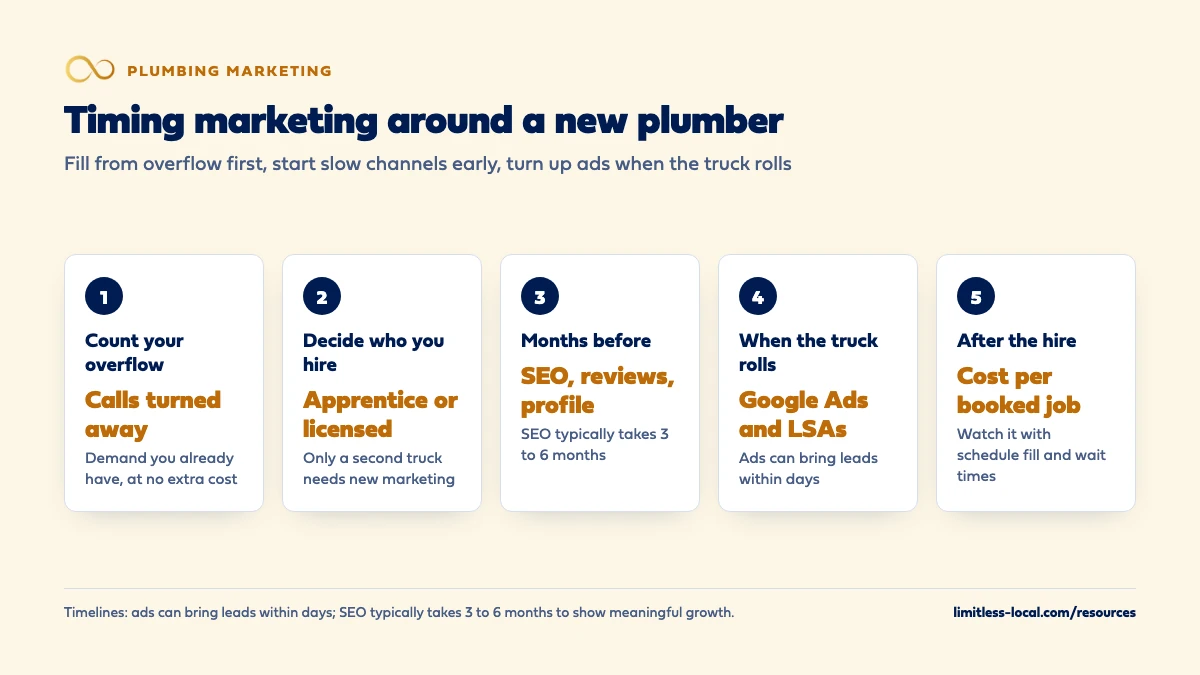
The channels ramp at very different speeds. Ads can generate leads within days of launch; SEO typically takes 3 to 6 months to show meaningful organic growth; reviews grow at the pace you finish jobs. That gives you a natural order:
- Months before the hire: start the slow channels. Service pages for the work the new plumber will do, a steady review habit, and a complete Google Business Profile. How long plumbing SEO takes covers that ramp.
- The week the new plumber can run calls: turn up the fast channels. Raise the Google Ads budget, turn on Local Services Ads job types you’ve been leaving off, and widen service areas only as far as the new truck will really drive.
- The first few months after: watch cost per booked job and wait times together, and move the fast channels up or down. They’re the dial; the slow channels stay steady.
How do I know there's enough work to keep another plumber busy?
Start with what you’re already losing. Count the calls the office turned away, referred out or couldn’t book within a reasonable wait over the last few months, month by month. That’s demand you already have, at no extra marketing cost.
Then look at what you could buy:
- Google Ads tells you when budget is the limit. Google marks a campaign “Limited by budget” when it’s underperforming because of a limited budget and offers a recommended budget. If your plumbing campaigns already carry that status, there are more searches out there than you’re paying for.
- Keyword Planner estimates the rest. Its forecasts draw on historical search data to estimate what a set of keywords might bring you, such as clicks, based on your spending. Treat them as an estimate, not a promise.
- Your own cost per booked job sets the price. If you know what a booked job costs you from each channel today, you can work out what filling a second truck would cost. Working out your customer acquisition cost walks through the math.

How do I hold marketing back while I'm short a plumber?
Trim it rather than switching everything off, so the accounts and their history are ready when you need them:
- Ad schedule. Ad scheduling lets you choose the hours or days of the week your Google Ads show, for example only when someone can answer and book.
- Narrow Local Services Ads. Google’s help page on job types and service areas shows how to toggle job types on and off and exclude areas. Turning off a job type you can’t staff is cheaper than paying for its leads.
- Keep the slow channels going. Reviews, your Google profile and service pages don’t flood the phone in a week, and stopping them costs you months later.
Keep your Google profile hours honest while you’re short-handed. If nobody can take a call at night, don’t list hours that say otherwise; stopping lost after-hours calls covers the options.
Does hiring an on-call plumber change my after-hours marketing?
Often, yes, and this is one of the clearest wins from a hire. The BLS says plumbers are often on call for emergencies, so evening and weekend work is common in the trade. If a new plumber lets you run a real on-call rotation, after-hours calls go from voicemail to booked jobs, and it can start to make sense to:
- Extend your Google Ads schedule into the evening and weekends.
- List business hours on your Google profile and Local Services Ads that match when someone really answers.
- Promote emergency service on your website and ads, now that you can back it up.
Plan the rotation before you advertise it, including pay. The Department of Labor’s fact sheet on hours worked explains when on-call time can count as working time under the federal Fair Labor Standards Act. This isn’t legal advice; check how it applies to your shop with an employment lawyer or HR adviser before you set the rotation.
How do I know the hire and the marketing are paying off together?
Watch three numbers side by side for the first few months:
- Schedule fill. How full the new plumber’s days are, week by week.
- Cost per booked job, by channel. Marketing spend divided by the jobs it booked. If it climbs sharply as you turn spend up, you’ve reached the edge of what your market gives you at that price.
- Wait times. How long a new customer waits for a visit. If it’s still days, demand is ahead of you, which is a good problem.
Judge it over months, not a week. A new plumber is slower at first, and ads need a few weeks of data before you trust them.
Not sure which of these is costing you jobs?
A free visibility audit checks the Google profile, reviews, site and tracking, and shows what to fix first.
What's different for plumbing companies
Emergency calls don’t wait. A burst pipe or sewer backup that can’t be booked today goes to the next plumber. That’s the cost of marketing ahead of capacity, and it’s highest exactly when your ads are working hardest.
A freeze isn’t a hiring signal on its own. Nearly every shop is short-handed during a hard freeze. If the board is only full for those weeks, plan overflow for the freeze and judge the hire on normal weeks.
The work mix decides the hire. A board full of small service calls and a board full of water heater swaps and repipes need different people and different marketing. In our judgement, a second licensed plumber earns their keep fastest when the marketing behind them is aimed at the bigger tickets the shop wants more of.
A worked example: an apprentice versus a second licensed truck
These numbers are made up to show the math, not a benchmark for your market. Say your shop turns away or refers out about 25 calls a month over the last few months, and you’re choosing between two hires.
- An apprentice riding with your lead plumber lets that truck finish one more call a day. Over a month of 21 working days, that’s fewer extra calls than the 25 you’re already turning away. No new marketing needed: book the overflow and see how the schedule looks.
- A licensed plumber running a second truck at 4 calls a day fills 84 slots a month. The 25 overflow calls cover part of that, leaving 59 calls for marketing to find.
If your Google Ads book jobs at a made-up $95 each, finding those 59 calls costs about $5,605 a month in added marketing. Put that on the cost side of the SBA-style comparison with the plumber’s pay and the truck, and the revenue from those 84 jobs on the benefit side. If the math works, ramp the ads up in steps from the week the second truck rolls.
For scale: our Essentials package ($3,500 a month) includes Google Ads management for up to $2,500 a month in ad spend, and Growth ($4,500 a month) raises that to $5,000 and adds Local Services Ads management. Ad spend is paid to Google separately. A jump like the one above is past both ceilings, another reason to ramp in steps and judge each one by cost per booked job.
Frequently asked questions
Should I pause all my ads while I'm short a plumber?
Usually trim rather than pause everything: run ads only when someone can book, turn off Local Services Ads job types you can’t cover, and keep reviews and SEO going so you’re ready when the new plumber starts.
Can I get Local Services Ads credits for calls I was too busy to take?
Not for being busy. A missed call during your business hours where the caller stays on the line for more than 20 seconds counts as a valid lead, so narrow your job types, areas and hours instead of relying on credits.
How soon after turning up ads will a new plumber's schedule fill?
Ads are the fastest channel to respond, often within days, but how many calls you get depends on your market and what you’re willing to pay per booked job. Nobody can honestly promise a full schedule by a set date.
Is it worth marketing jobs I'd have to subcontract out?
Only if you’ve priced it and the subcontractor’s quality and timing protect your reviews. In our judgement, most shops are better off aiming ads at the work their own plumbers can run.
What if the new plumber leaves after a few months?
Turn the fast channels back down first, since they’re the ones you can adjust in days. That’s another reason to keep the slow channels steady and treat ad spend as the dial.
Key takeaways
- Turning away calls or letting them ring out means hire first; open slots most days means market first.
- An apprentice usually fills from overflow; a second licensed truck needs a marketing plan and budget.
- Start SEO, reviews and your Google profile months before the hire, and turn up ads the week the new plumber can run calls.
- On Local Services Ads, missed calls during business hours can be charged and may hurt your ranking, so trim job types and hours while short-handed.
- Judge the hire and the marketing together on schedule fill, cost per booked job and wait times.
Want a second set of eyes on your setup?
We'll look at how you show up locally and where calls are leaking, then send you a plain-English breakdown.
More in this section
- Which plumbing services should I advertise first?
- Should I hire a plumbing marketing agency or do it myself?
- How do I get more plumbing leads?
- How should a new plumbing company get its first customers?
- How should a plumbing company market to commercial customers?
Sources
- How leads work — Google Local Services Help
- About ad rankings — Google Local Services Help
- Edit your industries, service areas, and job types — Google Local Services Help
- About Ad Scheduling — Google Ads Help
- Fix “Limited by budget” status — Google Ads Help
- Plumbers, Pipefitters, and Steamfitters: Occupational Outlook Handbook — U.S. Bureau of Labor Statistics
- Manage your business: marketing and sales — U.S. Small Business Administration
- Fact Sheet #22: Hours Worked Under the Fair Labor Standards Act — U.S. Department of Labor