
Should a restoration company hire an in-house marketer vs agency?

- Is an agency or an in-house marketing hire cheaper for a restoration company?
- What does a full-time in-house marketer actually cost?
- What does an agency cost for a restoration company?
- Can one in-house person cover everything a restoration company needs?
- When does hiring in-house make sense for a restoration company?
- When is an agency the better choice?
- Who should own the ad accounts and website either way?
- How do I compare an agency quote with a salary fairly?
- How do I hold either one accountable for real jobs?
- What's different about this decision for restoration companies
- A worked example: salary versus agency for one restoration company
- Frequently asked questions
- Key takeaways
- More in this section
- Sources
The short version
- A full-time marketer's salary plus benefits often runs well above an agency retainer.
- One person rarely covers ads, Maps, SEO, content, web and tracking well.
- In-house fits larger, multi-location or heavy commercial operations.
- Ad spend is extra either way.
- Own every account in the company's name, whichever you pick.
For restoration owners weighing a marketing salary against an agency retainer, who want the real cost of each and an honest view of what one person can cover.
Get a free visibility audit · Book a growth call
Is an agency or an in-house marketing hire cheaper for a restoration company?
In our judgement, for most single-location restoration companies an agency costs less than a full-time marketer once salary and benefits are counted, and it covers more skills: ads, Maps, SEO, content and tracking rarely live in one person. An in-house hire starts to make sense when you have enough steady work to keep someone busy full time, usually across several locations or a large commercial program, and you’re prepared to pay for tools and outside help on top. Whichever you choose, keep ownership of your ad accounts, Google profile and website in the company’s name.
We’re obviously on one side of this question, so here’s how we’d frame our side: our packages are published with prices and scope, so you can put them next to a salary and compare line by line. Our restoration marketing page covers the work itself, the restoration marketing guide covers DIY versus hiring help in broader terms, and the rest of the restoration marketing questions go one question at a time.
What does a full-time in-house marketer actually cost?
More than the salary. The U.S. Bureau of Labor Statistics reports that the median annual wage for market research analysts, the category we use as a rough reference point for an in-house marketing generalist, was $78,760 in May 2025. Source: Market Research Analysts: Occupational Outlook Handbook.
Wages aren’t the whole cost of an employee. BLS reports that for private industry workers in June 2026, wages and salaries accounted for 70.0 percent of employer compensation costs, with benefits making up the remaining 30.0 percent. Source: Employer Costs for Employee Compensation Summary.
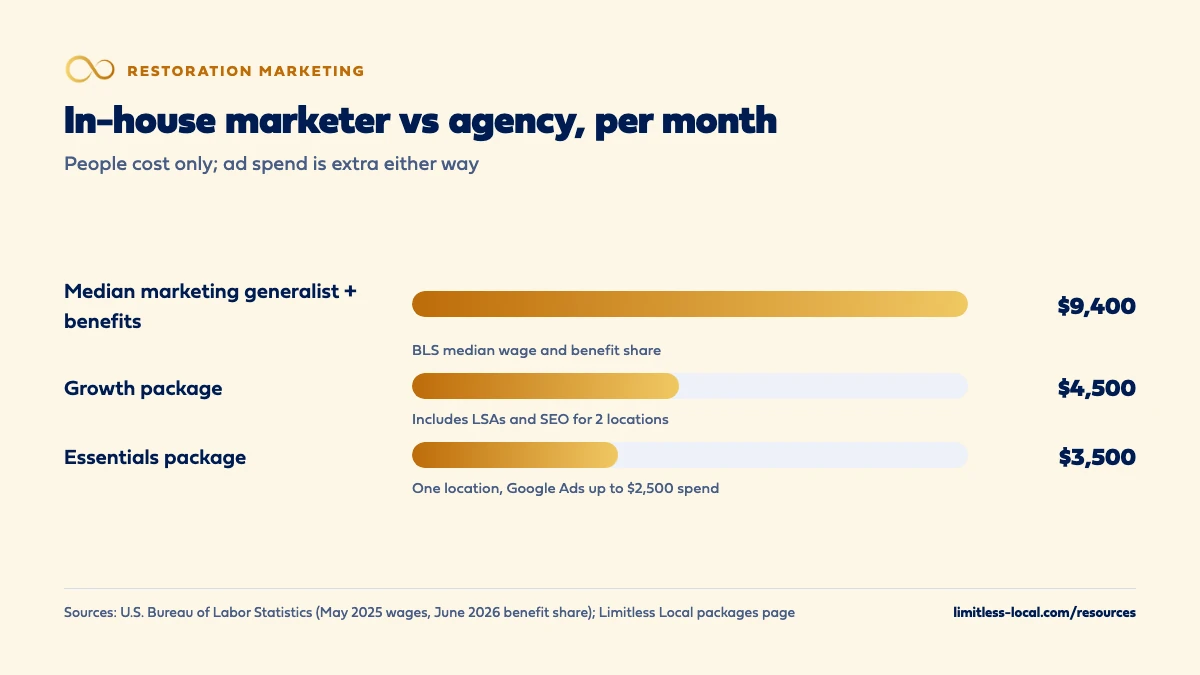
Put those together and a median-paid generalist costs roughly $112,500 a year with benefits, or about $9,400 a month, before any software, training, ad spend or recruiting. A manager-level hire costs more: BLS puts the median wage for marketing managers at $166,790 in May 2025. Source: Advertising, Promotions, and Marketing Managers.
Pay varies by market and experience, so treat these as national reference points, not quotes.
What does an agency cost for a restoration company?
Agency pricing varies widely, so get the scope in writing before you compare. As a published reference point, our Essentials package is $3,500 a month and our Growth package is $4,500 a month; Scale is custom. Those cover the management work. Ad spend is paid directly to Google or Meta in every case, and it would be paid with an in-house marketer too.
The comparison to make is like for like: the monthly cost of a salaried person plus benefits plus their tools, against the agency’s monthly fee for the same list of work. If an agency quote doesn’t spell out what’s included, ask for it line by line.
Can one in-house person cover everything a restoration company needs?
In our judgement, rarely. A restoration company’s marketing usually touches:
- Google Ads and Local Services Ads, including budgets, keywords and lead disputes.
- The Google profile, reviews and photos.
- Service and city pages, and the SEO behind them.
- Website changes and landing pages.
- Call tracking and reporting by job source.
- Relationships with plumbers, property managers and commercial accounts.
Those are different skills. A good ads person isn’t always a good writer, and a good writer may never have set up call tracking. Most solo marketers end up strong in one or two areas and paying freelancers or tools for the rest, which narrows the cost gap with an agency.
The part an in-house person does better is the last bullet. Someone on your payroll can show up at a property management office, a plumbers’ association meeting or an adjuster lunch. Building a referral network with plumbers and property managers covers that work.
When does hiring in-house make sense for a restoration company?
In our judgement, an in-house marketer starts to pay off when most of these are true:
- You run several locations or a franchise territory with enough work to keep one person busy every week.
- A big share of your revenue comes from commercial accounts or program work that depends on relationships.
- You already have someone managing the day-to-day who can direct a marketer’s priorities.
- You’re prepared to keep paying outside specialists or tools for the skills the hire doesn’t have.
Many larger companies run a hybrid: an in-house coordinator who owns relationships, content approvals and reporting, with an agency running ads, Maps and SEO. That puts the person who knows your jobs next to the people who know the platforms.
Curious what your marketing is actually booking?
Get a free visibility audit — no obligation, no sales pitch.
When is an agency the better choice?
For most one- or two-location restoration companies, in our judgement. You get several skills for one fee, there’s no recruiting gap when someone quits, and the work doesn’t stop when one person goes on vacation during storm season.
An agency also brings setup speed: the platform waits are the same for everyone, but an experienced team doesn’t have to learn the platforms on your time. How fast each marketing channel produces leads covers those waits.
The trade-off: an agency has other clients, and it won’t know your adjusters, your crews or which neighborhoods flood unless you tell it. Plan for a short weekly or monthly check-in and real job data flowing back.
Who should own the ad accounts and website either way?
You should, whether the work is done in-house or by an agency. Google Ads lets an account owner give other people different access levels, such as admin, standard or read-only, so you can grant access without handing over ownership. Source: About access levels in your Google Ads account.
Your Google Business Profile works the same way. Google says an owner can invite other owners and managers who can edit info, respond to reviews and manage posts. Source: Manage your Business Profile owners & managers. Keep the company as primary owner, and remove access when a person or vendor leaves.
The detail, including websites, domains and call-tracking numbers, is on who owns the website and ad accounts.

How do I compare an agency quote with a salary fairly?
Put both on one page with the same rows:
- Monthly people cost: salary plus benefits, or the agency fee.
- Tools and software: call tracking, SEO tools, design tools, CRM.
- Freelancers for gaps: design, writing, web development.
- Ad spend: the same on both sides.
- Owner time: hours a month you’ll spend directing the work.
- Risk: what happens if the person quits or the agency underperforms.
Then compare the result against booked jobs, not activity. Google’s own guidance on hiring SEO help is to interview the provider, check references and ask for explanations if something is unclear. Source: Do you need an SEO?
How do I hold either one accountable for real jobs?
The same way: count booked jobs and revenue by source, every month. Calls and clicks are a means, not the result. Set it up before you hire, so the first month has a baseline to compare against.
With an agency, ask for monthly reporting that ties spend to leads and booked jobs, and know how long you’re committing for; normal contract length for a restoration agency covers that. With an in-house hire, set the same targets you’d give an agency. Whether your marketing is producing real jobs lays out the checks.
What's different about this decision for restoration companies
Demand is lumpy. A freeze or storm can triple the work for a week. An agency can usually shift budget quickly; a solo in-house marketer can get buried right when the phones are busiest.
Relationships carry real weight. Plumbers, property managers, commercial facility teams and program work send restoration companies repeat jobs. That’s people work, and it favors someone local and on payroll, in our judgement.
After-hours matters. Restoration leads arrive at night. Whoever runs your marketing has to make sure tracking and ads match the hours someone actually answers, which is an operations question as much as a marketing one.
Not sure which of these is costing you jobs?
A free visibility audit checks the Google profile, reviews, site and tracking, and shows what to fix first.
A worked example: salary versus agency for one restoration company
The salary figures come from BLS; the job values are made up to show the math. A median-paid marketing generalist costs about $9,400 a month with benefits ($78,760 divided by 0.70, then by 12). Add tools and a freelancer for design and the total climbs further. Our Growth package is $4,500 a month and includes Google Ads management up to $5,000 in monthly spend, Local Services Ads management, SEO for up to 2 locations and monthly strategy calls.
Say each booked water job brings in $1,000 in gross profit, a made-up figure. The in-house route needs about 10 extra booked jobs a month just to cover the person ($9,400 divided by $1,000, rounded up). The agency route needs about 5 ($4,500 divided by $1,000, rounded up). Ad spend sits on top of both. Run it with your own job margin before deciding.
Frequently asked questions
Can my office manager handle marketing part time?
They can handle relationships, review requests and approvals well. In our judgement, ads, SEO and tracking need someone who does them every week, so pair them with outside help.
Is a freelancer a middle option?
Yes, for one skill like ads or web work. You still need someone to coordinate the pieces and own the reporting.
Does an agency need me involved at all?
Yes. Expect a short regular check-in, plus feedback on which calls became jobs. Our own onboarding asks about 2 to 3 hours of your team’s time up front.
Do I lose my accounts if I leave an agency?
You shouldn’t, if the accounts are in your company’s name with the agency added as a user. Set that up on day one.
Is ad spend included in an agency fee?
Not in ours. Ad spend is paid directly to Google or Meta, and you’d pay it with an in-house marketer too.
Key takeaways
- A median-paid marketing generalist costs about $9,400 a month with benefits, before tools and ad spend.
- One person rarely covers ads, Maps, SEO, content, web and tracking well.
- In-house makes sense for multi-location or relationship-heavy commercial operations, often as a hybrid.
- Compare like for like: people, tools, freelancers, owner time and risk.
- Own every account in the company’s name and judge either route by booked jobs.
Want a second set of eyes on your setup?
We'll look at how you show up locally and where calls are leaking, then send you a plain-English breakdown.
More in this section
- How should a restoration company market to real estate agents?
- How should a restoration company market to commercial properties?
- What marketing does a brand-new restoration company need first?
- How do I vet a restoration marketing agency before signing?
- Is my restoration marketing agency producing real jobs?
Sources
- Market Research Analysts: Occupational Outlook Handbook — U.S. Bureau of Labor Statistics
- Employer Costs for Employee Compensation Summary — U.S. Bureau of Labor Statistics
- Advertising, Promotions, and Marketing Managers: Occupational Outlook Handbook — U.S. Bureau of Labor Statistics
- About access levels in your Google Ads account — Google Ads Help
- Manage your Business Profile owners & managers — Google Business Profile Help
- Do you need an SEO? — Google Search Central