
What should I do when a new electrical competitor opens nearby?

- How should an electrician respond when a new rival opens in the same towns?
- Should I worry when a new electrician opens in my area?
- Step 1: How do I check whether they're actually taking my calls?
- Step 2: What should I look at on their profile?
- Step 3: Are they bidding against me in Google Ads?
- Step 4: What should I tighten on my own Business Profile?
- Step 5: How do I use reviews against a newer shop?
- Step 6: My website is old. Does that matter now?
- Step 7: How do I out-serve a new shop on the phone?
- Step 8: When should I report a competitor to Google?
- Should I drop my prices to compete?
- What if I have no time to deal with it this month?
- What's different when the new competitor is an electrician
- A worked example: reading the numbers after a rival opens
- Frequently asked questions
- Key takeaways
- More in this section
- Sources
The short version
- Measure first: Maps position from your key towns, plus calls and booked jobs over a few weeks.
- Tighten what you control: Business Profile, reviews, website and how fast you answer.
- Lean on the advantage a new shop doesn't have yet: past customers and the people who refer you.
- Skip the price war, and report them to Google only for real rule breaks.
For electrical contractors who just noticed a new shop on the map, on the trucks or in the ads, and want a calm, practical response plan.
Get a free visibility audit · Book a growth call
How should an electrician respond when a new rival opens in the same towns?
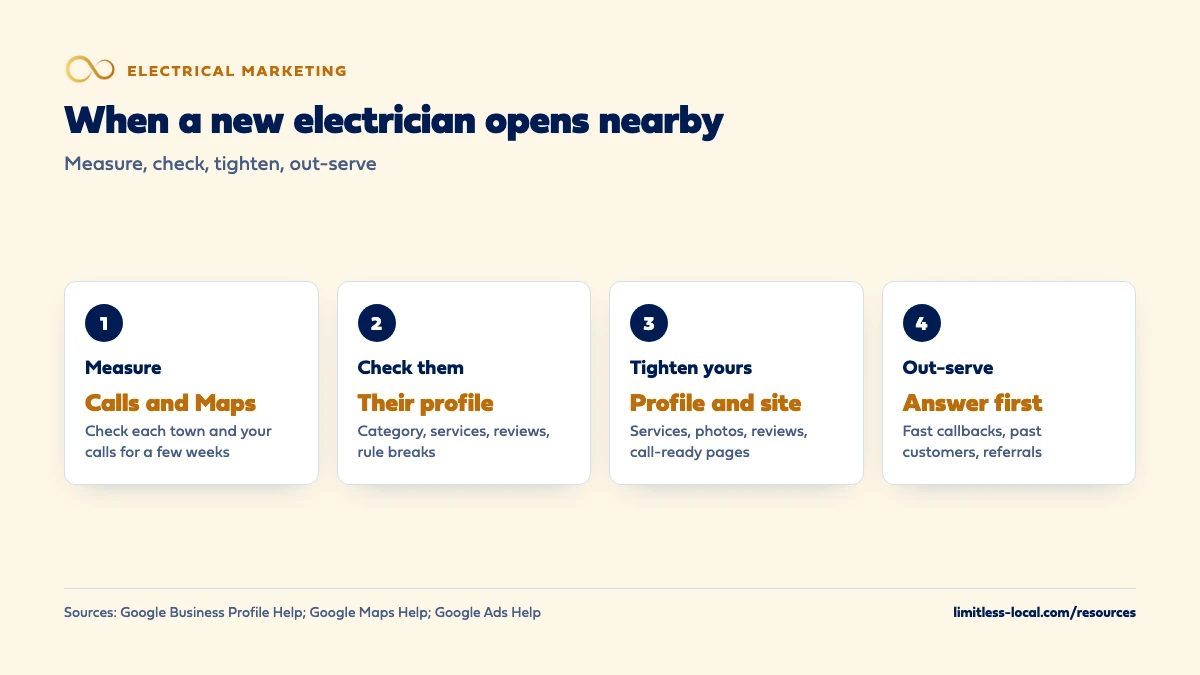
Start by measuring, not reacting: check where you show up in Maps from the towns you care about, and watch your calls and booked jobs for a few weeks to see whether the new shop is actually taking work. Then tighten what you control, which is a complete Business Profile, a steady flow of new reviews, a website that turns visits into calls and a phone that gets answered fast. Don’t start a price war, and only report the new competitor to Google if their profile actually breaks Google’s rules, such as a virtual office or a name stuffed with keywords.
Holding your spot in Maps when the market gets more crowded is the work our local SEO does for home-service businesses: Business Profile management, listing cleanup and review response, measured against calls. Our local SEO page explains the approach, and our electrical contractor marketing page covers how we think about electricians’ marketing. The full electrical marketing questions library has the related questions.
Should I worry when a new electrician opens in my area?
Pay attention, but don’t assume the worst. A new shop has no reviews, no history with your customers and no relationships with your general contractors. It may also have a fresh website, a big ad budget and an owner with time to market. In our judgement, the first few months tell you which of those matters in your market.
Google says local results are mainly based on relevance, distance, and popularity, according to its guide to improving your local ranking. A new competitor changes the picture mainly through distance (they may be closer to some of your customers) and relevance (their profile may match some searches better). Popularity, which Google says includes how many reviews you have, takes them longer to build. If they already outrank you, why a competitor ranks above you walks through each cause.
Step 1: How do I check whether they're actually taking my calls?
Measure before you change anything. Two checks, run for a few weeks:
- Where you show up. Search your main jobs (“electrician”, “panel upgrade”, “EV charger installation”) from addresses inside each town you serve, not just from your shop. Map results depend on where the searcher is, so a new shop across town may outrank you only in its own neighborhood.
- What’s coming in. Your Business Profile’s performance data shows views, searches and actions such as calls, and the searches people used to find you. Compare this month with the last few, and compare your booked jobs in your field software.
In our judgement, a dip in one town that matches where the new shop opened is a signal. A dip everywhere is more likely something else, such as season or a problem on your own profile.
Step 2: What should I look at on their profile?
Look at their Google Business Profile the way a homeowner would. Note their primary category, the services they list, their hours, their photos, how many reviews they have and how recent they are. That tells you which searches they’re built to win.
Then check whether the profile follows Google’s rules. Google’s guidelines for representing your business say the name should reflect the business’s real-world name, that including unnecessary information in the name isn’t permitted, and that a virtual office, meaning a rented mailing address where the business doesn’t operate, isn’t eligible for a Business Profile. A new shop that follows the rules is just competition. One that doesn’t may be reportable, which Step 8 covers.
Step 3: Are they bidding against me in Google Ads?
If you run search ads, Google’s auction insights report lets you compare your performance with other advertisers taking part in the same auctions. A new name appearing there, and your impression share falling, tells you a new advertiser is in your searches.
The response is not automatically to raise bids. In our judgement, check first whether your cost per booked job has actually changed. A new advertiser often spends heavily for a while and then settles. If your booked jobs hold, hold steady. If they fall, tighten your keywords to the jobs and towns that pay best before you add budget.
Step 4: What should I tighten on my own Business Profile?
The things a new shop is copying from the leaders, done properly:
- Categories: the primary category that matches the work you want most, and secondary ones for the rest.
- Services: panel upgrades, EV charger installation, generators, rewiring, lighting and commercial work, if you do it.
- Service area and hours: accurate and current, including holiday hours.
- Photos and posts: real jobs, real trucks, real crews, added regularly.
None of this is new advice, which is the point: it’s the part you control. Optimizing your Google Business Profile covers each setting in detail.
Curious what your marketing is actually booking?
Get a free visibility audit — no obligation, no sales pitch.
Step 5: How do I use reviews against a newer shop?
Reviews are where your head start is largest. A new shop starts with none, and Google says more reviews and positive ratings can help your local ranking. In our judgement, the worst thing an established electrician can do when a rival opens is let review requests slide, because that’s the gap the newcomer is working hardest to close.
Make sure every completed job gets a request, and that the requests go out automatically from your field software. Getting more Google reviews covers the system. Reply to new reviews, too; Google’s ranking guide says replying shows you value customers’ feedback.
Step 6: My website is old. Does that matter now?
It matters more than it did. A new competitor almost always launches with a new site. If a homeowner compares the two and yours is slow on a phone, hard to call from or missing pages for the jobs they want, the newer site can win the call even if you have the better reputation.
You don’t need to rebuild everything at once. In our judgement, the first fixes are a tap-to-call number on every page, a page for each main service and town you want, current photos and your license information where homeowners can see it. What to fix on your website first has the order.
Step 7: How do I out-serve a new shop on the phone?
A new shop usually has an owner answering every call, which makes it fast at first. You may be slower because you’re busier. In our judgement, this is where an established shop loses the most work to a newcomer without noticing: the homeowner calls you, gets voicemail, and books the next name on the map.
Check how many calls you miss during business hours, and who covers them. How fast your office should answer sets targets you can measure.

Step 8: When should I report a competitor to Google?
Only when the profile actually breaks Google’s rules, not because it’s competition. Google’s page on reporting a business on Google Maps says you can suggest an edit for incorrect info, report misleading business info or fraudulent activity, and report a business that offers incentives for reviews, which Google says are prohibited.
Keep it factual: a keyword-stuffed name, a virtual-office address or paid reviews you can point to. In our judgement, reporting a legitimate competitor wastes your time and does nothing for your own calls.
Should I drop my prices to compete?
In our judgement, rarely. A new shop that prices low is often buying its first reviews and customers. Matching it trains your customers to shop on price and cuts the margin you need to pay your crews. Many homeowners already compare several electricians, and some compare you with handymen too; competing on credentials, reviews and response time holds up better than competing on the lowest number.
If you lose specific jobs on price, look at which ones. Small service calls are easier to lose to a lower bid; planned projects like panel upgrades, where permits, inspections and warranty matter, are easier to defend with a clear quote and good follow-up.
What if I have no time to deal with it this month?
Do three things this week and leave the rest:
- Turn on automatic review requests for every completed job.
- Check that your Business Profile hours, phone and services are correct.
- Make sure someone answers or returns calls quickly during business hours.
Then check your numbers again in a month. Lean on the people who already know you, too: past customers and the contractors who send you work. A newcomer can buy ads, but not that history. More referrals from past customers covers how to ask.
Not sure which of these is costing you jobs?
A free visibility audit checks the Google profile, reviews, site and tracking, and shows what to fix first.
What's different when the new competitor is an electrician
Licensing is part of the comparison. Homeowners don’t always know the difference between a licensed electrician and a handyman, and a new shop’s marketing may blur that line. Show your license and insurance where homeowners can see them, and explain permits and inspections on your project pages.
Relationships with general contractors don’t move overnight. If part of your work comes from builders and remodelers, a new shop has to earn those relationships. Keep in touch with the people who send you work, especially in the months after a rival opens.
New-technology work is where newcomers often aim. A new shop may lead with EV chargers, generators or solar tie-ins. If that’s work you want, make sure your profile and site say so clearly, with reviews that name those jobs.
Emergency calls go to whoever answers. For urgent work, being the established name matters less than picking up. That’s the easiest place for a newcomer to take calls from you, and the easiest to defend.
A worked example: reading the numbers after a rival opens
These numbers are made up to show the method, not a benchmark. Say your Business Profile showed 45 calls a month before a new electrician opened on the north side of your area, and two months later it shows 36. That’s a 20% drop.
You search your main jobs from addresses in each town. In the four towns to the south, nothing has changed. In the two northern towns, the new shop now shows above you. So the problem is local, not general. The response is aimed there: ask for reviews from recent customers in the northern towns, add photos of jobs you’ve done there, make sure your service area covers them, and check that your site has pages for those towns. Then measure again in a month.
That kind of steady profile work is part of our packages: Business Profile management, listing cleanup and review response are in Essentials at $3,500 a month, and Growth at $4,500 a month adds more frequent profile posts and advanced review generation. We don’t guarantee rankings; we show you what we did and what it produced.
Frequently asked questions
Can I stop a new competitor from using a business name like mine?
That’s a legal question, not a marketing one, so talk to a lawyer; this isn’t legal advice. On Google, you can report a profile whose name breaks Google’s naming guidelines.
Should I start bidding on the new competitor's business name?
In our judgement, it’s rarely worth it for a local electrician. Spend on the jobs and towns you want instead, where your cost per booked job is easier to control.
How long until I know if the new shop is hurting me?
Give it a few weeks to a couple of months of comparing calls and booked jobs. A single slow week tells you very little.
Should I add a second Business Profile closer to them?
Only if you have a real, staffed location there. Google’s guidelines say a virtual office isn’t eligible for a Business Profile.
Is a new competitor ever good news?
Sometimes. Their ads can make more homeowners aware of work like EV chargers or panel upgrades. If your profile and pages are ready, you can win some of that new demand.
Key takeaways
- Measure first: Maps position town by town, plus calls and booked jobs over a few weeks.
- Check the new shop’s profile for what it’s built to win, and for real rule breaks.
- Tighten what you control: profile, reviews, website and how fast you answer.
- Use your head start: reviews, past customers and the contractors who refer you.
- Avoid price wars and baseless reports; neither brings you more booked jobs.
Want a second set of eyes on your setup?
We'll look at how you show up locally and where calls are leaking, then send you a plain-English breakdown.
More in this section
- How can a small electrical company compete with bigger competitors?
- How should a new electrical contractor get its first customers?
- Where should I advertise my electrical business?
- How should an electrical contractor market to commercial customers?
- How should I market a small electrical business on a tight budget?
Sources
- Tips to improve your local ranking on Google — Google Business Profile Help
- Understand your Business Profile performance & insights — Google Business Profile Help
- Guidelines for representing your business on Google — Google Business Profile Help
- Use auction insights to compare performance — Google Ads Help
- Report a business on Google Maps — Google Maps Help