
How should a pool builder split its marketing budget?

- How much of my pool marketing budget should go to ads, agency fees, the website and tools?
- What goes into a pool builder's marketing budget?
- What should I fund first?
- How much should go to ad spend versus agency or management fees?
- How should I split ad spend across channels?
- How much extra do I need for a website, a CRM and sales tools?
- How much should go to photos, video and content?
- How much should I hold back for testing new channels?
- Should the split change with the season?
- How do I check whether the split is right?
- What's different about splitting a pool builder's budget
- A worked example: splitting a monthly pool marketing budget
- Frequently asked questions
- Key takeaways
- More in this section
- Sources
The short version
- Fund the foundation first: tracking, a website that converts, and your Google profile and reviews.
- Put the largest share of ongoing money into channels that already produce signed contracts.
- Keep ad spend, management fees, one-time website costs and tools as separate lines.
- Hold back a small testing share, and re-split each season by cost per signed contract.
For pool builders who’ve settled roughly how much to spend each month and now need to decide how much goes to ad spend, management, the website, tools and everything else.
Get a free visibility audit · Book a growth call
How much of my pool marketing budget should go to ads, agency fees, the website and tools?
Once the total is set, a pool builder should split its marketing budget so that most of the money goes to channels that already produce signed contracts, usually Google search ads and the work that keeps your Google profile, reviews and website strong, with a smaller, fixed share held back for testing new channels. Treat the website as a one-time or yearly cost, budget separately for the tools that track leads to signed contracts, and pay for management only where it improves results. Revisit the split each season using cost per signed contract by channel, not cost per lead.
The split is easier to see when the costs are public, so ours are: our packages list what each tier covers and what it costs, and ad spend is always a separate line paid directly to Google or Meta. Our pool builder marketing page shows how we approach a high-ticket, long-cycle sale, and the rest of the pool builder marketing questions take the related steps one at a time.
What goes into a pool builder's marketing budget?
Before you split anything, list every line. In our judgement, most pool builders’ marketing money falls into six buckets:
- Ad spend: the money paid to Google, Meta or other platforms for clicks and views.
- Management: what you pay an agency, a freelancer or a staff member to run the ads, SEO and profiles.
- Website: the build or redesign, hosting and ongoing updates.
- Content: project photos, video, drone footage and written pages.
- Tools: call tracking, a CRM, scheduling and follow-up software.
- Offline and events: home shows, direct mail, yard signs and sponsorships.
The total belongs to a separate decision. How much a pool builder should spend on marketing covers that; this page is about dividing it.
What should I fund first?
The things every other dollar depends on. In our judgement, that’s three: tracking that follows a lead to a signed contract, a website that turns visitors into consultation requests, and a complete Google Business Profile with steady reviews. Without tracking you can’t tell which channel earns its share. Without a good website, ad clicks leak away. Without the profile and reviews, homeowners who hear your name from a neighbor, a postcard or an ad find little when they look you up.
The SBA’s guide to marketing and sales says a marketing plan should include a complete breakdown of its costs and that you’ll want to keep tracking those costs once the plan is in action. Building that breakdown is the first step in splitting the budget.
How much should go to ad spend versus agency or management fees?
There’s no fixed ratio, but there is a test: management is worth paying for when it makes the ad spend produce more signed contracts than it would without it. A small budget can be overwhelmed by fees; a large budget run badly wastes more than the fee would have cost.
Keep the two lines separate so you can see both. On our side, ad spend isn’t included in any package and is paid directly to Google or Meta. Essentials is $3,500 a month and covers Google Ads management up to $2,500 a month in ad spend, along with SEO, the Google profile, reviews and reporting. Growth is $4,500 a month, covers up to $5,000 a month in Google Ads spend, and adds Local Services Ads management and Meta remarketing. We recommend an ad budget after a quick audit rather than quoting one blind. Hiring an agency or doing it yourself covers the trade-off in more depth.
How should I split ad spend across channels?
Toward intent first. In our judgement, a pool builder’s largest ad share usually belongs on Google search, where homeowners are actively looking for a builder in their town, with a smaller share for Facebook and Instagram remarketing to people who already visited your site during the long months before they sign.
A 2019 SBA blog post on getting the most from your marketing budget suggests focusing on the methods that have produced the best results in the past and phasing out ineffective ones, while using a mix rather than putting everything in one basket. For a builder with history, that means starting from last season’s cost per signed contract by channel. For a newer builder, it means search first, then testing. Whether Google Ads are worth it for pool builders covers the search side in depth.
Curious what your marketing is actually booking?
Get a free visibility audit — no obligation, no sales pitch.
How much extra do I need for a website, a CRM and sales tools?
Treat them as their own lines, not as part of ad spend. A website is mostly a one-time cost with smaller ongoing costs for hosting and updates. Spread the build over the months you expect to use it so it doesn’t distort a single month’s split. On our side, a themed website is $3,750, or $3,000 with any package, with payment plans available.
Tools are smaller but easy to forget: call tracking, a CRM to hold every lead through a months-long cycle, scheduling and follow-up. Every package of ours includes call, web and form tracking with a real-time dashboard; automation such as unified messaging, calendar reminders and after-hours answering is an add-on, priced on the discovery call. In our judgement, a pool builder should keep the tool budget small but never zero, because it’s what tells you whether the rest of the split is working.
How much should go to photos, video and content?
More than most builders expect, because a pool builder’s work is visual and the same photos feed the website, the Google profile, the ads and social posts. In our judgement, professional photography and video of finished projects is one of the best-value lines in a pool builder’s budget, since one shoot can serve every channel for a year.
Plan it around the build calendar: shoot finished pools when the landscaping has filled in and the light is good, and capture stages during construction for social posts. Using project photos and videos covers where they go.
How much should I hold back for testing new channels?
A small, fixed share, decided in advance. In our judgement, a testing line keeps a builder from either ignoring new channels or betting the season on one. Use it for things like a direct mail drop, a home show, Nextdoor ads or a new campaign type, with a clear rule for what result earns it a permanent place in the budget.
Give each test a way to be tracked, since that SBA post suggests using different codes for each print, mail, TV or radio ad to see which ones attract customers. If a test can’t be tracked, it can’t earn a share.

Should the split change with the season?
Yes. Pool buying has a calendar: homeowners research and plan through winter and early spring, and contracts for the coming season tend to be signed before the hottest weeks. In our judgement, ad spend should lean toward the planning months, while photography and content work can move to the times when finished projects look their best.
Keep the foundation lines steady through the year. Reviews, the Google profile and the website don’t benefit from being switched off. Keeping leads coming in the off-season covers how to shift ad spend without going dark.
How do I check whether the split is right?
Once a season, put cost per signed contract next to each line. If Google search signed most of your pools at a cost your profit per pool can carry, it earns more. If a channel produced leads but no contracts over a full season, it gives up share. Google’s budget report help page notes that a campaign’s monthly spending limit is its average daily budget times 30.4, which helps when you plan ad spend by month.
Judge over a season, not a month. A pool can take months from first click to signature, and a channel cut too early may have been about to produce. What a good cost per signed pool contract looks like covers how to set the bar.
What's different about splitting a pool builder's budget
Few, large sales. A pool builder may sign a few dozen contracts a year, so each channel’s result rests on a handful of contracts. That argues for judging over a season and keeping a steady foundation.
A long cycle needs follow-up money. Leads may take months to sign, so tools and remarketing that keep you in front of them deserve a line that a same-day trade might skip.
The work is visual. Photos and video of finished pools carry more weight than in most trades, so content deserves its own line.
We’ve been on the owner’s side. The agency was an equity partner in a pool construction company, where it streamlined back-office operations, built the lead-generation engine and ran sales and marketing. That business did $2M+ revenue in year one.
Talk it through with someone who runs this every day
A 15-minute growth call: your market, your numbers, and what a realistic budget looks like. No pressure.
A worked example: splitting a monthly pool marketing budget
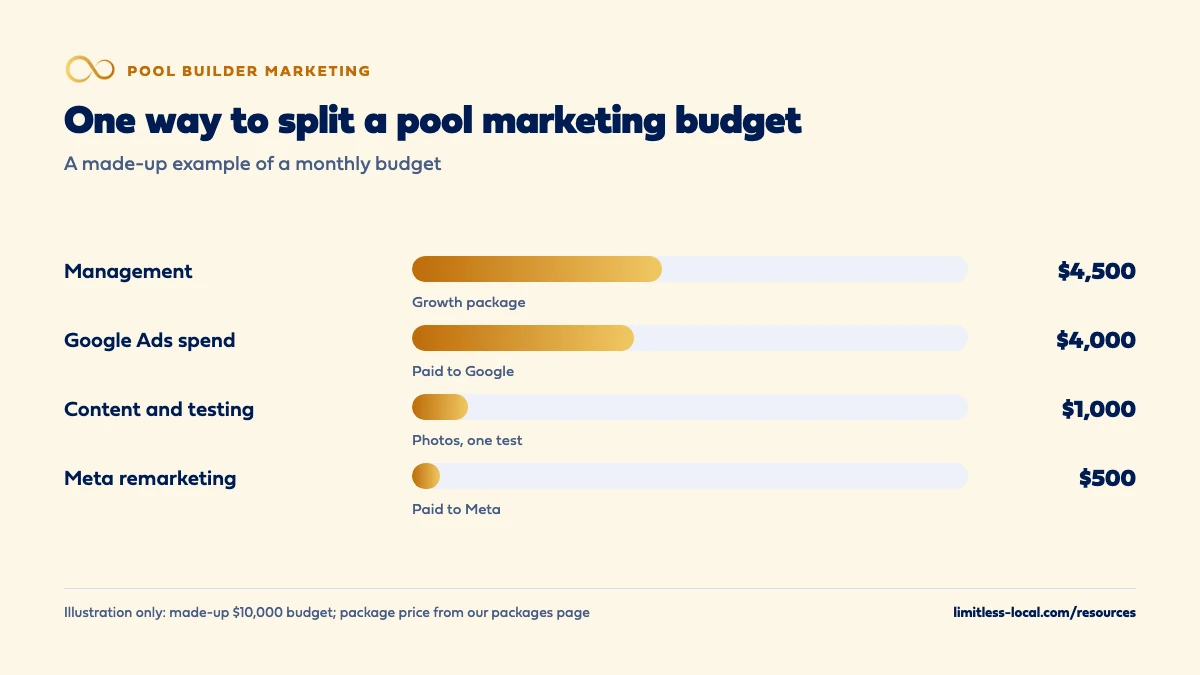
These numbers are made up to show the math, not a recommendation for your business. Say a pool builder has settled on $10,000 a month for marketing and chooses an agency on our Growth package at $4,500 a month.
- Management: $4,500 (45%) for the Growth package, covering SEO, the Google profile, reviews, Google Ads and Meta remarketing management, tracking and reporting.
- Google Ads spend: $4,000 (40%), paid directly to Google, within the package’s $5,000 ad spend limit.
- Meta remarketing spend: $500 (5%), paid directly to Meta.
- Content and testing: $1,000 (10%) for project photography and one tracked test, such as a direct mail drop.
A themed website at $3,000 with the package, spread over a year, adds $250 a month as a separate one-time line. At the end of the season, the builder compares cost per signed contract for search, remarketing and the test, and moves money toward whichever signs pools most cheaply.
Frequently asked questions
Is there a standard percentage split for pool builder marketing?
No. The split depends on your market, history and which channels already sign contracts, so start from your own cost per signed contract.
Should the website come out of my monthly marketing budget?
Track it as its own one-time line, then spread it across the months you’ll use it if you want to see a monthly picture. Don’t let a build month make every other channel look underfunded.
Does ad spend include the agency fee?
Not with us: our packages cover management, and ad spend is paid directly to Google or Meta. Ask any agency to show the two separately.
How much should a new pool builder put into testing?
A newer builder has less history, so in our judgement search ads and the Google profile come first, with a small test line added once those are producing.
Should I cut the budget when the build schedule is full?
Cut test lines and some ad spend first, and keep the foundation running: reviews, the Google profile and the website don’t benefit from being switched off, and a long sales cycle means today’s leads fill next season’s schedule.
Do I have to sign a long contract to get a split like this?
Not with us. We don’t use long-term contracts; the standard ask is three months, written into the contract, but we won’t make you stay.
Key takeaways
- List every line first: ad spend, management, website, content, tools, and offline or events.
- Fund tracking, the website and your Google profile and reviews before anything else.
- Put most ongoing money into channels that already sign contracts, usually Google search first.
- Keep ad spend, management fees and one-time website costs separate so each can be judged.
- Hold back a small tracked testing line, and re-split each season by cost per signed contract.
Ready to compare options?
Book a short growth call and we'll walk through the math for your service area, including when we're not the right fit.
More in this section
- How much should a pool builder spend on marketing?
- How should a pool builder prepare marketing before peak season?
- How do I grow a pool construction business with marketing?
- Should a pool builder hire an in-house marketer or an agency?
- What should a pool builder ask before hiring a marketing agency?
Sources
- Manage your business — U.S. Small Business Administration
- How to Get the Most From Your Marketing Budget — U.S. Small Business Administration
- About your budget report — Google Ads Help