
How do I tell how competitive roofing marketing is in my city?

- How can a roofer size up the competition in its own market?
- What does "competitive" actually mean for roofing marketing?
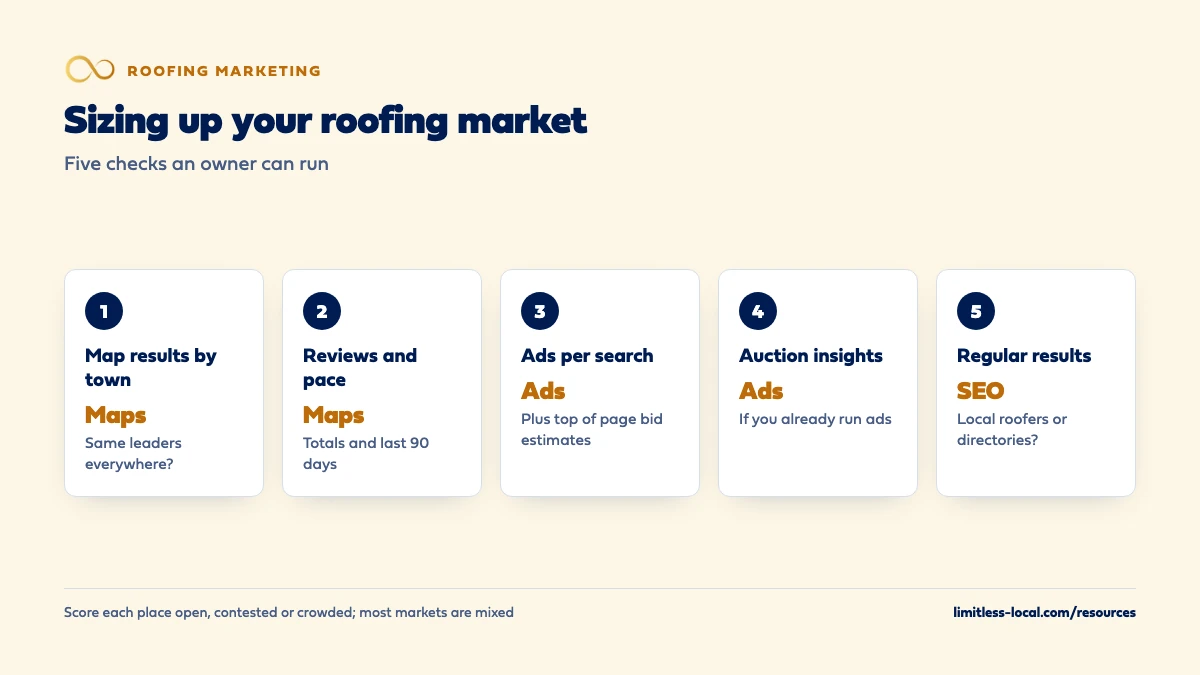
- Step 1: Who shows up in Google Maps for my main roofing searches?
- Step 2: How many reviews do the roofers ahead of me have?
- Step 3: How many roofing ads show up on each search?
- Step 4: What does Keyword Planner say about cost and demand?
- Step 5: If I already run ads, what do auction insights show?
- Step 6: Who owns the regular search results?
- How do I put the checks together into one read of my market?
- What should I do if my city turns out to be very competitive?
- What's different about sizing up a roofing market
- A worked example: scoring one roofer's market
- Frequently asked questions
- Key takeaways
- More in this section
- Sources
The short version
- Search your main roofing jobs from several towns you serve.
- Count the map pack roofers' reviews and recent review pace.
- Count the ads on each search and check Keyword Planner's top-of-page bid estimates.
- If you run ads, read auction insights and impression share.
For roofing company owners who want to size up their own market before deciding where to spend.
Get a free visibility audit · Book a growth call
How can a roofer size up the competition in its own market?
You can size up how competitive roofing marketing is in your city with a few free checks: look at who shows up in the Google Maps results for your main roofing searches across your service area, count their reviews and how fast they’re adding them, and note how many ads appear above and around those results. Then use Google’s Keyword Planner for search volume and the estimated cost to show at the top of the page, and, if you already run ads, the auction insights report to see how often you share auctions with other roofers. Many established profiles, strong review counts and several ads on every search mean a crowded market where results take more time and money.
Sizing up the market is where our local SEO work for roofing companies starts, and it decides how fast results are likely to come. A roofing client got 3x map pack visibility in its target towns; better presence and consistent info across the web increased inbound calls. That’s one client’s past result, not a forecast for your market. What drives roofing marketing prices in general is covered in roofing marketing cost, and the roofing marketing questions library takes the rest one at a time.
What does "competitive" actually mean for roofing marketing?
In practice, it means how much it takes to get in front of homeowners when they search for roofing work where you operate. That shows up in three places:
- Google Maps: how established the roofers in the map results are, mostly through reviews, how complete their profiles are and how long they’ve been around.
- Paid ads: how many roofers are bidding on the same searches, which drives what each click costs.
- Regular search results: how many strong local roofing websites, directories and lead-selling sites take up the first page.
A market can be crowded in one place and open in another. A suburb can have a crowded ads auction because several metro roofers bid there, while its map results are thin because few roofers are actually based nearby. That’s why the checks below look at each place separately.
Step 1: Who shows up in Google Maps for my main roofing searches?
Search the jobs you want, such as roof replacement, roof repair and roofer, from several towns in your service area, not just from your office. Google says local results are mainly based on relevance, distance, and popularity, and that distance is how far each business is from the person searching. Source: Tips to improve your local ranking on Google. So the map results in the town next door can look very different from the ones at your shop.
For each search, write down the roofers in the top map results and note:
- Whether the same few names show up everywhere, or the results change a lot from town to town.
- Whether those roofers are based in that town or in a bigger city nearby.
- Whether you appear at all.
If the same three or four established roofers hold the map results across your whole area, the Maps side is competitive. If results are scattered and change by town, there’s room. If you don’t show up anywhere, start with why a roofer is missing from Maps.
Step 2: How many reviews do the roofers ahead of me have?
Reviews are the easiest part of popularity to measure from the outside. Google says prominence draws partly on how many reviews a business has, and that more reviews and positive ratings can help local ranking. Source: Tips to improve your local ranking on Google.
For the roofers in the map results, write down:
- Total review count and average rating.
- How many reviews they got in the last 90 days, by sorting their reviews by newest.
- Whether their newest review is days, weeks or months old.
In our judgement, the gap between you and them tells you how long the Maps side might take. A roofer with a few hundred reviews adding several a month is a long climb for a company with thirty. A roofer with a big total that stopped collecting a year ago is more beatable than the total suggests. The full method for measuring review pace is in how many reviews a roofer needs each month.
Step 3: How many roofing ads show up on each search?
Look at the same searches and count the ads at the top and bottom of the page, and any Local Services Ads above them. Do it on a phone and on a computer, at different times of day. In our judgement, several ads on every roofing search, all day, usually mean a busy ads auction; one or two ads, or none at some times, mean fewer roofers are spending.
If you already advertise, don’t keep searching for your own ads. Google says its Ad preview and diagnosis tool is preferable to doing a Google search yourself, because it avoids building up ad impressions that affect your performance statistics. Source: About the Ad preview and diagnosis tool.
Also note who the advertisers are. Local roofers, national brands and lead-selling sites all compete in the same auction, but lead sellers often show up in markets where homeowners search a lot, which in our judgement is a sign of demand as well as competition.
Curious what your marketing is actually booking?
Get a free visibility audit — no obligation, no sales pitch.
Step 4: What does Keyword Planner say about cost and demand?
Keyword Planner is free with a Google Ads account. Google says it shows estimates of how many searches keywords get each month and the cost to target them, and that you can filter keyword ideas by criteria such as competition. Source: Use Keyword Planner. Set the location to your service area and enter your main roofing jobs.
Two numbers matter:
- Monthly searches: how much demand there is. A small town may show low numbers or none for some terms.
- Top of page bid estimates: Google defines the top of page bid estimate as the bid you likely need for your ad to show among the ads at the top of the first page, based on Quality Score and competition from other advertisers. Source: Top of page bid estimate: Definition.
Higher estimates on your main terms, compared with neighboring towns or with less contested jobs like repairs, are a fair read of how hard roofers are bidding. Google notes the estimate isn’t a guarantee of placement, and that a very high estimate can also mean a keyword’s Quality Score is poor, so use it to compare, not to predict.
Step 5: If I already run ads, what do auction insights show?
If you run Google Ads, two reports measure competition directly:
- Auction insights compares your performance with other advertisers in the same auctions, with statistics such as impression share, overlap rate and outranking share. Google notes the report doesn’t show insights when impression share is under 10%. Source: Use auction insights to compare performance.
- Impression share is the share of impressions your ads got compared with the total they could have got. Google says it’s a good way to see whether your ads might reach more people if you raise your bid or budget. Source: About impression share.
In our judgement, a low impression share on your main roofing terms, with the same few roofers showing up in auction insights month after month, means you’re in a contested market and your budget is spread thin. Whether to shift money between Google Ads and LSAs is covered in splitting budget between Google Ads and LSAs.
Step 6: Who owns the regular search results?
Below the map and the ads, look at the first page of regular results for your main jobs. In our judgement, it’s competitive when local roofers with strong service pages hold most spots. It’s more open when the page is mostly directories, lead-selling sites and national articles, with few local roofers’ own pages.
Note which roofers rank and click through to their pages. Are they detailed pages about one job in one area, with real photos and reviews, or thin pages? Google’s guidance is to create helpful, people-first content rather than content made mainly to rank. Source: Creating helpful, reliable, people-first content. Thin competitor pages are an opening. Strong ones mean SEO will take longer.
Google’s local ranking page also says prominence draws on how many websites link to your business. Source: Tips to improve your local ranking on Google. Long-established roofers with years of local links and mentions are harder to pass quickly.

How do I put the checks together into one read of my market?
In our judgement, score each place as open, contested or crowded:
- Maps: open if results vary by town and the leaders have modest review counts; crowded if the same established roofers hold every town with large, growing review counts.
- Ads: open if few ads show and bid estimates are low next to nearby areas; crowded if several ads show on every search and your impression share is low.
- Regular search: open if directories dominate; crowded if strong local roofing pages hold the first page.
Most markets end up mixed. The read tells you where to start: an open Maps side favors profile and review work; a crowded ads auction argues for tight targeting on the jobs and towns you want most; crowded everywhere means a longer ramp and a bigger budget to compete across the board.
What should I do if my city turns out to be very competitive?
Narrow down before you spend more, in our judgement:
- Pick fewer towns. Compete hard in the towns closest to you and where you already have jobs and reviews, instead of a whole metro.
- Pick fewer jobs. Focus on the jobs you’re best at and make the most on, rather than every roofing search.
- Win on proof. Specific reviews, real photos, license and warranty details; standing out from other roofers covers this.
- Fix what you control first. A complete profile, a steady review flow and fast call-backs often matter more than outbidding anyone.
- Be honest about time. Ads can generate leads within days of launch, while SEO typically takes 3-6 months to show meaningful organic growth, and longer in crowded markets in our judgement.
If your budget is small, whether $1,000 a month is enough shows how to concentrate it.
What's different about sizing up a roofing market
Storms change the market for weeks. After a hail or wind event, more roofers, including out-of-town crews, start advertising and knocking doors in the affected towns. In our judgement, check competition in a normal month as well as after a storm, or you’ll misjudge the market in both directions.
Metro roofers reach into suburbs. Large roofing companies based in a city often advertise and rank across the suburbs around it. A suburb with few local roofers can still be contested.
Replacement terms attract the most competition. Because replacements are the biggest tickets, they usually have the most bidders. Repair and specialty terms are often less crowded and can be a way in.
Lead sellers compete for the same homeowners. Sites that sell roofing leads advertise and rank for the same searches as you, which adds to the competition you see on the page.
Not sure which of these is costing you jobs?
A free visibility audit checks the Google profile, reviews, site and tracking, and shows what to fix first.
A worked example: scoring one roofer's market
These numbers are made up to show the method, not real data for any market. A roofer searches roof replacement from five towns in its service area.
- Maps: the same two roofers lead in four of five towns. They have 310 and 240 reviews and added 18 and 11 in the last 90 days. Our roofer has 45, adding about one a month. Score: crowded.
- Ads: three or four ads on most searches. Keyword Planner’s top of page bid estimates for replacement terms are well above the estimates for repair terms. Score: contested for replacement, more open for repair.
- Regular search: mostly directories and two strong local roofing sites. Score: contested.
The read: Maps will be a long climb, so the roofer focuses its ads on repair and replacement in the three closest towns, asks for a review on every job to close the gap over time, and builds one strong replacement page. Our Essentials package at $3,500 a month covers local SEO for one location, review response and basic review generation, and Google Ads management up to $2,500 a month in ad spend, which is paid to Google separately.
Frequently asked questions
Is a big city always more competitive for roofers?
Usually, but not always. In our judgement, a mid-sized market with several aggressive roofers can be harder than a large one with many small, inactive profiles, which is why the checks look at your actual searches.
Can I see what my competitors spend on ads?
No. Google’s auction insights show how often you share auctions and outrank other advertisers, not their budgets.
How often should I re-check my market?
In our judgement, every few months and after any major storm, since storms bring new advertisers and crews into an area.
Does a competitive market mean I shouldn't advertise?
No. It means narrowing to the towns and jobs where you can win, and expecting a higher cost per job and a longer ramp for SEO.
Should I check competition in Local Services Ads too?
Yes. Count how many roofers show in the Local Services Ads at the top of your main searches; several on every search is another sign of a crowded market.
Key takeaways
- Search your main roofing jobs from several towns, not just your office; map results change with distance.
- Count map leaders’ reviews and their last 90 days of new reviews to gauge the Maps gap.
- Count ads per search and compare Keyword Planner’s top of page bid estimates across jobs and towns.
- If you run ads, auction insights and impression share show how contested your auctions are.
- Score Maps, ads and regular search separately; most markets are crowded in one and open in another.
- In a crowded market, narrow the towns and jobs, win on proof and expect a longer SEO ramp.
Want a second set of eyes on your setup?
We'll look at how you show up locally and where calls are leaking, then send you a plain-English breakdown.
More in this section
- How do I know if my roofing marketing agency is getting results?
- How should a roofing company market commercial roofing?
- What marketing should a roofing company add first to grow?
- How should a roofing company market metal roof installs?
- How do I market a roofing company in the slow season?
Sources
- Tips to improve your local ranking on Google — Google Business Profile Help
- Use Keyword Planner — Google Ads Help
- Top of page bid estimate: Definition — Google Ads Help
- Use auction insights to compare performance — Google Ads Help
- About impression share — Google Ads Help
- About the Ad preview and diagnosis tool — Google Ads Help
- Creating helpful, reliable, people-first content — Google Search Central